Tag Archives: Ireland

Launch at Messrs Bewley and Webb’s yard

The first of two new steel canal boats which the above firm are building for the Grand Canal Company was successfully launched on Wednesday.  These boats are 60 ft long by 13 ft 2 in beam, and 5 ft 9 in depth of hold, and are designed to carry forty tons on a light draught of water. They are of improved design and construction, and expected to tow very easily. The Canal Company have expressed themselves well pleased with the time of delivery and workmanship, and it is to be hoped no more orders of this kind will go across the water in future. The firm appear to us to be well able to deal with the work of the port. The ss Magnet, of the Tedcastle Line, which had an extensive overhaul at this yard, we believe, gave every satisfaction, and had a most successful trial trip a few days ago. It is to be hoped that more of our local steamship companies will follow the lead of Messrs Tedcastle, and have their work done in Dublin.

The Freeman’s Journal 1 September 1893. From the British Newspaper Archive run by Findmypast Newspaper Archive Limited, in partnership with the British Library.

Some context here.

A glass of sherry …

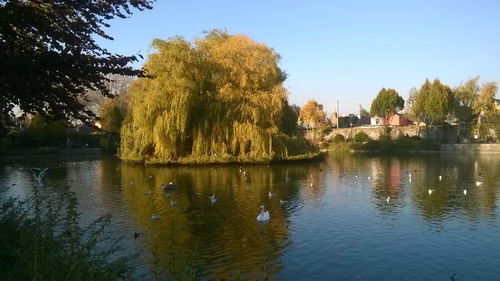
… to anyone (other than those present when the photo was taken) who can identify the Irish waterway shown in the new header pic above.

Blessington Street basin

Blessington Street Basin (Michael Geraghty) November 2015 01_resize

Blessington Street Basin (Michael Geraghty 2015)

One of North Dublin’s less-well-known treasures, this is Blessington Street Basin, off the (former) Broadstone Line of the Royal Canal. Thanks to Michael Geraghty for the photo, taken in November 2015.

Lacustrine expansions

SHANNON (THE) , the largest river of Ireland, and probably the largest in any equal extent of insular ground in the world. […]

The lower third of its course is tidal or estuarial; and the other two-thirds are, in a comparative sense, so straight, so deep, so free from current, and so much aided by lacustrine expansions, that the river can be navigated by barges, and made an aqueous highway for commerce, to within a few miles of its source.

Were all its facilities to trade and communication as fully recognised and used as those of the rivers of England, it could not fail to relieve and enrich the condition of a very large proportion of the Irish population, and would be burdened with a much greater annual aggregate of freightage than any other river of equal length in the world; yet, in spite of its voluminousness, its highly navigable capacities, and its intimate connection with many of the most populous inland and central districts of Ireland, it was, till a few years ago, very little cared for, and continues to the present day to be comparatively little known.

It effects, from Lough Allen near its source, to the sea at the level of low-water, an aggregate descent of 159 feet in summer, or 163 feet in winter; or, to speak popularly, and with reference merely to high-water level, it makes an aggregate descent of 147 feet; but it achieves no less than 97 feet of the 147 in the brief distance between Killaloe and Limerick; and it also effects, within its entire course, no fewer than 17 different falls or rapids; so that, in its entire current, except at these few particular localities, it is necessarily sluggish and silent almost to stagnation.

Much of its strictly fluviatile extent consists of very large and long lacustrine expanses; much also consists of dull, dead reaches of river, stagnating amid callows, meadows, bogs, and morasses, rankly overgrown upon the sides by aquatic vegetation, and periodically spreading out in cold and shallow floods; and surprisingly little consists of the merry and brilliant combinations of limpid and rippling current with clean well-defined and picturesque banks which so generally constitutes the river-scenery of Scotland.

The Parliamentary Gazetteer of Ireland, adapted to the new poor-law, franchise, municipal and ecclesiastical arrangements, and compiled with a special reference to the lines of railroad and canal communication, as existing in 1844–45; illustrated by a series of maps, and other plates; and presenting the results, in detail, of the census of 1841, compared with that of 1831 Volume III N–Z A Fullarton and Co, Dublin, London and Edinburgh 1846

Trade boats

Relatively little has been published about the horse-drawn cargo-carrying trade boats used by the Grand Canal Company in the latter half of the nineteenth century, before it adopted semi-diesel engines. Here is some information and some speculation about the subject, but there is much that is not clear.

Closing the Grand Canal

The excellent Co Kildare Online Electronic History Journal has a reprint here of a 1959 article about the ending of commercial carrying on the Grand Canal. And putting “canal” in its search engine reveals lots more of interest.

Shannon lake levels

According to the Shannon Catchment-based Flood Risk Assessment and Management (CFRAM) Study Technical Assessment: River Shannon Level Operation Review [PDF: Office of Public Works v2_0 July 2012]

ESB collects and maintains records of rainfall, river and lake levels and flow data. Even though ESB has no responsibility to supply flood warnings under their regulations, it issues twice weekly lake level forecasts to all the relevant stakeholders since 2010.

Those stakeholders include Waterways Ireland.

As the levels of the lakes are of great interest to boat-owners and others, it would be really nice if either the ESB or Waterways Ireland were to publish those forecasts. WI wouldn’t need any elaborate new system: they could send them around as marine notices, and the cost would be minimal.

But perhaps the forecasts are already published somewhere? If, Gentle Reader, you know where they are, do please leave a Comment [preferably with a link] below.

The sinking of the Longford 6

Here is the sixth and final page on the sinking of the passage boat Longford on the Royal Canal on 25 November 1845. This page is about who was steering the boat and why the steerer was unable to avoid the accident.

The price of fifteen lives was 1p.


The sinking of the Longford 4 and 5

Here are the fourth and fifth pages [I split one long page] in the sequence of articles about the sinking of the passage boat Longford on the Royal Canal in 1845. They discuss some of the evidence of corporate incompetence and farcical laxity that may have persuaded the inquest jury to award a deodand against the vessel (and thus against the Royal Canal Company).

Amongst other gems, the footnotes explain what a crapper is.

The sinking of the Longford 3

Here is the third page in the sequence about the sinking of the passage boat Longford on the Royal Canal in 1845. This page, The deodand, covers the inquest and the trial.