Tag Archives: Kilrush

Steam, the Shannon and the Great British Breakfast

That is the title of the Railway and Canal Historical Society‘s 2014 Clinker Memorial Lecture, to be held at the Birmingham and Midland Institute, Margaret Street, Birmingham B3 3BS, at 1415 on Saturday 18 October 2014.

The lecture will concentrate on the period before 1850 with such interesting topics as

  • Shannon steamers
  • the Grand and Royal Canals
  • the first Irish turf (peat) to reach the USA (possibly)
  • port developments in Dublin, Limerick and Kingstonw
  • the Dublin and Kingstown Ship Canal
  • the Midland Great Western Railway
  • what “cattle class” really means
  • bacon and eggs.

Admission is free and booking is not required. However, if you plan to attend, it would be helpful if you could e-mail […] to this effect.

The Clinker Memorial Lecture is named for Charles R Clinker, an eminent railway authoe and one-time historian of the Great Western Railway, who died in 1983.

If you would like the contact email address, leave a Comment below and I’ll get in touch with you direct.


Shannon history in Birmingham

According to the Railway & Canal Historical Society’s Events page, its annual Clinker Memorial Lecture, to be held in Birmingham in October 2014, will be about River Shannon steamers in the second quarter of the nineteenth century:

The 2014 Clinker Memorial Lecture will be held in Birmingham on the afternoon of Saturday 18th October 2014. The speaker will be Brian Goggin, BA (Mod), MA.

Brian graduated from Trinity College, Dublin in Economics and Politics, and spent some years as honorary Editor of the quarterly magazine of the Inland Waterways Association of Ireland. He and his wife Anne have been boating on Irish inland waterways since the late 1970s. He is currently working on a book on the Shannon steamers of the 1830s and 1840s, and the Clinker Lecture will draw on his research.

Before lunch (and independent of the Lecture) there will be a walking tour of central Birmingham, focusing on sites of waterway and railway interest.


No queue for the quay …

… at Querrin on the Shannon Estuary. The page discusses its building and the early years of its operation.

Up with this sort of thing

Folk interested in the history of the Shannon before 1850 may like to know of a talk …

The smart green technology of the 1830s: the Shannon steamers and the definition of Ireland

… to be delivered to the Thomond Archaeological and Historical Society on Monday 4 November 2013. It’s in Room T.1.17, TARA Building, Mary Immaculate College, Limerick, at 8pm.

A related topic …

Charles Wye Williams and the Anglo-Irish Trade

… will be discussed in one of the papers at the Eighth [British] Waterways History Conference on Saturday 26 October 2013 at the University of Birmingham. Leave a Comment below if you would like contact information for the conference.

Shannon passage times 1838

Estuary

Kilrush to Limerick 4 hours

Tarbert to Limerick 3 hours

Clare[castle] to Limerick 3.5 hours

Limerick Navigation

Limerick to Killaloe:

  • iron passenger boat 2.5 hours
  • timber passenger boat 3.5 hours
  • trade boat 6 hours.

Shannon

Killaloe to Portumna:

  • passenger steamer 6 hours
  • steamer towing lumber boats 8 hours.

Portumna to Shannon Harbour:

  • 6 hours.

Shannon Harbour to Athlone:

  • 8 hours.

Source: Railway Commissioners second report Appendix B No 6.

Canal carrying 1846: the Grand Canal

Isaac Slater’s Directory[i] of 1846 lists those carrying goods on inland waterways. Most of the carriers on the Grand Canal, which runs from Dublin to the River Shannon with various branches, claim to serve a modest number of places, but Thomas Berry & Co have a very lengthy list. So long is their list that it will require two maps to show all the places they served, with a third map for the rest of the carriers.

Note that the maps are from the 25″ Ordnance Survey map of around 1900 rather than the 6″ of around 1840: I used it because it was clearer, but it shows features (eg railway lines) that were not present in 1846.

There may be some cases where I have misidentified a destination; I would be grateful to have my attention drawn to such cases.

Click on a map to get a slightly larger version.

Thomas Berry & Co
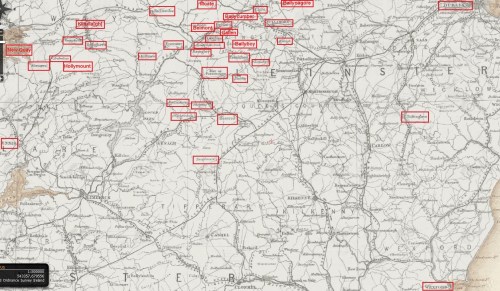
Thomas Berry & Co midland and south routes

Thomas Berry & Co midland and southern destinations (OSI)

The canal runs from Dublin, at the top right, left (roughly west) through Tullamore to Shannon Harbour, where it meets the river; there was an extension to Ballinasloe on the far side of the Shannon. Berrys served places along the canal and several others fairly close to it, but it looks to me as if there were three routes by road beyond that:

  • via Banagher (which has a bridge across the Shannon) to Eyrecourt and Killimor
  • from Ballinasloe to Loughrea and district and then south-west to Ennis in Co Clare
  • perhaps from Tullamore to Birr [Parsonstown], Roscrea (including Shinrone, Cloughjordan and Borrisokane) and Templemore.

There are also two outliers for which I can think of no plausible explanation: Baltinglass and Wexford. Perhaps their inclusion was a mistake. Certainly Berrys, like John M’Cann & Sons on the Royal Canal, seem to have had extensive road networks (perhaps using car-owning subcontractors?) to supplement their water-borne routes, but I don’t see why they would take on a route no part of which could sensibly have been conducted by inland navigation.

The next map shows the north-western destinations served by Berrys.
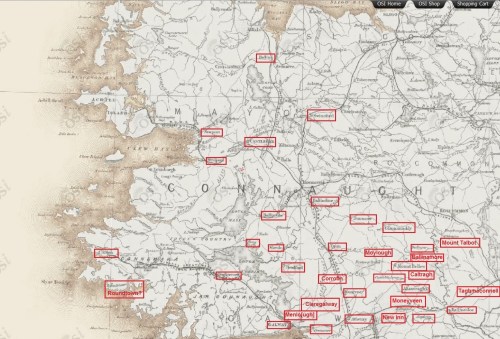
Thomas Berry & Co western routes

Thomas Berry & Co north-western destinations (OSI)

You can see that their network covered much of County Roscommon and went almost as far west into County Galway as it was possible to go; it also extended northwards into County Mayo.

I have not attempted to check what industries might have made these towns and villages worth serving. Berrys certainly seemed keen to take as much as possible of the traffic from west of the Shannon towards Dublin — excluding such of it as went by the Royal Canal: it is interesting to compare these maps with that for M’Cann on the Royal.

Finally, note that along the canal itself Berrys listed only destinations towards the western (Shannon Harbour) end: it seems likely that the roads took the valuable traffic from the eastern end into Dublin. There were no doubt turf boats taking fuel in from closer to Dublin, but they were not general carriers.

Other carriers

Now for the rest of the carriers.
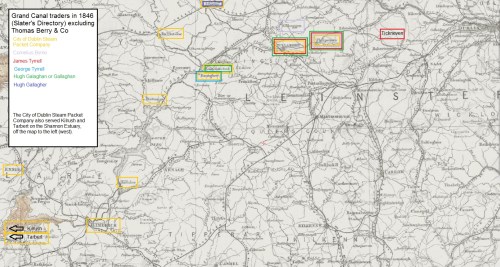
Grand Canal carriers 1846 excl Thomas Berry

Grand Canal carriers 1846 excluding Thomas Berry (OSI)

I have included the Shannon here as well as the Grand Canal; however I have covered the Barrow Line of the Grand Canal, as well as the navigable rivers Barrow, Nore and Suir, in a separate post. Of the carriers listed here, only the City of Dublin Steam Packet Company [CoDSPCo] (which employed horses to pull its boats on canals) ventured on to the Barrow Line, serving Portarlington and Mountmellick.

Berrys and the CoDSPCo were by far the largest firms on the Grand. I don’t know the size of the Berrys fleet, but the CoDSPCo had 52 barges in addition to its Shannon (and Irish Sea) steamers. Note that only on the middle Shannon, around the junction with the Grand Canal, and at Ennis did the two firms serve the same destinations: the CoDSPCo seems to have had the lower Shannon trade to itself.

With one exception, all the carriers, including Berrys, had Dublin depots at Grand Canal Harbour, James St; the Grand Canal Docks at Ringsend, joined to the Liffey, were not mentioned.

The exception is Hugh Gallagher, whose only listed destination was Athlone. It would be interesting to know how he served Athlone: whether by road or by water and, in the latter case, whether he used a steamer. I do wonder whether Hugh Gallagher might be the same person as the Hugh Galaghan (also Gallaghan) who served Philipstown [now Daingean], Tullamore and Shannon Harbour.

George Tyrrell is another who is listed with but a single destination, Banagher, whereas James Tyrrell is listed as serving Tickneven, Philipstown, Tullamore — and Edgeworthstown, which must be a mistake as it is closer to the Royal Canal.

Finally, Cornelius Byrne is shown as serving two destinations: Philipstown and Kilbeggan (which has its own branch off the main line of the canal).

Other information

A little extra information is available from the entries for towns other than Dublin in the Directory:

  • Naas has its own branch from the main line of the canal, but the directory says that “TO DUBLIN, there are Boats, as occasion require, but they have no fixed periods of departure.”
  • Edenderry also has its own branch, short and lock-free, but there is no mention of its being served by trade boats
  • Kilbeggan, with a longer, leakier, lock-free branch, was served by the CoDSPCo’s and Thomas Byrne’s boats travelling to Dublin three times a week. Is this Thomas Byrne related to the Cornelius Byrne mentioned above? It seems that Byrne went only eastward for only the CoDSPCo’s boats went westward (to Shannon Harbour, Ballinasloe and Limerick) two or three times a week
  • at Banagher, Fleetwood Thomas Faulkner of Main Street was the CoDSPCo agent; a downstream steamer left Shannon Harbour after the [passenger] boat from Dublin arrived and called at Banagher’s Bridge Wharf; an upstream steamer from Limerick called every afternoon at 3.00pm and met the night boat travelling to Dublin by the Grand Canal. I presume that this happened on every day except Sunday.

More

As far as I know, little has been written about the carrying companies, especially those of the nineteenth century. I would be glad to hear from anyone who can correct, supplement or comment on this information.

My OSI logo and permit number for website


[i] I Slater’s National Commercial Directory of Ireland: including, in addition to the trades’ lists, alphabetical directories of Dublin, Belfast, Cork and Limerick. To which are added, classified directories of the important English towns of Manchester, Liverpool, Birmingham, Sheffield, Leeds and Bristol; and, in Scotland, those of Glasgow and Paisley. Embellished with a large new map of Ireland, faithfully depicting the lines of railways in operation or in progress, engraved on steel. I Slater, Manchester, 1846

Bock goes boating …

… on the Shannon Estuary, the second most interesting coast of Clare (the inland coast is the most interesting, the north-west coast the least). Includes nice pics of the Scattery battery.

The Marquis survives

I reported last October that an unused London pub, named after Henry Petty-Fitzmaurice, 3rd Marquess of Lansdowne, KG, PC, FRS, was threatened with demolition in favour of a museum extension.

I pointed out that the late Marquis had two claims on the attention of Irish waterways enthusiasts. First, the best-known of the early River Shannon steamers, the Lady Lansdowne, was named after his wife. Second, he was Lord President of the Council [the current holder of the post is Nick Clegg] when the government of Her Late Majesty Queen Victoria decided, in 1839, to spend about half a million pounds improving the Shannon Navigation.

The Indie reports today that Hackney Council’s planning committee has voted against the demolition, so the Marquis survives, at least for now.

Piers and seed potatoes

I dare say you’ve observed, Major, how singularly little originality there is about Chief Secretaries. One of them, whose name is lost in the mists of antiquity, thought of piers and seed potatoes, and since then all his successors have gone on building piers and handing out seed potatoes. They never hit on anything original. Now if I was a Chief Secretary I’d strike out a line of my own. When I found I had to build something I’d run up a few round towers.

Thus the Rev J J Meldon, curate of Ballymoy, to Major Kent in George A Birmingham’s excellent Spanish Gold. (Birmingham was really Canon James Owen Hannay, who managed to annoy nationalist Catholics, which is always useful.)

Amongst the builders of piers were Alexander Nimmo and the Shannon Commissioners, whose works on the estuary included Saleen Pier.

The Irish Press Releases website has a page dated 17 April 2013:

Funding approved for Clare piers

Co. Clare, Ireland — 17 Apr. 2013 — Funding has been approved for various harbour and pier improvement projects in County Clare. Minister for Agriculture, Food and the Marine, Simon Coveney, T.D., today announced funds totalling 91,500 euro for projects at Ballyvaughan, Cappagh, Liscannor, Carrigaholt and Kilbaha harbours/piers.

“The safety works scheduled to take place at these harbours will have a hugely positive impact on the livelihoods of fishermen and other users of the piers,” explained Clare Senator Tony Mulcahy. He added: “These projects are central to ensuring the safety of all users of the piers. The continued upgrading of these piers is essential to the development of both industry and tourism in the respective areas.”

The funding announcement features allocations of €22,500 to Carrigaholt, €37,500 to Ballyvaughan, €9,000 to Kilbaha, and €11,250 to both Liscannor and Cappagh.

According to Senator Mulcahy: “The funding contribution from the Government covers 75% of the total cost of the relevant projects which include repairs to the pier wall in Ballyvaughan, the installation of a handrail to pier access, harbour wall and upgrade of visitor moorings at Carrigaholt, a complete remediation to the existing pier walls at Liscannor, repairs to the sea wall at Cappagh, and repairs to the harbour wall capping stones at Kilbaha.”

Carrigaholt, Kilbaha and Cappa[gh] are all Shannon Estuary harbour or piers; Cappa[gh] was extended by the Shannon Commissioners. This press release suggests therefore that, if the Chief Secretary’s successors cannot afford to build any new piers, they can at least afford some money to repair them. There is no news about seed potatoes (or, alas, about fodder).

Unfortunately I could find nothing about this topic either on the website of Senator Tony Mulcahy FG or on that of the Department of Agriculture and Technical Instruction, although I may have had the wrong search terms. However, some other (coincidentally. also Fine Gael) politicians have welcomed the planned spending of money on Glin pier [do look at all the pics], which seems to be used only for swimming, so perhaps there is a nationwide campaign of spending small amounts of money in many places — and getting local Fine Gael pols to announce it. Presumably it distracts attention from the shortage of seed potatoes.

The Minister for Ag is a member of Fine Gael.


The Charles Wye Williams bridge campaign

Dublin City Council has published its call for proposals for naming the new bridge across the Liffey. According to RTE, various bolshies and literary types have been suggested, as though we didn’t have enough of them (and of politicians too). Accordingly, I have submitted an application suggesting that the bridge be named after a successful entrepreneur who understood technology and created employment: Charles Wye Williams, the Father of the Shannon, whose fleet of nine steamers and fifty-two barges gave us the Shannon as we know it today.

I will be happy to send a copy (PDF) of my application to anyone who is willing to support it.