Tag Archives: lock

GCC Shannon steamers 1866

Here is a new page with an illustrated article from 1866 about the steam engines in three Grand Canal Company steamers of that era, which were used on the Shannon. I am grateful to Mick O’Rourke of Irish Shipwrecks for sending the article to me.


Shannon traffic figures for June


I am grateful to Waterways Ireland for letting me have the Shannon traffic figures for June 2014. All the usual caveats apply:

  • the underlying figures do not record total waterways usage (even for the Shannon) as, for instance, sailing, fishing or waterskiing on lakes or river stretches, which did not involve a passage through a lock or Portumna Bridge, would not be recorded
  • the passage records would not show, for instance, a change in the balance of types of activities from those in larger cruising boats to those in smaller (sailing, fishing, waterskiing) boats
  • figures like these, for a small number of months, will not necessarily be representative of those for the year as a whole. The winter months, January to March, see little traffic in any year; for April, May and June, the weather can have a large influence on the amount of activity especially, I suspect, in private boats.

On the other hand, the figures do include the Shannon’s most significant tourism activity, the cruiser hire business. And they are our only consistent long-term indicator of usage of the inland waterways.
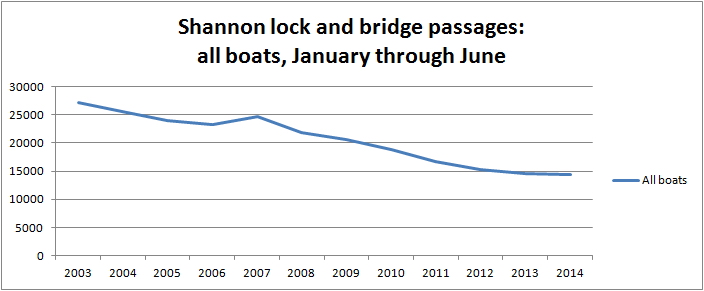
Total (private + hired) traffic for the first six months of each year

Total (private + hired) traffic for the first six months of each year

Total traffic is down again, but only slightly. The decline does seem to be levelling off and a continuation of the relatively good weather could increase usage.
SnnNav JanJun 2

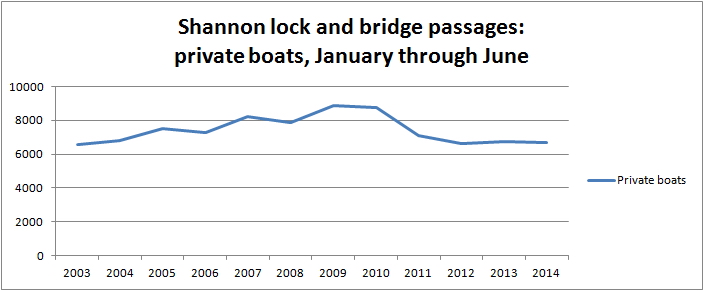
Private-boat traffic for the first six months of each year

Private traffic is down slightly on last year, but it has been pretty much the same for three years. I had thought that the good weather might have caused something of an increase, but on the other hand my own impression of Lough Derg traffic (not reflected in the passage figures) is that it has been fairly light.
SnnNav JanJun 3

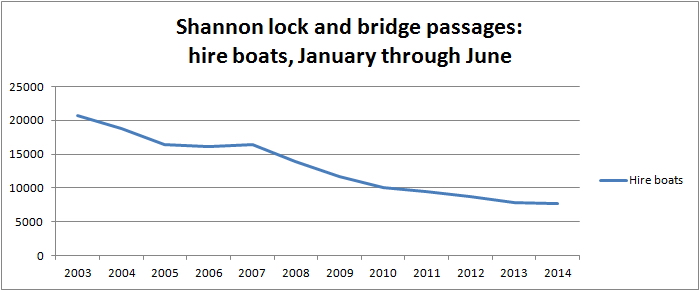
Hire-boat traffic for the first six months of each year

For hire-boat traffic, there is no sign of an upturn, although the drop on last year’s figures is not very large.
SnnNav JanJun 4

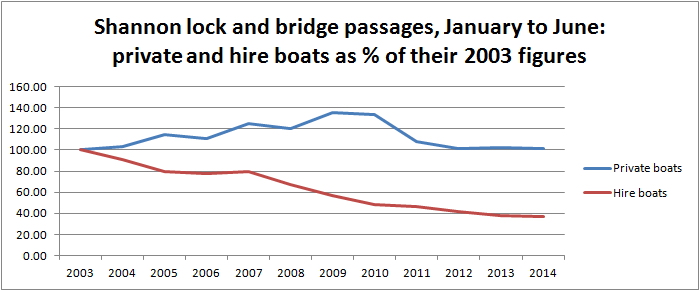
Changes since 2003: private and hired boats

That table amalgamates the two before it, but shows the figures as percentages of the 2003 figures. For private boats, the Celtic Tiger (nach maireann) caused an increase; that effect has worn off and usage has not changed much since about 2011. For hired boats, the decline began long before the Celtic Tiger idiocy.
SnnNav JanJun 5

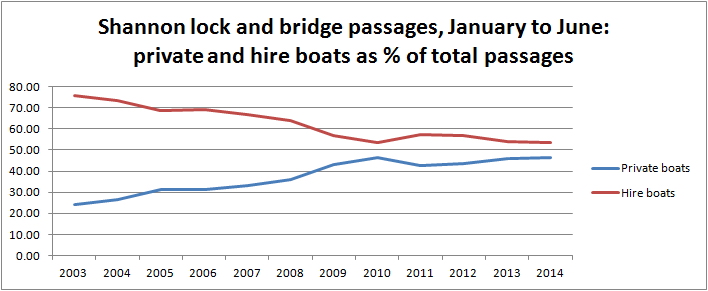
From 75/25 to 50/50

Hired boats were once the major users; private boats have almost caught up.
SnnNav JanJun 6

How to save money

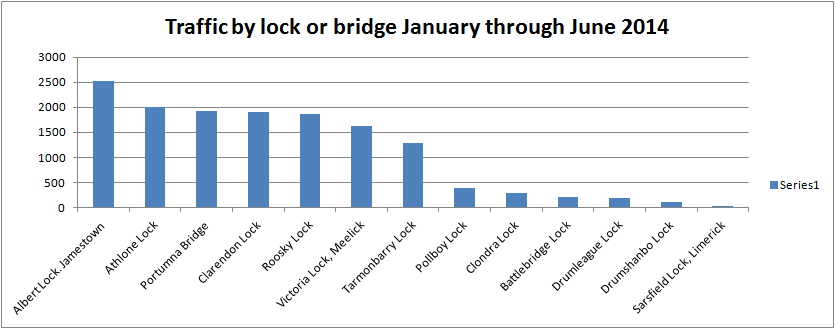
I don’t know how much the various locks cost to run, so I can’t work out any measure of value for money, but the sea lock in Limerick and the Lough Allen Canal must surely be candidates for the chop.


Dear Mr Bannon

I would be grateful if you could explain why any government in its right mind would restore the Longford branch of the Royal Canal given that (a) canal traffic in Ireland is so small as to be insignificant, (b) the upkeep of the Royal’s main line is causing severe budgetary strain and (c) the Irish hire boat industry is in decline.

If you have conducted any analyses of the costs and benefits of such restoration, I would be grateful if you would publish them.

bjg

Note: Mr Bannon is a Fine Gael TD. But that’s no excuse.


Thon sheughery business

It will be recalled that Her Majesty’s Loyal Home Rule Government in Belfast is considering investing in the Clones Sheugh [aka Ulster Canal] and that I asked DCAL, the department responsible, for a copy of the Business Case. To my surprise, it said:

Your request is being treated as a Access to Information request and will be handled under either Freedom of Information Act 2000 or the Environmental Information Regulations 2004.

Either way, DCAL has now told me that I can’t see it. The Business Case, which is apparently an addendum to the 2007 Business Case (which was rotten: see here passim), won’t be complete until November. I have made a note to remind myself to ask for it then.

I quite sympathise with the DCAL folks: it can’t be easy thinking of any good reason to spend taxpayers’ [British or Irish] money on the Clones Sheugh. But perhaps DCAL can spin it out until the Shinners have taken over the Free State, at which point the economics of Grattan’s Parliament will be in vogue and we can all take up growing flax, spinning and weaving, giving grants for canals and making money out of the slave plantations.

Speaking of Shinners, there’s one called Cathal Ó hOisín, a member of HM Loyal Home Rule Government in Belfast representing East Londonderry, who said there recently:

The possibility of the reopening of the Ulster canal would open up limitless opportunities in tourism. The idea that, once again, we could travel from Coleraine to Limerick, Dublin and Galway by boat would be absolutely wonderful.

Well, you can do that: by sea. There was never an inland navigation from Coleraine, Limerick or Dublin to Galway, despite the urgings of Lord Cloncurry and the nitwitted ideas of Sir Edward Watkin.

As for a connection between Limerick or Dublin and Coleraine, I suspect that Mr Ó hOisín is perpetuating the error into which Her late Majesty Victoria, by the Grace of God of the United Kingdom of Great Britain and Ireland Queen, etc, seems to have fallen when she appointed

Commissioners to inquire respecting the System of Navigation which connects Coleraine, Belfast, and Limerick

which Commissioners reported in 1882. There was no such system and, if Mr Ó hOisín can provide evidence that any vessel ever travelled by inland navigation between Coleraine and Limerick, I would be glad to hear of it. I prefer to think of the Commissioners’ conclusion that

As an investment for capital the whole canal system in Ireland has been a complete failure.

I see no reason why politicians of the twenty-first century should repeat the errors of their predecessors in the eighteenth, nineteenth and twentieth centuries.

You expect the Parnellite members to have a bit more sense, but one John Dallat said in the same debate:

[…] when the Ulster canal is open, tourists will come in their thousands and that will benefit the Lower Bann, the Foyle as well, and right over to Scotland.

Er, John? There are actually canals in other countries. Even in Scotland. Folk are familiar with canals. They’ve seen them before. And a short sheugh to Clones is not going to attract tourists (apart from the relatively small number of canal twitchers, who will need to tick it off on their lists) unless the town of Clones is particularly attractive. Which … well, let me put it this way: why not look it up on TripAdvisor?

Of course I’m all in favour of Clones myself: I am quite interested in concrete engine-sheds and former canal stores.


Shannon traffic to May 2014

I am grateful to Waterways Ireland for letting me have copies of the recorded numbers of boat passages through Shannon locks and Portumna Bridge for the first five months of 2014. All the usual caveats apply:

  • the underlying figures do not record total waterways usage (even for the Shannon) as, for instance, sailing, fishing or waterskiing on lakes or river stretches, which did not involve a passage through a lock or Portumna Bridge, would not be recorded
  • the passage records would not show, for instance, a change in the balance of types of activities from those in larger cruising boats to those in smaller (sailing, fishing, waterskiing) boats
  • figures like these, for a small number of months, will not necessarily be representative of those for the year as a whole. The winter months, January to March, see little traffic in any year; for April and May, the weather can have a large influence on the amount of activity especially, I suspect, in private boats.

On the other hand, the figures do include the Shannon’s most significant tourism activity, the cruiser hire business. And they are our only consistent long-term indicator of usage of the inland waterways.
Shannon passages May 2014 01


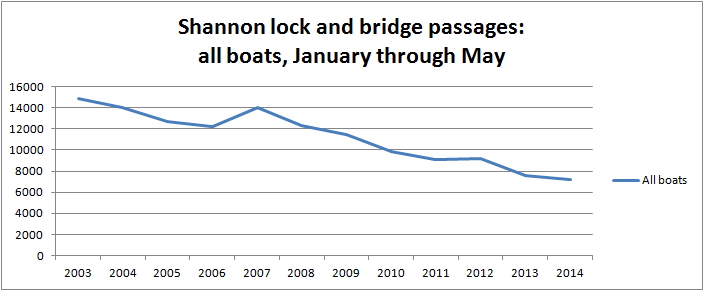
The total amount of traffic continues to decline.
Shannon passages May 2014 02

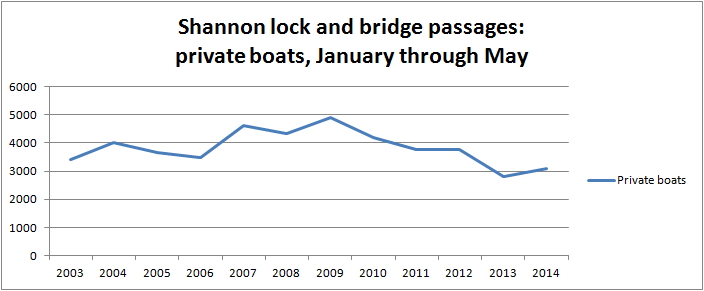
Private-boat traffic is still below its average for the period but increased slightly on the same period of the previous year [but see the third caveat above].
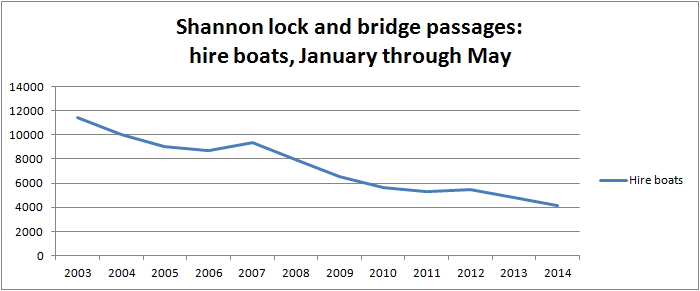
Shannon passages May 2014 03


Hire-boat traffic is just over one third of its 2003 level.
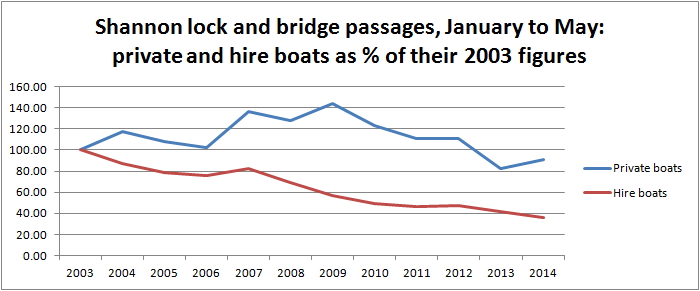
Shannon passages May 2014 04


Since 2003, both private and hired traffic have fallen, from the highest figures attained within the period, by about 60% of the 2003 figure. But private traffic first rose by 40% of the 2003 figure, so it is now only about 20% below that figure. Hire traffic has fallen pretty consistently since 2003.
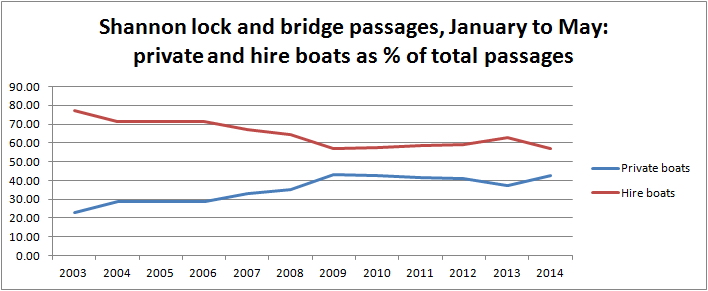
Shannon passages May 2014 05


Hire traffic is usually greater than private traffic between April and October (roughly speaking), but the gap is closing.

Carál Ní Chuilín, NI’s [SF] waterways minister, said the other day:

Waterways Ireland delivered a presentation to Ministers entitled ‘Ireland’s Inland Waterways — Building a Tourism Destination’. The presentation provided an overview of the progress that Waterways Ireland is making in placing waterways and the waterway experience at the centre of the tourism offering in Ireland and internationally.

And a good thing too, but the waterways need new water-based tourism products to complement, and perhaps to replace some of, the hire-boat cruising business. Opening new waterways — Royal Canal, Longford Branch, Ulster Canal, Kilbeggan Branch or anything else — is a waste of money until demand, domestic and visitor, private and hired, exceeds existing capacity.


Shannon history in Birmingham

According to the Railway & Canal Historical Society’s Events page, its annual Clinker Memorial Lecture, to be held in Birmingham in October 2014, will be about River Shannon steamers in the second quarter of the nineteenth century:

The 2014 Clinker Memorial Lecture will be held in Birmingham on the afternoon of Saturday 18th October 2014. The speaker will be Brian Goggin, BA (Mod), MA.

Brian graduated from Trinity College, Dublin in Economics and Politics, and spent some years as honorary Editor of the quarterly magazine of the Inland Waterways Association of Ireland. He and his wife Anne have been boating on Irish inland waterways since the late 1970s. He is currently working on a book on the Shannon steamers of the 1830s and 1840s, and the Clinker Lecture will draw on his research.

Before lunch (and independent of the Lecture) there will be a walking tour of central Birmingham, focusing on sites of waterway and railway interest.


Effin Bridge: a modest proposal

Effin Bridge, the railway lift-bridge over the Royal Canal on the seaward side of Newcomen Bridge in Dublin, has caused some little annoyance to boating folk. It is raised on a small number of days each year to allow boats through; many staff must attend and Waterways Ireland must pay Iarnród Éireann, the railway company, for each lift, as well as paying its own staff for attending.

Perhaps a more modest structure might work. Something like this.

Description of a new Lift Bridge for the Midland Great Western Railway, over the Royal Canal at Newcomen Bridge, Dublin. By Bindon B Stoney, MA, MInstCE

This bridge carries a short branch of the Midland Great Western Railway of Ireland across the Royal Canal immediately below Newcomen Bridge, at the very oblique angle of 25 degrees and, though the canal is only 15 feet wide, the bridge carrying the railway requires to be nearly 40 feet long on the skew.

The trains run over this bridge at about two feet above ordinary water level, and whenever a boat is passing along the canal the bridge is lifted from 8 to 13 feet, according to the height of the deck load, so as to permit the boat to pass beneath. The bridge is formed of two strong single-plate girders of the usual type, which lie underneath the rails, with cross girders and side brackets over which the platform is laid. This bridge is lifted by means of a lever 40 feet long, formed of two plate girders braced together horizontally, and attached rigidly at right angles to the centre of the bridge, and this lever is itself balanced at its centre on blunt steel knife edges like the beam of a pair of scales. The weight of the bridge at one end of the lever is counterpoised by an equal weight of metal attached to the other end, so that the whole structure turns freely on the knife edges, which work in steel pillow blocks on the top of metal standards, one on either side of the lever. The opening and closing motions are regulated by a small crab-winch and chain worked by hand; the ends of this chain are attached to the lever at several feet on either side of the knife edges, and its centre is wound on or off from the barrel of the winch, which is itself bolted down to a mass of concrete extending beneath the metal standards.

The man in charge works this arrangement with the greatest ease, and it is so regulated that the bridge is opened or closed in about one minute. It might be moved much faster than this, as the friction is reduced to a mere trifle by the knife edges, but it is not convenient to put so large a mass in rapid motion when there is nothing to be gained by so doing. It was essential that the bridge should be erected speedily and so as to interrupt the traffic as little as possible, and the first engine passed over it in about twelve weeks after the contractors, Messrs Courtney, Stephens and Bailey, of Dublin, got instructions to proceed with the work and the traffic was interrupted for only about one week during erection. The lever sloping upwards has a somewhat singular appearance when the bridge is in position for trains to pass over and, on the other hand, the bridge itself has a singular effect when it is tilted up into the air for canal boats to pass beneath; but the author has successfully obtained what he aimed at — namely, simplicity of design, strength, ease of working, little aptitude to go out of order and last, but not least, very moderate cost.

Report of the Forty-eighth Meeting of the British Association for the Advancement of Science; held at Dublin in August 1878 John Murray, London 1879


The Dublin Manure Company [updated]

Consulting Chemist:
Professor CAMERON, MD, MRIA
Secretary:
J G DAWSON
Offices:
20 USHER’S QUAY
Works — SEVENTH LOCK, ROYAL CANAL

The Company manufacture Superphosphate, Urate, Corn, Grass, Potato, and Blood Manure. These Manures are made from the best materials (which are purchased in the cheapest markets), and sold at the lowest remunerative price.

BRAZILIAN GUANO, sold only by the Company, at £9 15s per ton, is the best Guano for general purposes offered to the Public.

That is from the Freeman’s Journal of 12 June 1861. In a Comment [see below], Ewan Duffy asked:

Any idea where this was located? Neither of the historic OS maps online show anything in the vicinity of the 7th Lock/Liffey Junction.

I replied:

No, but perhaps Liffey Junction abolished it. It’s right in the middle of the period spanned by the two online maps, alas.

Later, I searched the Freeman’s Journal at the British Newspaper Archive for 1860 to 1880. The only ads for the Dublin Manure Company were in 1861. In December of that year the National Manure Company was being set up in Ringsend and featured someone who was “late of” the London and Dublin Manure Companies. After that there was just a single mention, in Shipping Intelligence in 1868, of the Dublin Manure Company; that could be an error, and I suspected that the company didn’t last into 1862.

However, Thom’s for 1868 listed the company offices at Usher’s Quay and the Chemical Works still at 7th Lock on the Royal [I wonder how it fitted in amongst the railway lines]. Slater’s 1870 had the Dublin and Wicklow Manure Company, offices 4 College St, works Dublin and Wicklow; later it said that the works were at Ballybough Bridge. There were no manure works listed at 7th Lock in that year.

Carthach O.Maonaigh very kindly pointed me to an article on the website of the Marino Historical Society, “Ref: 62 – Vitriol and Manure Works Fire – Ballybough Bridge – March 3rd 1890”, about a fire at the Dublin and Wicklow Manure Company’s works at Ballybough Bridge. I don’t think there is a direct link to the article but you’ll find it by searching the page for “manure”. The site is shown on the OSI Historic 25″ map here.

Carthach writes:

From what I recall hearing from my grand-parents, who lived in  the Ballybough area, this firm moved from the Royal Canal site when it joined with a similar business, The Wicklow Manure Company, located on the Murrough, Wicklow Town, to a site between Ballybough Bridge and Annesley Bridge sometime in the 1880s. Whilst jobs in the business was welcomed by the local community you can visualise their reaction to the strong smell that arose from the manufacturing end. The business closed in the early 1900s. The site was derelict for years before the Dublin Corporation bought it to build flats. An article was also published in the Journal of the Wicklow Historical Society in 2012 or 2013 about the firm in Wicklow Town.

I can’t find a site for the Wicklow Historical Society, its journal or the article in question, alas, but if anyone knows of one I’ll add a link.

We still don’t know exactly where the 7th Lock works were or how they fitted in with Liffey Junction; more information welcome.

WI and the canals

Three important documents [all PDFs] available for download from WI’s site:

  • Action Plan for Grand Canal Dock and Spencer Dock​ here
  • Grand Canal (rural) Product Development Study here
  • Royal Canal (rural) Product Development Study here.

These are lengthy documents [50, 177 and 175 pages respectively] and it will be some time before I can comment on them, but I welcome their publication. I also hope to be able to comment on the presentation Ireland’s Inland Waterways – Building a Tourism Destination which WI made to the recent meeting of the NSMC; I’m told it’s on its way to me but it hasn’t arrived yet.


Crossborderality and euroloot

I wrote here about last week’s NSMC meeting. I noted that the inland waterways meeting seemed to have transformed itself into an SEUPB [Euroloot] meeting: it is unusual for spending ministers to represent the government and executive on such occasions and it is also odd that the SEUPB did not have a meeting to itself, given that it is a separate body. I have asked the Department of Public Expenditure and Reform why spending ministers were allowed into the sweetshop unsupervised.

I now learn that this week there will be celebrations of the twentieth anniversary of the reopening of the Junction Canal in the Ballinamore and Ballyconnell Drainage District, now known as the Shannon–Erne Waterway. So watch for messages to the effect that cross-border waterways bring peace and prosperity … improved relationships in these islands … historic visit … peace in our time … as it happens, we have another sheugh up the road … how about it, Angela, another few quid for the other sheugh?