Tag Archives: Lough Derg

Shannon passage times 1838

Estuary

Kilrush to Limerick 4 hours

Tarbert to Limerick 3 hours

Clare[castle] to Limerick 3.5 hours

Limerick Navigation

Limerick to Killaloe:

  • iron passenger boat 2.5 hours
  • timber passenger boat 3.5 hours
  • trade boat 6 hours.

Shannon

Killaloe to Portumna:

  • passenger steamer 6 hours
  • steamer towing lumber boats 8 hours.

Portumna to Shannon Harbour:

  • 6 hours.

Shannon Harbour to Athlone:

  • 8 hours.

Source: Railway Commissioners second report Appendix B No 6.

Lough Derg jellyfish

Story here, here and here (and no doubt elsewhere).

Watering Dublin

Someone asked me recently about the progress of the scheme to supply Dublin with water from the Shannon. I had to confess that I haven’t been keeping up with the matter, because I don’t think it’s very important, but happily KildareStreet.com has provided an update. On Tuesday 16 July 2013 one of the Sinn Féin chappies, Brian Stanley of Laois-Offaly, asked a priority question:

54. To ask the Minister for Environment, Community and Local Government the progress being made on the Dublin, Garryhinch, Shannon water supply project; and the timeframe for planning, construction and completion phases of this project.

I suspect that most folk think of the scheme as one involving Dublin and the Shannon, so that the inclusion of Garryhinch may have been puzzling. It seems that Garryhinch is on the road from Portarlington to Mountmellick, just after that nasty bend where folk go to commit golf.

And Mr Stanley is interested not because he wants Garryhinch, Portarlington Golf Club, or indeed Portarlington and Mountmellick to be flooded but because he wants his constituents to be employed digging a hole in the ground there (a bit like the Clones Sheugh, really) and working in a water-based ecopark that will include a reservoir where the Shannon’s water will be stored.

Anyway, Fergus O’Dowd [FG, Louth], who is a Minister of State for something, replied:

The Dublin water supply scheme long-term water source is listed as a scheme at planning stage in my Department’s water services investment programme 2010 to 2013. Dublin City Council is the lead authority for this scheme, on behalf of all of the water services authorities in the greater Dublin area.

Studies carried out for the city council and a strategic environmental assessment have identified a preferred option which involves abstraction of raw water from Lough Derg and pumping the abstracted water through a new pipeline to a proposed storage reservoir at Garryhinch cut-away bog in County Offaly, forming part of a proposed midlands water-based eco-park. After treatment, water would then be conveyed to the west of Dublin where the new supply would be integrated with the existing storage and trunk distribution system.

In December 2012, the Department approved a brief for the engagement of consultants for the planning and statutory approval phase of the scheme. Dublin City Council has carried out a procurement process and I understand it will shortly be in a position to appoint a consultant to advance the further planning of this scheme.

The programme for project implementation has been developed based on the planning and statutory approval phase taking approximately two years. The detailed design and procurement phase should take a further two years, while the construction and commissioning phase should be completed in three years.

Following their appointment by Dublin City Council, the consultants will undertake the environmental impact statement and other statutory requirements in preparation for a submission to An Bord Pleanála which will adjudicate on the matter.

He forgot to mention “best practice”, so he’s lost some brownie points. Mr Stanley wanted it all to happen much faster, to be completed before 2021, but the discussion provided no more useful information. Bord na Móna has some more information about the eco-park here. All good stuff, much as I suggested for Lough Oughter, but I’d lose the eco title: eco stuff is so last millennium.

Shannon traffic to June 2013

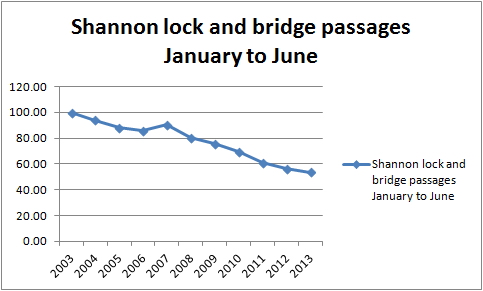
The figures for Shannon lock passages to the end of June 2013 are now available. The decline continues, though perhaps more slowly.

Shannon traffic Jan to June percent

Shannon lock and bridge passages January to June as percentages of the 2003 number

The usual caveats apply: the underlying figures (kindly supplied by Waterways Ireland) do not record total waterways usage because, for instance, sailing, fishing or waterskiing on lakes or river stretches, which did not involve a passage through a lock or Portumna Bridge, would not be recorded. The passage records are our only consistent long-term indicator of usage of the Shannon but they would not show, for instance, a change in the balance of types of activities from those in larger cruising boats to those in smaller (sailing, fishing, waterskiing) boats. It is quite possible, therefore, that overall usage might be increasing while long-distance cruising was declining.

Shannon traffic Jan to June private

Shannon lock and bridge passages by private boats January to June

As it happens, the figures show a small increase over 2012 in passages by private boats. I suspect that July’s warm weather will spur a further increase.

Folk living in Ireland, whether owners or prospective hirers, are likely to be able to react quickly to better (or worse) weather by doing more (or less) boating; folk living abroad may be less able to change their holiday plans. Accordingly, July’s weather might (I’m speculating here) mean an increase in passages by private boats and by boats hired by Irish residents; it might not lead to an increase in hiring from abroad.

Traffic in hired boats continued to decline in June.

Shannon traffic Jan to June hire

Shannon lock and bridge passages by hired boats January to June

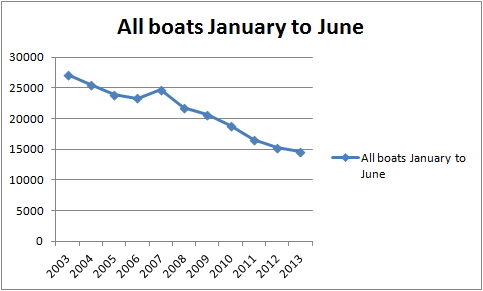
That decline outweighed the small increase in private traffic, leading to an overall decline in the first six months as compared with the same period in 2012, which itself continued the pattern set in 2007.

Shannon traffic Jan to June all

Shannon lock and bridge passages by all boats January to June

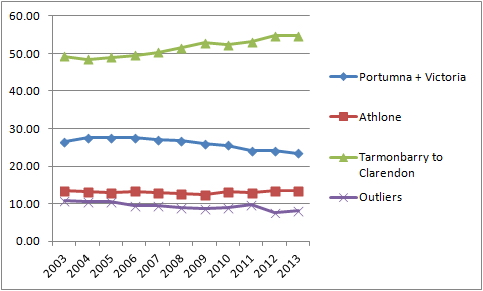
I wondered whether the figures might show any change in the geographical distribution of activity. WI’s reports don’t show separate figures for private and hired boats for the individual locks, but it seems to me that the hire business is becoming more concentrated on northern waters, from Lough Ree upwards. If that is so, then there might be an increase in the proportion of passages through the northern locks, from Tarmonbarry upwards, and a decrease in the proportion passing through Portumna Bridge and Meelick (Victoria) Lock.

I put the WI reporting stations in four groups:

  • Portumna + Meelick
  • Athlone
  • Tarmonbarry, Clondra, Roosky, Jamestown (Albert), Knockvicar (Clarendon)
  • the also-rans: the three locks leading to Lough Allen, Pollboy leading to Ballinasloe, the Limerick sea-lock (Sarsfield).

The figures suggest that the distribution is indeed changing, but gradually rather than dramatically. Athlone’s figures are pretty steady, the outliers are declining slightly and Portumna + Meelick are declining a bit more; the northern locks (Tarmonbarry to Knockvicar) are taking the gains. Comments or alternative interpretations welcome.

Change by region

Lock passages by group

The figures for 2013 are for the six months January to June; those for other years are for twelve months.

The locks could of course be grouped in other ways, and I may try some of them in future months.

Ardnacrusha drowning

Killaloe Coast Guard report.

Shannon Navigation Guide 1963

Messrs abebooks.co.uk have drawn my attention to the fact that Sharston Books of Manchester (which is a town or city within Her current Majesty’s Realm) have a copy of this 1963 Shell/BP guide for sale. John Weaving was Navigation Editor. I already have it, so I mention it here in case anyone else is interested.

I have no connection, commercial or otherwise, to the seller.

Lough Derg search: addenda

Some additional information from the Clare Champion and the Limerick Post. The Irish Mirror has one of the few accounts that includes discussions with participants.

More to come.

Wireless telegraphy

I mentioned here that I thought that, during the major search operation on Lough Derg on 21 June 2013, life would have been easier for everybody if each boat had had a handheld VHF and someone able to operate it. However, I should make it clear that I don’t know what equipment and what sort of organisation and safety procedures the rowing group had, so I’m not going to comment on them. Instead, I’m going to make a general point about what I think are obstacles to the more widespread use of VHF.

Buying a set

Handheld VHF sets can be bought for as little as £50 in the UK or €75 in Ireland. So the technology is now very cheap and, for short range work as on Lough Derg, a handheld VHF should be adequate.

So let’s say you do a bit of searching on tinterweb, say half an hour or so; you find a cheap set from a reliable retailer, give your credit card details and then sit back and wait for the set to be delivered. Elapsed time less than a week, your time say half an hour, the price from say €75 upwards. Getting the hardware is easy and cheap: quite a change from when the Wireless Telegraphy Act 1926 (still applicable) was passed.

But if you want to be legally entitled to use a VHF set, matters are much more complicated.

Hunt the department

Let us suppose that you are a poor benighted foreigner who has decided to hire a boat on the Shannon. You know there is Coast Guard VHF cover there and you think that it would be sensible to bring your handheld set and use it while in Ireland. But, being a poor benighted foreigner, you want to do it all legally.

Your first challenge is to find which Irish government department deals with the matter. Maybe it’s the Department of Communications? You have an old booklet somewhere saying its full name is the Department of Communications, Marine and Natural Resources, which sounds promising. However, you notice that the department seems to have dropped “marine” for “energy” and searching its site for “marine vhf” returns no results.

If, at this point, you were tempted to look at the website of the Commission for Communications Regulation, and thought of looking under Radio Spectrum/Licensing, you would find a link that took you to the right place. But let’s suppose instead that, in reviewing an official list of Irish government departments, you noticed that the word “marine” is now (for some reason) part of the title of the Department of Agriculture, along with “food”.

So you troll on over to the farmers’ friends. The main headings on the site’s front page don’t include marine, though; fisheries is the closest topic. If you use the search facility to find “marine” you get 10800 results, which is rather too many to be useful, but you find that there is a Marine Agencies and Programmes Division, which has a list of Useful Links. Unfortunately none of them are to the department that actually deals with most marine matters: the Department of Transport [and Tourism and Sport], which is at both www.transport.ie and www.dttas.ie.

Things are looking up.

Hunt the unit

Your next challenge is to find the section or unit within the Department of Transport Etc that looks after marine VHF. You could use the department’s search engine, which (at least on my computer) is great for showing the word “Loading” but not for anything else. Or you could click on the word “Maritime”, which takes you to a page whereon you read:

Maritime Safety Directorate (MSD)

The Maritime Safety Directorate (MSD) is comprised of two main sections; the Marine Survey Office (MSO) which includes the Marine Radio Affairs Unit (MRAU) and the Maritime Safety Policy Division (MSPD).

Sure enough, clicking on Maritime Safety Directorate in the left-hand column gives you another page whereon you read:

The Maritime Safety Directorate comprises of two main sections: the Maritime Safety Policy Division (MSPD) and the Marine Survey Office (MSO), which includes the Marine Radio Affairs Unit (MRAU). The Mercantile Marine Office (MMO) also works to the Directorate.

This doesn’t quite correspond to the list of headings in the left-hand column on that page, which makes no mention of a Maritime Safety Policy Division and has lots of other stuff that doesn’t seem to fit in the two (and a half?) main sections, but at least there is a link for the Marine Survey Office (MSO), and on that page there is a link to the Maritime Radio Affairs Unit (MRAU), so you click that and finally you’ve arrived.

Hunt the information

The MRAU has a top-level page and two lower-level pages. The top-level page has an email address, which is good, and a list (dated 6 April 2011) of nine PDFs of Marine Notices relevant to radio. They are identified by numbers rather than by names: there is nothing to indicate what any of them is about,  so the eager seeker after knowledge will have to read all of them. Some are about EPIRBs and suchlike; as far as I can see, the only three relevant to our poor benighted foreigner, wanting to use a handheld VHF, are this one [PDF], that one [PDF] and the other one about fees [PDF].

Selecting the Contact Us page gives you names and phone numbers as well as email addresses. So the page with the detailed information must be the other one headed Forms (and not this one, which seems to be orphaned). Each of the links on the Forms page takes you, for some reason, to another page, from which you can download a document: most are indeed PDFs but two are Word DOC files.

The documents cover three topics:

Thre is also e FAQ [PDF], which outlines the rules. It also suggests that one document is missing from those downloadable: it may be called Ships Radio
Operators Certification and may be an application form.

The FAQ does not explain the different types of licences that are mentioned in Marine Notice 35 of 2010:

An Irish Certificate of Equivalent Competency (CEC) or Irish Certificate of  Competence (COC) issued by the Department of Transport, Ireland, when such
certificate states that the holder has a valid Global Maritime Distress and Safety System (GMDSS), General Operator Certificate (GOC) or Restricted Operator Certificate (ROC) qualification. An Irish CEC or Irish COC must be accompanied by the persons separate valid GMDSS, GOC or ROC qualification.

I have no idea whether I have a CEC, a GOC, a ROC or a … the other thing. And I can’t make out which of them a new applicant (or a poor benighted foreigner) should apply for.

Then Marine Notice 12 of 2004 adds another variant, the SRC:

Radio Operators on board Irish recreational craft, and on board certain other Irish craft  that are required to comply with Merchant Shipping legislation regarding the carriage of maritime radio equipment, must hold as a minimum qualification the Radio Operator’s Short Range Certificate of Competency(SRC) issued by the Commission for Communications Regulation, or an equivalent certificate that is recognised by the Commission as being the equivalent of the Irish SRC.

Is ComReg still involved? I didn’t think so.

But the main point of this marine notice is to say that the only poor benighted foreigners whose short range certificates of competency are recognised in Ireland are the Finns and the Germans; only they can get the Authority to Operate. What should other foreigners do? I don’t know and I can’t see the answer anywhere.

Information

So far, then, it seems to me that (for someone outside the system) it is hard to find the bit of the Irish government web presence that holds the information. (That, of course, is not the fault of the Department of Transport.) Once you’ve got to the relevant part of the Department of Transport website, you have to read far too many documents to find the information you want; it’s not easy to understand and it may be incomplete.

Getting a certificate and a licence

As far as I can see, the process is this:

  • attend a course from one of the approved providers [DOC]. It’s not clear to me which course our poor benighted foreigner [or other would-be operator] would have to do; BIM offers courses ranging from two to ten days, but doesn’t show the costs; I suspect that courses for pleasure-boat operators, especially those from private-sector providers, take rather less time, but I don’t know the cost. The elapsed time could be several months, depending on local supply of and demand for courses
  • take an exam from one of the approved examiners [DOC]. Again, I don’t know the duration (it used to be less than half a day), the cost or the elapsed time (how long you would have to wait until a course is available locally). As far as I can see, the syllabus is not published, so you have no choice but to go to one of the approved providers; that sounds like an anti-competitive practice
  • apply to the department for a certificate. That, it seems, has to be done on paper; the fee [PDF] depends on the certificate you need, which I don’t know, but is either €50 or €60
  • when you’ve got the certificate, you apply for a licence for your, er, ship, using this form [PDF] and paying €100. You give details of the radio operator’s certificate; if it’s a non-Irish certificate you provide a copy, and I guess that you have already applied for an Authority to Operate [PDF].

So your cost is €150 or €160 plus the course fee plus the exam fee; the elapsed time could be several months. All for permission to operate a piece of equipment that is rather less complex than a modern smartphone.

Costs and benefits

Years ago, there was some abuse of VHF channels, which were sometimes used for casual chit-chat. From what I can hear, that is no longer a problem; folk probably send text messages instead. I don’t see any reason to fear an increase in the number of VHF users, and indeed I see many reasons to promote such an increase.

Some of the recent reports of the Marine Casualty Investigation Board on small-boat accidents describe cases in which handheld VHFs could have summoned assistance faster — and would, I think, have been more useful than orange smoke flares. In other cases, folk summoning assistance have relied on mobile phones.

It seems to me that the present system, designed almost ninety years ago for an entirely different context, for large and cumbersome equipment on large vessels, is unsuited to modern leisure boating, with large numbers of small boats that could carry small, cheap, battery-powered handheld VHF sets.

At present, the rational decision for a boat-owner is to buy a cheap VHF without bothering to get either a certificate for the operator or a licence for the vessel. This is the rational decision because the official channels for getting certificates and licences are slow, expensive and cumbersome. It may therefore be — who knows? — that the populace has already decided to ignore the regulations.

For leisure boating within some sensible distance of the shore, I suggest that the current regulations be either drastically simplified or, perhaps better, scrapped altogether. That might mean giving the International Telecommunication Union a kick up the transom, but the present system is counterproductive: it seems to limit the use of handheld VHFs in cases where they could be very useful, if only to allow search and rescue volunteers to stand down earlier.

 

Searching Lough Derg

Last Friday evening, 21 June 2013, was not a good time to be out on Lough Derg. We were heading north, with the waves behind us, and had little difficulty until entering port, but we could hear on the VHF what must have been one of the biggest search and rescue operations on the Shannon in recent years.

We had switched on at what seemed like a fairly early point in the proceedings, and kept listening until the Coast Guard were assured that everybody was accounted for. We weren’t able to attend to the whole thing, as manoeuvres during and after berthing occupied our attention for some time, but we got a pretty clear picture. The Irish Times report (which will probably disappear behind a paywall at some stage) is here; I think it has some minor details wrong but the gist of it is correct; its later report is here. The Clare Herald has a very detailed account here, the Clare Champion account is here and the Limerick Post adds some information here.

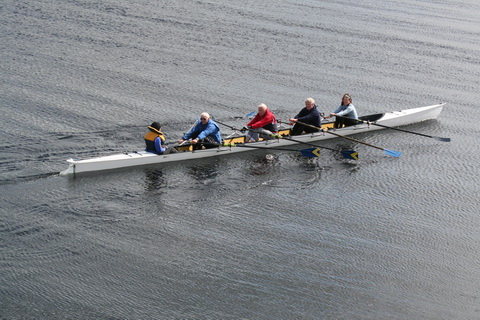
The event was said by the Irish Times to be “hosted for FISA in Ireland by St Michael’s Rowing Club of Limerick” but I can’t see anything about it on either organisation’s website. I presume that the boats were something like this one.

Quad at Clonlara in 2011

It’s a quad, with each rower using two oars; it carries a cox and it’s used for touring rowing, so it’s not as slim as a standard racing shell.

By the way, just to be clear, none of the photos on this page were taken during last Friday’s operation.

RNLI Lough Derg lifeboat

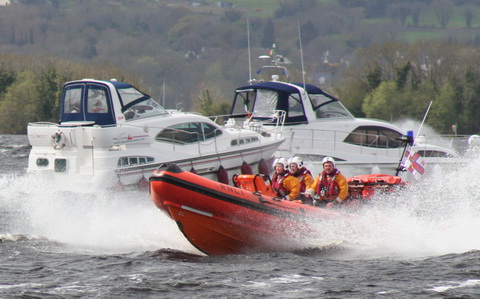
From what we could hear, the operation involved volunteers from Killaloe Coast Guard, the RNLI at Dromineer, the Community Rescue Boats from Mountshannon and Limerick and at least one yacht, which (I think) took one of the rowing boats in tow; that yacht’s participation and careful provision of information to the Coast Guard was admirable.

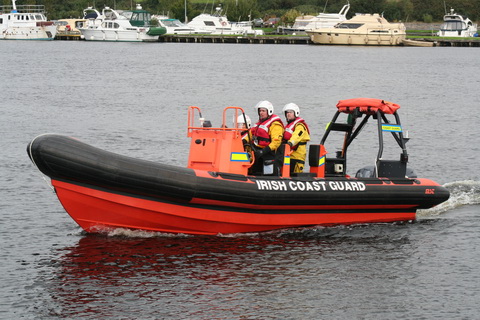
Killaloe Coast Guard RIB

Killaloe Coast Guard RIB

We heard discussion of proposals to ask the Civil Defence to participate as well, and the Clare Herald confirms they did turn out. It seems that the University of Limerick Activity Centre boat was out too, as was Peter Hooker of RNLI in his own boat.

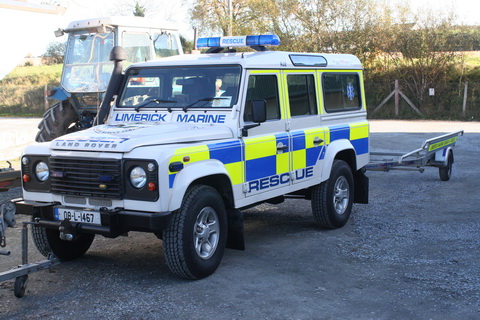
Limerick Marine SAR Land Rover

Limerick Marine SAR Land Rover

That’s just the volunteers, and if I’ve left anybody out I’m sorry; let me know and I’ll amend this.

Then there were the professionals: the Coast Guard staff on VHF, the Gardaí on shore, the helicopter crew. And, again, the Clare Herald makes it clear that lots of other people were involved too: fire brigade and ambulance units, paramedics and a hospital consultant.

All in all, this was a major operation and a lot of people put in a lot of effort that night, in bloody awful weather.

Communications

I formed the impression that communication amongst the members of the rowing fleet, and between them and the rescue services, was poor. It was difficult to establish what rowers were where and how many were unaccounted for. The Clare Herald story seems to support that conclusion: it says that Gardaí had to travel to the rowers’ hotel to make sure that everybody had turned up and that the search was not formally stood down until 11.30pm.

I don’t know what communications equipment and what sort of organisation and safety procedures the rowing group had, so I’m not going to comment on them. Instead, I want to go off at a tangent. It struck me that life would have been easier for everybody if each boat had had a handheld VHF and someone able to operate it. Such sets can be bought for as little as £50 in the UK or €75 in Ireland.

So the technology is now very cheap and, for short range work as on Lough Derg, a handheld VHF should be adequate. But if you want to be legally entitled to use a VHF set, matters are much more complicated. I’ll discuss that in another post.

Not Grand

Limerick’s SmarterTravel initiative aims to promote cycling, walking, car sharing and public transport. It has a little leaflet (I can’t find a downloadable version) describing five walking and cycling routes and including information on bus routes, a cycle to work scheme and car sharing.

One of the cycling and walking routes is along the towing path of the Limerick Navigation from Limerick to Plassey. It is described thus:

The Tow Path was part of the Grand Canal system stretching to Dublin and was used by the Guinness brewery to bring stout to Limerick.

The towing-path was not part of “the Grand Canal system”, although I suppose it might be described as a facility used by the Grand Canal Company. The Park Canal in Limerick, and the towing-path on the river navigation to Plassey, were not built or owned by the Grand Canal Company; they were part of the independent Limerick Navigation until subsumed into the Shannon Navigation in the 1840s. The Grand Canal Company was permitted to use its vessels on the navigation when it began carrying cargoes, which it did for, amongst others, Guinness; Guinness itself did not own or operate boats on the Shannon Navigation or the Limerick Navigation.