Tag Archives: Lough Derg

Murder on a Grand Canal Company boat

At the inquest on the body of Myles Crofton, who was, as alleged, murdered on board one of the Grand Canal Company’s boats on the Limerick Canal, the jury returned the following verdict:— “That the deceased, Myles Crofton, aged 45 years, dies at Killaloe on Sunday, the 29th November, 1891, from certain wounds inflicted on him in boat No 17, plying on the canal, but we find there is not sufficient evidence before us to enable us to say who the guilty person or persons are that inflicted said wounds. We unanimously wish to put before the Grand Canal Company the unhappy position of the wife and large family of the deceased, and to pray the merciful consideration of the company on their behalf.”

Freeman’s Journal 5 December 1891

From the issue of 1 December 1891 we learnt hat, on 30 November 1891, two Grand Canal Company boatmen, and a third man, were charged with the murder. The boat had left Limerick for Killaloe on Saturday 28 November with Crofton, two other crewmen and a fourth person, not a boatman, on board. When it reached Killaloe, Crofton was found to be unconscious “with seven wounds about the head and over both eyes”. The police were called and the dispensary doctor attended but Crofton died next morning “in great agony”. The other three were remanded to Limerick Jail for a week. Crofton left eight children.

On Tuesday 29 December [FJ 30 December 1891] the three men were brought before the magistrates. They were defended by P S Connolly, solicitor. District Inspector M’Donald said that one of the accused had made an important statement but, as he had not yet received instructions from Dublin Castle, he requested an adjournment which, despite Mr Connolly’s opposition, was granted. On the following day [reported in FJ 31 December 1891] the DI said that one of the men, George Farrell, had been released from prison and was prepared to give evidence against Frank Egan.

On being sworn, Farrell deposed he had heard a row in the cabin of the boat between Frank Egan and the deceased, Myles Crofton, and afterwards saw them fighting with their fists. Subsequently he saw Egan strike the deceased with his boot.

Dr John Keogh, who had attended Crofton before he died [was he the dispensary doctor?], said that the wounds were caused by violence, not by accident.

The Belfast News-Letter [1 January 1892] had a slightly different account:

[…] one of the men turned Queen’s Evidence, and confessed that while going down [sic] the Shannon a comrade named Miles [sic] Crofton was repeatedly assaulted while all the party were drinking.

Egan was committed for trial; Farrell had already been released and now the third, Nutterfield [Yorkshire Post and Leeds Intelligencer 1 January 1892] or Netherfield [Hampshire Telegraph and Oxford Journal, both 2 January 1892], was also released.

I have not been able to find anything about Egan’s trial, if there was one, or subsequent fate.
 

Shannon traffic figures to August 2014

I am grateful to Waterways Ireland for letting me have the Shannon traffic figures for August 2014.

Regular readers may wish to skip this section

All the usual caveats apply:

  • the underlying figures do not record total waterways usage (even for the Shannon) as, for instance, sailing, fishing or waterskiing on lakes or river stretches, which did not involve a passage through a lock or Portumna Bridge, would not be recorded
  • the passage records would not show, for instance, a change in the balance of types of activities from those in larger cruising boats to those in smaller (sailing, fishing, waterskiing) boats
  • figures like these will not necessarily be representative of those for the year as a whole. The winter months, January to March, see little traffic in any year; for April, May and June, the weather can have a large influence on the amount of activity especially, I suspect, in private boats.

On the other hand, the figures do include the Shannon’s most significant tourism activity, the cruiser hire business. And they are our only consistent long-term indicator of usage of the inland waterways.

All boats

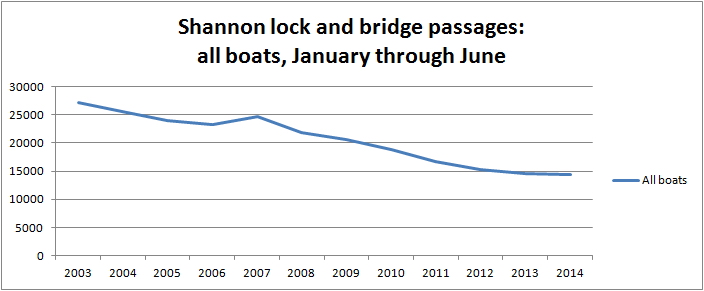
Shannon traffic all boats to August 2014

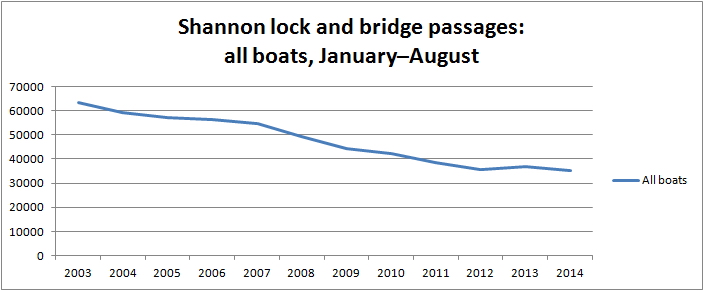
Total (private + hired) traffic for the first eight months of each year

I thought that the good weather in July might have brought more boaters out in August (when the weather was not so good), but it didn’t. This is the lowest eight-month figure in my series; traffic is just under 56% of what it was in 2003.

Private boats

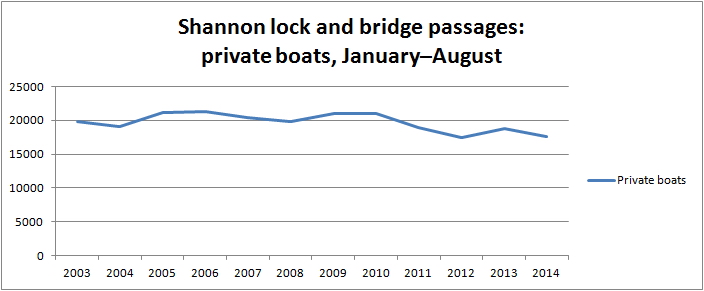
Shannon traffic private boats to August 2014

Private-boat traffic for the first eight months of each year

Nothing much to cheer about there. Traffic was very slightly higher than in 2012.

Maybe lots of people have taken up sailing, and thus been confined to the lakes, instead of cruising. If, gentle reader, you can think of a way of measuring sailing usage, let me know.

Hire boats

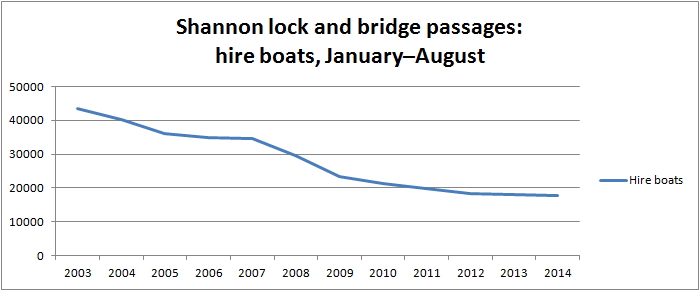
Shannon traffic hire boats to August 2014

Hire-boat traffic for the first eight months of each year

As I said last month, the pace of decline seems to have slowed, but this is still the lowest figure in my series.

Percentages of 2003 levels

Shannon traffic private and hired as % of 2003 to August 2014

Changes since 2003: private and hired boats

The eight-month figures for private traffic are a bit worse than the seven-month, but perhaps September’s extraordinarily good weather will prompt an increase. There is no good news for the hire business, but perhaps the profitability of the remaining operators will be improved.

Private -v- hired

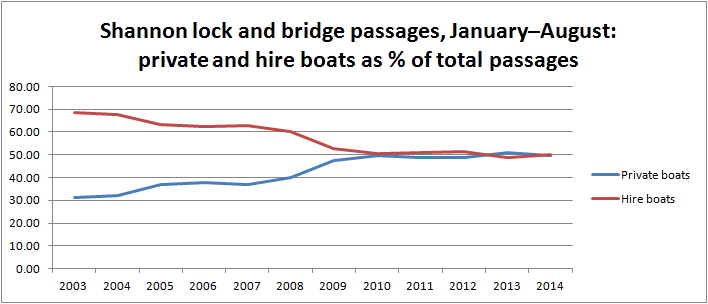
Shannon traffic private -v- hired to August 2014

Still roughly 50/50

What is the Shannon’s USP?


Stealth seaplanes?

I have made several visits to Mountshannon this year, but unfortunately none of them coincided with an appearance by any of the “brand new fleet of aircraft, operating from destinations nationwide” that Harbour Flights promised would arrive “early in the new year” of 2014.

A puzzle in waterways history

According to the Lagan Canal Trust,

The Lagan Navigation also forms part of a wider all Ireland waterway network. This network of waterways once traversed through the towns and cities of Ireland delivering goods and produce, helping to shape the economic fortunes of the country.

I would be grateful for information about any goods or produce that were ever carried from the Shannon, or from the Royal or Grand Canals or the River Barrow via the Shannon, through the Junction Canal in the Ballinamore & Ballyconnell Drainage District [later called the Ballinamore & Ballyconnell Canal and later still the Shannon–Erne Waterway] and then the Ulster Canal to Lough Neagh or any of the waterways connected therewith. Or, of course, in the opposite direction.

As far as I can tell, outside the sales blurbs written by engineers seeking employment and waterway owners seeking subsidies, there was never a connected all-Ireland waterways network; nor was there ever any need or demand for such a thing.

Any more than there is now.


The Royal under the Railway

A new, short book, on aspects of the history of the Royal Canal, published by the Railway and Canal Historical Society, will be launched at the Clinker Lecture on 18 October 2014. The title is The Royal under the Railway: Ireland’s Royal Canal 1830–1899 and it covers a number of topics, mostly about the canal after it was bought by the Midland Great Western Railway. From the Introduction:

The accounts of the Midland Great Western Railway for the half year ending 31 December 1849, four years after it bought the Royal Canal, showed its gross income from the railway as £23,773 and its income from the canal as £7,677, roughly a quarter of the total. By 1899, though, income from the railway was £264,393 and that from the canal £2,220, less than one per cent of the total. The Royal Canal, never particularly successful, had declined into utter irrelevance.

It may seem perverse, therefore, to offer even a short book on the canal’s history in that period, especially as there exist two full histories, by Peter Clarke and by Ruth Delany (with Ian Bath in the most recent edition). This, though, is not a full history, even of the limited period, roughly 1830–1899, from just before the railway took over until the end of the nineteenth century. This is rather a complement to those histories, providing just enough background information to  enable the book to stand alone while covering some new topics and providing new or extra information on others. The topics include:

  • the 120-foot steam-powered narrowboat
  • the Midland Great Western Railway’s early attempts at running canal boats
  • the ingenious Mr Mallet’s moveable bridge
  • the whore who held the mortgage on the canal
  • the competition between the roads of Roscommon and the Royal Canal
  • the reconstruction of Dublin bridges over the canal
  • the horses who slept on board their boat.

[…] this book is not intended to be the last word on any of those topics. I hope that it might encourage others – those researching local, family, social, industrial, transport, economic or technological history – to record and transmit anything they might learn about the history of the Royal Canal. To take just three topics, we know very little about canal employees, the operations of canal traders or the management of the horse-drawn canal boats. On any one of those, useful information could just as easily be found by a local or family historian as by a canal specialist.


Steam, the Shannon and the Great British Breakfast

That is the title of the Railway and Canal Historical Society‘s 2014 Clinker Memorial Lecture, to be held at the Birmingham and Midland Institute, Margaret Street, Birmingham B3 3BS, at 1415 on Saturday 18 October 2014.

The lecture will concentrate on the period before 1850 with such interesting topics as

  • Shannon steamers
  • the Grand and Royal Canals
  • the first Irish turf (peat) to reach the USA (possibly)
  • port developments in Dublin, Limerick and Kingstonw
  • the Dublin and Kingstown Ship Canal
  • the Midland Great Western Railway
  • what “cattle class” really means
  • bacon and eggs.

Admission is free and booking is not required. However, if you plan to attend, it would be helpful if you could e-mail […] to this effect.

The Clinker Memorial Lecture is named for Charles R Clinker, an eminent railway authoe and one-time historian of the Great Western Railway, who died in 1983.

If you would like the contact email address, leave a Comment below and I’ll get in touch with you direct.


Sliabh Aughty Furnace Festival

I don’t know how many people are aware that there were once extensive ironworks [which used water transport] along the lower western shore of Lough Derg and in the foothills of Sliabh Aughty. The existence of a townland called Furnace, near Whitegate, might be a clue, I suppose. Ger Madden had an article on “The Iron Works of Sliabh Aughty” in Sliabh Aughty: East Clare Heritage Journal No 7 [1997]; he told me the other day that the works burned an acre of oak every day during the season. That bears out what J H Andrews said in “Notes on the Historical Geography of the Irish Iron Industry” [Irish Geography: bulletin of the Geographical Society of Ireland Vol III No 3 1956]:

[…] the Irish woods were exploited [for charcoal] with an extravagant disregard for the future supply position, although at first the conversion of woodland to permanent pasture could have been justified in many cases as a rational long-term economic decision. […] [Cpppicing was] never adopted in Ireland, even by such enlightened land owners as Sir William Petty, so that even a small forge or furnace could despoil its woods at an alarming rate.

Ger and others in Mountshannon have now organised the Sliabh Aughty Furnace Festival, to be held in Mountshannon on 20 and 21 September 2013. The leaflet says:

In the 17th and 18th century, the western shores of Lough Derg were the setting for an intensive iron industry. Although little known, it has left many traces in the landscape and various archives.

The Sliabh Aughty Furnace Project is hoping to safeguard these monuments for the future, research the history and develop the story as a touristic attraction. […]

The festival caters both for those with a deep interest in the subject and for those who might like a lighter approach. For the first group, there is a series of talks in the Mountshannon Hotel, running from 1030 to 1630 (with an hour for lunch):

1030 Paul Rondelez “Iron production in the Sliabh Aughty mountains”
1100 Mary Sleeman “Heritage and the law”
1200 Gerard Madden “The Emmerton Papers” [an archive with valuable
information about the Clare ironworks]
1230 Professor Audrey Horning “Archaeology and early industry in Ireland and
the Americas” [yes, there is a direct link]
1400 Dr Colin Rynne “Industry on the Shannon”
1430 Dr Christy Cuniffe “An elusive foundry in the Slieve Aughty foothills: the
work of T Clarke”
1530 Sean Spellissy “Expanding on Slieve Aughty”
1600 Ewelina Rondelez “The Sliabh Aughty Furnace Project”

The Aistear Iniscealtra Park [the maze] will have events including blacksmithing, charcoal production, a living history tent, sword-fighting demonstrations, 17th century games, a knitting demonstration, an exhibition on the ironworks, stalls with local produce and a barbecue.

All of that for €10 (adult rate; under-16s €5, toddlers free).

On the Sunday there is a guided tour of the remaining furnaces, leaving the harbour at 10.30am: free if you use your own transport, €20 by bus.

There is a website here with full details including information about accommodation in the area.


Loos change as TippCoCo hopes to swipe the loot

Er … sorry about the outbreak of headlineitis: it’s corresponding with journalists that does it.

The Tipperary Star reports (on paper, not on its website) that Tipperary County Council intends to issue “swipe cards for boating facilities along Lough Derg”. Michael Hayes, the engineer for Nenagh Municipal District Council, said that the cards were sold along the Shannon but that the revenue went to Waterways Ireland whereas the council bore all the costs. He is quoted as saying that “We are pursuing it to have them pay some of the costs”: another threat to WI’s budget.

Councillor Phyll Bugler said that it was “not acceptable” that shower and toilet blocks closed early, although she is not reported to have commented on the cost of having staff to clean the blocks late at night.

I suspect that Waterways Ireland’s income from the smart cards is minimal.


GCC Shannon steamers 1866

Here is a new page with an illustrated article from 1866 about the steam engines in three Grand Canal Company steamers of that era, which were used on the Shannon. I am grateful to Mick O’Rourke of Irish Shipwrecks for sending the article to me.


Shannon traffic figures for June


I am grateful to Waterways Ireland for letting me have the Shannon traffic figures for June 2014. All the usual caveats apply:

  • the underlying figures do not record total waterways usage (even for the Shannon) as, for instance, sailing, fishing or waterskiing on lakes or river stretches, which did not involve a passage through a lock or Portumna Bridge, would not be recorded
  • the passage records would not show, for instance, a change in the balance of types of activities from those in larger cruising boats to those in smaller (sailing, fishing, waterskiing) boats
  • figures like these, for a small number of months, will not necessarily be representative of those for the year as a whole. The winter months, January to March, see little traffic in any year; for April, May and June, the weather can have a large influence on the amount of activity especially, I suspect, in private boats.

On the other hand, the figures do include the Shannon’s most significant tourism activity, the cruiser hire business. And they are our only consistent long-term indicator of usage of the inland waterways.

Total (private + hired) traffic for the first six months of each year

Total (private + hired) traffic for the first six months of each year

Total traffic is down again, but only slightly. The decline does seem to be levelling off and a continuation of the relatively good weather could increase usage.

SnnNav JanJun 2

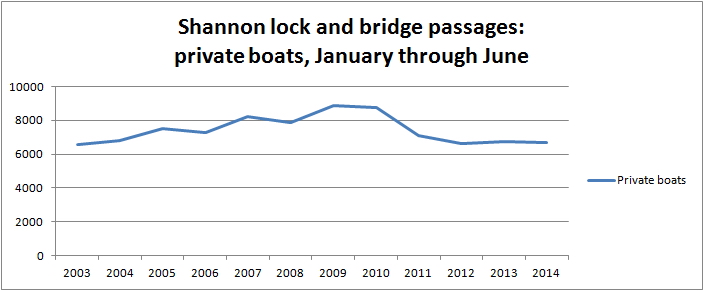
Private-boat traffic for the first six months of each year

Private traffic is down slightly on last year, but it has been pretty much the same for three years. I had thought that the good weather might have caused something of an increase, but on the other hand my own impression of Lough Derg traffic (not reflected in the passage figures) is that it has been fairly light.

SnnNav JanJun 3

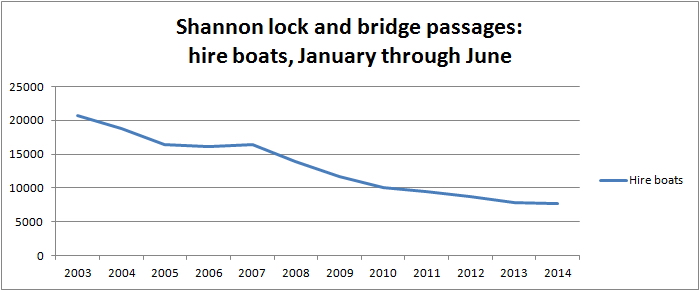
Hire-boat traffic for the first six months of each year

For hire-boat traffic, there is no sign of an upturn, although the drop on last year’s figures is not very large.

SnnNav JanJun 4

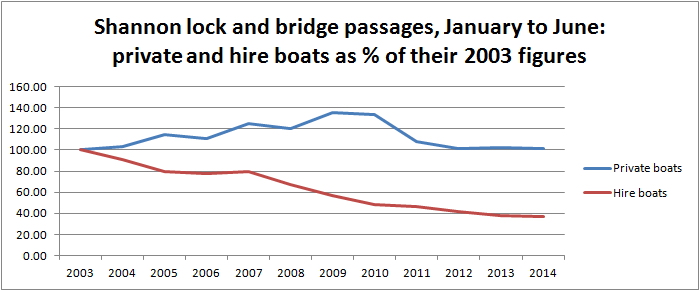
Changes since 2003: private and hired boats

That table amalgamates the two before it, but shows the figures as percentages of the 2003 figures. For private boats, the Celtic Tiger (nach maireann) caused an increase; that effect has worn off and usage has not changed much since about 2011. For hired boats, the decline began long before the Celtic Tiger idiocy.

SnnNav JanJun 5

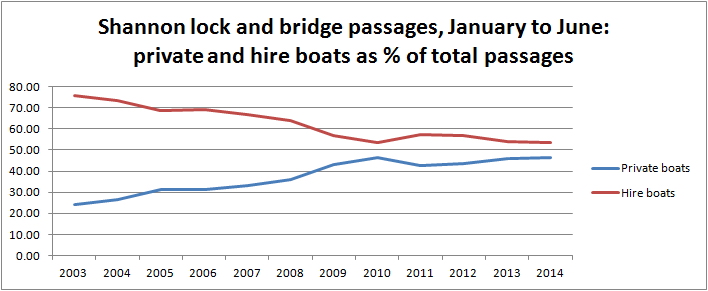
From 75/25 to 50/50

Hired boats were once the major users; private boats have almost caught up.

SnnNav JanJun 6

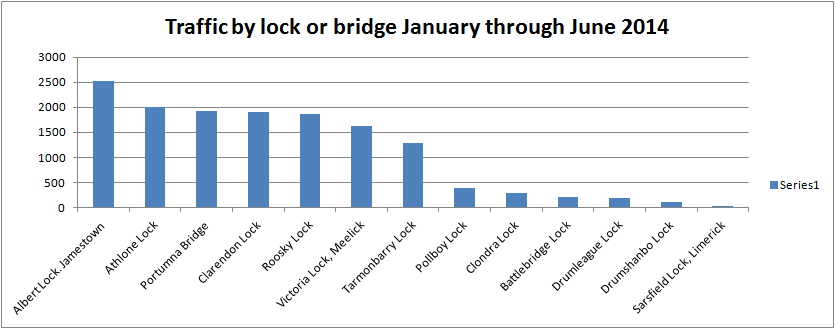
How to save money

I don’t know how much the various locks cost to run, so I can’t work out any measure of value for money, but the sea lock in Limerick and the Lough Allen Canal must surely be candidates for the chop.