Tag Archives: Lough Neagh

A sheugh would solve it …

… not.

If you’re feeling the need of something to depress you, troll on over to the website of the Northern Ireland Community Relations Council and download the six PDF sections of the third Peace Monitoring Report. Written by Dr Paul Nolan, it is an extremely impressive piece of work — and a welcome counter to the witterings of the peaceprocess feelgoodistas who are so prominent on 2RN these days.

If you would prefer a summary, here is Liam Clarke’s account in the Belfast Telegraph, and here is his commentary; Tomboktu and others pointed to some problems with the headline on the first piece, but I’m more concerned that the focus on education in the headline on Clarke’s account may distort perceptions of what the report and, indeed, the rest of Clarke’s article are really about.

The report uses indicators grouped into four domains:

  • the sense of safety
  • equality
  • cohesion and sharing
  • political progress.

I didn’t find much that was cheering in any of them. Nolan lists ten key points:

  1. The moral basis of the 1998 peace accord has evaporated
  2. The absence of trust has resulted in an absence of progress
  3. There has been some increase in polarisation
  4. A culture war is being talked into existence
  5. The City of Culture year presented a different understanding of culture
  6. Failure lies in wait for young working-class Protestant males
  7. Front line police have been the human shock absorbers for failures elsewhere
  8. The rebalancing of inequalities unbalances unionism
  9. At grassroots level the reconciliation impulse remains strong
  10. No one picks up the tab.

Only the fifth and ninth offer any good news. But, from a waterways perspective, I was struck by the complete irrelevance of the proposed reconstruction of the Ulster Canal, the Clones Sheugh, to solving any of these problems. Yet Waterways Ireland, around whose neck this dead albatross has been hung, is the largest of the cross-border bodies and the sheugh is the largest capital project proposed to be undertaken by any of them. If the Irish government wants to do something to solve the real and continuing problems of Northern Ireland, as outlined in the Peace Monitoring Report, couldn’t it find something more useful to do?

Incidentally, I have not been able to find coverage of the report on the websites of the Irish Times, Irish Independent or Irish Examiner, although that may reflect poor searching on my part rather than any lack of interest on theirs.

Shannon traffic 2013

Some weeks ago Waterways Ireland kindly supplied me with the Shannon traffic figures for the final three months of 2013 and I have just now had a chance to add them to my spreadsheets and produce some graphs.

The usual caveats apply: the underlying figures do not record total waterways usage (even for the Shannon) as, for instance, sailing, fishing or waterskiing on lakes or river stretches, which did not involve a passage through a lock or Portumna Bridge, would not be recorded. The passage records are our only consistent long-term indicator of usage of the Shannon but they would not show, for instance, a change in the balance of types of activities from those in larger cruising boats to those in smaller (sailing, fishing, waterskiing) boats. On the other hand, they do include the Shannon’s most significant tourism activity, the cruiser hire business.

It is good to note, incidentally, that, in its draft Corporate Plan 2014–2016, Waterways Ireland says that it intends to

Develop and implement a research programme to measure waterway usage and inform planning and development.

It won’t be easy to do, but we need much better measures of all types of activities on all seven of the waterways managed by WI.

The final outcome for 2013 won’t greatly surprise anyone who has read earlier bulletins on this subject, like this covering the figures to end-September 2013. All the illustrations are based on information supplied by Waterways Ireland, with some minor adjustments by me to eliminate anomalies, but the interpretation and comments are mine own.

All boats full year

Total Shannon traffic 2003–2013, private and hired

The decline in traffic since 2003 seems to have been halted …

All boats full year %

Total Shannon traffic as a percentage of 2003 traffic

… but it is 40% below what it was in 2003.
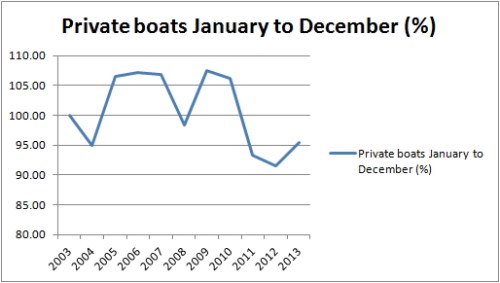
Private boats full year %

Private-boat traffic 2003–2013 as a percentage of 2003 traffic

Traffic in private boats seems to be recovering, but what is perhaps more significant is that it never went more than 10% above or below the 2003 figure. It has been remarkably stable over the period, despite the economic crash and despite the anecdotal evidence of boats being sold to overseas owners and trucked out of the country. Perhaps larger boats were replaced by smaller? Perhaps only boats bought in the boom were sold in the bust? Unfortunately the deficiencies of the registration system make it very difficult to determine what has been happening.

Hire boats full year %

Hire-boat traffic 2003–2013 as a percentage of 2003 traffic

But if private-boat traffic has been remarkably stable since 2003, the same cannot be said of hire-boat traffic. The best that can be said of 2013 is that the figures didn’t get [much] worse, but a 60% decline since 2003 is really, really dreadful.

WI’s draft Corporate Plan, which does not explicitly mention the hire industry, talks of

… unlocking opportunities to achieve recreational growth, and economic and social development.

I don’t know whether that omission means that WI sees little prospect of a rejuvenated hire-boat industry. And I note that, other than in the titles of organisations, the draft plan rarely mentions tourism or tourists. Are the waterways only for natives? If so, is that a deliberate policy decision? Or is there something that could be done, cheaply, to help to revive waterways tourism?

Emma Kennedy, writing in the Sunday Business Post on 23 February 2014, wrote about Fáilte Ireland’s latest brainwave, which is to “target” three groups:

  • social energisers, which are gangs of young people interested in “new and vibrant destinations”, which I take to mean Temple Bar
  • culturally curious folk aged 50 or over, with money, who are interested in “exploring new landscapes, history and culture”
  • great escapers, who like energetic rural holidays with their partners.

No families with kids, I see, although “Families & Loved Ones” (the latter term, by the way, nowadays seems to mean either dead people or their relicts) were one of the two “primary target customer segments” identified in Fáilte Ireland’s Inland Cruising Market Development Strategy. (Fat lot of good that strategy did, but we mustn’t be bitter.)

Anyway, without having done any market studies (though WI has funded lots of them), it seems to me that there is scope for more tourism on the waterways, but it might not be on traditional cruisers. It might involve outdoor activities like cycling and walking along the canals and Barrow: WI’s plan discusses them, but without adverting to an overseas market. And it might involve small-boat activities — canoeing, touring rowing, small-boat sailing, camping — on Shannon, Erne and SEW: WI says it will support micro-enterprises, and those providing outdoor activity holidays may need expertise and assistance rather than hard cash.

I admit to having little evidence on this, but it seems to me to be too early to give up on the tourism potential of the waterways. And the decline of the cruiser hire business does not necessarily mean that all waterway tourism is doomed.
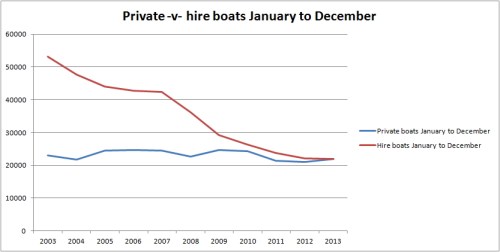
Private -v- hire full year

Private boats overtake hire boats

That said, 2013 was the year when, for the first time since Noah was an Able Seaman, the number of passages by private boats exceeded that by hire boats.
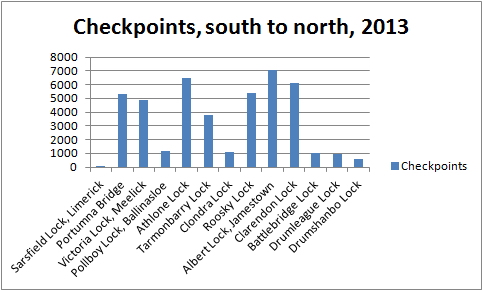
Checkpoints 2013

The points at which numbers were recorded

Finally, this chart suggests that any structures that were not built by the Shannon Commissioners in the 1840s will not attract many visitors. The extensions off the main stem of the Shannon — south to Limerick, west to Ballinasloe, east through Clondra, north to Lough Allen — are much less used than the main line from Lough Derg to Lough Key. It seems unlikely that any further extensions, especially to small towns that it would take three hours (at canal speed) to get to, are likely to be any more successful in attracting traffic.

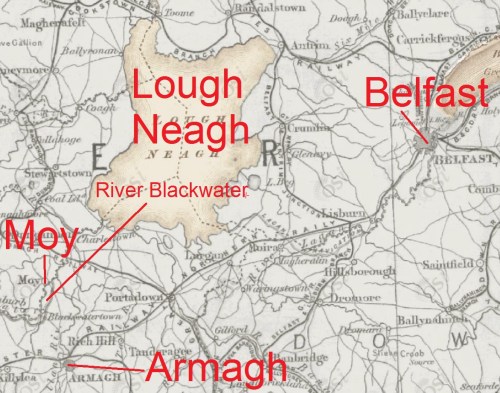
The Armagh Canal

Another unbuilt canal mentioned by the indefatigable Mr Atkinson.

A proposal for making a canal from the city of Armagh to the river Blackwater, near the town of Moy

In order to shew, that carrying into effect the annexed sketch of a line [alas not annexed to the Google scan of Atkinson’s book], for opening a navigable communication from Armagh to the river Blackwater, would be a work of public utility, the following reasons are most respectfully submitted to the Right Honourable and Honourable the Committee of the House of Commons.

From Armagh, being the most considerable market in the kingdom for the sale of brown linens, the manufacture of that staple article is carried on to a very great extent in its neighbourhood; but this manufacture is in danger of being most materially injured, from the great scarcity of fuel, which is such as to oblige the opulent inhabitants to use English coal, at a great expense of land carriage; and they have latterly, at inclement seasons, been under the necessity of subscribing large sums, to procure that article at a low price for the poor, to prevent them from perishing.

Should a navigation be opened from Lough Neagh it would give the means of a supply of turf from the extensive bogs in the neighbourhood of the lake, would open a communication with the collieries at Coal island, in the county of Tyrone, and bring English or Scotch coal at considerably under the prices at which they can now be procured.

An extensive trade in general articles of merchandise being carried on from Armagh, not only to its own neighbourhood, but to a considerable part of the counties of Monaghan and Tyrone, by opening a navigation through Lough Neagh to the ports of Belfast and Newry, this trade would be very considerably extended, to the great advantage of Armagh, and all those places to which its trade extends, and would tend much to improve the public revenue.

To the great number of bleach-greens and flour mills in the neighbourhood of Armagh, water carriage would be of the highest importance, as well for the conveyance of bleaching stuffs, coals, grain, and flour, as of timber, slates, and other heavy articles, used in erecting and repairing the necessary buildings, machinery, &c.

In a large tract of country, from Blackwater town to Lough Neagh, and from thence up the river Bann, and along the canal to Newry (an extent of nearly 30 miles), there is no limestone whatever; so that lime can only be procured by land carriage from a distance of several miles, which prevents its being at all used in that important national object — agriculture.

Was a canal opened from Armagh, it must necessarily go through the lands in that vicinity, containing inexhaustible quantities of limestone, which could be conveyed by boats returning from Armagh, at a very inconsiderable expense, to all that part of the county above mentioned.

The cut, as laid down in the plan, would extend about five and a half miles; and according to the estimate, would, when completed, cost from £18,000 to £20,000, about one-third of which could be raised by subscription.

To keep the works in repair, and pay interest to the subscribers, would require a toll of about sixpence per ton on all boats carrying coals, or any other species of merchandise; but boats laden merely with turf or limestone might be charged only twopence per ton.

The number of horses constantly employed in bringing coals, turf, and other necessaries, to Armagh, amount to some hundreds; two-thirds of these would, from a canal, become unnecessary, and consequently make a saving to the country of their keeping, attendance, &c to a very large amount.

Should the Armagh navigation be carried into execution, it would be necessary to give the commissioners of it a power of laying on a very small toll on vessels coming into the Blackwater from Lough Neagh, to enable them to clear, and keep in order, a cut which was made many years ago (as marked in the plan), to avoid a sand bank in the mouth of the river Blackwater.


Armagh, Moy and Lough Neagh

Armagh, Moy and Lough Neagh

A Atkinson Esq (late of Dublin) Ireland exhibited to England, in a political and moral survey of her population, and in a statistical and scenographic tour of certain districts; comprehending specimens of her colonisation, natural history and antiquities, arts, sciences, and commerce, customs, character, and manners, seats, scenes and sea views. Violent inequalities in her political and social system, the true source of her disorders. Plan for softening down those inequalities, and for uniting all classes of the people in one civil association for the improvement of their country. With a letter to the members of His Majesty’s Government on the state of Ireland Vol II Baldwin, Cradock, and Joy, London 1823.

The Armagh canal document, bearing a date of June 20th 1800, is also included in Rev John Dubourdieu Statistical Survey of the County of Antrim, with observations on the means of improvement; drawn up for the consideration, and by direction of The Dublin Society Dublin 1812 [Google scan, again sketchless] but is not, oddly, mentioned in Sir Charles Coote Bart Statistical survey of the County of Armagh: with observations on the means of improvement; drawn up in the years 1802, and 1803, for the consideration, and under the direction of the Dublin Society Dublin 1804 [at archive.org here], although Coote does say of Newry

A canal has been in contemplation, to be cut from this town to Armagh, and an iron road is also talked of, but there has been no decision in either cases.

My OSI logo and permit number for website

The Dublin to Lough Neagh Canal

Here’s another lunatic canal proposal: one I hadn’t come across before.

Proposal for making a line of navigation from Dublin to Lough Neagh

It is proposed by several noblemen and gentlemen of the county of Meath, and of the manufacturing counties of the north of Ireland, the river Boyne company, with several merchants of the city of Dublin and of the commercial towns of the north, to complete, by private subscription, together with such aid as parliament may be pleased to grant, a navigable canal, from the royal canal at Blanchardstown, near Castleknock, in the county of Dublin, to Navan, Kells, Balieborough, Monaghan, Armagh, and Lough Neagh.

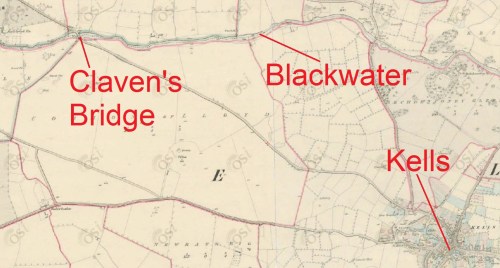
The object of this undertaking is to open a direct intercourse between the metropolis and the manufacturing towns of the north; and it is conceived, by the proposers for this undertaking, that a canal, large enough to navigate twenty-five ton boats on, would answer the trade; and in consequence of many locks being already made, rising from the city of Dublin to Castleknock, they think such a canal could be carried on very cheaply from thence to Navan, where another ascent takes place, through the locks of the Boyne navigation to the level of the town of Kells, and the river Blackwater, at Glevin’s bridge, three miles north of that town.

Claven's Bridge over the Blackwater near Kells

Claven’s Bridge over the Blackwater near Kells

My OSI logo and permit number for website

The country northward appears so fit for inland navigation, that no doubt can be entertained of being able to cut cheap canals through it. It is therefore most humbly hoped, if a line for a canal in this direction should be found to answer the expectation, that parliament will be pleased to allow the undertaking to become a part of the intended system of inland navigation of Ireland, and to a share of whatever bounty parliament may grant to accomplish the same.

The advantages that would arise to the nation from this undertaking, are too obvious to take up the time of this honourable house with any comment upon them.

A Atkinson Esq (late of Dublin) Ireland exhibited to England, in a political and moral survey of her population, and in a statistical and scenographic tour of certain districts; comprehending specimens of her colonisation, natural history and antiquities, arts, sciences, and commerce, customs, character, and manners, seats, scenes and sea views. Violent inequalities in her political and social system, the true source of her disorders. Plan for softening down those inequalities, and for uniting all classes of the people in one civil association for the improvement of their country. With a letter to the members of His Majesty’s Government on the state of Ireland Vol II Baldwin, Cradock, and Joy, London 1823

Shinners losing patience over sheugh

Caoimhghín Ó Caoláin [SF, Cavan-Monaghan] in the Dáil on 5 February 2014:

There is no excuse for either the British or the Irish Governments to stand over any delay in advancing with key cross-Border infrastructural projects such as the Carlingford Narrow Water bridge and the Ulster Canal. With regard to the Ulster Canal, I have been in touch with the office of the Northern Ireland Minister for Culture, Arts and Leisure, Carál Ní Chuilín MLA, my party colleague. She assures me that both she and her counterpart here, the Minister for Arts, Heritage and the Gaeltacht, Deputy Jimmy Deenihan, are fully committed to this project, and I welcome that affirmation. As I pointed out in the debate on the Six Counties last year, the North-South Ministerial Council agreed to proceed with the Ulster Canal project in 2007. In the intervening period, we have seen the economic collapse in this State and a parallel contraction in the North. Despite this, the Ulster Canal project was kept alive.

Permission was granted last year for the Northern section by Environment Minister, Alex Atwood, and by Clones Town Council and Monaghan County Council for the section in this jurisdiction.

The Minister for Arts, Heritage and the Gaeltacht, Deputy Jimmy Deenihan, has advised that the earliest the contract could be awarded would be late 2014 with a completion date in spring 2017. I urge the Minister to do all in his power to expedite this process and to encourage his colleagues to do so. I also urge him to maximise the possible EU funding for the project from the Peace IV programme.

The Ulster Canal project is about greatly enhancing one of the finest landscapes in Ireland for locals and tourists alike, regenerating rural areas that have long been neglected and delivering a tangible peace dividend to Border communities that were neglected for far too long. It is time to get the work on the ground under way.

Yes …. Sinn Féin’s faith in the economic potential of canals is touching, if slightly worrying for anyone who believes that the world economy has changed since the late eighteenth century.

But wait: as far as I can see, SF is one of the few groups that has not asked Jimmy Deenihan about Waterways Ireland’s proposed new byelaws, which might force boaters to pay slightly more of the cost of their hobby. Perhaps SF is secretly hoping that user charges on the Clones Sheugh will be high enough to pay at least the interest on the construction cost? That would be nice.


An eels update, updated

Pat Rabbitte’s reply to Michael Colreavy; thanks to KildareStreet.

Update 6 February 2014: Fergus O’Dowd [FG, Louth] responded to the Dáil’s most famous canoeist, Ming Flanagan [Ind, Roscommon/South Leitrim], the Rockville navigator, with some more information about eels.

Reading list

Waterways Ireland has been putting out more and more stuff on its website.

If you haven’t already seen them, you can get the full set of Product Development Studies, in PDF format, here.

Even more interesting, to this site, are the waterway heritage surveys. Those for all waterways other than the Shannon are available here. The Shannon study was done some years ago (I remember making some comments on it at the time) and will be uploaded “in due course”.

I was in a WI office yesterday and had a quick look at the Lower Bann survey, which was done by Fred Hamond (so we know it will be good), and I’m looking forward to learning more about the waterway I know least about. It is done thematically and has lots of illustrations: Fred is able to see and present the bigger picture, but a full database, with all the supporting information, is available on request.

The grunts of Lough Neagh

In The Cookin’ Woman: Irish country recipes (Blackstaff Press, Belfast and Dover New Hampshire, facsimile edition 1986), Florence Irwin says of Lough Neagh:

This lake, 153 square miles, has always provided much sea-food. Eeels [sic], pollan, trout, grunts and their elderly relatives, perch, to mention the most common fish eaten by the loughsiders and sold by them.

No doubt that is true for certain values of “sea”.

She says that the (Irish) pollan is found only in Lough Neagh, but that does not seem to be true. I had not come across the grunt before: earlier, in her chapter on soups, Ms Irwin has a recipe, from Moortown, for grunt soup, which requires 1 dozen grunts; she explains that

Grunts are the young of perch.

Seamus Heaney says

Perch we called “grunts” …

which suggests that perch are grunts or vice versa. Wikipedia says

The grunts are a family, Haemulidae, of fishes in the order Perciformes.

The taxonomy set out on its page about Perciformes suggests a relationship between grunts and perch that is more complex than either Ms Irwin or Mr Heaney allows, but says

Classification is controversial.

I am left wondering whether there are still grunts in Lough Neagh and, if so, whether they are of the Haemulidae family or whether the name is simply used locally for perch, young or old.

Here is a page about the Lough Neagh fisheries.

Sheughery

I wonder why Sinn Féin asks questions when it does. This one [h/t KildareStreet.com] seems to have been asked at a time that the minister might have welcomed.

Sandra McLellan [SF, Cork East]:

To ask the Minister for Arts, Heritage and the Gaeltacht the position regarding the Ulster Canal restoration project; the steps that must be taken to complete the project; the indicative timeline for the completion of the project; and if he will make a statement on the matter.

Jimmy Deenihan [FG, Kerry North/West Limerick] [the third para is the interesting one]:

As the Deputy will be aware, in July 2007 the North/South Ministerial Council (NSMC) agreed to proceed with the restoration of the section of the Ulster Canal between Clones and Upper Lough Erne. The then Government agreed to cover the full capital costs of the project, which were estimated at that time to be of the order of €35m.

It was always the intention that the Ulster Canal project would be funded from the Waterways Ireland annual allocations, as agreed through the annual estimates processes in this jurisdiction, as well as the deliberations of NSMC in relation to annual budgets. It was a key consideration throughout the process that the Ulster Canal project would be supported by a significant level of projected income from the commercialisation of certain Waterways Ireland assets. However, the economic downturn has had a negative impact on those plans.

I am continuing to explore all possible options to advance this project within the current fiscal constraints. In this regard, I established an Inter-Agency Group on the Ulster Canal to explore ways to advance the project and to examine possible funding options for it, including existing funding streams and the leveraging of funding from other sources. The Inter-Agency Group last met on 9th October and will meet again next week, on 9th December.

In the meantime, the Ulster Canal project is progressing on an incremental basis. Planning approvals have now been received for the project in both jurisdictions. Compulsory Purchase Order land maps are in preparation and consideration is being given to how the construction work and other technical aspects of the project will be structured once the necessary lands have been secured. The timeline for completion of the project will be determined when these preparatory steps have been completed.

I welcome these developments, which, I am sure the Deputy will agree, are a significant milestone for the project.

Hmm. The inter-agency group first met on 20 September 2012 and its second meeting was to take place in May 2013 or thereabouts. Now it’s going much faster, with meetings on 9 October and today, 9 December. Does this suggest that the group has found a pot of gold? Is there any link to the cancellation of SEUPB funding for the Narrow Water project?

And what has been going on in (and around) the North/South Ministerial Council? At its June 2013 meeting the Council approved or noted:

  • the business plan for 2012 (which had ended six months earlier)
  • the budget for 2012
  • the annual report for 2012
  • the draft accounts for 2012.

That suggests to me that there was either a major disagreement between the northern and southern ministers or a serious problem that rendered ministers unable to approve the WI budget and business plan until 18 months after the documents were required. Could it be that the northern minister, Carál Ní Chuilín [SF], like other NI politicians, had been looking for something from the waterways sector that hasn’t been delivered so far?

Note also that Jimmy Deenihan said

[…] consideration is being given to how the construction work and other technical aspects of the project will be structured once the necessary lands have been secured.

I understand that the design and construction of the Clones Sheugh was to be put out to tender but I wonder whether keeping the work in house might help WI to meet its increasing wage costs with a declining budget.


Setback for Sheugh

The likelihood that limitless wealth will result from the construction of the Clones Sheugh was reduced recently with the closure of the cruiser-hire base closest to the Ulster Canal: the Emerald Star (Le Boat) operation at Belturbet.

Perhaps, though, it reflects a wider decline in the hire business rather than disappointment at the delay in the canal’s reconstruction.