Tag Archives: Shannon

Effin stats

I wrote here about Maureen O’Sullivan’s questioning of ministers about Effin Bridge, the lifting railway bridge below Newcomen Bridge on the Royal Canal in Dublin. It seems that she would like a drop-lock to replace the bridge, thus enabling boats to pass under the railway at any time without interfering with the operation of the trains. Which would be very nice, but that it would cost over €5 million and cause significant disruption to the railway during construction.

I was distressed by Ms O’Sullivan’s failure to make any sort of economic case for the drop-lock or for any other measure that might allow for free movement of boats on that section of the Royal Canal. I said:

As the expenditure on reopening the Royal Canal is a sunk cost, I am all in favour of making its use easier — provided that it can be demonstrated that (a) there is a demand for increased use, (b) such increased use will have benefits that outweigh the costs of any improvements and (c) no alternative investment offers better returns. As far as I can see, Ms O’Sullivan has demonstrated none of the three: indeed I see no evidence that she has even considered them.

Ms O’Sullivan’s position might be described as favouring an increase in the supply of possible passages along that section of the canal, but I thought it might be interesting to know what the demand for such passages was, so I asked Waterways Ireland how many boats had passed under Effin Bridge in 2013.

I was wrong about the number of days on which the bridge was lifted: nine lifts were available altogether. Six were on Tuesdays, two on Saturdays and one on a Sunday (to facilitate the Dublin boat rally):

Tuesday 16 April 2013:           0 boats
Tuesday 30 April 2013:         10 boats
Sunday 5 May 2013:            24 boats
Tuesday 21 May 2013:           0 boats
Saturday 1 June 2013:           8 boats
Tuesday 18 June 2013:           2 boats
Saturday 20 July 2013:          3 boats
Tuesday 13 August 2013:       7 boats
Tuesday 17 September 2013:  4 boats

So that’s 58 boats in a year.

I asked what the cost was: I was told that Irish Rail charges €1200 per weekday lift and €2000 per weekend lift. I presume that Waterways Ireland itself incurs other costs, perhaps overtime at weekends, but I don’t know what they are. The cost per boat for each lift was:

Tuesday 16 April 2013:           0 boats: lift cancelled as no boats wanted it
Tuesday 30 April 2013:         10 boats: €120.00 per boat
Sunday 5 May 2013:            24 boats: €83.33 per boat
Tuesday 21 May 2013:           0 boats: lift cancelled as no boats wanted it
Saturday 1 June 2013:           8 boats: €250.00 per boat
Tuesday 18 June 2013:           2 boats: €600.00 per boat
Saturday 20 July 2013:          3 boats: €666.67 per boat
Tuesday 13 August 2013:       7 boats: €171.43 per boat
Tuesday 17 September 2013:  4 boats: €300.00 per boat

The total charged to Waterways Ireland (not to the boaters) by Irish Rail was €10800.00.

Suppose that a drop-lock had been built for €5000000. Would it be worth investing that amount to save an annual expenditure of €10800? I suspect not, although I am open to correction by anyone capable of calculating NPVs or other relevant measures.

It seems to me, though, that the case for any capital expenditure is weak while demand for passages is lower than supply. Perhaps Royal Canal enthusiasts might work on attracting more boats to the Dublin end, whether from the Shannon end or from the Grand and Liffey.
 

Levels

On 9 October 2013 minister Brian Hayes spoke in the Dáil about Shannon water levels, saying:

A meeting between the ESB, Waterways Ireland and the Office of Public Works to review the interim operating regime is due to take place shortly.

On 17 and 18 October 2013, in correspondence with Waterways Ireland, I learned that the meeting had not then taken place and that no date had been set. I have now sent WI another note asking whether the meeting has been held and, if it has, requesting a report on the proceedings and outcome.

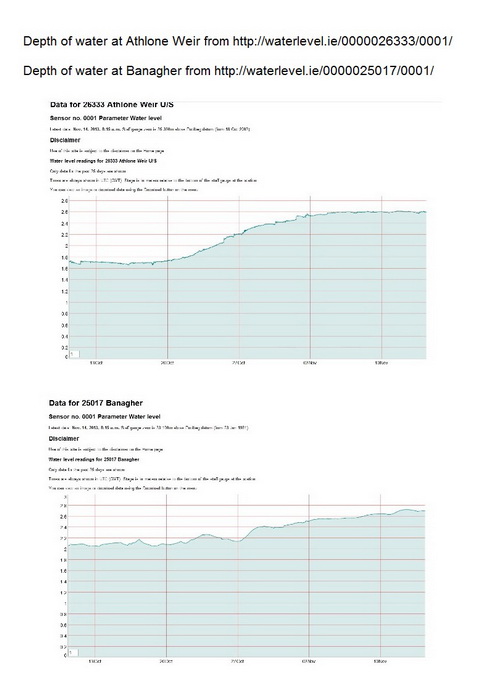
In the meantime, I have put together two charts nicked from waterlevel.ie for Banagher and Athlone:

Athlone and Banagher water levels

Athlone and Banagher water levels

Both of them show the levels for the last 35 days. I’m sure that more data and much more sophisticated analysis would be required to reach any reliable conclusion, but my untutored impression is that, in what has been a fairly dry autumn, keeping Lough Ree low didn’t do much to keep Banagher low. If that is so, and if I’m right in thinking that this autumn was dry (see below), the outcome would not show whether lowering Lough Ree would help in a very wet season; it may be necessary to repeat the experiment next year while performing rain dances. I would be glad, though, to have comments from more erudite folk and, if I get any information from TPTB, I’ll publish it here. In the meantime, this CFRAM PDF provides background reading.

On the dryness: Met Éireann’s monthly report for September 2013 is headed “Dry everywhere; warm and dull in most places” while that for October says “Rainfall was above average except in parts of the West, Northwest and North”. Its report doesn’t, AFAIK, specify any stations in the Shannon catchment (apart from Shannon Airport), but those to the west were generally below average while whose to the east were above; it may be that the Shannon rainfall was moderate.

Ticking all the boxes

Sometimes an idea comes along that is just so good, so right, so advantageous on all counts that it is simply irresistible. This idea comes from the Americas, from the US Coast Guard. Adapted to the Irish inland waterways, and specifically to the Shannon, it could:

  • help to promote industry in recession-hit rural areas
  • create direct employment
  • help to stimulate indirect employment
  • promote Irish energy independence by reducing reliance on imported hydrocarbons
  • counter pollution of water-courses
  • reduce the number of heavy trucks using remote rural roads
  • use environmentally-friendly water transport, by barge along the Shannon
  • honour and promote the industrial heritage of Co Leitrim and the transport heritage of the Shannon
  • help to defray the costs of maintaining the Shannon Navigation
  • solve Dublin’s water supply problem, at least for non-potable water.

How could anybody resist?

The US Coast Guard has proposed that wastewater from fracking [PDF] should be transported by barge, rather than by truck or railway train, from the fracking sites to remote storage or treatment facilities. So, when fracking begins around Lough Allen, the wastewater could be carried down the Shannon by barge and, if necessary, pumped to Dublin.

It sounds like a winner to me.

No queue for the quay …

… at Querrin on the Shannon Estuary. The page discusses its building and the early years of its operation.

Wasting sewage

An inquest has recently been held in Limerick, on the bodies of three seamen; and the jury gave a verdict, founded on the evidence of seamen and medical men, that the deaths had been caused by drinking the water of the Shannon, which the drainage of gas works and the common sewage had rendered poisonous. We trust that this unfortunate event, will induce the authorities of Limerick to take measures for applying sewage to the legitimate puspose of manuring the ground, instead of allowing a valuable material to go to waste, and to poison the waters of their river.

The Artizan July 1846

Fatal incident Lough Derg August 2012

On the morning of 2nd August 2012, Mr Patrick Danaher purchased fuel for his powerboat at New Line, Killaloe. That evening, the boat was seen floating partially submerged and overturned with the bow out of the water near Youghal Bay, Lough Derg. The boat had struck submerged rocks at high speed and suffered major damage to the outdrive allowing the free ingress of water into the boat. The boat was recovered that evening and Mr Danaher’s body was recovered from the lake the following day.

The Marine Casualty Investigation Board’s report is available here [PDF].

Lusmites rejoice

P J Norris commented here on the need for a walkway across Meelick Weir. The excellent KildareStreet.com tells us that the drought will end, as a Dáil written answer on 22 October 2013 showed.

Michael Kitt [FF, Galway East] had asked the Minister for Arts, Heritage and the Gaeltacht

… when it is proposed to reopen the walkway which spans the weir on the River Shannon in Meelick, County Galway; if funding has been provided for this work; if his attention has been drawn to the fact that this is an important local and tourist amenity; and if he will make a statement on the matter.

Jimmy Deenihan [FG, Kerry North/West Limerick] said

I am informed by Waterways Ireland that it is currently preparing a submission for planning permission to construct a new walkway over the River Shannon at Meelick. Indeed, environmental studies are underway to support the planning application.

I must advise the Deputy that construction work may only commence when all necessary permits have been received. It is Waterways Ireland’s intention to undertake works at the weir during 2014, subject to the appropriate statutory approvals being granted and financial resources being available.

Financial resources, eh? Perhaps a coin- (or note-)operated toll-gate on the walkway would be best.

More on Major Rowland Raven-Hart

A recent comment by Horacio A Nigro of Montevideo, Uruguay, may have solved the mystery of the birthplace of Major Rowland Raven-Hart, whose Canoeing in Ireland covered several inland navigations in the 1930s. You can see Horacio’s comments, and the subsequent discussion, on my page here.

But, on his own site, Horacio has cast light on Rowland-Hart’s career in radio, working in South America between the Kaiser’s War and Hitler’s War, and he has also very kindly provided an English-language version here as a PDF.


Fun for anoraks

Lots of info on the WI website:

I liked the bit on this page:

Enforcement

Boats in non-compliance with the bye-laws will enter an enforcement process. Enforcement is undertaken by Authorised Officers and will begin with a notification in the form of a sticker and if non-compliance continues may result in the ​craft being removed from the navigation at the owners cost.

I wonder about investing in a crane company.


Like the Mary Ellen Carter …

rise againJust a few weeks ago the depth was around 1.7m at Athlone weir, about 7″ above the navigational minimum. But today the depth is over 2.4m and, with staff gauge zero at 35.360m above Poolbeg datum, the water level is 37.760 m above Poolbeg datum.