Tag Archives: steamer

Waterside Belturbet

Here is a small amount of information about Belturbet and some of its industrial heritage. The photos were taken on a brief visit in July 2011.

Shannon history

Folk interested in the history of the Shannon Navigation, and in particular in the work of the Shannon Commissioners in the 1840s, may like to get hold of an article “Steam, the Shannon and the Great British breakfast”, published in the Journal of the Railway & Canal Historical Society Vol 38 Part 4 No 222 March 2015.

The Deel navigation

The Deel linked the Co Limerick town of Askeaton to the south side of the Shannon Estuary. Here is a page about the navigation and some of its quays. Note that it is a long page with many maps and photos, although they’re all reduced in size to minimise the strain on tinterweb.

Killaloe Regatta

If you enjoyed the account of the 1851 cot race at Plassey, you might also like to read about the 1850 regatta at Killaloe.

The madness of Daniel O’Connell

In 1828 Daniel O’Connell was elected to the House of Commons for County Clare. As a Roman Catholic, he could not take the Oath of Supremacy [Frizzell, the illustrator, seems to have got his date wrong] and so could not take his seat, but the Emancipation Act 1829 removed that obstacle. However, it was not retrospective, so O’Connell had to stand again in County Clare; he was elected unopposed in July 1829.

On Sunday 31 January 1830 “The Patriotic member for Clare, Daniel O’Connell Esq, sailed from Howth […] at 8 o’clock, for England, to attend his Parliamentary duties” [Tipperary Free Press 3 February 1830] and when Parliament resumed on Thursday 4 February 1830

Daniel O’Connell Esq took the oaths prescribed by the Catholic Relief Bill, and his seat as a member for the county of Clare. The honourable member seated himself on the third row of the opposition side of the house, and exactly opposite to Mr Peel.

[London] Standard 5 February 1830

O’Connell’s letter

Before he left Ireland, O’Connell issued a letter to “the people of the County of Clare”; according to the Morning Post of 20 January 1830 it was issued from the Parliamentary Intelligence Office, 26 Stephen-street, on 15 January 1830. It began

MY FRIENDS AND BRETHREN — I take up the pledges which I made to you when I called on you to repose in me the high and awful trust of being your Representative. I will endeavour honestly to redeem those pledges.

For this purpose I propose to leave Dublin on the 26th of this month. I go off at the commencement of Term, and I shall be absent for two, if not three, entire Terms. Men will sneer at me for talking of these sacrifices to public duty, who, themselves, seek their own individual advantage in all their political exertions. I readily consent, and will proceed to do my duty to you with alacrity, zeal, and perseverance.

There was more along those lines, and then he said

My Parliamentary duties will naturally divide themselves into two distinct branches: the first relates to your local concerns; the second, to those mighty interests in which your prosperity is involved with that of all Ireland.

There were four local concerns: two about canals and two about ports.

An asylum harbour

West Clare [OSI ~1900]

West Clare [OSI ~1900]

The first port proposal was to build an “asylum harbour” on the west coast. An asylum harbour was a port that provided refuge in storms: Kingstown [Dun Laoghaire] was an asylum harbour (amongst other things). O’Connell thought an asylum harbour on the west coast would provide a safe haven for vessels coming across the Atlantic, feeling the force of the Gulf Stream and the prevailing westerly winds: they risked being “embayed on the iron-bound coast between Loop Head and Hag’s Head” where the Cliffs of Moher are. It is not clear how vessels could safely enter such a harbour, given that it would require them to come close to the lee shore, but O’Connell said

The existence of an asylum harbour on Malbay would be of the greatest value to the trade of the British Isles. I do hope to be able to realise this project, in the execution of which the talents of my most valued friend THOMAS STEELE would be found to be most highly beneficial to that county which he adorns by his abilities and patriotism.

O’Connell no doubt had in mind Thomas Steele’s talents as a urinator.

Carrigaholt and Kilrush

O’Connell also wanted

[…] the construction of two suitable piers, with other works, completely to protect shipping; the one on the Bay of Carrigaholt, the other on Scattery or Kilrush Harbour.

The commerce of Kerry, Clare, and Limerick, are interested in these works. We shall certainly obtain the powerful assistance of the patriotic Member for Limerick. His assiduity, information, and public spirit, render him a model which Irish representatives should imitate.

He wasn’t quite as complimentary about Thomas Spring Rice a few years later, when O’Connell’s five-hour speech in favour of the repeal of the Acts of Union was topped by Spring Rice’s six-hour contribution.

Here is a page about Kilrush. I haven’t done a page about Carrigaholt so there follows some information to fill the gap until I get around to doing it properly.

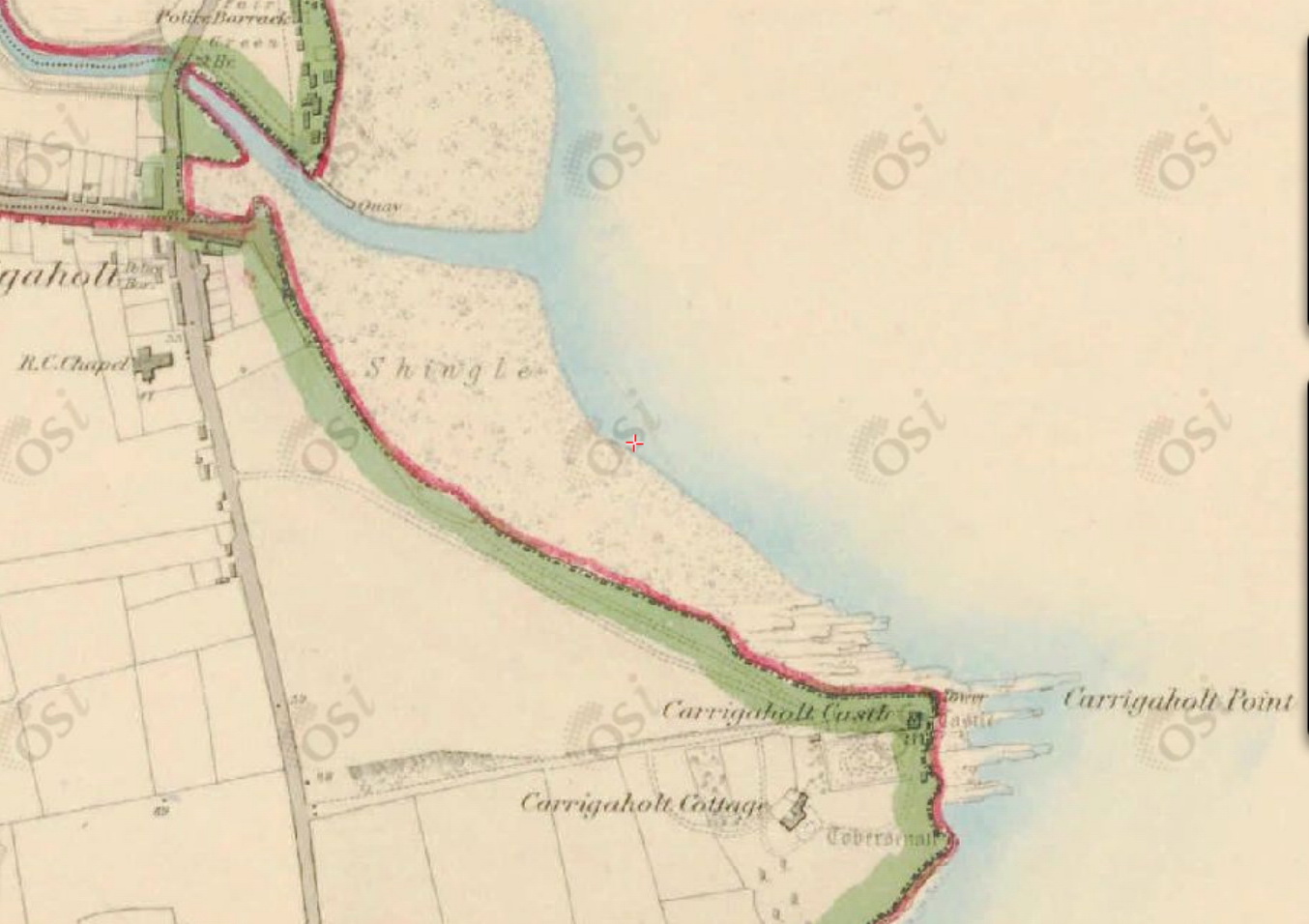
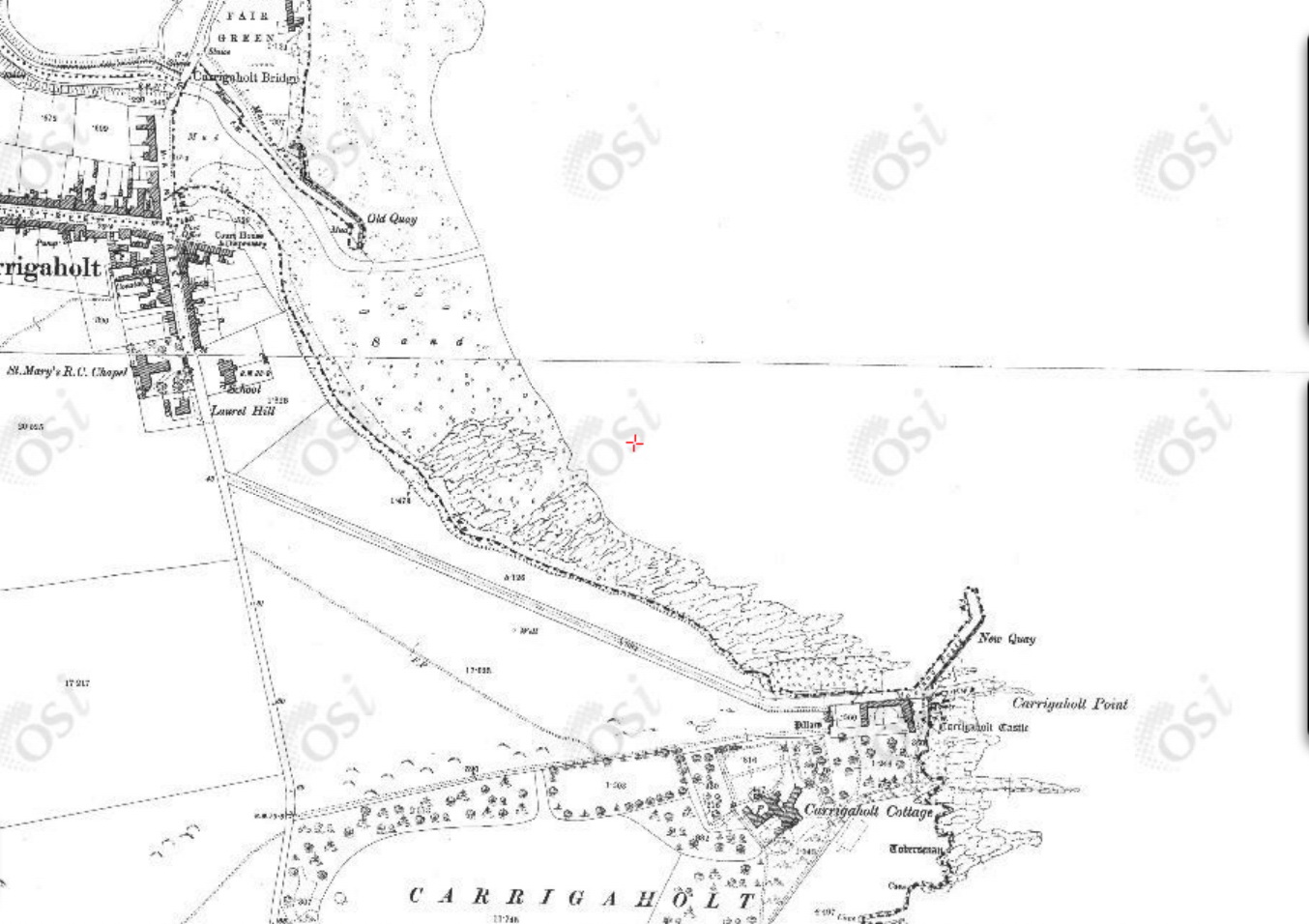
The earlier pier at Carrigaholt was built by Alexander Nimmo and was more successful than his harbour down the road at Kilbaha. Despite the description on the DIA site, I assume that it is the one shown on the 6″ OSI map.
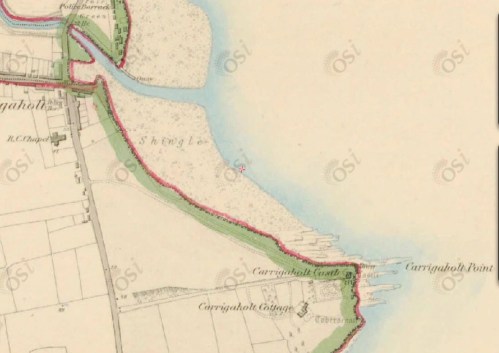
Carrigaholt map 1

The old quay at Carrigaholt (OSI ~1840)

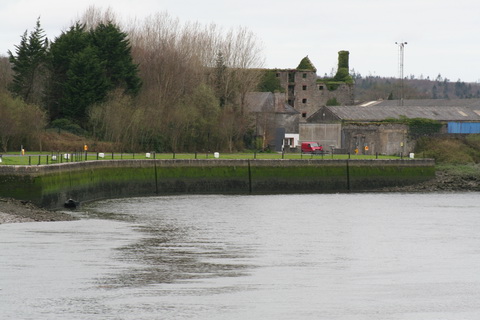
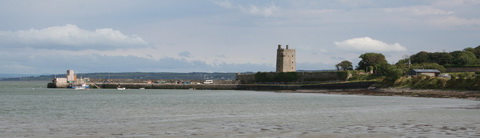
Here’s a photo.
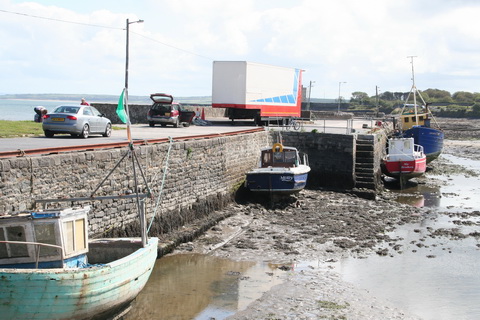
Carrigaholt August 2011 7_resize

The old quay at Carrigaholt as extended

Commander James Wolfe’s Sailing Directions [PDF], compiled some time before 1848, say

Round Kilcradan, to the northward, and protected by it, is the anchorage or Road of Carrigaholt. It is a very fine secure anchorage with all winds from the westward, but from the ENE to S much sea prevails, though not heavy enough to endanger a vessel well found in ground tackling. With SW gales, a long rolling swell sets in round Kilcradan Point, which renders riding here at those times very uneasy. These roads have the advantage of being free from any great strength of tide.

The ground is level all over the road, but from six fathoms it shoals gradually towards the shores; the bottom, of sand over clay and mud, is generally considered good holding ground. The best anchorage for a large ship is with the top of Ray Hill in one with the Coast-guard Watchhouse W ¾ N, and Moyarta Lodge, just open of the point on which Carrigaholt Castle stands, nearly N ½ W in 5½ to 6 fathoms low-water springs.

The shore forms two smaller bays, the northern of which takes its name from the village which stands on its shores, and the southern is called Kilcradan. Both are very flat and shallow; in the latter there is a coast-guard station, but it is not a boarding station. The village is a poor miserable place, and does not afford supplies of any sort, nor can a ship complete water here. At the village is a small pier, accessible only (to loaded boats) at high water. It is used by the turf-boats, though most of these load on the beach.

Carrigaholt Castle, a high square tower on the point, and the chapel, a cruciform building, with its belfry, are very conspicuous objects.

As those directions were written some years ago, I suggest that you should not use them for navigating nowadays. You can tell that they are out of date because the village does now afford most excellent supplies, chiefly in the Long Dock. The Long Dock does not, alas, seem to have updated its website since 2006, having gone over to the Dark Side of FaceTweet which, at least to me, is impossible to search, so I can’t point you to a list of the interesting beers the Long Dock stocks in addition to its excellent food.

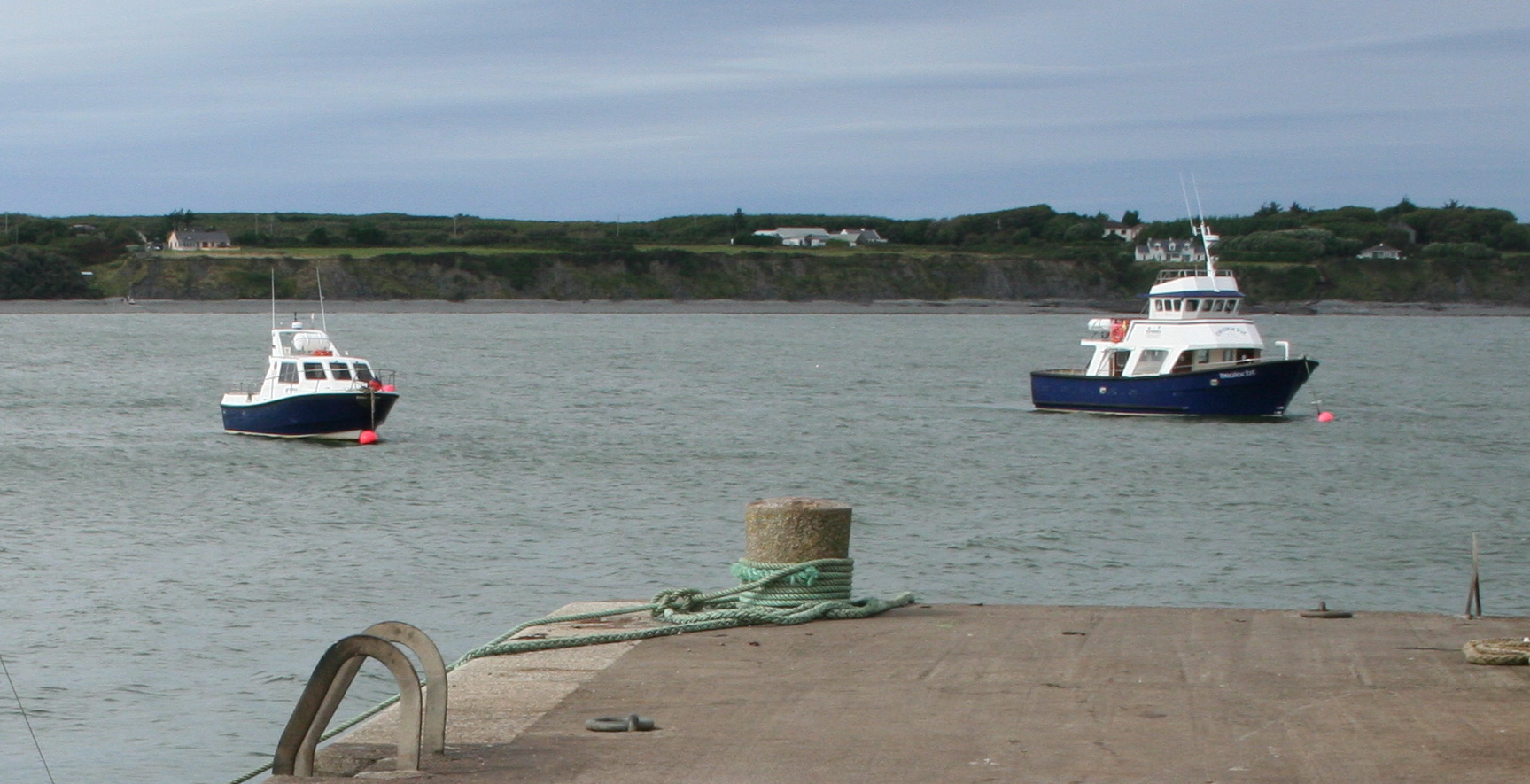
My spies tell me that, if you happen to be driving a barge from, say, Donegal to Limerick — not that I’m encouraging you to do anything of the sort — Mr Luke Aston of the Carrigaholt Sea Angling Centre will be able to advise on moorings. He’s got a Lochin, so he must be sound. You can have a day’s sea angling with him or a day watching dolphins with Geoff Magee (to whom I owe a glass of sherry), followed by a meal at the Long Dock: what more could you want?
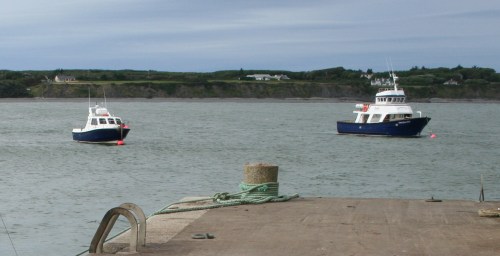
Carrigaholt new harbour 24

Luke Aston’s Lochin [I assume] and Geoff Magee’s Draíocht

Well, if you were Daniel O’Connell, you’d want a new pier or quay.
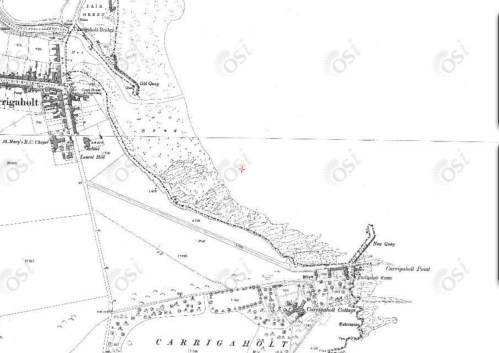
Carrigaholt map 2

Carrigaholt old and new quays [OSI ~1900]

The old quay was extended at some stage and a new quay was built at the castle. I don’t know have dates for either of those, but I think the new quay was built as a fisheries pier in the 1890s. If, Gentle Reader, you know the dates, and can save me from having to plough through years of Board of Works reports, do please leave a Comment below.

If O’Connell had any role in having the old pier extended, that would have been the only one of his four local concerns on which he had any success, although he could also claim a minor supporting role in having the pier at Cappa, Kilrush, extended in the 1840s.

Carrigaholt new harbour 30_resize

Carrigaholt new quay seen from the old quay

The canal to Ennis

Daniel O’Connell’s third local concern was

The opening of the navigation of the Fergus to Ennis, so as to make that town a sea-port. The tide rises about half a mile beyond that town; and if there were a short canal cut near the village of Clare, of about 300 yards, vessels of burden could deliver their cargoes at Ennis, and carry away the produce of the country to the most remote markets.

This was a proposal that came up several times, but it was never implemented. The Shannon Commissioners built a fine quay at Clare [now Clarecastle] in the 1840s, but they left it as the head of the navigation.

Wolfe’s Sailing Directions made it clear that the passage of the Fergus estuary was not to be undertaken lightly:

A mile to the eastward of the Beeves is the principal and only navigable entrance to the River Fergus, which comes from the NNE amid vast banks of mud, and numerous islets and rocks. Having passed the Beeves, steer up for Feenish Island till you bring the tall square tower of an old castle (called Court Brown) in one with the north point of Low Island, WNW¼W, which is studded with white houses.

You must then keep rather more to the northward for the round hill of Coney Island, until Cannon Castle is in one with the peak of Grady Island, W¼S, when you must bear away for the east point of Coney Island; you will then shortly come into five and six fathoms, where you must anchor with the sharp peak of Coney Island bearing N by E and Cannon Castle WSW1/3W in about six fathoms soft muddy bottom.

Grady's and Cannon Islands from off Innish Corker [Admiralty Surveyors 1841 by kind permission of the UK National Archives]

Grady’s and Cannon Islands from off Innish Corker [Admiralty Surveyors 1841 by kind permission of the UK National Archives]

Beyond this it would be impossible to proceed without a pilot. The river beyond Coney Island winds through vast banks of mud, extending from 1 to 1½ miles from the shore, decreasing gradually in width from 600 yards, and varying in depth from nine to three feet up to the town of Clare, nearly seven miles in a direct line, and nine following the channel.

At Clare the bed of the river is dry at low water, but there is a quay, alongside of which vessels load. Clare is a miserable place, though the shipping port of Ennis. It is a military station.

Pilots may be had at Low Island, but no vessel above 150 tons should go up to Clare.

Clare_resize

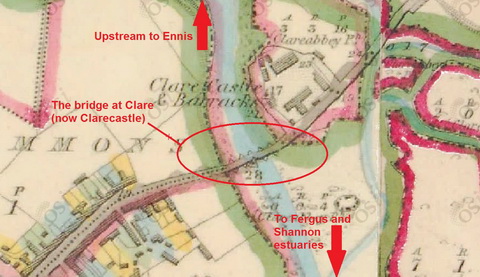
The bridge at Clare[castle] [OSI ~1840]

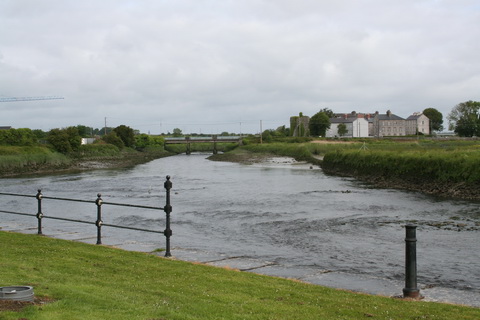
As well as a lock, some opening mechanism would have been required for vessels to get though the bridge, which was not the current flat structure; here is a photo of the old bridge.
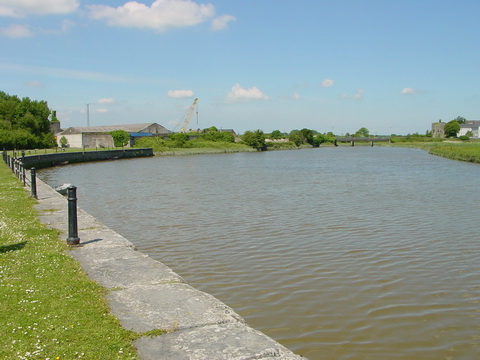
Clarecastle Fergus Navigation June 2007 07_resize

Looking from the Shannon Commissioners 1840s quay at Clare towards the bridge
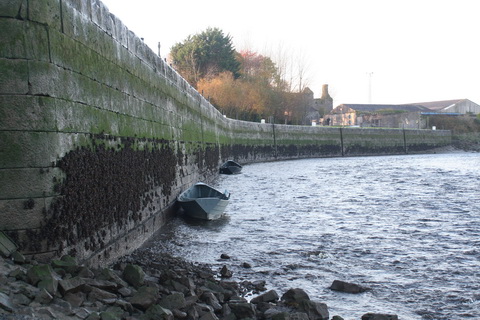
Clarecastle November 2014 16_resize

Clarecastle gandalows at the quay

Clarecastle old quay from far side 03_resize

The quay from across the river

Very low water at Clarecastle 5_resize

Low water at Clarecastle

The interesting thing is that, even though a boat could not pass through Clarecastle to the estuary, there must have been some navigation on the Fergus; I would like to know more about what and how much was carried when. There was a quay, Parson’s Quay, in Ennis …
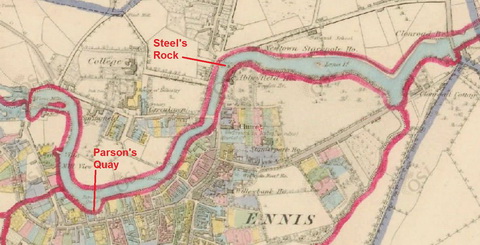
Ennis_resize

Parson’s Quay in Ennis [OSI ~1840]

… and another quay further downstream. I put the next map in black and white to make it easier to see things; it’s scaled down from the Ennis map.
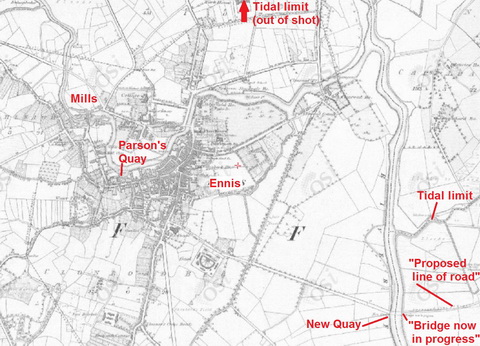
Quays_resize

Ennis and district [OSI ~1840]

The map also shows that O’Connell was right about the tide: it did flow well above Ennis.

The other canal

Although the first three proposals were not implemented, and probably would have been either uneconomic or unsuccessful, they weren’t absolutely bonkers. His fourth idea, though, was nuts.

The fourth local concern relates to a communication by a canal from the bay of Galway to Limerick. The point of junction should be somewhere in the neighbourhood of Killaloe. The entire of the western and midland counties of Ireland would derive great advantage from such a canal.

Getting through the hills above Killaloe would have been fun. But the real problem with the proposal is that O’Connell fundamentally misunderstood the nature of the Irish economy. Each Irish port served its own hinterland, shipping out its produce and shipping in coal, timber and other overseas goods. But the ports did not need to trade with each other, as each performed the same function.

The exception to that was created by the application of steam on the inland Shannon, which allowed perishable produce from the Limerick area to be carried across Ireland for export through Dublin to Britain. That role was soon taken over by the railways.

But there was no point in connecting two westward-facing ports by canal: if they needed to trade with each other, they could do so by sea.

My OSI logo and permit number for website

Greyways and the Black Bridge

Martin McGuinness [SF] was asked recently, in the Northern Ireland Assembly, about blueways:

Leslie Cree [UUP]: It was interesting to read that Waterways Ireland has developed this first blueway in the Carrick-on-Shannon area. Can he share with us if, in fact, Waterways Ireland has developed any projects for the Erne waterway itself?

Mr McGuinness said:

These projects are under ongoing consideration by Waterways Ireland, as the development of blueways and greenways could add to our tourist potential. It is clear from how greenways have been used, particularly in the west of Ireland, that they have huge health benefits for those now walking and cycling and involved in physical activity.

There is a proposal for another greenway from Derry city to County Donegal. Blueways and greenways offer important tourist potential, and it is exciting to see that Waterways Ireland is considering the linkage in the Leitrim area and how it can be extended to Lough Erne.

But, if I might remind TPTB, not everybody likes walking, cycling and physical activity; not everybody is going to be rolling around in a kayak or paddling a canoe. There are older folk, there are those who rightly view exercise with the gravest of suspicion and there are those whose interests simply lie elsewhere.

The Greyway concept

It is for such folk that I have developed the Greyway [TM]  concept. It’s the same as a blueway or a greenway but without the sweating or the lurid dayglo clothing.

The basic idea is that you form a “route” or “way” as a marketing concept to get more people using your existing assets. Your expenditure is low: research, product development, marketing and information provision rather than infrastructure; self-guided rather than staffed user experiences. Direct income might be low too, although there may be ways to extract cash from users; there might also be spin-off opportunities for other providers. [All my usual reservations about small-scale providers apply here too.]

There might be Greyways catering for

  • walkers: gentle walks with opportunities for sitting down, drinking tea and getting a taxi back to the start
  • drivers: long-distance routes taking in several sites
  • boaters: most of Waterways Ireland’s sites are accessible by water and by road. Furthermore, some trip boats might use elements of the Greyway material in providing information for their passengers.

Themes

You need a theme to attract people: “come and walk/drive the X Greyway and see all the lovely/interesting Ys”. No doubt there are several possible values for Y: bunnies, trees, fish, bogs, hills …. But the main thing that Waterways Ireland has to sell, and that it does not currently sell, is its industrial heritage. The Shannon, in particular, exists as an improved navigation only because of (a) steam, (b) the British industrial revolution, (c) Irish agriculture and (d) low politics. And industrial heritage is something that interests some at least of the older folk. Package it into routes and sell it for grey pounds, euros or dollars.

There is all sorts of interesting stuff along the Shannon, mostly just lying there, and it should be put to work. The most concentrated section is along the old Limerick Navigation, from Limerick to Killaloe: for instance, last time I looked seven of the original twelve milestones were still present. [The distance was 12 Irish miles, approx 24 km or 15 statute miles.] It’s a walkable route and it includes

  • the neglected Black Bridge at Plassey, whose very existence reflects the Victorian version of Just-in-time delivery
  • the bridge and artefacts at O’Briensbridge
  • the richest waterways heritage site in Ireland at Killaloe.

But there could also be driving tours along the middle Shannon, between Portumna and Athlone, where there is lots to see, and from Lanesborough upwards. Shannon Harbour might eventually house a museum ….

ERIH

What I’m suggesting is that Waterways Ireland should designate the Shannon as the first route (as opposed to site) in Ireland within the European Route of Industrial Heritage [ERIH] framework. ERIH’s website includes descriptions of the route system and of anchor points, which may be too advanced for present use, but why not a European Theme Route in Transport and Communication? Ireland might even make a case for the use of advanced (or at least interesting) transport technology (steamers) in carrying agricultural produce to industrial markets.

Furthermore, if CIE were to cooperate, the railways might be brought in too, and the livestock trade, and Dublin Port, and a regional route linking to Liverpool and the railway to Manchester ….

There is an interesting story to be told about the Shannon and its links to the east coast and beyond; its industrial heritage could be used to attract tourists and entertain natives.


Rail, road and river: steam in 1829

Four news items, all in the Varieties section of the Hampshire Chronicle on 19 October 1829.

Rail

The trial of the locomotive carriages near Liverpool was continued on Saturday, when Mr Stephenson’s engine, the Rocket, disencumbered of every weight, shot along the road at the almost incredible rate of 32 miles in the hour! So astonishing was the celerity with which the engine, without its apparatus, darted past the spectators, that it could be compared to nothing but the rapidity with which the swallow darts through the air.

Road 1

Mr Gurney’s steam carriage can be stopped dead within the space of two yards, though going at the rate of from 18 to 20 miles an hour, and this without any inconvenient shock to the machinery or passengers. It is capable of dragging a carriage, weighing three tons and containing 100 passengers, over a level road, at the rate of eight, nine, or ten miles an hour: will drag the same carriage, containing 25 passengers, up the steepest road in England, at the same rate. On ascending hills, for every cwt that is shifted from the front to the hind wheels, the carriage requires an additional drawing power of 4 cwt and on level ground an additional power of half a ton. The contrivance by which the carriage may be retarded at pleasure on descending hills, acts independently of the wheels, so that the sliding and cutting effect of the ordinary drags is entirely avoided.

Road 2

Sir James Anderson has entered into a contract with the Irish Post Office, by which he undertakes to convey the mails throughout Ireland at the rate of 12 miles an hour, in coaches impelled by steam, calculated to carry two or three passengers, in addition to the coachman and guard. This invention of Sir James Anderson, for which he has obtained a patent, has seldom been exhibited out of the yard in which it was constructed; but it is said to bear very little resemblance to the drag-coach of Mr Gurney. The contract is understood to be for 14 years, and the only pecuniary stipulation made by Sir James is, that he shall receive half the money which the Government shall save by adopting his system. He will shortly commence carrying the mails between Howth and Dublin. The road is level and good, and the distance not more than nine or ten miles.

[Note: an 1841 proposal by Sir James Anderson is covered here. And here is a longer piece about Sir James and the Steam Carriage and Waggon Company of Ireland.]

River

An iron steam boat of a peculiar construction, and having the paddles in the centre, has been built at Liverpool, by Messrs Fawcell and Co for the Irish Inland Steam Navigation Company. This vessel was tried in the Mersey on Monday, and the result was highly satisfactory. Another iron vessel, of 60 tons burden, was launched on Tuesday from Messrs Wm Laird and Son’s yard, on the banks of Wallasey Pool.

[Note: the Fawcett steamer and the 60-ton barge were destined for the Shannon. The barge was the first iron vessel built by Lairds.]

Nenagh Canal

Canal between Nenagh and the River Shannon

At a numerous and highly respectable Meeting of the Gentry, Merchants, Traders, and Freeholders of the Baronies of Upper Ormond, Lower Ormond, and Owney and Arra, held at Nenagh, County of Tipperary, on Wednesday, the 30th day of January, 1839.

PETER HOLMES, Esq, JP, and DL, in the Chair.

Moved by John Bayly, Esq; seconded by the Rev J H Poe, Rector of Nenagh:

Resolved — That we consider a Canal communication between Nenagh and the River Shannon, of vital importance to the prosperity of the town and neighbourhood, as increasing commerce, lessening the cost of fuel, facilitating intercourse with the sea ports of the country, and giving employment to the poor.

Moved by John Bouchier, Esq; seconded by the Reverend Ambrose O’Connor, PP of Nenagh:

Resolved — That we have heard with interest the Report of Mr Henry Buck, Engineer, on the proposed line of Canal; and recommend the adoption of the line he has surveyed.

Moved by John M’Keogh Dwyer, Esq; seconded by Thomas Maguire, Esq:

Resolved — That we recommend the adoption of the Prospectus that we have heard read.

Moved by Hastings Atkins, Esq; seconded by J J Poe, Esq:

Resolved — That we appoint Peter Holmes, Esq, a Commissioner, who is to name a second, the second a third, and so on, until the whole are appointed.

Moved by O’Brien Dillon, Esq; seconded by John Bayley, Esq:

Resolved — That the names of Lords Dunally, and Orkney be added to the list of Commissioners.

Moved by Doctor Quin; seconded by Doctor Dempster:

Resolved — That we recommend the proceedings of the Meeting to be published in the Nenagh Guardian, Limerick Chronicle, and other Papers, and that the Secretary be instructed to get printed 300 copies of the Prospectus.

Moved by John M’Keogh Dwyer, Esq; seconded by Thos Maguire, Esq:

Resolved — That we now enter into a Subscription list for Shares, according to the provisions of the Prospectus read at this Meeting.

PETER HOLMES, Chairman.
O’BRIEN DILLON, Secretary.

Mr Holmes having left the Chair, and Mr Bayley having been called thereto —

Resolved — That the thanks of the Meeting are due, and hereby given, to Peter Holmes, Esq, for his impartial conduct in the Chair, and for the spirited example he has set in being the first to subscribe for Fifty Shares.

JOHN BAYLEY, Chairman.
O’BRIEN DILLON, Secretary.

Dublin Monitor 7 February 1839

Recent developments in boat design

Mr Busk’s elastic paddle

A small Steam Boat (apparently about fifty feet long, and six or seven feet wide), belonging to Mr Wm Busk, of Pall-mall, was exhibited on Friday on the Thames. The boat was propelled easily and rapidly through the water, both with and against the tide, by a very small steam power, without the use of any paddle-wheel, by means of an elastic paddle, or fin, recently invented by Mr Busk, which was subject to a reciprocating motion wholly under water, and acting equally both ways.

When the action is not brought too near the surface, no motion seems to be occasioned in the water which could at all prejudice canal banks; and as the range of the fins, by their being placed in the narrow after-part of a boat, admits of being confined completely within the depth and breadth of the boat, no impediment need be presented to the passing of locks or bridges. The invention appears to be extremely simple and efficacious, and of very ready application to vessels of all classes and dimensions.

Bath Chronicle and Weekly Gazette 5 May 1825

Canal steam navigation

Experiments of rather a novel character have for some weeks been in progress on the Forth and Clyde Canal, to ascertain the merits of an invention for propelling boats on canals at greater velocities than have hitherto been attained either by steam or horses. The principle on which the experiments are founded may be thus described.

A light chain is laid in the canal, from one extremity to the other, and firmly fixed at each end. To effect motion by this means, a twin boat is used, in the trough of which a grooved wheel (receiving the chain) is made to revolve by a steam engine placed in the boat. From this description it will be evident that, as the wheel revolves, the boat is drawn forward at a speed equivalent to the power, or at precisely the same velocity as the periphery of the grooved wheel.

At first sight there appear to be several objections to the plan, not the least of which are turning the bends, and meeting and passing general craft on the canal. The experiments made on Friday the 29th ult, however, fully prove the facility with which the vessel can be steered from side to side of the canal; describing, at the same time, quicker curves than any to be met with on the Forth and Clyde navigation.

On the whole the experiments, though conducted under great disadvantages, were highly satisfactory, and such as to induce further trials. A speed of 8¼ miles per hour was attained, and there was little doubt in the minds of those who witnessed the trials, that, with a lighter engine, and a boat drawing less water, a higher velocity might be acquired at a cheaper rate than is now produced by horses.

It will be proper here to observe that it is not intended to carry passengers in the same boat that contains the engine and propelling apparatus.

Chester Chronicle 12 September 1834

India Rubber Boat

An American journal says that a Mr Caleb Williams, of New York, has just constructed a boat of this material, and that he has applied for a patent for his invention.

Huntingdon, Bedford & Peterborough Gazette 4 July 1835


Fuel consumption

The Dublin Monitor of 3 December 1839 quoted the celebrated Dublin-born adulterer and polymath Dionysius Lardner [who said that Victorians were prudish?] as saying

A train of coaches, about eighty tons, and transporting 230 passengers, with their luggage, has been taken from Liverpool to Birmingham, and from Birmingham to Liverpool, the trip each way taking about four hours, stoppages included. The distance between these places by the railway is ninety-five miles.

This double journey of 190 miles is effected by the mechanical force produced in the combustion of a quarter of a ton of coke, the value of which is 6s.

To carry the same number of passengers daily between the same places by stage coaches, on a common road, would require twenty coaches, and an establishment of 3,800 horses, with which the journey in each direction would be performed in about twelve hours, stoppages included.

Dr Lardner on the Steam Engine

The fuel consumption figure seemed odd to me, because I had recently read about the fuel consumed by a steamer on the Shannon in 1851. This was evidently one of the two screw steamers put to work by the Grand Canal Company in 1851, on which Sir John MacNeill conducted the experiments described here.

A luggage boat propelled by steam, on the screw principle, has been for the first time placed on the waters of the Shannon between Shannon Harbour and Limerick, taking in Portumna, Dromineer, Williamstown [probably Hollands], Killaloe, and the river and canal, to the terminus lock at Limerick.

As a specimen of aquatic architecture, the boat presents no very peculiar or striking features; it is built of iron, with a flush deck; it is capable of carrying about thirty tons, and the rate at which it goes on the canal, is about three and a half miles an hour, whether singly, or as a tug boat with two or three heavy lighters after it; whilst on the broader waters of the river, it is capable of going at a rate of seven and a half miles an hour!

This phenomenon may be explained by the fact that on the canal, which is comparatively narrow, there is no expansion of the waters displaced by the boat, whilst there is always a considerable swell raised about the prow, causes which conspire to retard her speed, and which do not operate when she is on the river.

The expense of working this boat is considerably less than that of the ordinary boat drawn by horses. A ton of coal supplies the engine between Limerick and Shannon Harbour; whereas the horsing alone of a boat between Limerick and Killaloe amounts to something about ten shillings.

The experiment, however, has not been sufficiently tested; and there is some doubt that it may succeed according to the expectations of its projectors. Just now several industrious persons with horses are employed on the canal: and it is to be hoped that in this season of dearth and destitution, no hasty means will be adopted to force them for subsistence on overgrown poor rates.

Limerick Reporter 27 May 1851

The Limerick Reporter article does not say, and I cannot determine, whether this was  Towing steamer No 2 [Appendix 3 in Ruth Delany The Grand Canal of Ireland David and Charles, Newton Abbot 1973], the twin-screw vessel which MacNeill, confusingly, called the No 1 Boat, or the single-screw Towing steamer No 1, which MacNeill called the No 2 Boat.

But I was surprised that the railway train could do 190 miles on a quarter ton of coke while the steamer required a ton for the (roughly) 54 miles from Shannon Harbour to Limerick.

On consulting the online Gutenberg version of the seventh edition of Dionysius Lardner The Steam Engine explained and illustrated; with an account of its invention and progressive improvement, and its application to navigation and railways; including also A Memoir of Watt Taylor and Walton, London 1840, I found that there were some differences between that and the Dublin Monitor‘s version:

A train of coaches weighing about eighty tons, and transporting two hundred and forty passengers with their luggage, has been taken from Liverpool to Birmingham, and back from Birmingham to Liverpool, the trip each way taking about four hours and a quarter, stoppages included. The distance between these places by the railway is ninety-five miles.

This double journey of one hundred and ninety miles is effected by the mechanical force produced in the combustion of four tons of coke, the value of which is about five pounds.

To carry the same number of passengers daily between the same places by stage-coaches on a common road, would require twenty coaches and an establishment of three thousand eight hundred horses, with which the journey in each direction would be performed in about twelve hours, stoppages included.

So 240 passengers, not 230; 4¼ rather than 4 hours — and most significantly 4 tons of coke, costing about £5, rather than ¼ ton costing 6s [£0.3].

Did the Dublin Monitor get it wrong — and, if so, why and how? Or were the lower figures in some earlier edition of Lardner’s work?