Tag Archives: waterways

Sorry, Longford

Waterways Ireland’s Feasibility Study into the Restoration of the Longford Branch of the Royal Canal is available for download [7 PDFs: main report + 6 appendices]. Skip straight to page 59:

6.5 Recommendation

Given the current financial climate and because of the associated costs, environmental issues and uincertainty regarding planning approval it is not recommended to pursue this project any further at this time.

The recent work undertaken in regard to the shared walkway/cycleway has protected the asset as a publicly owned recreational amenity and it is recommended that any outstanding property issues be resolved and finalised in order to complete the protection of the asset.

I hope that admirable recommendation survives the pre-election period.

By the way, there’s a snail ….

Down to the sea in steps

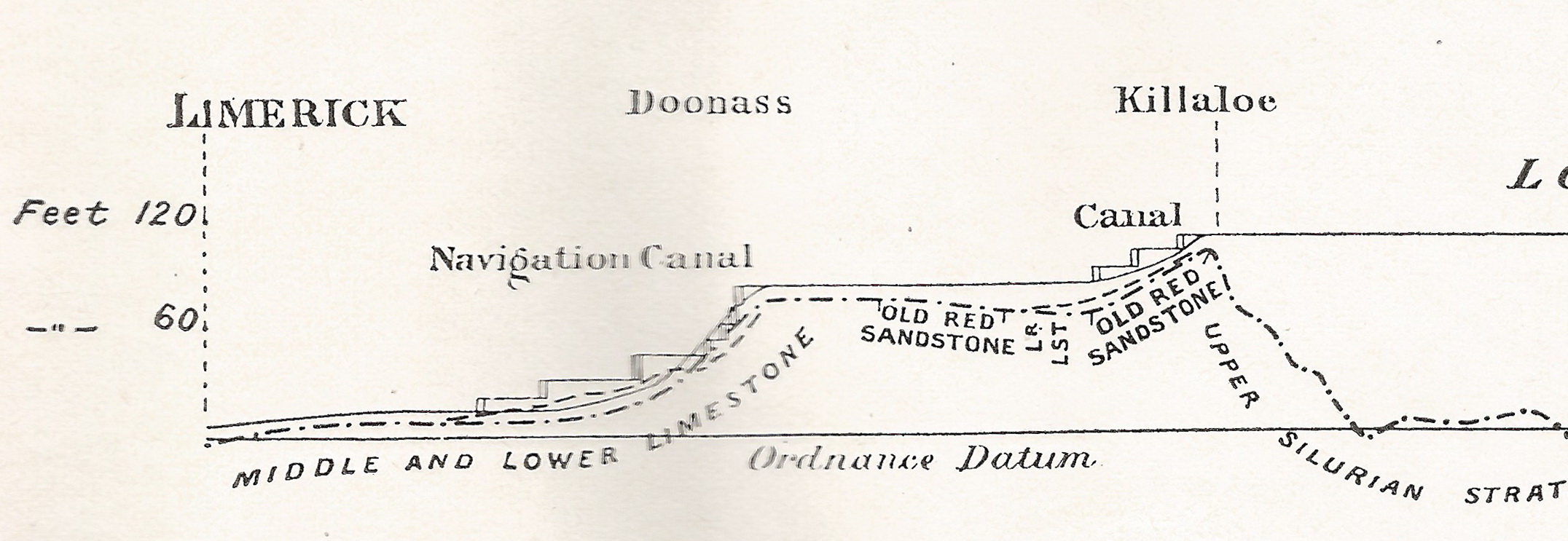
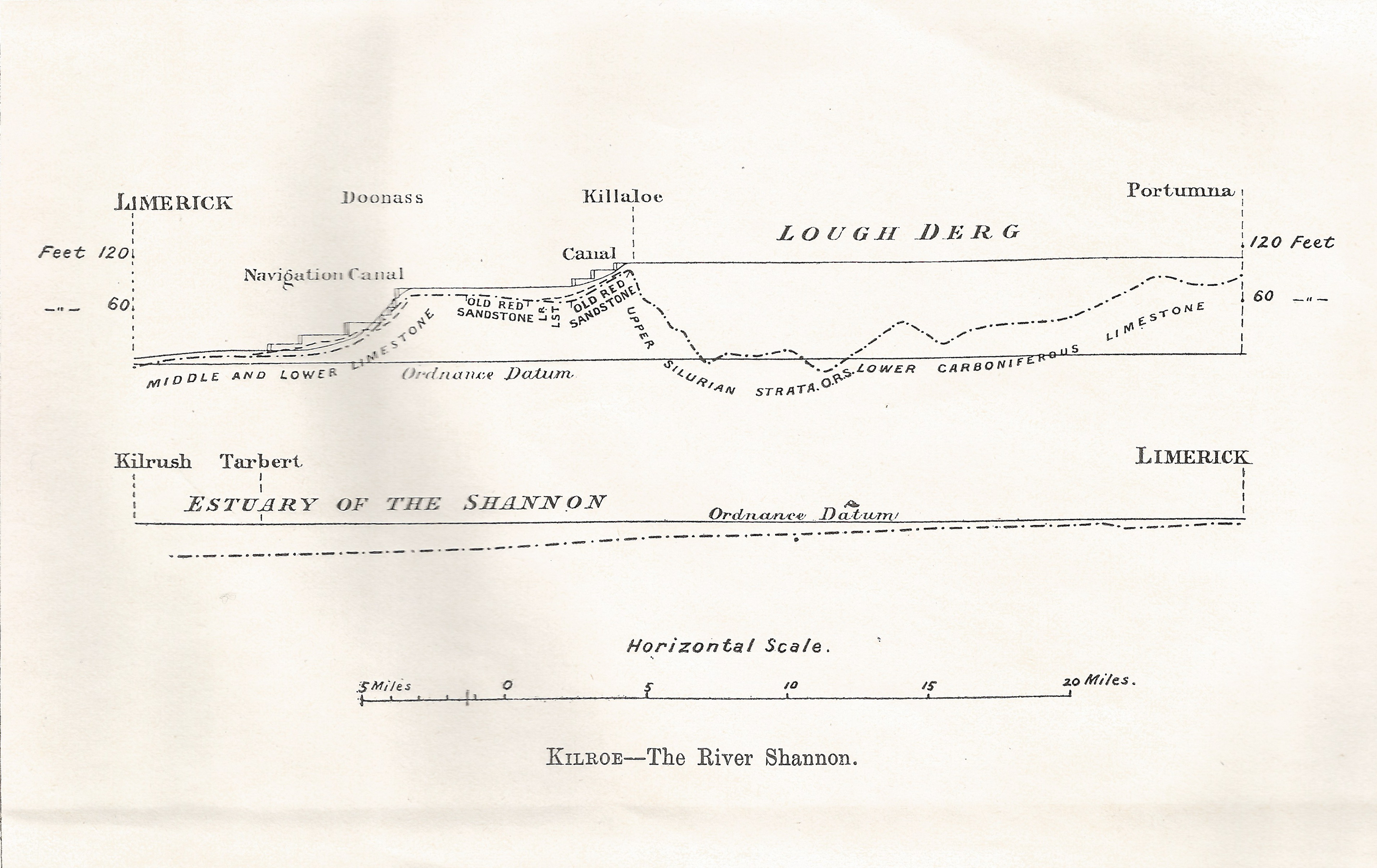
On 28 January 1907 James Robinson Kilroe [near the bottom of the page] of H M Geological Survey read to the Royal Irish Academy a paper on “The River Shannon: its present course and geological history” [Proceedings of the Royal Irish Academy Vol XXVI Section B No 8 Hodges, Figgis & Co Ltd, Dublin; Williams & Norgate, London 1907]. I thought that Plate V was interesting.

Shannon Derg to sea

Plate V

Kilroe wrote:

It will be perceived that instead of the river being shallow over the unyielding Silurian slate-rock, set almost vertically, and striking across the river-course, it is deeper than over the limestone of Lough Derg, and much deeper than over the comparatively easily eroded Old Red Sandstone at Killaloe. The river-bed actually drops below the datum line above the town, while at the town it is 100 feet above datum.

Old Red Sandstone strata are here to be seen in the river-bank, and Silurian rocks in situ in its bed. A barrier is thus formed, partly of Silurian, and partly of Old Red Sandstone rocks, which without the artificial impounding weir would retain the waters of Lough Derg to a depth of some 104 feet opposite Derrycastle — two miles above Killaloe.

One might have expected to find a fairly level shallow bed from Killaloe northward, a sudden drop from slate-rock to the sandstone floor, and  a pronounced wide, well-formed valley in the limestone district southward to Limerick.

None of these elements exist; instead, we have the formidable barrier at Killaloe, naturally damming up a considerable depth of water in Lough Derg, and the river falling away southward by a series of rapids which correspond with drops in the canal, south of O’Briensbridge […], along an alternative course, possibly one used by a branch of the Shannon.

Here is an extract from the Plate V map, showing the steps of the (pre-Ardnacrusha) Limerick Navigation between Lough Derg and the sea.

Shannon Killaloe to Limerick

The steps of the canal (click to enlarge)

Upstream

Kilroe wrote of Lough Ree:

The waters of Lough Ree stood some 10 feet higher within recent times than they now do, as proved by evidence of solution, with under-cutting of limestone blocks, to be seen about five miles north-west of Athlone, close to the railway, in the townland of Cornaseer.

Under these conditions the lake must have been, perhaps, twice its width, and for a considerable period. Its ancient surface-level is clearly indicated by the caps of the mushroom-shaped blocks.

And of the Shannon between Lough Ree and Lough Derg:

The extreme flatness of the river between Athlone and Meelick is such that, consequent upon the completion of the Suck Drainage-works in 1892, it was found that the callows along the Shannon above the confluence of the Suck at Shannonbridge were much more liable to sudden and frequent floodings than they previously had been.

The more rapid discharge of the Suck waters into the Shannon, before ordinary extra water had time to pass away, had the effect of modifying the regimen of the main stream to an extent which resulted in an action at law [La Touche -v- The Suck Drainage Board].

I have found only one account of that case, in the Freeman’s Journal of 1 July 1893. The plaintiffs, Messrs Harrison and La Touche, owned land at Cappaleitrim, on the west bank of the Shannon above Shannonbridge. They said that the actions of the Suck Drainage Board had caused their lands to be flooded:

[…] that the defendants brought water from the Suck into the Shannon, containing a drainage of 40 miles, with such velocity and such volume that the Shannon was penned back, and that the back water caused the damage to the lands complained of.

[…] The jury disagreed and were discharged.

I don’t know whether the matter ever again came before a judge.

Green diesel

Big it up for Messrs Breakingnews.ie for the information that the European Commission is taking Ireland to court over the ludicrous regulations for the use of green diesel in private pleasure craft. The topic has been covered here more than once, most recently here; I discussed the ludicrous regulations here.

Breakingnews.ie says that Ireland ignored the EU’s “letters” (presumably the Reasoned Opinion) on the subject. That is consoling, because my own requests for information about Ireland’s response to the Reasoned Opinion have likewise been ignored.

The EU’s press release is here; the EU notes that

While Irish law requires craft owners to pay to the Revenue the difference between the tax paid on marked gas oil and that due if the gas oil had been charged at the standard rate, the low number of tax returns indicate that the minimum level of taxation is not applied.

Indeed.

Royal Canal drawbridge

According to the Freeman’s Journal of 5 April 1837, Henry Garnett was

superintendent or agent to the èxtensive and highly respectable firm of Purcell and Jameson, coach proprietors.

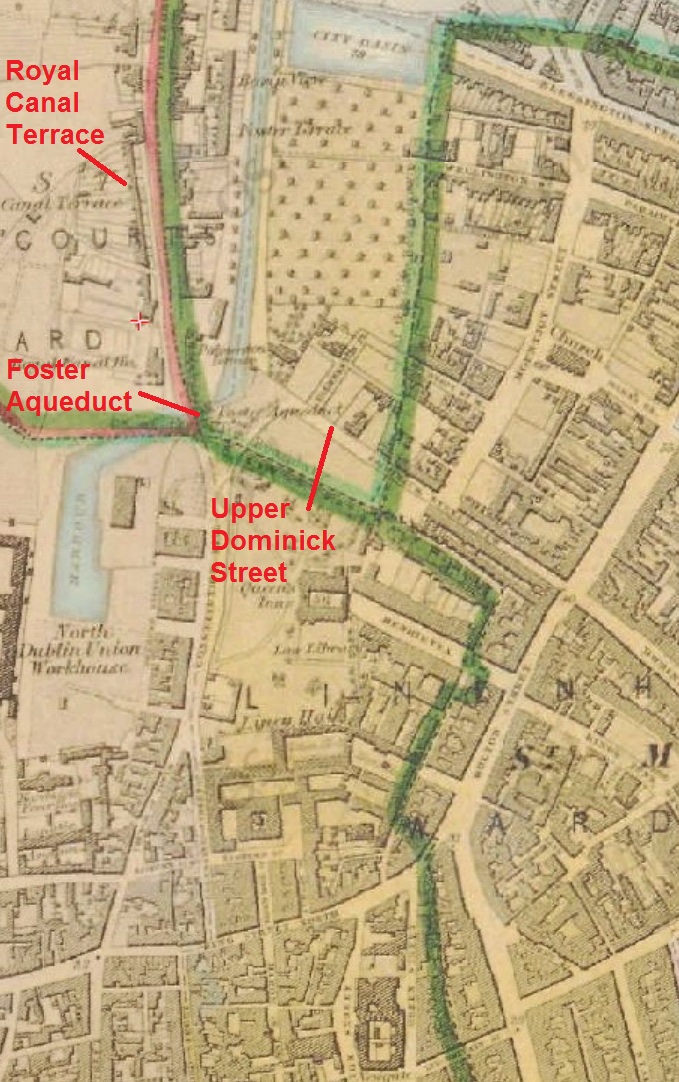
Their offices were in Sackville Street. On Sunday 2 April 1837 Mr Garnett had been on his way home to [Royal] Canal Terrace when

as he ascended the hill at the bend of Upper Dominick-street he met a man habited in a dark cloak, and having a cap on his head, who, after looking him steadfastly in the face, opened the cloak, and fired at him.

The man was not more than a yard away, so close that the powder scorched Garnett’s hand, but the bullet struck a suspender button, wounding but not killing the victim.

The scene of the crime

The scene of the crime [OSI ~1840]

William Cagburn heard the shot and also heard Garnett calling out

I am shot — stop the murderer, he has run in the direction of the aqueduct.

Cagburn gave chase:

He instantly pursued, crossed the draw-bridge, and came under the aqueduct, when he saw the prisoner running along the Phibsborough road.

Cagburn and the watchman seized the man; the watchman took two pistols from him and another witness found a third, discharged, pistol nearby on the pathway.

The prisoner, Christopher Clanchy, had been a road maker for eight years. The Freeman’s Journal said:

While a contractor for repairing part of the Ashbourne road, in the employment of Messrs Bourne, he [Clanchy] was allowed to travel free by Mr Purcell’s coaches, and Mr Garnett in the discharge of his duty having occasion to withdraw this privilege, hence proceeding his desire to be revenged. […] We are happy to state Mr Garnett is not likely to suffer any inconvenience from the injury.

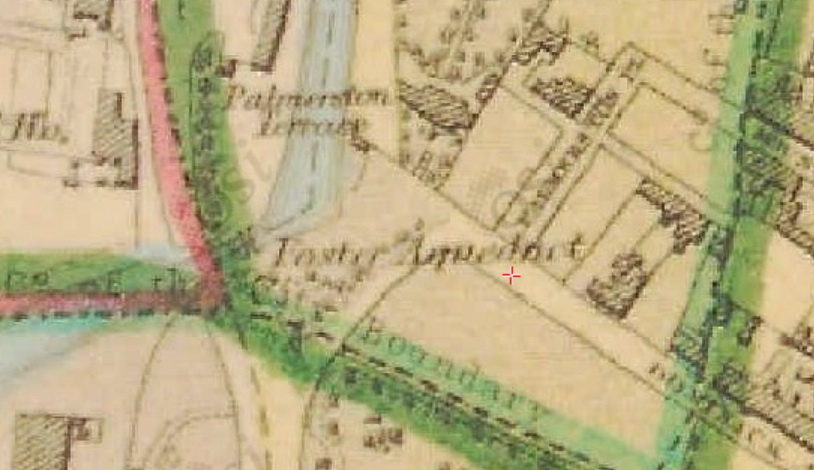
But of more interest for this site is the route taken by William Cagburn. What or where was the drawbridge he crossed?

Foster Aqueduct

Upper Dominick Street and the Foster Aqueduct [OSI ~1840]

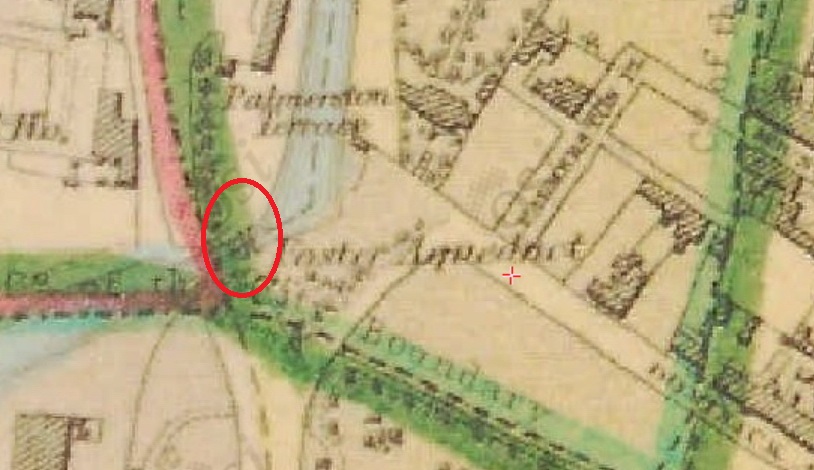
I haven’t come across [or at least I haven’t noticed] any previous mention of a drawbridge in this area. I presume that it was across the canal. And, looking closely at the map extract above …

Possible site of drawbridge

Possible drawbridge [OSI ~1840]

… I see what might be a bridge just to the left of the F of Foster. It shows up more clearly on the black and white OSI map. At Clanchy’s trial before the Commission of Oyer and Terminer, reported in the Freeman’s Journal of Monday 26 June 1837, the bridge was said to be a wooden bridge; George Cayburn [probably the William Cagburn named in the earlier report] described it as “the swinging bridge”.

Perhaps Mallet’s Insistent Pontoon merely replaced an old nuisance with a new.

Clanchy, incidentally, was found guilty: there were suggestions that he was insane, but the jury rejected them. Baron Richards said [Freeman’s Journal 1 July 1837]

The court had no discretion but to pass the extreme sentence of the law, that he should be hanged by the neck […].

Purcell, Garnett’s employer, had requested a commutation of his sentence; Richards said that it was open to Clanchy to memorial for a commutation, and the court would put no obstacle in his way; indeed it hoped he would meet the mercy “which he would have denied his intended victim”. I do not know what happened to Clanchy.

Update December 2016

The Warder and Dublin Weekly Mail of 26 September 1835 mentions the bridge:

Monday night a respectable looking elderly man fell into the Royal Canal Basin, at the Broadstone, on the Dominick-street side, within a few yards of the draw bridge.

A canal employee called Keybourne hauled Mr White out within a few minutes, but he was DOA at the Richmond Hospital.

This seems to confirm that the bridge was moveable and was where the OSI map suggests.

From the BNA

My OSI logo and permit number for website

The Black Bridge at Plassey

I am repeating here a point I made in response to a comment on this page. I do so because the point is, I think, an important one: some readers don’t check the comments and might miss this.

I have an imperfect copy [with some lines missing] of an indenture made on 8 July 1949 between the Minister for Finance and Limerick County Council under which the Council leased from the Minister

… all that those parts of the lands of Garraun and Sreelane on which Plassey Bridge abuts on both banks of the River Shannon and the site and piles of said Plassey Bridge together with said Plassey Bridge […].

I am not a lawyer, so my interpretation may be misleading, but I think that there are two points of interest.

The first is that, under the indenture, the Council is obliged to “well and sufficiently repair cleanse maintain amend and keep the hereby demised premises”, which includes the bridge. The Council is also required to “use the said demised premises as a public highway”.

The second is that, if the Council fails to do so, the Minister, and his agents the Commissioners of Public Works in Ireland, are entitled (after giving due notice) “to enter upon the hereby demised premises and to execute and to do the necessary repairs and works and the Lessees [ie Limerick Councy Council] shall repay the expenses of such repairs to the Lessor on demand […]“.

As far as I can see, Limerick County Council is in breach of its agreement with the Minister for Finance, and that Minister is entitled to repair the bridge and charge the Council for the cost.

If only there were a Minister for Finance who had an interest in Limerick (or in bridges) ….

Remarkable case of abduction

At the Nenagh Petty Sessions, on Thursday last, information was sworn by Catherine M’Namara against John Creighton, Martin Creighton, and others, for abduction and assault; a warrant was consequently issued by the Bench of Magistrates.

Margaret M’Namara, a very pretty country girl, is the only unmarried daughter of a comfortable farmer of that name, residing in the parish of Island, in Galway.* John Creighton, a hamlet rake and village debauchee, living in the same neighbourhood, took it into his head, by one bold stroke, to secure himself in a pretty wife and handsome fortune, which would enable him to give larger and longer scope to his abandoned career.

Confederating with a few of his associates (among whom was his brother Martin) at a public-house, he there revealed to them his adventurous project, and it was unanimously agreed that their leader should have a wife and fortune. Accordingly, at dead of night, they sallied forth, and soon arrived at the cottage-home of the devoted girl.

A solitary and startling knock at the door was the first intimation that the unconscious inmates had of their danger. “Who comes there?” — “A friend, open the door!” — “What is wanted at this unseasonable hour?” — “No matter — open the door.” Old M’Namara rose, and the maiden cowered behind her mother in the bed. A dead silence of some moments elapsed — a murmur of whispering voices was heard, and, in another instant, in tumbled the door with a crashing noise.

All then was uproar and confusion — resistance was useless. Old M’Namara was felled to the ground, others of the family were unmercifully beaten, the mother’s arm broken, and the maiden herself was dragged from her bed out into the bawn in almost a state of nudity!

Her clothes were then brought out, and she was compelled to huddle them on her. Fearful lest powerful assistance might be brought to the spot, and that they might be deprived of their prize, the heartless wretches dragged her along the verge of the Shannon, and alike regardless of the forlornness of her condition and the delicacy of her sex, they flung her into a boat and splashed to the opposite shore.

After landing she was literally dragged for the distance of five miles across a lonely and cheerless tract of country; and as the dawn was breaking, she was secreted, in a state of exhaustion, in a friend’s house of Creighton’s, on the lands of Carighatogher, near Nenagh. During the journey, Creighton’s brothers frequently said to him — “Glory to you, John, you can now drink and smoke enough.”

The next morning M’Namara’s friends were indefatigable, though unsuccessful, in their efforts to find Creighton and his party. Mr Reed, a neighbouring magistrate, granted a search warrant; and himself in person, with an escort of police, scoured the country, but their exertions were equally uncrowned with success.

Mr Reed having received intelligence that the offenders were in the neighbourhood of Castle Lough, sent a note by express to Mr Anthony Parker, a gentleman of high respectability, a magistrate, and a deputy lieutenant of the county of Tipperary. Mr Parker, with his usual promptitude, instituted a general search throughout Castle Lough and the surrounding country.

During this lapse of time, Catherine M’Namara was removed to a cabin belonging to an individual named Reedy, the local position of which was the centre of a dreary bog. While there, deploring her unfortunate condition,she was alarmed by the cry of “Police! police!” “fly, fly!” She lifted her head, and saw Creighton running out of the back door, while a middle-sized, sandy-complexioned man and five country-fellows, who were well armed, darkened the front entrance at almost the same moment. An involuntary shuddering seized her when she saw the men staring inquisitively in her face.

Reedy, the lord of the “mud edifice,” demanded “by what authority they dared to enter his mansion?” The man who seemed to be the leader, heedless of Reedy’s questions, approached the shivering girl, and asked her in a northern accent, “if she were detained against her inclination, or if she needed protection?” Her humid eyes met his, and in mute eloquence implored protection. “Child, do you need protection?”the game voice again repeated in a hurried cadence.She grasped his arm, and almost breathlessly exclaimed, “I want nothing else!”

The house was instantly cleared of a crowd that had collected; her clothes were gathered; the little party filed around her, and proceeded silently to the road, expecting each moment to be attacked. She was afterwards conducted to the house of a respectable farmer named Quin, where she was hospitably received and entertained, and protected for the following night and day.

Mr Baxter, the leader of the little party that had rendered such signal service to the cause of humanity, then learned from the poor girl’s own lips the particulars connected with her abduction. Before he went to Reedy’s cottage, all he knew was,that a strange young woman was detained there against her inclination, and under suspicious circumstances.

Next day she was accompanied to the sessions-house of Nenagh, where Mr Parker, fortunately, was a sitting Magistrate; she was admitted into the jury-room, and her evidence taken, and a warrant was issued as before mentioned. After being examined, Mr Parker very kindly gave her money, got her a proper conveyance, and an escort of police to conduct her to the arms of her afflicted parents, where she now remains under the especial protection of Mr Reed.

Leamington Spa Courier 7 March 1835

* I have no idea where that is: Griffith, Lewis and the Parliamentary Gazetteer make no mention [that I can find] of a parish called Island or Islands in County Galway or County Clare [I checked both because the boundary changed later in the nineteenth century]. Could the author have meant Illaunmore? Or Inis Cealtra? Griffith finds McNamaras and a Creighton in the parish of Inishcaltra.

Any old iron

Amongst the objects of iron found during the Shannon Navigation Works, 1843–48, and presented by the Shannon Commissioners to the Academy, an iron sword (figure 1) is of much interest. It is of the Halstatt class, and is, I believe, the only iron example of that class which has been found in Ireland.

A label attached to the sword states that it was “taken up in the buckets of the ‘C’ dredger” out of the bed of the Shannon above the new bridge of Athlone, August, 1847.

It is incomplete, and has lost much of its substance from rust, especially along the edges. The form, however, can be distinguished. It is made on the pattern of the leaf-shaped bronze sword. The width of the blade increases towards the point, and the handle-plate was of the flat form of the bronze swords.

Fig 1 Iron sword found in the Shannon [rotated]

Fig 1 Iron sword found in the Shannon [rotated]. Top end to right-hand side

This latter feature is certain, and is the most definite in the specimen. The edge of the handle-plate is intact for a short length at the right side; and the remains of a rivet-hole can be seen on the expanded portion at the hilt.

The curve in the blade does not appear to be intentional, but to be due to a bend it has received about one-third up; the line of the ridge is straight to and beyond the bend. This ridge along the centre of the blade is not a very usual feature; but it occurs occasionally on the bronze swords, and on an iron Halstatt sword found in Poitou, figured by the Abbé H Breuil (Revue Archéologique 1903 II p57).

This latter sword was found at Mignaloux-Beauvoir, near Poitiers, in 1836, but had remained unnoticed in the Museum at Poitiers until the paper mentioned. It measures in its present state 45 cm. The Irish fragment is 18½ inches long (47 cm); so the two swords were much of the same length.

A fairly large number of the bronze swords of the Halstatt type have been found in Ireland. There are twenty in the collection, and six of the winged chaps or scabbard ends of that period.

The occurrence in Ireland of the type in iron is therefore of considerable interest. The somewhat slender look of the sword and the ridge disposes me to regard it as late in the series; it must, however, rank as probably the earliest type of the iron sword which has been found in this country.

The early iron sword with flat handle-plate had been found in considerable numbers east and south of Poitou in Berry, Bourgogne, and in Lot. But its extension to the west had not been known till the example figured by the Abbé Breuil. It should be noted that Poitiers is close to the old line of communication between Ireland and the Continent by way of the Loire valley.

Illness has prevented me from placing before the Academy the archaeological evidence I have collected bearing on the question of early intercourse between Gaul and Ireland; but I should like to state as a preliminary note, that certain forms of bronze caldrons and types of pottery at the close of the Bronze Age, also of types of iron spear-heads and other objects of the La Tene period, may be advanced in support of the historical tradition in our tales of a settlement of Gauls in Leinster under Labraidh Loinngsech, at a date placed perhaps too early by the Four Masters (BC 541), and from whose “broad blue spears” the name of the province of Leinster (Laighen) is derived.

George Coffey “Early iron sword found in Ireland” Proceedings of the Royal Irish Academy Vol XXVI Section C No 3 February 1906 Hodges, Figgis & Co Ltd, Dublin; Williams & Norgate, London

Three drowned on Lough Neagh

Most distressing accident on Lough Neagh — three young gentlemen drowned

It is with painful regret we have to announce a very afflicting calamity that occurred on Lough Neagh, on Friday, by which Mr Alexander Charters, son of our esteemed townsman, Mr John Charters, Mr Henry Nelson, son of Mr James Nelson, Ballinderry, and Mr Allen Bell, Glenavy-water-foot, have been consigned to an early grave.

They had that day gone on the lake on a pleasure excursion; and between three and four o’clock in the afternoon, when rounding Ram’s Island, the yacht in which they were capsized in a sudden and violent squall and sunk, when the three young men perished. Several persons on the shore witnessed the occurrence, but at the distance, and the wind blowing an unusually stiff gale from the north, no assistance could be afforded.

All the bodies have been recovered. Mr Alexander Charters, whose untimely death it is thus our melancholy duty to record, had been on a visit to his uncle, who resides near the shore of the lake.

The Dublin Monitor 3 May 1844, quoting the Northern Whig

Two men drowned on Lough Derg

A melancholy loss of life took place on the river Shannon, within five miles of Nenagh. Master Edmond Bourke (eldest son of John Bourke, of Tintrim, Esq, JP) in company with two men named Fahy and Conway, was on an excursion of pleasure in his father’s yacht. On entering Lough Derg with swelling sails a sudden squall bowed the vessel on her side and dipped the sails beneatht he surface of the water. The yacht recovered her upright posture, but being so full of water she went down gradually until completely hidden from view. The two boatmen perished, but Master Bourke clung to an oar and struggled with his fate. He was picked up in the last stage of exhaustion by some persons who had witnessed the melancholy scene from the shore, and had put out a boat to his assistance.

The Dublin Monitor 8 July 1841 quoting the Limerick Chronicle


Willie Penrose notices the cuts

It is nice to know that at least one politician has spotted the most important issue affecting Waterways Ireland. Here’s what the minister told him about the 85% of WI’s current budget that comes from her department:

Funding allocated to Waterways Ireland 2011-2014
Year €m
2011 €30.300m
2012 €27.099m
2013 €25.463m
2014 €24.183m

Now, Willie, ask her how much of each year’s allocation is gobbled up by pensions.