Category Archives: Ashore

Eccentricity by steam

Folk interested in eccentric early steam inventions, such as that described on my page about chain haulage, might also be interested in the invention of Captain George Beadon RN, as described on the invaluable Grace’s Guide site.

Her late Majesty Queen Victoria, by the Grace of God of the United Kingdom of Great Britain and Ireland Queen, had the foresight to acquire a photograph of Captain Beadon’s vessel and to make it available on tinterweb.

Captain Beadon’s route to London took him through Keynsham: that’s K-E-Y-N-S-H-A-M.

Tralee Ship Canal

The principal export trade of Tralee is in grain, cattle, and pork; they are sent to Cork by land. The harbour is exceedingly bad and dangerous, and, at the time of my visit, a ship-canal was in process of cutting from the bay. By some men of intelligence and experience, a railway was considered preferable.[1]

[1] Jonathan Binns The Miseries and Beauties of Ireland Longman, Orme, Brown and Co, London 1837

Launch at Messrs Bewley and Webb’s yard

The first of two new steel canal boats which the above firm are building for the Grand Canal Company was successfully launched on Wednesday.  These boats are 60 ft long by 13 ft 2 in beam, and 5 ft 9 in depth of hold, and are designed to carry forty tons on a light draught of water. They are of improved design and construction, and expected to tow very easily. The Canal Company have expressed themselves well pleased with the time of delivery and workmanship, and it is to be hoped no more orders of this kind will go across the water in future. The firm appear to us to be well able to deal with the work of the port. The ss Magnet, of the Tedcastle Line, which had an extensive overhaul at this yard, we believe, gave every satisfaction, and had a most successful trial trip a few days ago. It is to be hoped that more of our local steamship companies will follow the lead of Messrs Tedcastle, and have their work done in Dublin.

The Freeman’s Journal 1 September 1893. From the British Newspaper Archive run by Findmypast Newspaper Archive Limited, in partnership with the British Library.

Some context here.

A Grand Canal mystery

Passenger boat over lock1

Boat at Lowtown

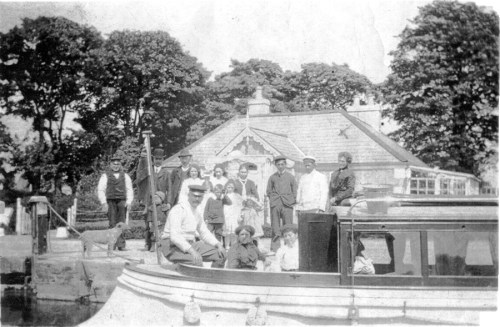
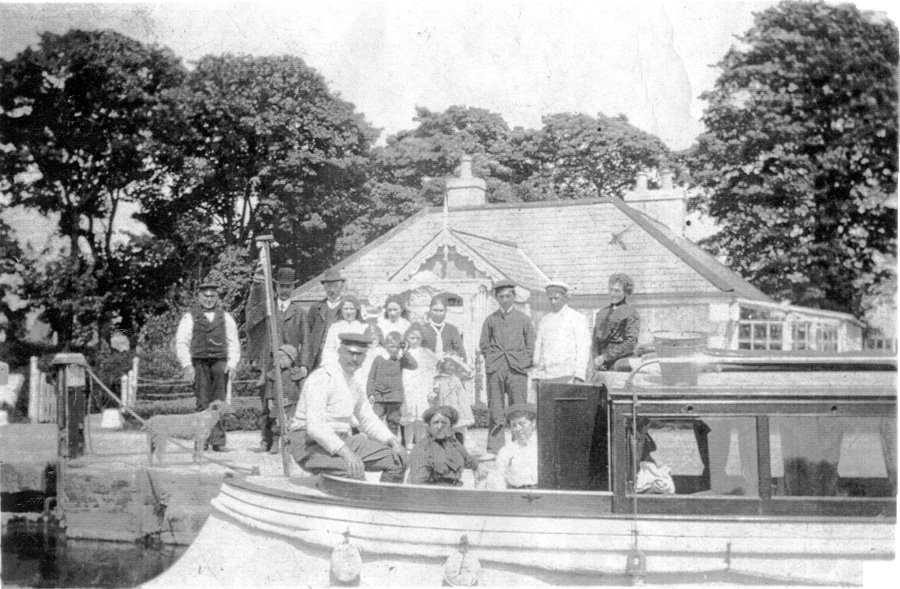
Alan Lindley has very kindly sent me, and permitted me to publish, this photograph.

It was taken at Lowtown lock, on the Grand Canal, in 1911 or 1912.

Alan says that the man on the left of the group — with cap, waistcoat and watch-chain, and with a dog standing in front of him — is the lock keeper, Murtagh Murphy, the great-grandfather of the present incumbent, James (Jimmy) Conroy. Murtagh was born in Ballycowan, near Tullamore, Co Offaly, in 1849 and, after working on a Grand Canal Company boat, married a Kildare girl and took the job at Lowtown.

The boat had been described as a passenger flyboat but, as the Grand Canal Company had ceased carrying passengers in 1852, that seems unlikely. And the boat looks much more like a pleasure vessel than a working boat.

If the Grand Canal Company had an inspection launch, this might be it, but I have found nothing to indicate that it did. The boat does, though, seem to have been designed for canal travel: it seems (from the twenty feet or so we can see) to have straight sides and to be well equipped with fenders. It might therefore have been designed to travel on the canals (as well as on other waters).

At least one director of the Grand Canal Company, Henry Samuel (aka Harry Samuel) Sankey, of Fort Frederic, Virginia, Cavan and of 64 Wellington Road, Dublin, did have a launch or pleasure craft on the canal, the Aja, which you can read about here. Incidentally Mr Sankey, who died on 5 December 1925, directed “that no Roman Catholic shall take any benefit” under his will.

Further information about the boat and the people shown in the photograph, and about Mr Sankey’s launch, would be very welcome; please leave a Comment below.

And the prize goes to …

… Niall Galway, who identified the Cong Canal. bjg

Athlone 1889

To the Editor of the Athlone Times 24/8/1889

Dear Sir

I understand that the Athlone Board of Guardians passed a resolution at a recent meeting in favour of the drainage of the Shannon. May I ask, is it the object of these enlightened gentlemen to destroy the navigation of 240 miles passing through our country, which no law can ever restore; or can it be possible they so far despair of the future traffic of the country under the management of their Parliament, in College Green, as to feel warranted in doing away with such a natural and beautiful highway for trade.

I happen, myself, to be in a position to judge the agricultural part of the question, and after the experience of 25 years of the lands which are subject to the Shannon flooding, I have no hesitation in saying that the meadows are greatly improved, and I may mention that in no way could these lands be more profitably farmed than by meadowing.

To the Athlone people, it seems to me a matter of the greatest importance, or do they realise that their beautiful river is about to be turned into a mere cesspool, their traffic to be left at the mercy of the railway companies, and their boating excursions on their fine lake to be made almost impossible, as this drainage will create such a current at the opening of the lake that it will require their strongest efforts to force a boat against it, and even after overcoming this difficulty, they would have little to look at but white shores and barren rocks.

I remain, Mr Editor, Faithfully yours… R D Levinge, Carnagh

Thanks to Vincent P Delany for this.

Blessington Street basin

Blessington Street Basin (Michael Geraghty) November 2015 01_resize

Blessington Street Basin (Michael Geraghty 2015)

One of North Dublin’s less-well-known treasures, this is Blessington Street Basin, off the (former) Broadstone Line of the Royal Canal. Thanks to Michael Geraghty for the photo, taken in November 2015.

Transhipment

At the Grand Canal Company’s half-yearly meeting on 22 February 1890, a Mr Geoghegan

[…] said he had heard from a gentleman interested in the trade between Dublin and Limerick that it often took six days for Guinness’s porter to be carried by canal from the former of these cities to the latter. The cause of this he believed was the necessity for trans-shipment at Shannon Harbour.

The Chairman disagreed:

As to the delays at Shannon Harbour there had been some, but he believed these had been caused by floods and storms in the river.[1]

The company had commissioned Mr E Lloyd, engineer and general manager to the Warwick and Birmingham Canal Company, to inspect the Grand Canal and to advise the board. It was estimated that his survey would cost between £100 and £120. The chairman accepted that there were

[…] many matters […] which demanded immediate steps, and these entailed considerable outlay. It has been evidenced that before the property of the company could be stated to be in a thoroughly satisfactory condition some further exceptional outlay would be advisable from time to time.[2]

At the next half-yearly meeting, held on 23 August 1890, the chairman said that the company was considering investing in a more rapid transhipment system “from our barges to the Shannon steamers” at Shannon Harbour, in accordance with Mr Lloyd’s suggestion.[3]

Shannon Harbour June 2008 02_resize

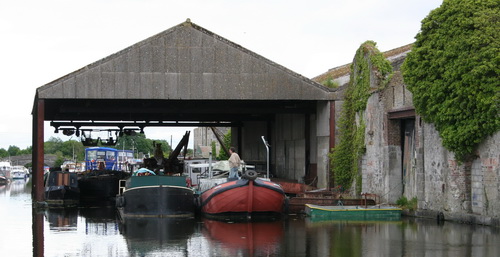
The transhipment shed at Shannon Harbour in June 2008, before its canopy was removed

I do not know whether the transhipment shed at Shannon harbour, and the gantry mechanism on which goods could be loaded and unloaded under cover, was built on Mr Lloyd’s suggestion. It would be interesting to know more of the building’s history.

Sources


[1] The Freeman’s Journal 24 February 1890

[2] ibid

[3] The Freeman’s Journal 25 August 1890

From the British Newspaper Archive run by Findmypast Newspaper Archive Limited, in partnership with the British Library.

The King of Dalkey

The King of Dalkey and the Dublin and Kingstown Railway Company

A report being generally circulated that the Dublin and Kingstown Railway Company contributed liberally to defray the expenses of the revival of this old custom, the Committee of Management regret to say such is not the fact, notwithstanding the immense increase of traffic as returned by the company’s accounts. The loss sustained by the principals in this transaction is very considerable. The committee for the present will decline any further interference in the Kingstown locality. His facetious Majesty Henry the First will issue his proclamation when and where he next intends to appear in public, which will be strictly select.

Freeman’s Journal 27 August 1850. From the British Newspaper Archive run by Findmypast Newspaper Archive Limited, in partnership with the British Library.

A Steam-ship Canal from Kilkenny to Inistiogue

A gentleman has mooted the propriety of forming a steam-ship canal from Kilkenny to the tidal water of Innistiogue,  and he has lodged £400 in the Provincial Bank as a beginning, and as an earnest of his good faith. His name is not given, why we cannot say; but of the fact that the money is actually lodged, we have been assured by the respectable manager of the bank, Andrew M’Kean Esq.

This half anonymous character is to be regretted; and we trust the promoter will not hesitate to announce his name at once, and set the project fairly before the public. Men do business now-a-days with their eyes well open. It is computed that £320000 would be sufficient for the completion of the undertaking. The distance is only thirteen miles. The promoter calls upon eight hundred men in the counties of Kilkenny, Waterford, and Wexford to come forward with £400 each, or else raise the money in £5 shares.

Dublin Evening Packet and Correspondent 27 August 1850 quoting the Kilkenny Journal. From the British Newspaper Archive run by Findmypast Newspaper Archive Limited, in partnership with the British Library.

[NB I have not been able to find any later notice of the development of this proposal. Further information will be welcomed]