Category Archives: Ashore

Saunderson’s Sheugh

The Minister for  Arts, Heritage and the Gaeltacht [who is also a Fine Gael TD for Cavan–Monaghan] spoke at the meeeting of the Joint Oireachtas Committee on Environment, Culture and the Gaeltacht on 25 November 2014. She said:

In addition to progressing North-South co-operation, my key priority is progressing the first stage of the Ulster Canal project from upper Lough Erne to Castle Saunderson, near Belturbet, County Cavan. I am working on this with the Government and other key partners, including the North-South Ministerial Council and Waterways Ireland. […]

It sounds, then, as if the minister intends to get work started on the Clones Sheugh, but only as far as Castle Saunderson, where there is a scouting establishment. The route from Quivvy Lough (location of the Quivvy Marina) is along the Finn River; the first 5.5 km of the route would be in the river and the last 8.5 km to Clones in a canal. The route to Castle Saunderson would, I imagine, require dredging and the removal of rocks as well as work on [or replacement of] Derrykerrib Bridge [I have not read all the details].

It would, of course, be faster to get there by road, but no doubt lots of people will travel from Foreign Parts for the excitement of seeing Castle Saunderson from the water and paying tribute to the memory of a stout Orangeman and founder of the Irish Unionist Alliance.

No mention of the treasure-hunting group who are to find the money, but there’s an election in the offing so money won’t be a problem. Until afterwards.

Quivvy to Castle Saunderson [OSI ~1840]

Quivvy to Castle Saunderson [OSI ~1840]

The minister also said:

Regarding the Ulster Canal, which stretches from upper Lough Erne to Castle Saunderson, we hope to get the project started on that section because that is the one part of the inland waterway system that has not been developed. If we get that done, the Ulster Canal will connect into Lough Neagh. That means we will have a complete network of waterways in Ireland, which is very important. It is also a cross-Border project, and there is a peace dividend in terms of that project. It is very important in terms of cross-Border relationships. It is one shovel-ready project that can be progressed.

The minister said that “a complete network of waterways in Ireland […] is very important”. She did not say why and I can think of no possible economic justification for the creation of such a “network”. Nor is it clear what the “peace dividend” is. But the phrase that evoked most terror is “shovel-ready project”, which I take to mean something that might buy votes in the next election.

The minister’s predecessor, Éamon Ó Cuív, a Fianna Fáil TD for Galway West, said:

I welcome the Minister’s continuation of the work on the Ulster canals. There was quite a bit of work done on that in my time and I was very anxious to see it progress on a step-by-step basis. I was going to bring it to Clones, I am not sure whether the place the Minister mentioned is further or nearer than that.

The minister interjected:

It is not as far as Clones. We will start it anyway and we will get it there.

And Mr Ó Cuív continued:

I take the view that even if she were to get it half a mile, we should just nibble away at it until we get it finished. It is of strategic national importance and if we could connect Coleraine, where I was the other day and where my poor car is getting mended, all the way down the coast through Lough Neagh down to Shannon and back up the canals, it would be a fantastic facility for the island. I will not be heard complaining in any way that it is in the Minister’s constituency – that just happens to be a happy coincidence in this case.

Actually, although both Quivvy Marina and Castle Saunderson are in the Free State, most of the River Finn route is in the United Kingdom of Great Britain and Northern Ireland.

It seems that I must cease to speak of the Clones Sheugh: it’s Saunderson’s Sheugh. I suppose that, if reaching Castle Saunderson were enough to shut up the Shinners, who seem to be madly keen on Sheughery for some reason that is hidden from me, that might be a bargain: it would certainly be better than going all the way to Clones.

My OSI logo and permit number for website


Down to the sea in steps

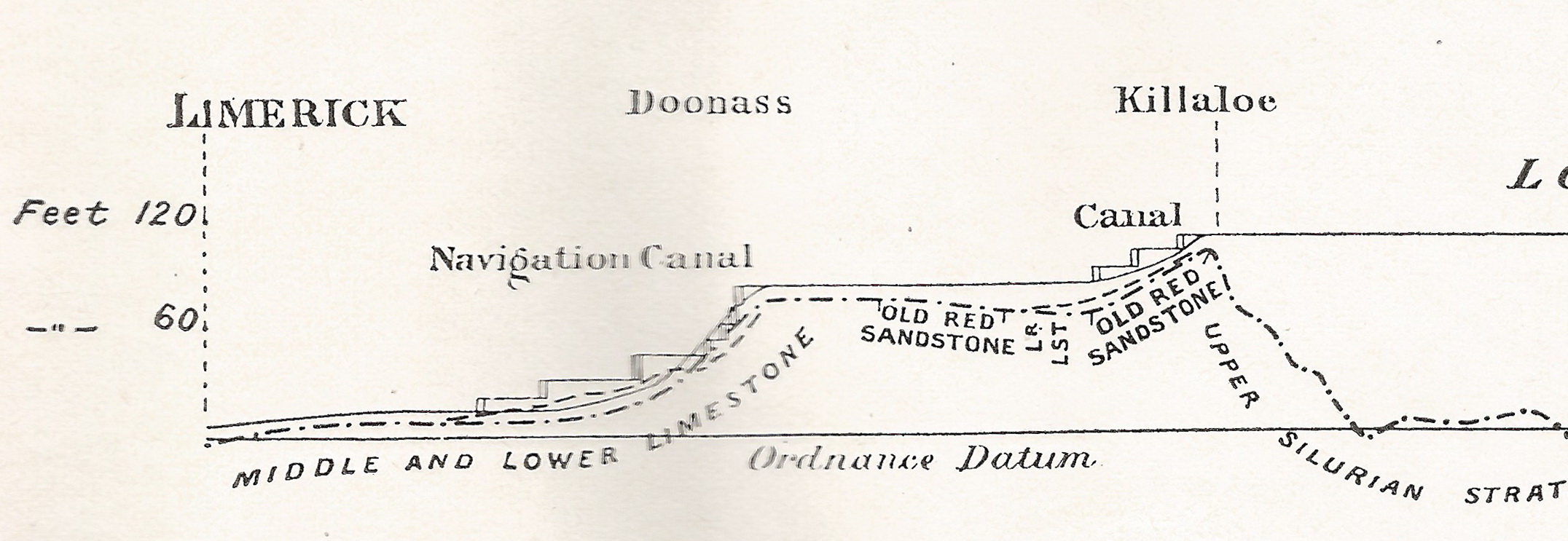
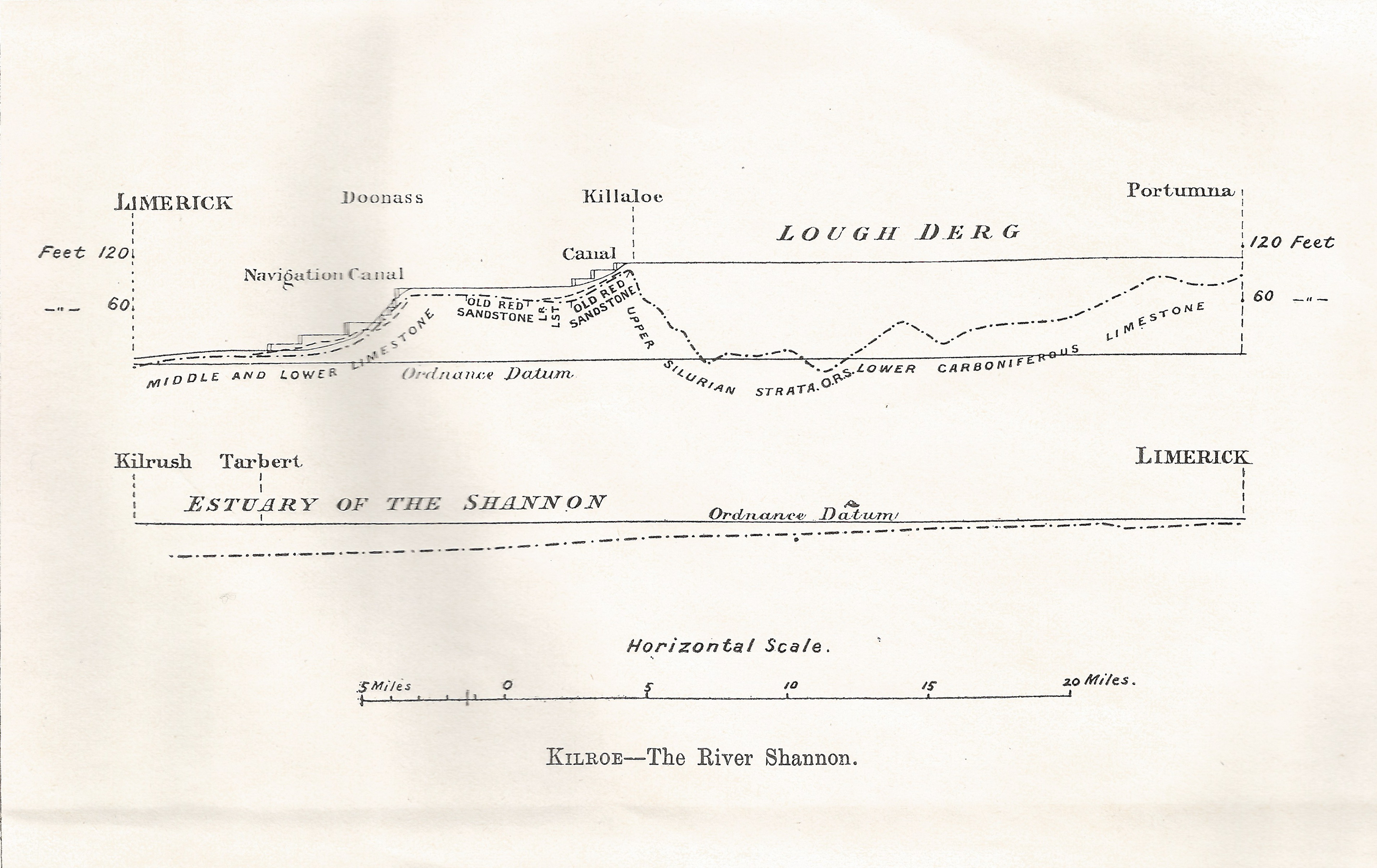
On 28 January 1907 James Robinson Kilroe [near the bottom of the page] of H M Geological Survey read to the Royal Irish Academy a paper on “The River Shannon: its present course and geological history” [Proceedings of the Royal Irish Academy Vol XXVI Section B No 8 Hodges, Figgis & Co Ltd, Dublin; Williams & Norgate, London 1907]. I thought that Plate V was interesting.

Shannon Derg to sea

Plate V

Kilroe wrote:

It will be perceived that instead of the river being shallow over the unyielding Silurian slate-rock, set almost vertically, and striking across the river-course, it is deeper than over the limestone of Lough Derg, and much deeper than over the comparatively easily eroded Old Red Sandstone at Killaloe. The river-bed actually drops below the datum line above the town, while at the town it is 100 feet above datum.

Old Red Sandstone strata are here to be seen in the river-bank, and Silurian rocks in situ in its bed. A barrier is thus formed, partly of Silurian, and partly of Old Red Sandstone rocks, which without the artificial impounding weir would retain the waters of Lough Derg to a depth of some 104 feet opposite Derrycastle — two miles above Killaloe.

One might have expected to find a fairly level shallow bed from Killaloe northward, a sudden drop from slate-rock to the sandstone floor, and  a pronounced wide, well-formed valley in the limestone district southward to Limerick.

None of these elements exist; instead, we have the formidable barrier at Killaloe, naturally damming up a considerable depth of water in Lough Derg, and the river falling away southward by a series of rapids which correspond with drops in the canal, south of O’Briensbridge […], along an alternative course, possibly one used by a branch of the Shannon.

Here is an extract from the Plate V map, showing the steps of the (pre-Ardnacrusha) Limerick Navigation between Lough Derg and the sea.

Shannon Killaloe to Limerick

The steps of the canal (click to enlarge)

Upstream

Kilroe wrote of Lough Ree:

The waters of Lough Ree stood some 10 feet higher within recent times than they now do, as proved by evidence of solution, with under-cutting of limestone blocks, to be seen about five miles north-west of Athlone, close to the railway, in the townland of Cornaseer.

Under these conditions the lake must have been, perhaps, twice its width, and for a considerable period. Its ancient surface-level is clearly indicated by the caps of the mushroom-shaped blocks.

And of the Shannon between Lough Ree and Lough Derg:

The extreme flatness of the river between Athlone and Meelick is such that, consequent upon the completion of the Suck Drainage-works in 1892, it was found that the callows along the Shannon above the confluence of the Suck at Shannonbridge were much more liable to sudden and frequent floodings than they previously had been.

The more rapid discharge of the Suck waters into the Shannon, before ordinary extra water had time to pass away, had the effect of modifying the regimen of the main stream to an extent which resulted in an action at law [La Touche -v- The Suck Drainage Board].

I have found only one account of that case, in the Freeman’s Journal of 1 July 1893. The plaintiffs, Messrs Harrison and La Touche, owned land at Cappaleitrim, on the west bank of the Shannon above Shannonbridge. They said that the actions of the Suck Drainage Board had caused their lands to be flooded:

[…] that the defendants brought water from the Suck into the Shannon, containing a drainage of 40 miles, with such velocity and such volume that the Shannon was penned back, and that the back water caused the damage to the lands complained of.

[…] The jury disagreed and were discharged.

I don’t know whether the matter ever again came before a judge.

Royal Canal drawbridge

According to the Freeman’s Journal of 5 April 1837, Henry Garnett was

superintendent or agent to the èxtensive and highly respectable firm of Purcell and Jameson, coach proprietors.

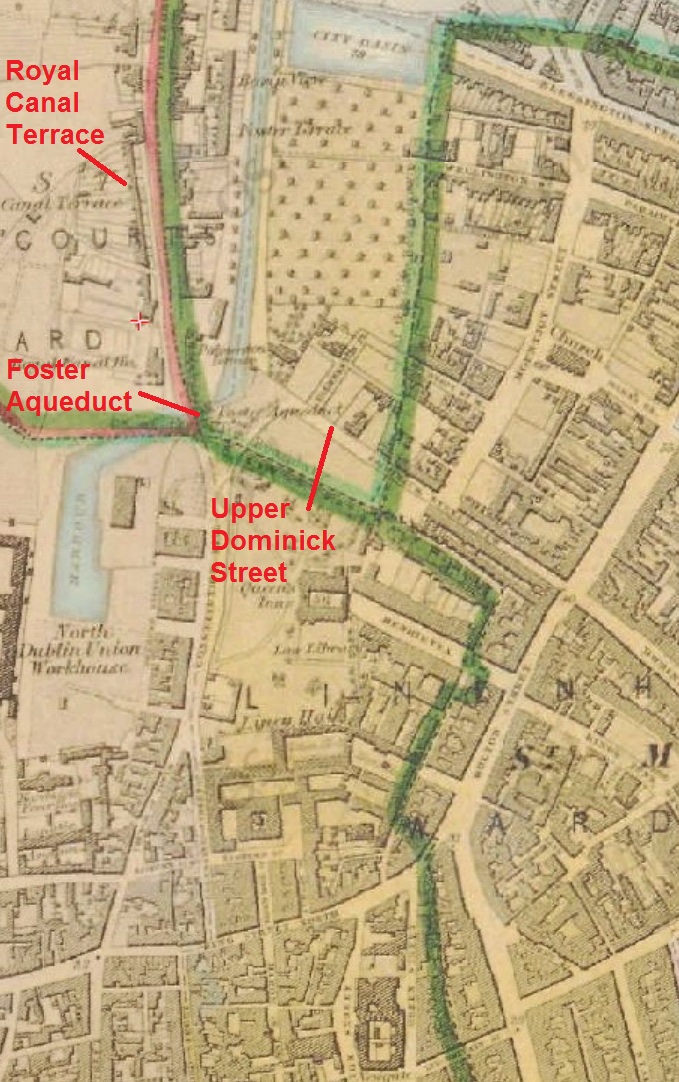
Their offices were in Sackville Street. On Sunday 2 April 1837 Mr Garnett had been on his way home to [Royal] Canal Terrace when

as he ascended the hill at the bend of Upper Dominick-street he met a man habited in a dark cloak, and having a cap on his head, who, after looking him steadfastly in the face, opened the cloak, and fired at him.

The man was not more than a yard away, so close that the powder scorched Garnett’s hand, but the bullet struck a suspender button, wounding but not killing the victim.

The scene of the crime

The scene of the crime [OSI ~1840]

William Cagburn heard the shot and also heard Garnett calling out

I am shot — stop the murderer, he has run in the direction of the aqueduct.

Cagburn gave chase:

He instantly pursued, crossed the draw-bridge, and came under the aqueduct, when he saw the prisoner running along the Phibsborough road.

Cagburn and the watchman seized the man; the watchman took two pistols from him and another witness found a third, discharged, pistol nearby on the pathway.

The prisoner, Christopher Clanchy, had been a road maker for eight years. The Freeman’s Journal said:

While a contractor for repairing part of the Ashbourne road, in the employment of Messrs Bourne, he [Clanchy] was allowed to travel free by Mr Purcell’s coaches, and Mr Garnett in the discharge of his duty having occasion to withdraw this privilege, hence proceeding his desire to be revenged. […] We are happy to state Mr Garnett is not likely to suffer any inconvenience from the injury.

But of more interest for this site is the route taken by William Cagburn. What or where was the drawbridge he crossed?

Foster Aqueduct

Upper Dominick Street and the Foster Aqueduct [OSI ~1840]

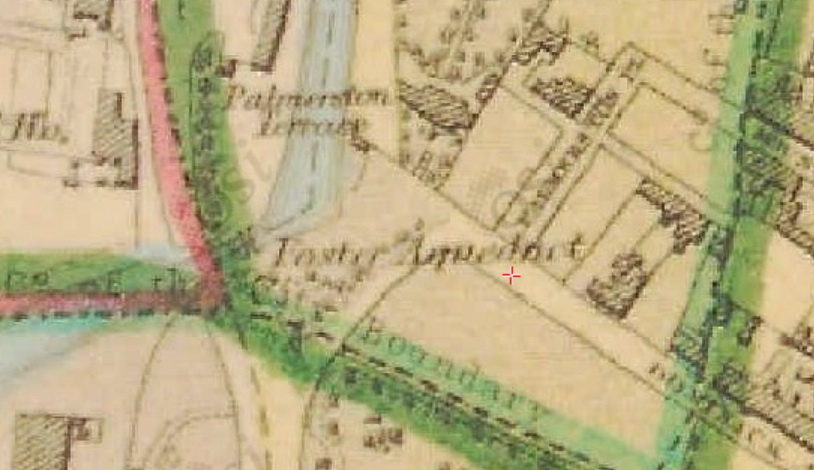
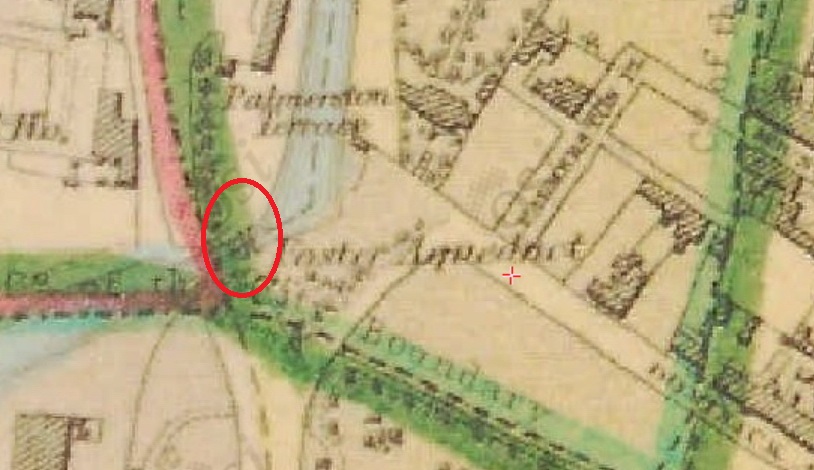
I haven’t come across [or at least I haven’t noticed] any previous mention of a drawbridge in this area. I presume that it was across the canal. And, looking closely at the map extract above …

Possible site of drawbridge

Possible drawbridge [OSI ~1840]

… I see what might be a bridge just to the left of the F of Foster. It shows up more clearly on the black and white OSI map. At Clanchy’s trial before the Commission of Oyer and Terminer, reported in the Freeman’s Journal of Monday 26 June 1837, the bridge was said to be a wooden bridge; George Cayburn [probably the William Cagburn named in the earlier report] described it as “the swinging bridge”.

Perhaps Mallet’s Insistent Pontoon merely replaced an old nuisance with a new.

Clanchy, incidentally, was found guilty: there were suggestions that he was insane, but the jury rejected them. Baron Richards said [Freeman’s Journal 1 July 1837]

The court had no discretion but to pass the extreme sentence of the law, that he should be hanged by the neck […].

Purcell, Garnett’s employer, had requested a commutation of his sentence; Richards said that it was open to Clanchy to memorial for a commutation, and the court would put no obstacle in his way; indeed it hoped he would meet the mercy “which he would have denied his intended victim”. I do not know what happened to Clanchy.

Update December 2016

The Warder and Dublin Weekly Mail of 26 September 1835 mentions the bridge:

Monday night a respectable looking elderly man fell into the Royal Canal Basin, at the Broadstone, on the Dominick-street side, within a few yards of the draw bridge.

A canal employee called Keybourne hauled Mr White out within a few minutes, but he was DOA at the Richmond Hospital.

This seems to confirm that the bridge was moveable and was where the OSI map suggests.

From the BNA

My OSI logo and permit number for website

A concession to new technology

It appears that these new-fangled railways are here to stay, displacing the passage-boat and the mail-coach, the Scotch cart and the lumber boat.

Accordingly, I have rearranged my small number of railway-related pages under a top-level heading of their own.

I have added a new railway page, about the Lundy Island Railway and Colonization Company, from the Dublin Evening Mail of 2 May 1845. Gerald M King has produced stamps for Lundy, including Railway Parcel Stamps, but it is not clear whether they depict any of the engines or rolling stock described in the Mail and there are few other sources of information about the railway.

I have tried to explain as many of the references as I could, but some are still obscure to me and I would welcome comments from those expert in Irish religious conflicts of the 1840s (as well as those knowledgeable about railways and other technology of the period).


The Black Bridge at Plassey

I am repeating here a point I made in response to a comment on this page. I do so because the point is, I think, an important one: some readers don’t check the comments and might miss this.

I have an imperfect copy [with some lines missing] of an indenture made on 8 July 1949 between the Minister for Finance and Limerick County Council under which the Council leased from the Minister

… all that those parts of the lands of Garraun and Sreelane on which Plassey Bridge abuts on both banks of the River Shannon and the site and piles of said Plassey Bridge together with said Plassey Bridge […].

I am not a lawyer, so my interpretation may be misleading, but I think that there are two points of interest.

The first is that, under the indenture, the Council is obliged to “well and sufficiently repair cleanse maintain amend and keep the hereby demised premises”, which includes the bridge. The Council is also required to “use the said demised premises as a public highway”.

The second is that, if the Council fails to do so, the Minister, and his agents the Commissioners of Public Works in Ireland, are entitled (after giving due notice) “to enter upon the hereby demised premises and to execute and to do the necessary repairs and works and the Lessees [ie Limerick Councy Council] shall repay the expenses of such repairs to the Lessor on demand […]“.

As far as I can see, Limerick County Council is in breach of its agreement with the Minister for Finance, and that Minister is entitled to repair the bridge and charge the Council for the cost.

If only there were a Minister for Finance who had an interest in Limerick (or in bridges) ….

Remarkable case of abduction

At the Nenagh Petty Sessions, on Thursday last, information was sworn by Catherine M’Namara against John Creighton, Martin Creighton, and others, for abduction and assault; a warrant was consequently issued by the Bench of Magistrates.

Margaret M’Namara, a very pretty country girl, is the only unmarried daughter of a comfortable farmer of that name, residing in the parish of Island, in Galway.* John Creighton, a hamlet rake and village debauchee, living in the same neighbourhood, took it into his head, by one bold stroke, to secure himself in a pretty wife and handsome fortune, which would enable him to give larger and longer scope to his abandoned career.

Confederating with a few of his associates (among whom was his brother Martin) at a public-house, he there revealed to them his adventurous project, and it was unanimously agreed that their leader should have a wife and fortune. Accordingly, at dead of night, they sallied forth, and soon arrived at the cottage-home of the devoted girl.

A solitary and startling knock at the door was the first intimation that the unconscious inmates had of their danger. “Who comes there?” — “A friend, open the door!” — “What is wanted at this unseasonable hour?” — “No matter — open the door.” Old M’Namara rose, and the maiden cowered behind her mother in the bed. A dead silence of some moments elapsed — a murmur of whispering voices was heard, and, in another instant, in tumbled the door with a crashing noise.

All then was uproar and confusion — resistance was useless. Old M’Namara was felled to the ground, others of the family were unmercifully beaten, the mother’s arm broken, and the maiden herself was dragged from her bed out into the bawn in almost a state of nudity!

Her clothes were then brought out, and she was compelled to huddle them on her. Fearful lest powerful assistance might be brought to the spot, and that they might be deprived of their prize, the heartless wretches dragged her along the verge of the Shannon, and alike regardless of the forlornness of her condition and the delicacy of her sex, they flung her into a boat and splashed to the opposite shore.

After landing she was literally dragged for the distance of five miles across a lonely and cheerless tract of country; and as the dawn was breaking, she was secreted, in a state of exhaustion, in a friend’s house of Creighton’s, on the lands of Carighatogher, near Nenagh. During the journey, Creighton’s brothers frequently said to him — “Glory to you, John, you can now drink and smoke enough.”

The next morning M’Namara’s friends were indefatigable, though unsuccessful, in their efforts to find Creighton and his party. Mr Reed, a neighbouring magistrate, granted a search warrant; and himself in person, with an escort of police, scoured the country, but their exertions were equally uncrowned with success.

Mr Reed having received intelligence that the offenders were in the neighbourhood of Castle Lough, sent a note by express to Mr Anthony Parker, a gentleman of high respectability, a magistrate, and a deputy lieutenant of the county of Tipperary. Mr Parker, with his usual promptitude, instituted a general search throughout Castle Lough and the surrounding country.

During this lapse of time, Catherine M’Namara was removed to a cabin belonging to an individual named Reedy, the local position of which was the centre of a dreary bog. While there, deploring her unfortunate condition,she was alarmed by the cry of “Police! police!” “fly, fly!” She lifted her head, and saw Creighton running out of the back door, while a middle-sized, sandy-complexioned man and five country-fellows, who were well armed, darkened the front entrance at almost the same moment. An involuntary shuddering seized her when she saw the men staring inquisitively in her face.

Reedy, the lord of the “mud edifice,” demanded “by what authority they dared to enter his mansion?” The man who seemed to be the leader, heedless of Reedy’s questions, approached the shivering girl, and asked her in a northern accent, “if she were detained against her inclination, or if she needed protection?” Her humid eyes met his, and in mute eloquence implored protection. “Child, do you need protection?”the game voice again repeated in a hurried cadence.She grasped his arm, and almost breathlessly exclaimed, “I want nothing else!”

The house was instantly cleared of a crowd that had collected; her clothes were gathered; the little party filed around her, and proceeded silently to the road, expecting each moment to be attacked. She was afterwards conducted to the house of a respectable farmer named Quin, where she was hospitably received and entertained, and protected for the following night and day.

Mr Baxter, the leader of the little party that had rendered such signal service to the cause of humanity, then learned from the poor girl’s own lips the particulars connected with her abduction. Before he went to Reedy’s cottage, all he knew was,that a strange young woman was detained there against her inclination, and under suspicious circumstances.

Next day she was accompanied to the sessions-house of Nenagh, where Mr Parker, fortunately, was a sitting Magistrate; she was admitted into the jury-room, and her evidence taken, and a warrant was issued as before mentioned. After being examined, Mr Parker very kindly gave her money, got her a proper conveyance, and an escort of police to conduct her to the arms of her afflicted parents, where she now remains under the especial protection of Mr Reed.

Leamington Spa Courier 7 March 1835

* I have no idea where that is: Griffith, Lewis and the Parliamentary Gazetteer make no mention [that I can find] of a parish called Island or Islands in County Galway or County Clare [I checked both because the boundary changed later in the nineteenth century]. Could the author have meant Illaunmore? Or Inis Cealtra? Griffith finds McNamaras and a Creighton in the parish of Inishcaltra.

Airholes on the Kennet & Avon Canal

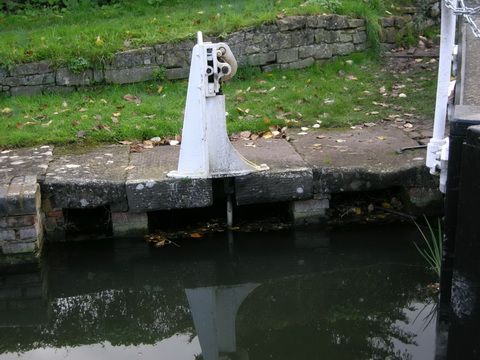
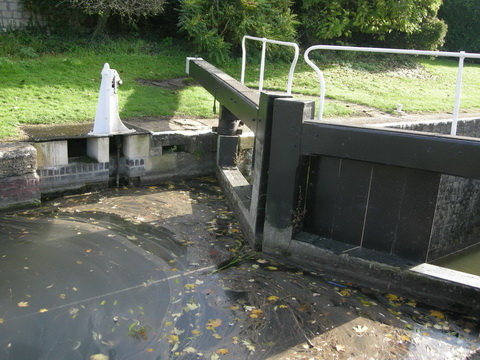
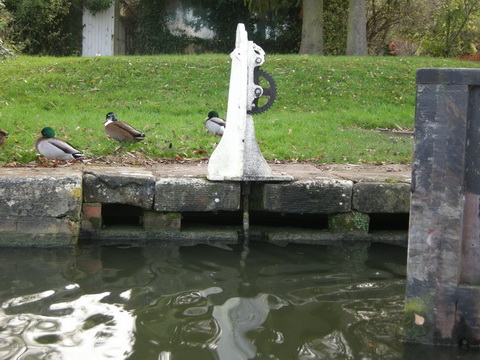
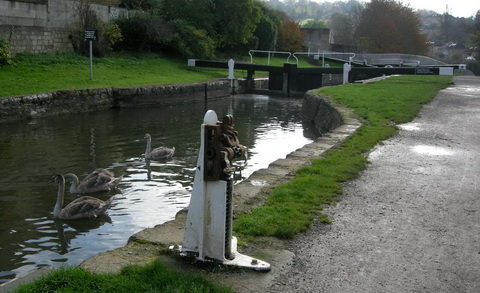
John Ditchfield very kindly photographed some airholes on the Kennet & Avon Canal and sent on the photos. The captions are his comments.

Bath05_resize

Good length of overflow. Water flowing.

Bath07_resize

No overflow.

Bath06_resize

(Rebuilt) small openings are above the level of the top of the adjacent lock gate. However, just upstream there is another paddle or sluice gate on the canal side (next photo), so perhaps that is used to control the level.

Bath08_resize

The upstream paddle or sluice gate.

Bath09_resize

Overflow in action, preventing water overflowing gates.

Note: this lock connects the canal with the River Avon, and the building in the background was a steam pumping station, presumably for topping up the canal from the river.

Many thanks to John for taking the trouble.

Fuel consumption

The Dublin Monitor of 3 December 1839 quoted the celebrated Dublin-born adulterer and polymath Dionysius Lardner [who said that Victorians were prudish?] as saying

A train of coaches, about eighty tons, and transporting 230 passengers, with their luggage, has been taken from Liverpool to Birmingham, and from Birmingham to Liverpool, the trip each way taking about four hours, stoppages included. The distance between these places by the railway is ninety-five miles.

This double journey of 190 miles is effected by the mechanical force produced in the combustion of a quarter of a ton of coke, the value of which is 6s.

To carry the same number of passengers daily between the same places by stage coaches, on a common road, would require twenty coaches, and an establishment of 3,800 horses, with which the journey in each direction would be performed in about twelve hours, stoppages included.

Dr Lardner on the Steam Engine

The fuel consumption figure seemed odd to me, because I had recently read about the fuel consumed by a steamer on the Shannon in 1851. This was evidently one of the two screw steamers put to work by the Grand Canal Company in 1851, on which Sir John MacNeill conducted the experiments described here.

A luggage boat propelled by steam, on the screw principle, has been for the first time placed on the waters of the Shannon between Shannon Harbour and Limerick, taking in Portumna, Dromineer, Williamstown [probably Hollands], Killaloe, and the river and canal, to the terminus lock at Limerick.

As a specimen of aquatic architecture, the boat presents no very peculiar or striking features; it is built of iron, with a flush deck; it is capable of carrying about thirty tons, and the rate at which it goes on the canal, is about three and a half miles an hour, whether singly, or as a tug boat with two or three heavy lighters after it; whilst on the broader waters of the river, it is capable of going at a rate of seven and a half miles an hour!

This phenomenon may be explained by the fact that on the canal, which is comparatively narrow, there is no expansion of the waters displaced by the boat, whilst there is always a considerable swell raised about the prow, causes which conspire to retard her speed, and which do not operate when she is on the river.

The expense of working this boat is considerably less than that of the ordinary boat drawn by horses. A ton of coal supplies the engine between Limerick and Shannon Harbour; whereas the horsing alone of a boat between Limerick and Killaloe amounts to something about ten shillings.

The experiment, however, has not been sufficiently tested; and there is some doubt that it may succeed according to the expectations of its projectors. Just now several industrious persons with horses are employed on the canal: and it is to be hoped that in this season of dearth and destitution, no hasty means will be adopted to force them for subsistence on overgrown poor rates.

Limerick Reporter 27 May 1851

The Limerick Reporter article does not say, and I cannot determine, whether this was  Towing steamer No 2 [Appendix 3 in Ruth Delany The Grand Canal of Ireland David and Charles, Newton Abbot 1973], the twin-screw vessel which MacNeill, confusingly, called the No 1 Boat, or the single-screw Towing steamer No 1, which MacNeill called the No 2 Boat.

But I was surprised that the railway train could do 190 miles on a quarter ton of coke while the steamer required a ton for the (roughly) 54 miles from Shannon Harbour to Limerick.

On consulting the online Gutenberg version of the seventh edition of Dionysius Lardner The Steam Engine explained and illustrated; with an account of its invention and progressive improvement, and its application to navigation and railways; including also A Memoir of Watt Taylor and Walton, London 1840, I found that there were some differences between that and the Dublin Monitor‘s version:

A train of coaches weighing about eighty tons, and transporting two hundred and forty passengers with their luggage, has been taken from Liverpool to Birmingham, and back from Birmingham to Liverpool, the trip each way taking about four hours and a quarter, stoppages included. The distance between these places by the railway is ninety-five miles.

This double journey of one hundred and ninety miles is effected by the mechanical force produced in the combustion of four tons of coke, the value of which is about five pounds.

To carry the same number of passengers daily between the same places by stage-coaches on a common road, would require twenty coaches and an establishment of three thousand eight hundred horses, with which the journey in each direction would be performed in about twelve hours, stoppages included.

So 240 passengers, not 230; 4¼ rather than 4 hours — and most significantly 4 tons of coke, costing about £5, rather than ¼ ton costing 6s [£0.3].

Did the Dublin Monitor get it wrong — and, if so, why and how? Or were the lower figures in some earlier edition of Lardner’s work?


Demolishing the bridge at Athlone

If you happen to be thinking of demolishing the road bridge in Athlone at any time, please try to remove the foundation stone carefully, without breaking it, and look for a cavity.

Mr Rhodes, the principal Engineer of the River Shannon Improvement Works, having paid a visit of inspection to the bridge works of Athlone; a copperplate, with an inscription thereon, was deposited in a cavity in the foundation stone, which was laid on the 6th instant. The site on which the new bridge is to be erected is 70 yards up the river from the present bridge. The new bridge is to consist of three elliptical stone arches, each of 60 feet span, and 14 feet rise, and one iron swivel arch of 40 feet, to admit the passage of steam vessels of a large class.

The Galway Vindicator and Connaught Advertiser 27 November 1841

If you find the copperplate, do please tell us what the inscription says.

The agency model

I have been told that, until recent years, travel agents in Germany and elsewhere would buy packages of weeks on Irish hire-boatsa and then sell them on to their own clients. I have also been told that this “agency model” ceased to be used [or became less used], perhaps because of the growth of internet booking. And it has been suggested that this was one of the factors in the decline of the Shannon hire-boat trade, to which I have repeatedly drawn attention [most recently here].

I do not know whether this phenomenon has been documented or formally studied. If it has, I would be grateful if any reader can point me to the documents or studies. I would also welcome other Comments on the proposition.

Packaging and marketing

I mention it now because, when launching the Shannon Blueway project, the waterways minister Heather Humphreys said:

The launch of the Blueway will allow local businesses [to] capitalise on an increase in demand for transport, equipment hire, accommodation and entertainment.

I think that the Blueway is an excellent idea, but I am concerned about whether small local companies will be able to package and market it effectively to overseas tourists. If the long-established cruiser-hire-firms were or are finding effective marketing difficult, why would (say) a canoe- or bicycle-hire-firm in Drumshanbo find it any easier?

Marketing to anglers

There was an interesting discussion at the Joint Oireachtas Committee on Transport and Communications about “Depletion of Inland Fish Stocks and Impact of Estuary Poaching: Inland Fisheries Ireland” on 22 October 2014. Note in particular the contributions of Dr Ciaran Byrne from 10:25 onwards about how Inland Fisheries Ireland markets Irish angling to overseas anglers.

What struck me was not that IFI uses any particularly magical marketing methods but that it is dealing with a well-defined interest group: people who are committed to a particular activity and have invested heavily in it (buying rods and stools and nets and umbrellas and maggots and whatever else anglers use).

Identifying potential customers

Anglers form one segment of the market for inland waterways holidays, but the task of selling to other segments is harder if they lack a single compelling interest. Hence, no doubt, those rather demented attempts by Fáilte Ireland or Tourism Ireland to categorise potential customers as ‘Sightseers and Culture Seekers’, ‘Family & Loved Ones’, ‘Relaxers’ and ‘Outdoor Actives’. None of their interests strikes me as being exactly compelling: there are several countries where you can relax, engage in outdoor activities or look at sights.

What you really need is obsessive customers: folk, with money to spare, who are really interested in one thing. Then you entice them to your area and take their money from them: not, as Brian Ború would have done, by hitting them over the head and stealing it, but by selling them overpriced goods and services.

Lough Derg

If you don’t have obsessive customers, who are compelled by their inner urges to dangle maggots in your waters (or whatever else turns them on), then you might try offering a compelling attraction: something that is so interesting that folk put it on their to-do lists. Unfortunately, as Fáilte Ireland’s Lakelands Lough Derg Roadmap [PDF, 6.7MB; well worth reading] admits,

Lough Derg does not have suffient key attractions that act as a draw to the area.

The same thought has often struck me. As you drive around the lake, you see signs pointing towards it. But suppose you’re a casual tourist who hasn’t already booked an activity. When you get to the lake, about the only thing you can do is look at the water (which becomes less interesting after a while) or at the jolly people enjoying themselves on boats (ditto).

You can, in some places, go to a pub or eatery, but you don’t need to come to Ireland to do that. Or you can paddle. If you fish, you can fish, but I’m trying to think of things for non-anglers. In Killaloe, you can take a boat trip; in Dromineer, you can hire a sailing boat; in Mountshannon, you can visit Holy Island. But there is nothing you would come to Ireland for: nothing you can’t do in other places.

Roadmap remedies

The Roadmap proposes these remedies:

The following three key tourism products are proposed:

  • A Discovery Point and Trailhead at the Portroe lookout
  • A Lough Derg Canoe/Kayak trail
  • An enhanced offering and facilities at University of Limerick Activities Centre (ULAC).

Two additional tourism products are proposed:

  • Portumna eco-park (masterplanning required)
  • Publications to promote and support active enjoyment of Lough Derg and surrounds.

There is, alas, another set of categories of potential visitors:

The three market segments identified with the best potential for delivering international visitors to Lough Derg have been identified as Curiously Cultural, Great Escapers and Nature Lovers.

Other, less exploitable, market segments are identified too, but I can’t bring myself even to name them.

Finding the punters

I’d hate it to be thought that I was a marketing expert, but it seems to me that this segmentalisation is coming at things from the wrong end. In effect, it’s saying “We have these things; what sort of person might be induced to buy them?” Then you give each of those sorts of person a category and say that you’ve found your market.

But compare that with what the fisheries folk do. They can identify magazines that anglers read, maybe (for aught I know) television programmes they watch, trade shows they visit. Identification is easy: the titles will include words like “fishing” or “angling”.

But what magazines — other than those on the top shelf — have “Curiously Cultural” or “Nature Lovers” in the title? How do you track down “Great Escapers”? It seems to me that these categories might help you to tailor a message that is broadcast to large audiences through mass media: in such cases it doesn’t matter if you appeal to only 1% of the audience, provided that that audience is large enough. However, that’s not an option available to those with small budgets: they need cheaper marketing through channels that will provide much higher returns.

Small operators

And that’s where we come back to the fact that most of the potential tourism operators around Lough Derg are pretty small. Who is going to put together packages of activities that will appeal to the curiously cultural? I’m interested only in filling my B&B and you’re interested in hiring out bicycles. I’m happy to refer customers to you and vice versa, but are we going to get together to provide packages and to share our marketing budgets? There is a Lough Derg Marketing and Strategy Group, but it seems to be dominated by representatives of public sector bodies, and there is a limit to what they can do.

To compete on a European scale, what’s really needed is a large commercial organisation. I suggest, therefore, that the best thing to do would be to get Goldman Sachs to advise on how Lough Derg might be privatised.

Second-best would be the formation of a tourism cooperative.