Category Archives: Built heritage

The habits of the papists

On 15 February 1833 the Earl of Roden presented to the House of Lords petitions from various places “praying for the better observance of the Sabbath”. Some of the petitioners seemed to be shopkeepers who liked to take Sundays off and didn’t want anyone else taking their custom while they were closed.

Lord Cloncurry, however, pointed to the problems such observance might cause in Ireland, where there were different understandings of what should be done on Sundays. He felt that

[…] care should be taken, in enforcing the law, not to create discord, and do mischief to the people.

Not that creating discord would have bothered Roden, one of the nineteenth century’s prize nitwits.

Cloncurry, of Lyons House, Ardclough, Co Kildare, near where a brewer is buried, was a director of the Grand Canal Company — or rather

He was engaged in the Canal Navigation of Ireland, which afforded valuable commercial opportunities to private individuals, and to those of the middling classes the means of maintaining their families in decency and comfort.

He pointed out to his noble colleagues that canal boatmen treated Sunday like any other day: boats left Limerick and other places on Saturdays and kept going throughout the weekend, probably stopping for mass on Sunday morning:

Noble Lords, perhaps, were not aware, that in the Catholic Church, the rule was to attend mass in the forenoon, and it was then deemed allowable to spend the remainder of the day in amusement or business.

However, two magistrates had “at no distant period” ordered the police to stop boats from travelling on Sundays. These were probably the magistrates in Athy and Monasterevan, as described by Nicholas Fanning of the Grand Canal Company in 1830. The result of the magistrates’ action was that the boatmen went to the pub and their cargoes were plundered. The same magistrates had stopped cargoes of cattle from Clare and Galway en route to Dublin port [although it is difficult to see why they would have gone through Athy or Monasterevan].

The act of the Magistrates already alluded to was in violation of law; for the proper course was to have summoned the boatmen for the offence, instead of stopping the boat. It was not, therefore, surprising that law should be held cheap in Ireland, when it was broken by those who ought to uphold it.

Roden said that Cloncurry should name the magistrates so that there could be an inquiry — Cloncurry refused as he didn’t want to bring odium on them — but he reckoned that they were probably only enforcing the law. Roden said

As to the opinions of Roman Catholics relative to the Sabbath, he would say, without meaning them any offence, that Parliament ought to legislate according to its own religious feelings.

He didn’t foresee the rise of the shopping centre.
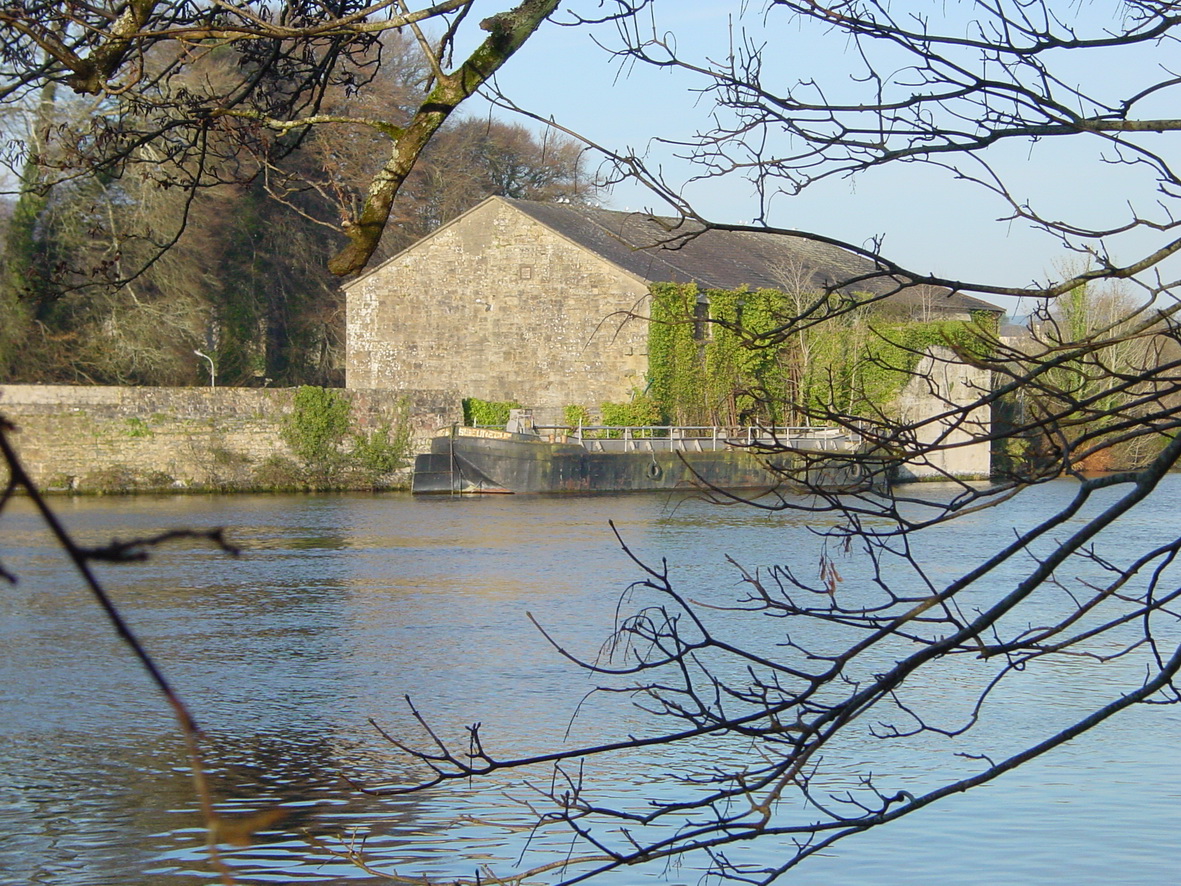
 

Marble from Killaloe

KILLALOE MARBLE WORKS

The marble mill in Killaloe

The marble mill in Killaloe

W & W Manderson

Beg respectfully to inform the Nobility, Gentry, and the Public in general, that they have (from their Practical experience) made considerable and most important improvements in the working and Polishing of Marble at the above Establishment, so that every variety of work is executed in a superior style hitherto unprecedented, and which has enabled them to offer at such Reduced Prices, as greatly to facilitate its general use both in public and private Buildings.

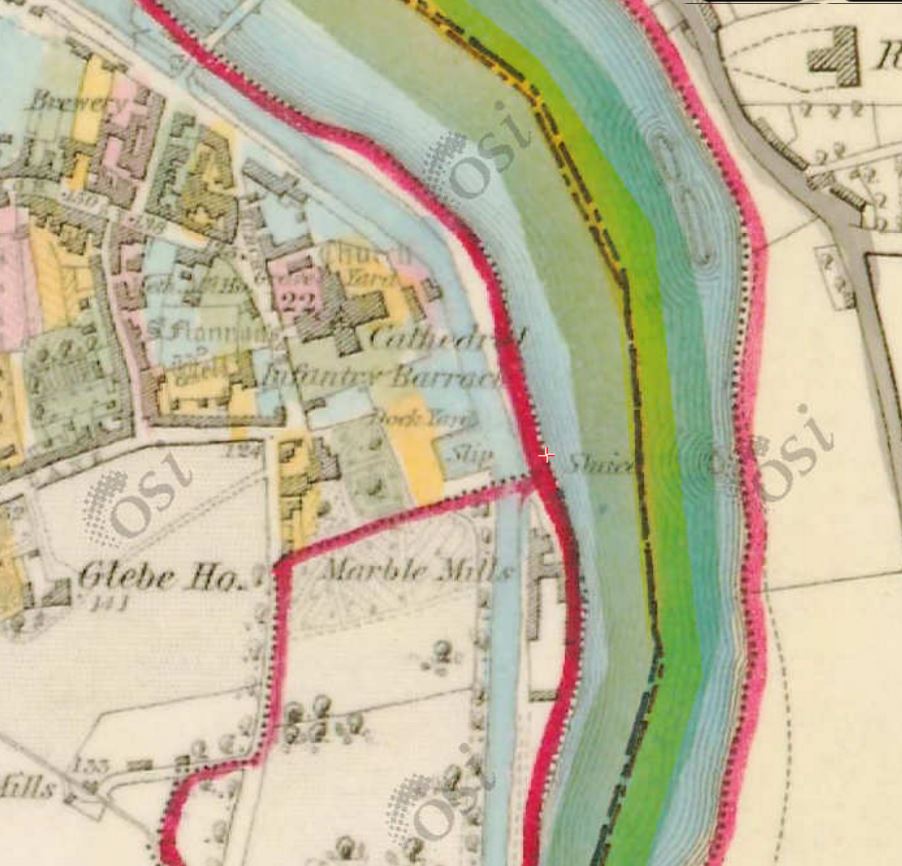
The marble mill at Killaloe (OSI 6" map ~1840)

The marble mill at Killaloe (OSI 6″ map ~1840)

They have for Inspection an Extensive Stock of Irish and Foreign MARBLE CHIMNEY PIECES (of various designs, suited for every description of rooms).

In STATUARY, ELABORATELY, SCULPTURED and CARVED, of exquisite designs and good material.

In VEIN, DOVE, BLACK AND GOLD, ST ANN, BURDILLA, SHANNON SIENNA, IRISH PORPHYRY, FOSSILS, GREY AND BLACK.

MONUMENTS, TABLETS, COLUMNS, BUST PILLARS, WASH AND DRESSING TABLES, TABLE TOPS, BATHS, PAVEMENTS, SLABS FOR DAIRIES, and various other Ornaments.

Also an Extensive Stock of MILL RUBBED, AND SQUARED FLAGS, WINDOW SILLS, BARGE AND EAVE COURSES, TOMB, HEADSTONES, &c &c.

The safe conveyance and fixing of work guaranteed if required.

July 28, 1842

Nenagh Guardian 6 August 1842

My OSI logo and permit number for website


Trolley canal boats

Fascinating page here; h/t TC/R&CHS. IIRC someone wrote to the Editor of the Irish Times in about 1906 suggesting an electric system for the canals in Dublin, but I cannot find the reference at the moment.

Cussane lock

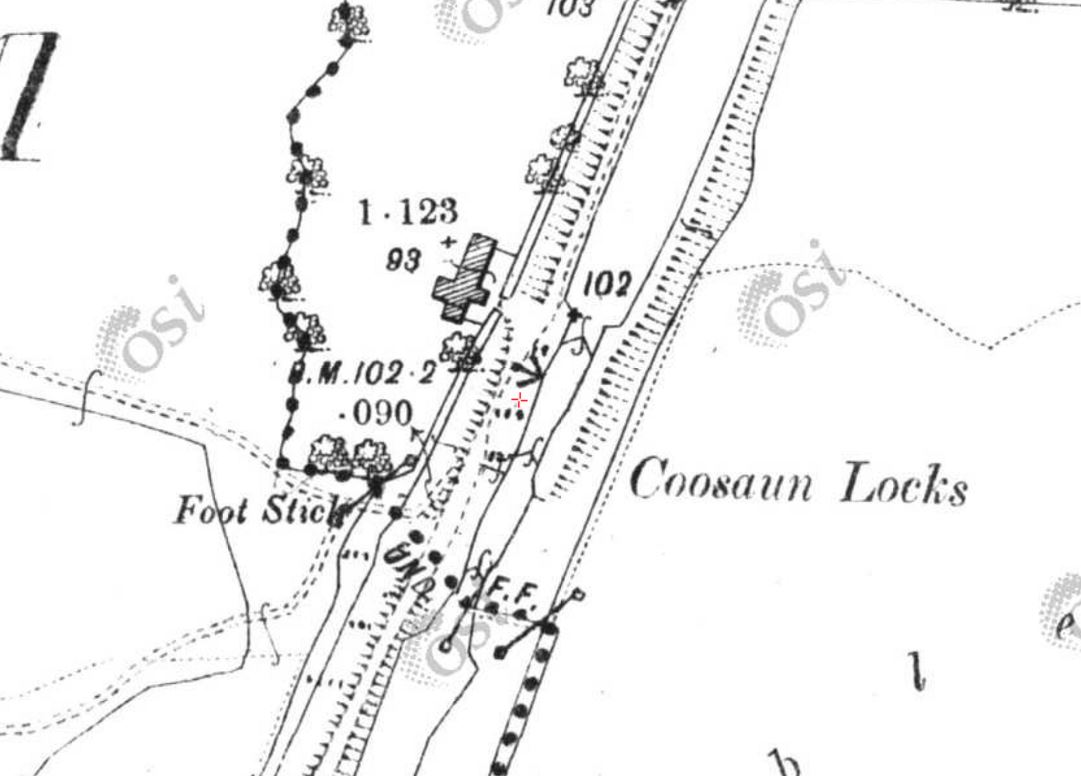
Cussane or Coosaun Lock was the lowest of three on the Killaloe Canal, which was the uppermost section of the Limerick Navigation. It was a double lock or “staircase pair”.

Cussane Lock (OSI ~1900)

Cussane Lock (OSI ~1900)


You can see what the lockkeeper’s house looked like in 2015 in the article “A Flooded Landscape Revealed“, written by folk who surveyed the area last year for Irish Water.

My OSI logo and permit number for website

Building Ireland

There is a television series called Building Ireland, about “Ireland’s building and engineering heritage”. A series of six programmes will begin on Friday 30 September 2016 at 8.30pm on RTÉ One, which is a television station.

The third programme, on 14 October, covers Ardnacrusha and the sixth, on 4 November, is entitled “Galway’s Corrib Canal” and covers canals in Galway and, I believe, may have some material about the Cong Canal.

Here is a PDF describing the series.

building-ireland-series-info-and-billings


A Suir thing

Some weeks ago Redmond O’Brien left a comment here; later he very kindly sent some photos. I have interspersed comment and pics here.

Today, while cycling on the Greenway along the Suir, I noticed a small pier and harbour by Mount Congreve.

Pier @ Mount Congreve

Pier at Mount Congreve (copyright Redmond O’Brien)

Is anything known about this? Possibly used by Mount Congreve at some time? A rather unusual design. The pier/quay is rectangular with stone steps on the upriver side.

Pier @ Mount Congreve

Stone steps (copyright Redmond O’Brien)

On the downriver side of the pier is a small rectangular harbour with a wall enclosing the side opposite the pier.

Boat Dock @ Mount Congreve

Enclosure at Mount Congreve (copyright Redmond O’Brien)

I wondered whether the pier or quay might have anything to do with the Christmas Canals, which Anthony M Sheedy said were “a joint effort between the Two Estates to bring irrigation into the Mount Congreve Estate”. I emailed the Mount Congreve Estate to ask if they knew anything about it, but I had no reply.

I also wondered whether the enclosed area might be for smaller boats, which might be transhipping cargoes to or from larger vessels tied at the end of the pier, quay or wharf. However, all of that is speculation.

The pier or wharf is shown on the 6″ Ordnance Survey map.

suir-whard-1840_resize

The pier on the 6″ Ordnance Survey map ~1840 (copyright Ordnance Survey Ireland)

It also appears on the 25″ map of around 1900.

suir-whard-1900_resize

The wharf and the wall on the 25″ map (copyright Ordnance Survey Ireland)

Here’s a close-up.

suir-whard-1900-close-up_resize

The wharf ~1900 (copyright Ordnance Survey Ireland)

I have found nothing about this in Charles Smith’s The Ancient and Present State of the County and City of Waterford or anywhere else, save for one possible clue in an article “Rambles by Road and by Rail” published in the Waterford Mail on 3 December 1862 and in the Waterford News on 12 December 1862 (both on the British Newspaper Archive), but originally from the Farmers’ Gazette. The article, part of a series, is about Mount Congreve. It begins:

There is scarcely an individual in Waterford or Tramore who does not know Mount Congreve, the beautifully situated residence of John Congreve Esq, in consequence of the free permission given by that gentleman to those who may wish at any time to visit his grounds. It is, consequently, the regular resort during summer and autumn of pleasure parties from Waterford and Tramore, those visiting it from Waterford generally preferring to sail up the Suir to the place, handy quays being erected at different parts of the grounds for the accommodation of visitors.

No doubt the quays could accommodate visitors, but a later part of the article offers a more plausible explanation for the existence of the handy quays:

Four large lime kilns are kept constantly at work during summer, one of them being generally working all the year round, not so much as a matter of profit, as for the purpose of affording employment and of supplying Mr Congreve’s tenants and others in the neighbourhood with lime at moderate rates. The limestone is brought from Mr Congreve’s property on the county Kilkenny side of the Suir, as there is no limestone on the county of Waterford side, and the navigable capabilities of that river enables vessels to discharge their cargoes of culm just at the kilns, thereby effecting a considerable saving in point of carriage. One way or other, a considerable number of people are employed by Mr Congreve in connection with his lime works, besides being of great service to the neighbourhood.

The 6″ OSI map shows what may be the handy quays here (they’re easier to see on the black and white version). And if you switch to Historic 25″ you’ll see even more round objects, with the legend LK, which I take to mean Lime Kiln.

However, the kilns are some way downstream of the wharf, and it has no LK legend or round objects near it. There are, though, some LKs just a little way up the Christmas canals.

But this is speculation, and I would be glad to hear from anyone who knows anything about the wharf on the Suir.

My OSI logo and permit number for website


From the BNA

A distinguished visitor to the Shannon

Dwarkanauth Tagore, of Calcutta, the distinguished and princely East Indian, who is making a tour of the United Kingdom, arrived in this city, on Tuesday evening with his suit [sic], in an elegant drag with four horses, and he put up at Cruise’s hotel.

The native Prince merchant partook of a dejeune at Killaloe on Tuesday. The City of Dublin Steam Company placed all their vessels on the Upper Shannon, at his command, and they were gaily decorated with flags, in compliment to the distinguished stranger, who left Limerick this day on a visit to Killarney Lakes, and is expected to call at Derrynane, the seat of Mr O’Connell.

Dwarkanauth Tagore dined and slept at Lord Rosse’s, on Monday night, where he examined the prodigious telescope — drove to Banagher, on Tuesday morning, and embarked on board the Lansdown [sic] steamer, proceeded through Victoria Locks Meelick, accompanied by Colonel Jones, and Mr Rhodes CE, also by Mr Howell, Secretary to the Dublin Steam Company. He was much pleased with the new works at Meelick, and also with the operations of a diver in a helmet, who exhibited the mode of using that apparatus.

The dejeune on board the Lansdown was provided by the Steam Company. Several ladies and gentlemen came up by the Lady Burgoyne to join the party of [at?] Portumna in the Lansdown. After partaking of the good cheer, they had dancing and music on deck till they reached Killaloe, much to the amusement of the stranger guest, who felt edlighted, not only with the scenery of the lake, but also with the company of the ladies.

Limerick Reporter 5 September 1845

From the BNA

Oberkommando der Wehrmacht and O’Briensbridge

Boogie on over to the splendid David Rumsey Historical Map Collection and put

ireland shannon

in the search box. All going well, you’ll get a set of 14 pages published by Generalstab des Heeres (the German Military High Command) in 1940, with drawings, maps, photos and a page of text about the Shannon. The set includes Clonmacnoise (no doubt because the Wehrmacht intended to go there on pilgrimage), Foynes and, in particular, Ardnacrusha, O’Briensbridge, Parteen Villa and Killaloe.

Industrial railway enthusiasts may also be interested.

And the collection includes many photos of British ports and other installations.

Tralee Ship Canal

The new ship canal at Blennerville, Tralee, has lost three foot of water out of twelve since its construction.

Catholic Telegraph 8 May 1852

From the BNA

Delegated authority in the ESB

Just over a year ago, in June 2015, I wrote — at some length — about the right to navigate the Shannon through Castleconnell, Co Limerick. A member of the staff of the ESB fisheries department told me

The legislation empowering ESB to regulate activity on the Shannon is contained in the Shannon Fisheries Act 1935 – Section 9.1 (D).

That accorded with my own untutored understanding: according to Section 9 (1) (d) the Board is empowered to

(d) terminate, restrict, or otherwise interfere with, either permanently or temporarily and either compulsorily or by agreement, any easement, way-leave, water-right, fishing right, or other right over or in respect of any land or water[.]

However, I responded to the ESB pointing out that the existence of a power does not prove that the power has been exercised, much less that it has been exercised validly. I asked for information on (inter alia)


[…] what strategic decisions the Board has made on this subject, or what decision-making powers it has conferred on its fisheries staff […]

whether the Board has actually decided to “terminate, restrict, or otherwise interfere with, either permanently or temporarily and either compulsorily or by agreement, any easement, way- leave, water-right, fishing right, or other right over or in respect of any land or water”

if it has so decided, what the details of the decision are: details both of its making and of its application [.]


The Act gave the ESB a power, but the power has to be exercised properly and there must be a record of the making of the decision. I have had no reply to my queries, and my working hypothesis is therefore that the ESB has not validly terminated, restricted or interfered with the right to navigate the Shannon at Castleconnell. If I receive evidence to the contrary, I will of course change my view.

One part of the problem is that the Act gives the power to the Board and, in my view, employees of the Board cannot of themselves decide to exercise that power unless the Board has validly delegated the power to them. The fisheries department cannot close the navigation unless the Board explicitly gave them the power to do so.

A case at the Court of Appeal, reported in the Irish Times today [11 July 2016: the article may disappear behind a paywall at some stage], seems to support that view [although I am not a lawyer: please consult your own legal advisers]. The relevant paragraph is

The board was entitled to delegate the power to issue wayleave notices to its chief executive but was not entitled to “sub-delegate” to the chief executive power to authorise such other persons as he deemed appropriate to issue wayleave notices, Mr Justice Brian Cregan held. Any such persons had to be directly authorised by the board.

I suggest that the same may apply to fisheries and navigation. If the navigation at Castleconnell was validly terminated, restricted or interfered with, either the Board took that decision itself or it explicitly delegated the power to do so to the fisheries department (or someone else). In either case, there should be a Board minute on the matter and it should be possible for the fisheries department to cite that minute.