Category Archives: Built heritage

Sallins speculation

I emailed Waterways Ireland on 4 February 2014:

I would be grateful if you could tell me whether any person applied, under byelaw 38q, for permission to hold an aquatic event on the Grand Canal at or near Sallins on or after Friday 24 January 2014.

WI said:

No-one applied to hold an aquatic event on or around that date on the Grand Canal.

If I were Waterways Ireland, and I heard a rumour (or got a tip-off from the NSA) to the effect that some boaters were going to hold a demo at Sallins, and if nobody had asked permission to hold the demo, or made any arrangements with me about it, and if I expected work to start shortly at Sallins, I might be worried that the demo might turn out to be more than a photo opportunity: that it might turn into an occupation or moor-in, one that would delay the work and possibly expose me to additional costs.

So I would do what I could, within the byelaws, to prevent the holding of the aquatic event. I would note byelaw 18 (2) (b):

(2) The Commissioners, or any authorised officer, may prohibit navigation on the canals or any part thereof from time to time for the purposes of—

( a ) an emergency, or

( b ) preventing the passage of a boat in respect of which a permit has not been issued under these Bye-Laws, or has been withdrawn, or is not displayed in the manner prescribed in Bye-law 40 of these Bye-laws.

If I were not Waterways Ireland, then, but a would-be demonstrator, I would make a note to inform the authorities next time I planned a demo so that there would be no surprises on either side.

I am, however, neither WI nor a would-be demonstrator, so (apart from the information I gleaned from WI) I know nothing of what either side may have done or not done, thought or not thought.

English pensioners

How useful it is to have such well-informed politicians as John Kelly, a Labour Party senator from Co Roscommon. He was able to tell us that there are 300–400 people “moored on our canals and waterways”, which is rather fewer than WI thinks, what with there being over 8000 boats registered on the Shannon. The learned Senator Kelly was also able to tell us that, of those 300–400 people,

Most of them are retired couples from England who are receiving small English pensions. This proposal will drive them off the water and back to England. They are contributing hugely to local economies throughout this country.

Most of them? For, I presume, certain values of most — and certain values of 300–400.

Maybe whoever is briefing politicians could make sure they can read their briefs properly …. It was almost a relief to turn to the more conventional Trottery from Joe Higgins. I imagine that his intervention will certainly sway Fine Gael.

Addendum: Senator Kelly did it again next day, but at least he had changed most to many.

Approximately 400 families in this country currently paying only €126 per year in respect of mooring will if these by-laws are introduced now be faced with charges of €3,500 per annum. Many of the people concerned are retired English couples and families who cannot afford housing.

The concept of a range of prices seems to be unfamiliar to the good senator, so he takes the top rate, for the largest size of boat in the best location with the highest level of services, and says that that applies to all. And he seems to be unaware that many boats are parked by people who do not live on them.

Had the good senator had able to read Waterways Ireland’s document, he would have seen that proposed mooring fees range upwards from €160 for non-residential moorings (many boats are not lived on) and €1250 for residential. Claiming that the highest value is the only one is seriously misleading.


Goodbye Naomh Éanna?

See Fergal.b’s post today on boards.ie. Scrapping sounds like a good idea to me, but it would be nice (if it hasn’t already been done) to take as many photos as possible of the vessel.

Floating faithful

An entry in J W de Courcy’s The Liffey in Dublin (Gill & Macmillan, Dublin 1996) alerted me to the existence of the Port of Dublin Society for the Religious Instruction of Seamen. It bought, he tells us, the hull of the appropriately named Danish vessel the Prince Christian, and used it as a floating chapel.

The National Library has an engraving of the vessel. I haven’t seen it, but de Courcy says it shows the chapel moored at the corner of Hanover Quay and Grand Canal Quay in the Grand Canal Dock, Ringsend.

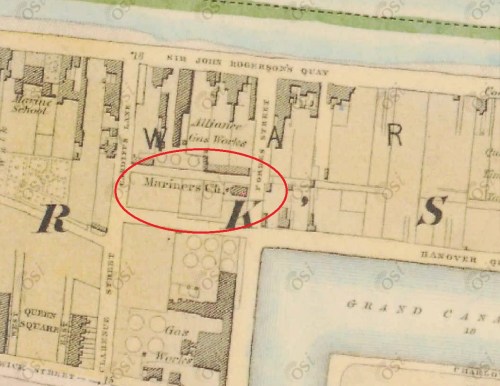
In 1833 the Society moved ashore to the new Mariners’ Chapel in Forbes Street. That was sold to the Gas Company in 1889; the 25″ Ordnance Survey map shows tanks on the site.

The Mariners' Church, Forbes Street, Dublin (OSI ~1838)

The Mariners’ Church, Forbes Street, Dublin (OSI ~1838)

In The Picture of Dublin or Stranger’s Guide to the Irish Metropolis. Containing an account of every object and institution worthy of notice, together with a brief description of the surrounding country and of its geology. New Edition. With a plan of the city and thirteen views (William Curry, Jun and Company, Dublin 1835) we read this:

MARINER’S CHURCH — In the year 1822, the Episcopal Floating Chapel, for the especial use of seamen, was fitted up and opened under the sanction of the late Archbishop of Dublin, and a Chaplain appointed, whose duty is not only to perform divine service, but to visit the vessels frequenting this port, and otherwise to attend to the spiritual wants of seafaring persons.

The Floating Chapel being old and decayed, and requiring frequent and expensive repairs, it was at length determined to substitute for it a Chapel on shore, to be built in the immediate neighbourhood. The first stone of the Mariner’s Church was accordingly laid by Vice-Admiral Oliver, July 18, 1832, in Forbes-street, Sir John Rogerson’s Quay.

This neat and commodious edifice, capable of containing 500 persons, cost, including school-rooms, &c, about £2000. It was opened for divine service, Sept 15, 1833. Hours of service on the Sunday, half-past ten AM, four PM; Lectures on the evenings of Wednesday and Friday, at seven o’clock. In winter there is a daily evening school for seamen, and a Sunday-school throughout the year.

It is in contemplation to erect another Mariner’s Church at Kingstown, immediately.

The National Archives have the society’s regulations, from October 1822, amongst the Chief Secretary’s papers [Record 3435]; the National Library has a report of proceedings from 1824 and another for the years 1837 to 1842. I found various items, mostly ads seeking funds, in Dublin newspapers of the 1860s; I found none for earlier years, which may suggest that a different variant of the name was used — or that the society was in less need of assistance.

In Britain, the Boaters Christian Fellowship keeps the faith afloat on the inland waterways; some of the Canal Ministries boats are pictured here. I am not aware of any similar organisation or activity in Ireland.

My OSI logo and permit number for website

Relationships: guest post by Adele Picard

I invited Adele Picard to write a piece explaining why canal-based boaters are distrustful of Waterways Ireland. I am very grateful to her for agreeing to do so. The post’s appearance here does not mean that Adele and I agree on all the issues, but we are agreed that relationships are important and that the relationship between WI and canal-based boaters needs to be improved.

The Comments facility has been switched off. bjg

Relationships between WI and canal boaters

I have been asked to write this piece to explore a range of issues faced by canal users in recent years.

I set up home in 2003 when my partner and I bought our first narrow boat Chimwemwe. We lived in Lowtown and were enjoying life so much that we bought a wide-beam barge Rigmarole in 2005. We moved ashore in 2007 and soon after got married and started a family. Fortunately my two little boys are just as mad about the boat as we are and we enjoy cruising all over Ireland on the inland waterways.

In this piece I will be talking about issues that I have witnessed myself as well as first-hand accounts that have been related to me by others. I would like to point out at this stage that what follows is my personal opinion and is in no way claimed to be representative of views that may be held by any Irish boating organisations I may be a member of.

Lack of regulation and enforcement of bye-laws has always been a contributing factor to the issues experienced by users of the canals and River Barrow. In the current times as Waterways Ireland (WI) attempts to throw down the gauntlet and assert some kind of control over the navigations, a deepening of these issues is inevitable.

Control = a means of limiting or regulating something in order to mitigate any inherent risk that may occur.

At the moment Waterways Ireland’s reputational risk among the boaters on the canals has been realised but can this risk now be mitigated?

Taking control of the electricity

During my time as a liveaboard in Lowtown, a lot of boaters availed of the precious electricity supply, regardless of distance from their vessel to the power points. This resulted in long leads being run down the towpaths. When the clampdown started on this sort of thing by WI in 2006, a warning was shot across the bows and soon after the electricity was removed. In some cases this action resulted in vulnerable people being left without shore power. People felt that this situation could have been handled better by WI. On the other hand, everybody knew that, underneath it all, this situation represented a serious health and safety violation. This for me was the first indication that WI was putting controls in place to minimise their exposure to risk.

The Lowtown fiasco

In early 2012, after WI pulled out of a deal with Robert Few and Vita Marine on the expansion of Lowtown Marina, a meeting was held with the residents, a representative from WI and the management of Vita Marine. What came out of that meeting was that everybody moored there had to leave within the following 30 days due to health and safety concerns.

This is where we as a boating community started to engage with WI on the issues, mostly through the Property and Legal section. The frustration of going back and forth with emails and letters with no clear answers forthcoming from WI was disheartening. Furthermore the action led to the desolation and abandonment of Lowtown. This is when we started to open our eyes to the lack of willingness from WI to engage with the boating community. Legal proceedings began shortly afterwards, and we got very little information after that.

Rollout of new permits

The introduction of new permits in 2012 was at first to me a positive step, as one of the main issues on the canal is the number of sunken vessels; there was a real need to implement controls where every vessel is registered so owners can be contacted.

Then you go a little deeper and realise that these permits come with new issues. I would like to make it very clear that I have no problem paying for permits, but the following issues have not been dealt with to my satisfaction:

  • the legality of the new indemnity clause
  • the lack of an appeals process when and if there is action taken
  • the need for a deposit
  • the lack of a dispute resolution mechanism.

Although WI will say that they are within their rights to introduce reasonable changes to the terms and conditions of their permits, in my opinion these changes are not reasonable. Furthermore, the complaints procedure is frustrating due to a weak corporate governance structure.

Extended Mooring Permit (EMP)

It was after I had given up the liveaboard lifestyle, although still using the boat regularly, that I noticed that far fewer of the usual gang were travelling by boat to attend social gatherings along the waterways. I subsequently found out that the commonly accepted gentlemen’s agreement that many liveaboards have in relation to their spots had been broken. A boater returning from a rally had their spot taken. This kind of behaviour added to the already problematic lack of movement of some boats which has raised debate before. People were afraid to move!

The addition of the EMP, I felt, could stop this situation, but friends of mine bought one in 2013 to find that when they went out for the day their spot was occupied on their return. A WI official said nothing could be done. The EMP is now not fit for the purpose intended.

Also for those of us who like to move around the system there seemed to be no options: we didn’t really need an EMP as we would be in many different locations over the season and one location in the winter.

Then the stickering started in selected areas on the canal for those in breach of the five-day rule. In one instance boats were being stickered for the breach in Lowtown, while less than a mile down the road in Robertstown boats that hadn’t moved for years were not stickered.

Furthermore boats that wanted to move on the Royal were encountering their own problems in relation to low water levels, canal closures and the difficulties lifting Newcomen bridge.

Of course a barrage of correspondence ensued from boaters with WI on all these issues only to be met with what was becoming the standard with WI: more emails and unclear answers. It’s hard to explain this frustration but what it feels like is someone just shrugging their shoulders at you and saying “I don’t know”. Not a good way to treat your customer base in these times of expected transparency and professional standards in public service.

Liveaboards

I think on the whole liveaboards in general would welcome regulation on mooring as long as the terms and conditions are not too harsh and the price is right. I think the terms and conditions that are currently on offer at this present time are too stringent and could be improved with some consultation with the users.

For example during the planning process on the proposal to build jetties in Sallins Harbour submissions were made to Kildare County Council in August 2012 asking that Sallins should not go down the same road as the jetties in Shannon Harbour and Grand Canal Dock, which were lying empty at the time.

Following this WI did actively consult with the boating community and a deal was struck. This shows how a positive approach and engagement can make a real difference to our waterways and the communities on and around them.

The Sallins lockout

This positive development now has a shadow lying over it. Subsequent to the start of the consultation period on the 2014 proposed bye-law amendments, a campaign was launched on social media by concerned boaters and support grew rapidly. A peaceful protest was planned for Sallins on 25 January 2014. What follows are a series of actions by WI:

  • on Friday 24 January a Marine Notice issued stating that the canal at Sallins would be closed from Monday 27 January
  • on the Friday morning WI blocked the western entrance to the harbour and removed the racks from lock 14 on the eastern side, stranding 6 boats between locks 13 and 14
  • a Marine Notice issued after the fact stating that WI were now closing the canal on 24 January.

There was a serious risk to those stranded boats not only from a health and safety viewpoint but also because most of them were too big to turn around on that stretch of canal.

Conclusion

My opinion on the events of the recent past is that WI has a lot to do in order to improve communication with canal boaters. If the true purpose of these bye-law amendments is to …

develop the canals as a vibrant recreational waterway for all users by enhancing Waterways Ireland’s ability to manage the investment in infrastructure and facilities on the canals for both the navigational and recreational user

… the only way forward is for WI to actively engage with the communities both on and around the waterways.

© Adele Picard 2014

Comments closing

Very large numbers of new readers have visited this site in recent days and have read my posts about the draft WI canals byelaws. I am grateful to them and even more grateful to those who took the trouble to comment.

I have spent pretty well the whole week on this, between reading the legislation and draft byelaws, writing up posts and responding to comments. I have fallen behind with other work, and accordingly I need to turn my attention to other issues.

I have invited one person to write a guest post on an aspect of the byelaws issue that I think is important, but that apart I won’t be adding new material on the subject for some time. Furthermore, later this evening I will close the existing posts to comments. Those posts, latest first, are:

Draft canals byelaws: comments on what I sent to WI as my contribution to the consultation process

Bang em’ up? Alas, no more on the enforcement mechanisms

Pull the plug: drain the canals on WI’s financial situation. I hope it is clear that I don’t really want to see them drained, but that I do think action is needed

Asleep at the wheel on why the production of new draft byelaws should not have come as a surprise.

The posts themselves and the existing comments will remain visible.

I hope that readers have found the discussion and information useful — even those who didn’t agree with my views.

My next substantial post will be on the Dublin & Kingstown Canal.

If you are interested in the mix of contemporary and historical waterways matters, you are welcome to subscribe to the site’s RSS feeds or by email. Note that the site is non-commercial and does not carry advertisements.

Jimmy Deenihan, cricketer

Jimmy Deenihan, minister for waterways and some other stuff, supporter of the Lartigue Monorail in Listowel, is known to have played two forms of football: rugby and Gaelic. His cricketing expertise is perhaps less well known but, in a written answer to four Dáil questions yesterday, he showed his mastery of the straight bat.

I was surprised to find Bernard Durkan [FG, Kildare North] referring to “traditional canal boat dwellers”. I suppose it depends on your timescales: in my view, anything that began after 1850 isn’t really traditional.

Drawbacks of canals

There was a proposal in the 1830s for a ship canal along the coast, outside the railway embankment, from Dublin to the asylum harbour at Kingstown. A preliminary report was provided by William Cubitt after the House of Commons Select Committee on the Dublin and Kingstown Ship Canal had reported in July 1833.

Henry E Flynn was opposed to the idea and, in his A Glance at the Question of a Ship Canal connecting the asylum harbour at Kingstown with the river Anne Liffey at Dublin &c &c &c [George Folds, Dublin 1834], dedicated to Daniel O’Connell, he wrote eloquently of the drawbacks of the proposal, which included this:

Be it remembered, that the whole coast from Ringsend to Merrion is the bathing ground for the less affluent classes of the Citizens; and hundreds get their bread by attending on and bathing the females who frequent it.

And are the patriotic Would-be’s who support a Ship Canal equally reckless of the health, the morality, and the existence of those persons? Would they have no objection to expose their mothers, wives, sisters and daughters to the immediate wanton gaze, the scoffs, the jeers, the immodest jest, the filthy exposure and indecent exhibitions which the most abandoned race of men [ie sailors] could find in their dissolute minds to perpetrate in their view, and within their hearing? And yet, all this must be the consequence of a Ship Canal in the immediate vicinity of the female baths and bathing ground along the line.

Happily, the canal was never built.

Bang ’em up? Alas, no more

According to the Sindo,

Concerns were also expressed that the new system of fines “will see the canals fall into a similar state of dereliction to the 1960s, when entire sections of the waterways were filled in”.

Right. Well. Yes. The Sindo evidently has its own definition of the word “new”. This is from Section 7 of the Canals Act 1986:

(3) A person who contravenes a bye-law under this section shall be guilty of an offence and shall be liable—

(a) on summary conviction, to a fine not exceeding £1,000 (together with, in the case of a continuing contravention, a fine not exceeding £100 for every day on which the contravention is continued and not exceeding in total an amount which, when added to any other fine under this paragraph in relation to the contravention concerned, equals £1,000) or to imprisonment for any term not exceeding six months or, at the discretion of the court, to both such fine or fines and such imprisonment, or

(b) on conviction on indictment, to a fine not exceeding £5,000 (together with, in the case of a continuing contravention, a fine not exceeding £500 for every day on which the contravention is continued) or to imprisonment for any term not exceeding two years or, at the discretion of the court, to both such fine or fines and such imprisonment.

Emphasis mine.

So a Sindonian “new” includes anything up to twenty-eight years old.

The provisions of the Canals Act 1986 were modified by the Maritime Safety Act 2005. Now, I am not a lawyer, but this is what I think is happening. I would be glad to hear from any of My Learned Friends who happen to be passing. My interpretation, open to correction, is this:

  • under the Canals Act 1986 and the 1988 byelaws, contravention of a byelaw is an offence for which offenders can be fined or imprisoned or both; the severity of the sentence depends on whether there is a summary conviction (District Court) or a conviction on indictment (higher courts)
  • the Maritime Safety Act 2005 increased the level of fines, removed the threat of imprisonment and made all but one of the offences subject to summary conviction, thus confining all prosecutions to the District Court
  • the exception is that contravention of byelaws relating to fees, tolls and charges is no longer an offence: Waterways Ireland may instead initiate civil court proceedings to recover amounts owed and may (presumably) seek to have any judgement enforced through the usual channels
  • the Maritime Safety Act also provides an alternative to prosecution for alleged breach of those byelaws whose contravention is still an offence. In such a case, Waterways Ireland may issue a fixed payment notice, seeking the sum of €150 which, if paid, will avoid prosecution. The proposed Byelaw 7 will enable this provision to be implemented.

Working out how a speedy system of enforcement will lead to the filling in of waterways requires an exercise of the imagination that is beyond me. But the only thing that is new here is that Waterways Ireland is implementing a power that it has had for seven years. Under the system introduced in 2007:

  • offending boaters can no longer be imprisoned
  • a breach of the byelaws is now a summary and not an indictable offence
  • non-payment of fees etc is no longer an offence but WI can recover the money through a civil court proceeding and by enforcing a judgement
  • for those breaches of byelaws that are still offences, there is a fixed-penalty alternative that avoids prosecution.

I think that the explanatory note at the end of WI’s draft byelaws document is badly drafted in that it does not explain the difference between breaches of byelaws that constitute offences and those (relating to fees etc) that do not. On the whole, the 2007 rules, now being implemented, seem to me to represent an easing of the rules on enforcement.

I repeat: I am not a lawyer; my interpretation may be mistaken. Caveat lector.

Pull the plug: drain the canals

The worst aspect of the piece published by the Indo last Sunday is that information is presented entirely without context. Persecuted boatowners are, it seems, to be forced to pay money, and the economy of the canals (such as it is) is to be damaged, for no reason whatsoever. The assertions of the boatowners go unchallenged.

Happily, this site provides a bilge-cleaning service. Here is the news.

1. Waterways Ireland is in dire financial straits

I have written extensively here about Waterways Ireland’s finances. I pointed out that there is a continuing dispute between the NI minister responsible for waterways and her southern counterpart, but that if the RoI government gets its way WI’s income will be cut by one third between 2010 and 2016. I showed that WI’s operating income is negligible and that most categories of expenditure have already been cut; I also showed that retirements will increase the cost of pensions benefits from just under €1000000 in 2011 to just under €2400000 in 2016, which will account for 10% of the total real staffing budget.

The combined effect is that Waterways Ireland needs to make further cuts in its spending, but that its scope for doing so is extremely limited: further cuts are bound to affect the staffing budget. WI’s only other option is to increase its (pathetically small) operating income.

2. canals and Barrow are disproportionately expensive

Here, I gave WI’s programme costs for 2011, taken from the annual report for that year (the most recent available). Here they are again, rearranged:

Royal Canal €2908k
Grand Canal €1556k
Barrow €600k

Total Canals + Barrow €5064k

Shannon €1882k
Erne & Lower Bann €478k
Shannon–Erne Waterway €658k

Total other waterways €3018k

There are all sorts of caveats to be entered about these figures: for instance, as I observed here, WI has different levels of non-navigational responsibilities on different waterways, and programme costs do not include staffing costs; nor do they include overheads like IT, marketing, personnel and so on.

But the Canal-and-Barrow costs clearly offer more scope for cutting than those for other waterways, as WI’s Corporate Plan 2011–2013 recognised. I showed here that it proposed these cuts for the period:

  • Grand Canal €910,000
  • Royal Canal €503,000
  • Barrow Navigation €387,000
  • Shannon Navigation €662,000
  • Shannon–Erne Waterway €232,000
  • Erne System €70,000
  • Lower Bann €69,000.

That’s €1800ooo in reductions from Canals + Barrow, €1033000 from the rest. However, budget developments since that plan was drawn up are likely to have increased the amounts required to be cut.

3. Canals and Barrow boaters get huge subsidies

I do not have up-to-date figures for the numbers of boats on the waterways, but suppose for the sake of argument that there are 500 on the Canals + Barrow and 8000 on the rest. I am confident that those figures are of the right order of magnitude.

In that case, counting only WI’s programme costs for the waterways in question and excluding staffing and central overheads, the costs to the taxpayer are:

  • Shannon, Erne, Shannon–Erne, Bann: €377.25 per boat
  • Grand, Royal, Barrow: €10128 per boat.

I hope to be able to provide better figures later, but the exact figures don’t matter very much: the point is that every boat on the canals and Barrow is benefiting to an enormous extent from taxpayer support. The poor persecuted boaters are seeking the continuation of a very, very privileged position: owners of camper vans, for instance, get no comparable benefit.

4. Canals and Barrow boaters contribute very little

I have figures for the numbers of boats on the canals and Barrow that held permits in September 2013. I have sought those for December, but I suspect that the number did not greatly increase by the end of the year.

By September:

  • 254 boats had Combined Mooring and Passage Permits
  • 134 boats had Extended Mooring and Passage Permits.

So the total contribution by boaters to the cost of the canals and Barrow was (254 X €126) + (134 X €152) = €52372, about 1% of the programme costs for the three waterways, which means it was considerably less than 1% of the total costs including salaries and overheads.

Let me dwell on that for a moment. The poor persecuted boaters, some of them members of organisations that claim to value the canals, themselves think that the canals are worth only €50000 a year, because that’s all they’re prepared to pay. It is not clear to me why anybody else, like the taxpayer, should pay more.

The poor persecuted boaters are now being asked to pay more than 1% of the total cost of the waterways they use (and, presumably, support). I would have thought that they would welcome an opportunity to contribute.

These figures also suggest that the level of compliance on these waterways is low, although I accept that my figures are inadequate and I will try to obtain more comprehensive information.

5. canals and Barrow are a poor use of public money

It is not clear how the taxpayer benefits by keeping the canals and Barrow open to navigation. Suppose Waterways Ireland were to open all the racks, drill holes in the bottoms of aqueducts and run off all the water. What then?

I suspect that it wouldn’t be that simple: that there are engineering-type reasons why some structures would need to be maintained and some water flow kept up. Perhaps the Morrell Feeder would suffice to keep the Grand Canal in Dublin looking nice; the flow from the Milltown Feeder, the canal’s main supply, could be sold off to Irish Water to relieve the Dublin drought. The Royal could simply be abandoned altogether; the Barrow would continue to be navigable by canoes and small craft. Shannon Harbour and Richmond Harbour could be kept in water (by pumping if necessary) and operated as commercial marinas, charging commercial rates.

Staffing could be reduced: even if there were no immediate redundancies (or transfers to Irish Water), the need for any new recruitment would be avoided for some time. Overtime would never be required and Irish Rail wouldn’t have to lift Effin Bridge.

So who would lose? The Irish tourist trade would hardly notice: as far as I can see, very few tourists go boating on canals or Barrow. There are two small hire firms on the Barrow Line, but apart from them there are (as far as I know: correct me if I’m wrong) only individual boats for hire here and there. Unless a large, well-capitalised firm, with a large marketing budget, moves in here, I can’t see there being any significant tourism activity that relies on there being water in the canals. Walking and cycling routes could be improved along the towing-paths, while the Barrow could also cater for canoeing and kayaking.

Who else benefits from having the canals and Barrow navigable? A publican or two in rural areas will sell an extra pint or two to passing boaters whose money might otherwise have been spent in Dublin; a takeaway in Tullamore will have a tiny increase in turnover … but that’s about it. This vast expenditure moves the spending of a few quid from Dublin to Daingean, but I doubt if the total is enough to create even one job in any location. I cannot see that there is any multiplier effect worth talking about.

Furthermore, such business as there is is highly seasonal, with very few boats moving any considerable distance other than in short periods in spring and autumn. Traffic is low in winter and summer.

Over the last ten years canal businesses have closed down. There were four hire fleets on the Barrow: they’ve all gone. Various trip boats have gone. Lowtown Marina is for sale. All of that during a period when capital expenditure on the canals was rising, facilities were being improved and charges to users ranged from low to non-existent.

I suggest therefore that spending on the canals and Barrow is not of any benefit to the tourist industry and is of minimal benefit to commercial service providers along the waterways. Instead the benefits go largely to two groups: the employees, who work for what they get, and the boat-owners.

6. Waterways Ireland should share the benefits

The cost of a year-round berth for a 60′ barge at a marina in a small village on the east (Dublin) side of Lough Derg is €3000. Lower rates are available on the west side.

The cost of a year-round berth for a 60′ (or any other size) barge in Shannon Harbour, a small village on the east (Dublin) side of the Shannon is currently that of an Extended Mooring and Passage Permit, €152. Thus Waterways Ireland is providing a benefit worth over €2800 to someone keeping a barge at Shannon Harbour.

I can see no good reason why Waterways Ireland should allow the Shannon Harbour owner the whole of that benefit: it would seem reasonable that Waterways Ireland should claw back at least half of it. Most marinas charge by the foot (or metre) of length, so rates for other boats could be worked out in proportion.

A berth at Shannon Harbour enjoys easy access to the Shannon; a berth in (say) Pollagh is less favourably situated and might thus be charged for at a lower rate. But berths closer to Dublin – say at Sallins or Hazelhatch or at the Leinster Mills on the Naas Branch — should attract a premium. And folk who are saving money by living in boats should be happy to share part of their savings with Waterways Ireland. (I don’t know what the premiums should be but, in another post, I’ll discuss pricing.)

The point here, the point ignored by the Indo, is that Waterways Ireland needs to narrow the gap between income and expenditure on the canals and Barrow. It is entirely fair that it should charge for the services it provides and that the burden should be borne by those who benefit.

However, it should be noted that WI’s charges are not inescapable: anyone who does not want to pay them is at liberty to remove his or her boat from the canal or Barrow and place it elsewhere, or to sell it and buy a camper van.

That being so, I see no more ground for objecting to any level of charge that WI might bring in than there is for objecting to the prices in, say, Brown Thomas.

Envoi

If (as seems to be the case) boaters’ organisations are incapable of engaging in rational discussion of the funding and management of the waterways, I suggest that Waterways Ireland should ignore them. Just pull the plug, shut down the canals and spend the savings elsewhere.

WI and the state should not continue to spend ridiculously large amounts of public money subsidising the leisure activities of a small number of people, who don’t themselves value what they’re getting, when there is little benefit to the economy as a whole. There has to be some better balance between income and expenditure on the canals and Barrow.