Category Archives: Canals

Another waterways mystery

According to Ruth Delany [Ruth Delany and Ian Bath Ireland’s Royal Canal 1789–2009 The Lilliput Press, Dublin 2010], the Royal Canal’s fast passenger-carrying fly-boats had neither toilets nor cooking facilities; the slower night-boats were better equipped.

So how did the fly-boat passengers relieve themselves?

Given that the boats travelled at six Irish miles per hour (about 12 km/h), any passenger who disembarked for the purpose would have found it difficult to catch up again. Yet standing on the notoriously unstable boats might have been difficult for the gentlemen, while the problems facing the ladies are not to be contemplated.

I don’t think that the india-rubber urinal had been invented by then. So what did they do?


Alice is at it again

Learned readers are no doubt familiar with Dame Felicity Lott‘s interpretation of the song Alice is at it again, wherein the nature of what Alice was actually at is left to the imagination of the listeners.

Aengus Ó Snodaigh [SF, Dublin South Central] and the Minister for Fairytales [FG, Drumlins/Stony Fields] have been performing a duet to something the same effect:

[AOS] To ask the Minister for Arts, Heritage and the Gaeltacht the steps she is taking in conjunction with Waterways Ireland to bring to an end an issue that is occurring with increasing frequency (details supplied).

[MfF] I have been informed that Waterways Ireland technical staff recently visited the location in question to assess the situation referred to by the Deputy and to determine the options available to try to make the location referred to by the Deputy less attractive to such activities. Waterways Ireland is currently assessing these options and, subject to available funding, hope to be in a position to implement measures to improve matters, while ensuring that any changes do not negatively impact on the general public.

With regard to an immediate response to dealing with the specific issue raised by the Deputy, Waterways Ireland staff do not have enforcement powers to restrict this activity.

I and Waterways Ireland would encourage anyone who witnesses such activity to report the matter to An Garda Siochána.

So unspecified persons have been engaging in unspecified activities at an unspecified location.

And if we see them at it we should tell the police.


Clonsilla again

I have added a thought to my post about stonework at Clonsilla. To save readers from having to open that page, here is the text.

Peter Clarke, in The Royal Canal: the complete story Elo Publications, Dublin 1992, points out that, in 1807, there was a passenger service from Dublin to Clonsilla: the six miles cost 1/7½ in first and 1/1 in second class.

Could it be that the passenger station was under the bridge, with access controlled by gates at either end? Horses could have been changed too, with the ramp providing access for horses to the road. Passengers too could use the ramps, but horses could not use steps. And, as modern canal users will attest, it is always easier to embark and disembark passengers under bridges, where there is deep water at the edge and where the boat does not have to go off its course.

If that is so, there might be similar stonework at the other passenger stations that were located at bridges rather than at harbours. There would be traces of gate pillars at either side of a bridge. Ramps would be required only where the canal bank’s level was significantly above or below that of the road.


McCanns and the Royal Canal

I mentioned McCanns, important Royal Canal carriers, here. The Dublin Mercantile Advertiser, and Weekly Price Current of 13 June 1845 mentioned the firm in another context. On 11 June 1845 the parliamentary committee on the Dublin and Mullingar railway examined H M Tuite, MP for Westmeath, on the subject. A Mr Callaghan appeared for Messrs McCann, “extensive carriers of the Royal Canal”, who opposed the proposed railway. He cross-examined Tuite who, in response to a Callaghan query, said

Since the canal has been under the management of Messrs McCann it has much improved in every respect; the goods are now punctually delivered at their destination.

It’s not clear what that means. Were McCanns managing the canal itself? Or were they effectively managing the general transport business thereon? Slater’s listing may imply that the Royal Canal Company carried (small) parcels pretty well everywhere but that McCanns dominated the general freight trade. At any rate, I would like to know more about McCanns.

From the BNA

The Patowmack Canal Company …

… and George Washington. And wars. And wealth.

Royal towpath Clonsilla

Visiting the Royal Canal at Clonsilla recently, I noted some interesting features of the canal’s stonework. I do not know how old they are or what they were for; I would welcome information from readers.
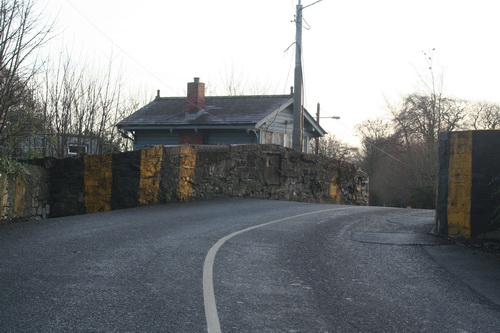
img_7796_resize

Clonsilla (Callaghan) canal bridge in the foreground; a railway signal box behind it

The towpath crossed from the south to the north bank at Porterstown (Kennan) Bridge, just east of this one. The passage boat Longford sank in 1845 between these two bridges; fifteen people died.
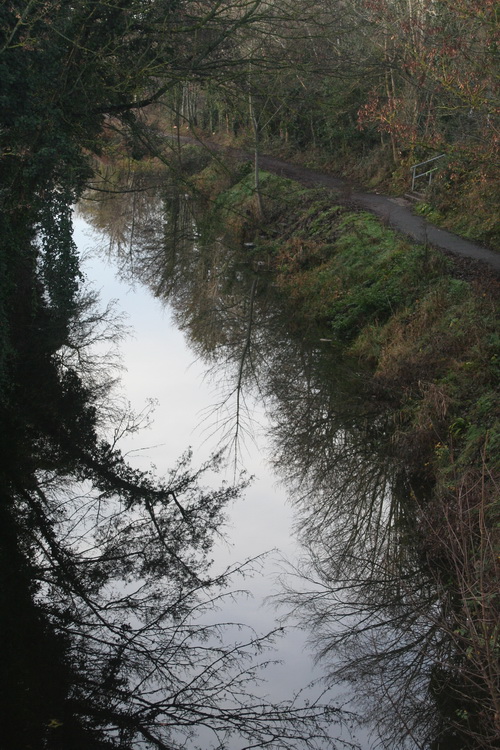
img_7792_resize

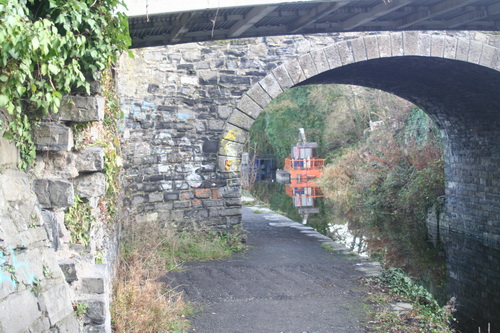
Looking west from the bridge

Clonsilla (Callaghan) Bridge (OSI ~1900)

Clonsilla (Callaghan) Bridge (OSI ~1900)

The Ordnance Survey of Ireland 25″ map of around 1900 shows what looks like a ramp leading up from the towpath, on the east side, to the level of the bridge and the road; the earlier 6″ map (late 1820s to 1840s) is less clear and I cannot tell whether the ramp existed then. However, the recent photograph, taken from the bridge, does suggest that the wing wall of the ramp has been built up, with newer stone, and that much of the area of the ramp has been taken in to the gardens above. This, of course, is speculation on my part and I would welcome clarification (leave a Comment below).
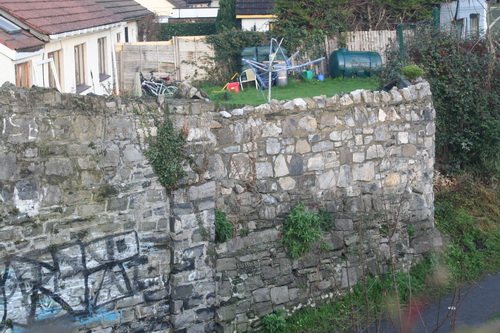
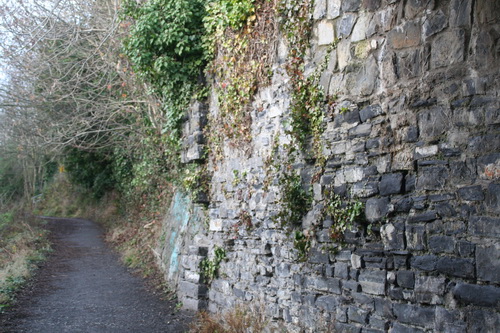
img_7797_resize

Built-up wall

Note what looks like a very tall gate pillar half way along. I don’t know much about architecture or construction, but the fact that the canal side is vertical makes it look to me more like a gate pillar than a supporting buttress for the wall of the ramp.
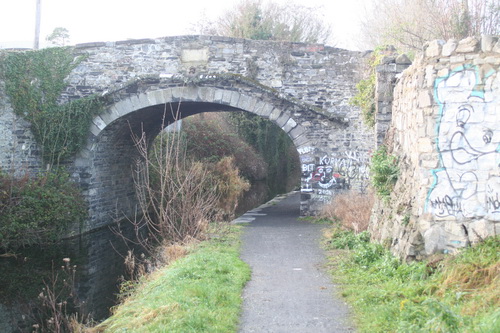
img_7800_resize

The eastern pillar from the towpath

Here’s a close-up. You can also see what looks like the dividing line between the older stone of the ramp, which slopes away from the towpath, and what I assume to be newer stone, built vertically, integrating part of the ramp (presumably with infill) with the garden above.
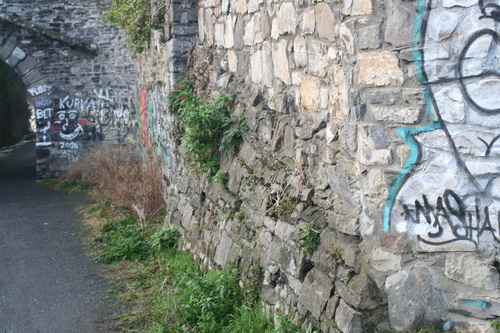
img_7801_resize

The eastern pillar from the towpath (close-up)

Here it is looking eastward (away from the bridge).
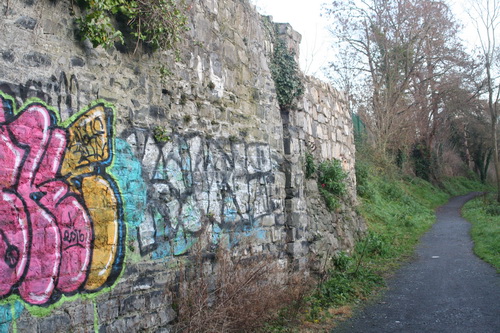
img_7803_resize

Looking eastward

There is a similar structure on the west side of the bridge.
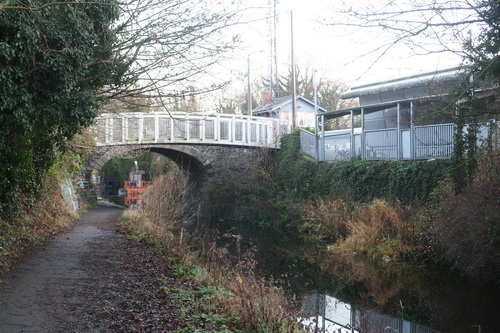
img_7798_resize

The west side of the bridge with a pedestrian bridge beside it; the railway station is on the right

Here is what looks like the remains of a similar gate pillar.

img_7805_resize

Western pillar (looking west)

Note the vertical face of the pillar against the slope of stones on the embankment,

img_7808_resize

Vertical face (with missing stones)

These pillars may have some engineering significance in holding up the embankment, but I wonder whether they might have been used to hang gates closing off access to the towpath for some reason. I don’t know whether other bridges have similar arrangements.

Waterways Ireland commissioned a Heritage Survey of the Royal Canal, which is available here [PDF], but that document does not contain any of the details and, judging by WI’s Heritage Surveys page, it does not seem that the “detailed database report” on the Royal will be made available on the WI website. Accordingly, I do not know what the survey says about these pillars.

All information welcome.

Addendum December 2016

Peter Clarke, in The Royal Canal: the complete story Elo Publications, Dublin 1992, points out that, in 1807, there was a passenger service from Dublin to Clonsilla: the six miles cost 1/7½ in first and 1/1 in second class.

Could it be that the passenger station was under the bridge, with access controlled by gates at either end? Horses could have been changed too, with the ramp providing access for horses to the road. Passengers too could use the ramps, but horses could not use steps. And, as modern canal users will attest, it is always easier to embark and disembark passengers under bridges, where there is deep water at the edge and where the boat does not have to go off its course.

If that is so, there might be similar stonework at the other passenger stations that were located at bridges rather than at harbours. There would be traces of gate pillars at either side of a bridge. Ramps would be required only where the canal bank’s level was significantly above or below that of the road.

My OSI logo and permit number for website

A one-act history of a bridge

The Limerick Harbour (Bridge) Act 1963 No 1/1963 (Private), in its preamble, gives the history of the swivelling section of the Wellesley (now Sarsfield) Bridge in Limerick.

THE LIMERICK HARBOUR (BRIDGE) ACT, 1963

Skipping some of the formalities …

WHEREAS by a local and personal Act of 1823 entitled “An Act for the erection of a bridge across the River Shannon and of a floating dock to accommodate sharp vessels frequenting the port of Limerick” the Limerick Bridge Commissioners were incorporated for the purpose of erecting such bridge and floating dock;

A swivel bridge was required …

AND WHEREAS to the intent that the navigation of the River Shannon might receive no prejudice it was provided by the said Act of 1823 that the bridge so to be erected or built under the authority of the said Act should be so constructed and built as that there should remain a free and open passage for ships and vessels to pass up and down the said river on the south side or end of the said bridge through, at, or near the said bridge; and that for such purpose there should be on the said bridge so to be built or on the bank immediately adjoining the south end thereof one or more swivel bridge or drawbridge or bridges so as to admit of vessels passing up and down the said river near the south bank thereof from the parts thereof above the said bridge to the parts thereof below the said bridge and the contrary;

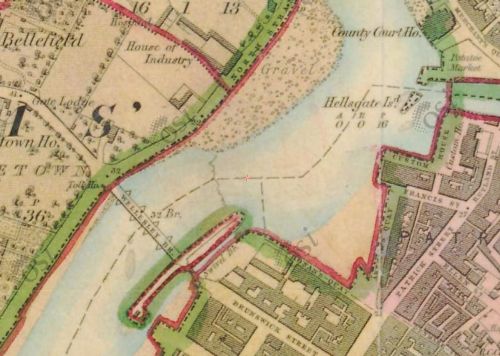
Wellesley Bridge (OSI ~1840)

Wellesley Bridge (OSI ~1840)

AND WHEREAS the said bridge (then known by the name of “the Wellesley Bridge” and now known as “Sarsfield Bridge”) and a swivel bridge in connection therewith were in pursuance of the said Act erected in or about the year 1825;

Control passed to the Harbour Commissioners in 1883

AND WHEREAS by virtue of an order of the Commissioners of Public Works bearing the date the 22nd day of March 1883 and made in pursuance of the provisions of the Wellesley Bridge (Limerick) Act, 1882 and of such provisions the said swivel bridge and the approaches thereto by water were vested in the Limerick Harbour Commissioners (in this Act called the Commissioners) for the use of the public and it was the duty of the Commissioners to maintain the same in good repair and condition and to work the same in such manner as to afford adequate accommodation to shipping and persons using the said bridge;

AND WHEREAS by an Act entitled “The Limerick Harbour (Bridge) Act, 1913” the Commissioners were authorised to make and maintain a new swivel bridge and approaches for vehicular and pedestrian traffic across the River Shannon in substitution for the said swivel bridge and the said Act provided that all powers rights duties and liabilities enjoyed by or imposed on the Commissioners at the date of the passing of the Act in connection with or in anywise concerning the swivel bridge or the approaches thereto by road or by water or the works in connection therewith and all byelaws in force at said date should be deemed to apply and should apply to the new swivel bridge and the approaches thereto and the works in connection therewith;

A new swivel section was built in 1923 …

AND WHEREAS the said new swivel bridge was in pursuance of the last recited Act erected in or about the year 1923 and has been since and still is in use;

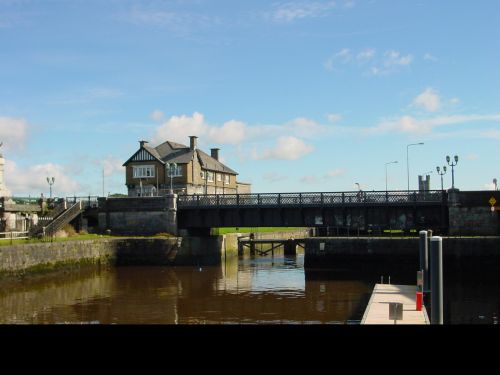
The formerly swivelling section

The formerly swivelling section

AND WHEREAS up to and including the 8th day of February 1927 the said new swivel bridge was from time to time opened by the Commissioners for the purpose of enabling ships and vessels to pass up and down the River Shannon to and from two quays on the east side of the bridge known as Honan’s Quay and McGuire’s Quay;

… but never opened after 1927

AND WHEREAS the new swivel bridge has not been opened for the passage of a ship or vessel since the month of February 1927;

AND WHEREAS Sarsfield Bridge and the new swivel bridge carry the main stream of vehicular traffic across the River Shannon to and from Shannon Airport and to and from the West of Ireland and the traffic by road over the new swivel bridge has increased greatly;

AND WHEREAS the opening of the said swivel bridge would cause a serious disruption of such traffic by road and pedestrian traffic;

Opening it would be a nuisance

AND WHEREAS it is expedient in the interests of the public travelling by road that the Commissioners should be relieved of their duty to open the said new swivel bridge for the passage of ships and vessels;

AND WHEREAS the purposes of this Act cannot be effected without the authority of the Oireachtas.

So the Commissioners don’t have to do it any more

Interpretation.

1.—In this Act unless the subject or context otherwise requires:—

the expression “the Commissioners” means the Limerick Harbour Commissioners;

the expression “the new swivel bridge” means the swivel bridge authorised by the Limerick Harbour (Bridge) Act, 1913.

Restriction of Commissioners’ liability in respect of swivel bridge.

2.—From and after the passing of this Act and notwithstanding anything contained in any other Act the Commissioners shall not be under any liability to open the new swivel bridge for the passage of ships or vessels or to maintain or repair the said swivel bridge in such a manner as to render the same capable of being opened.

Compensation.

3.—(1) Where this Act has the effect of curtailing or terminating a legal right of any person (including, in particular, a right of navigation, whether or not conferred by statute), such person may, within twelve months after the passing of this Act, make to the Commissioners a claim for compensation in respect of such curtailment or termination and he shall be entitled to be paid compensation therefor by the Commissioners and, in default of being paid such compensation when the amount thereof has been agreed upon or has been determined under this section, to recover it from the Commissioners in any court of competent jurisdiction.

(2) In default of agreement, the amount of any compensation payable by the Commissioners under this section shall be determined by arbitration under the Acquisition of Land (Assessment of Compensation) Act, 1919 (as amended by subsequent enactments) as if the compensation were the price of land compulsorily acquired and the arbitrator shall have jurisdiction to determine whether compensation is, in the circumstances, payable at all.

(3) Such compensation shall be paid by the Commissioners out of any moneys for the time being in their hands.

Expenses.

4.—All costs, charges and expenses preliminary to and of and incidental to the preparing, applying for and passing of this Act or otherwise in relation thereto shall be paid by the Commissioners out of any monies for the time being in their hands.

Short title and collective citation.

5.—(1) This Act may be cited as the Limerick Harbour (Bridge) Act, 1963.

(2) This Act, the Wellesley Bridge (Limerick) Act, 1882, the Limerick Harbour (Bridge) Act, 1913 and the Act 4 George IV Cap XCIV may be cited together as the Limerick Harbour (Bridge) Acts, 1823-1963.

I wonder whether anyone got compensation.

My OSI logo and permit number for website


GCC inspection launch again

The other day I posted an account of the Grand Canal Company’s inspection launch, built at its own docks in James’s Street Harbour in 1909. I said

I had not been aware of the existence of a GCC inspection launch later than the gondola of 1795. I would be glad of information from anyone who knows more about it: please leave a Comment below if you can help.

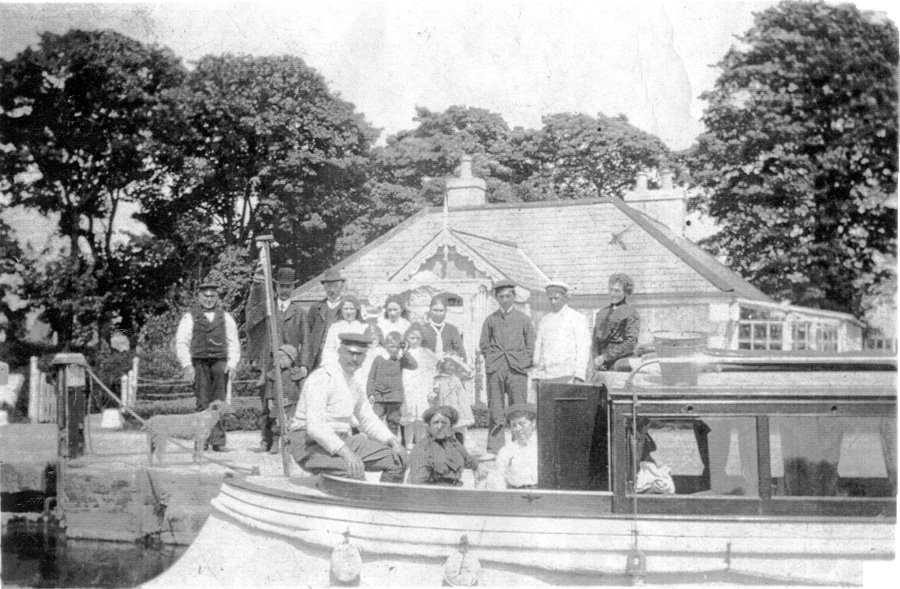
Then I remembered that, back in January, Alan Lindley had kindly permitted me to post this photograph, taken at Lowtown in 1911 or 1912.

Unidentified boat at Lowtown (courtesy Alan Lindley)

Unidentified boat at Lowtown (courtesy Alan Lindley)

 
Alan identified the man on the left of the group — with cap, waistcoat and watch-chain, and with a dog standing in front of him — as the lock keeper, Murtagh Murphy, the great-grandfather of the present incumbent, James (Jimmy) Conroy.

I said at the time that, although the boat had been described as a passenger flyboat, that seemed unlikely, and that the boat looked much more like a pleasure vessel than a working boat. I added:

If the Grand Canal Company had an inspection launch, this might be it, but I have found nothing to indicate that it did. The boat does, though, seem to have been designed for canal travel: it seems (from the twenty feet or so we can see) to have straight sides and to be well equipped with fenders. It might therefore have been designed to travel on the canals (as well as on other waters).

Well, now we know that the Grand Canal Company did have an inspection launch, built in 1909, not long before this photo was taken. Could this be it?


GCC inspection launch

Under the heading

GRAND CANAL COMPANY’S ENTERPRISE

the Irish Times reported, on 21 December 1909, on the trials of a launch newly built by the Grand Canal Company in their own docks at James’s Street Harbour.

The launch was 40′ long and 6½’ wide, screw propelled and driven by a Daimler 12-15 hp petrol engine. This engine was placed in the forward part of the launch

… and is worked in the manner which is usual with road motor cars: the driver or steersman sitting at the wheel having a clear view ahead.

That part of the launch was open; in the centre was a “deck-house or saloon, constructed principally of teak wood”. Aft of that was another open area. The launch could carry 20 people.

The saloon had “a sliding weatherproof door at the fore end, and two removable swing doors in the aft end”. It was lit by electric lamps and had cushioned seats at each side, with storage lockers underneath. A “table of novel design” was lowered from the ceiling when required, then pushed back up to leave a clear passage through the saloon. The launch, which was fitted up very tastefully, and

… the creditable manner in which the work of turning out the launch as a whole has been accomplished reflects great credit on the company’s workmen, and promises well for the future of local industries.

The trials were attended by the GCC General Manager George Tough and its Engineer Harry Wayte. The launch left James’s Street at 10.30am for Ringsend, travelled up the Liffey to Kingsbridge and back down again, before going out into Dublin Bay two miles beyond the Poolbeg lighthouse. On a measured mile in the Liffey, between the Pigeon House and the lighthouse, she managed 12 mph against the tide. She returned to James’s Street Harbour after arousing “considerable interest amongst spectators along the route”.

The launch was intended as “an officers’ inspection boat, to travel all over the company’s extensive system” of waterways routes.

The boat in every respect worked very satisfactorily, and reflected great credit on its designers. […] The success which has attended this experiment may lead to the establishment of fast or express goods boats all over the system.

I had not been aware of the existence of a GCC inspection launch later than the gondola of 1795. I would be glad of information from anyone who knows more about it: please leave a Comment below if you can help.

From the BNA

Disentangling Waterways Ireland

A possible outcome of the dog’s brexit?

Saith Alan Bermingham, policy and technical manager of the Chartered Institute of Public Finance and Accountancy:

I assume some of the cross-border bodies such as Waterways Ireland with separate jurisdictions would need to be disentangled,

He says that closing cross-border projects could increase administrative costs.