Category Archives: Canals

The (re)invention of heritage

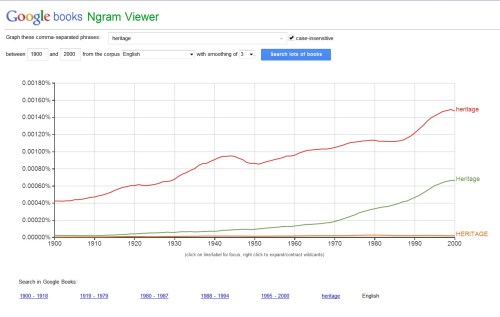
From Google’s Ngram viewer (more here):

ngram[Sorry, Google: couldn’t get the embedding to work properly. WordPress’s whitelist omits Google, though maps seem to work OK. Here’s the original.]

The growth in the use of “Heritage” with an initial capital is particularly interesting. I can think of three possible reasons:

  • that more organisations, eg The Heritage Council, use the word in their titles
  • that the word is increasingly used as an abstract noun at the start of sentences like “Heritage is important”
  • that the word is increasingly used as an attributive adjective at the start of sentences like “Heritage apples should be preserved”.

Traditional, personal uses (like “My heritage from my ancestors …”) are, I think, less likely to require initial capital letters. That in turn might suggest that Google’s Ngram viewer is reflecting a new(ish) set of meanings for the word and might lead us to ask what that new(ish) usage is (or was) intended to achieve.

It might also lead us to ask whether an even newer concept might now be more useful: one that would dissuade well-meaning folk from preserving and displaying context-free old tat and persuade them to find and record information instead.

The Gillogue railroad

Gillogue, in Co Clare, is the site of a former Burlington factory and of a Clare entrance to the University of Limerick. It is also the site of a lock on the Plassey–Errina Canal, a section of the old Limerick Navigation, and of quarries, gravel pits and lime kilns.

And, according to the 6″ Ordnance Survey map, of around 1840, Gillogue also had a railroad.

The Gillogue rail road

The Gillogue rail road (click to enlarge)

The railroad was almost certainly not for carrying passengers; it may have been a light railway, with small wagons pushed by men or pulled by horses, and designed to be taken up and moved elsewhere fairly easily. However, I have no hard information about who owned it, who built it or what it was for. I can make guesses, based on its closeness to the canal and to the quarries, but it would be nice to have evidence.

If, Gentle Reader, you know anything about it, do please leave a Comment below.

My OSI logo and permit number for website

G boats, Biffs, armoured cars and the Lagan

On the Grand Canal, M boats (boats with the letter M added to their numbers) were motor barges owned by the Grand Canal Company itself; E boats were engineering boats, used for canal maintenance and B boats (whether motor or horse-drawn) were bye-traders’ or hack boats, boats owned by traders other than the Grand Canal Company itself.

G boats were wooden horse-drawn boats, built to carry turf (peat) during The Emergency, which to the rest of the world was the second world war. Some of them [PDF] were built by Thompsons of Carlow, whose archives are now in the National Archives of Ireland; you can read about them in the Summer 2012 newsletter [PDF] of the Archives & Records Assocation.

The same organisation’s Autumn 2013 newsletter had an interesting article about Lagan Navigation archives in the Public Record Office of Northern Ireland. Unfortunately something has gone wrong with the links on its newsletter web page so the relevant PDF is not available at the moment.

h/t CO’M

Eglinton update

I have updated my page on the Eglinton Canal in Galway, adding some map extracts and some information about Parkavera Lock, kindly provided y Colin Becker.

An investment plan for the Naomh Éanna?

In a debate about the Naomh Éanna in the Dáil on 13 February 2014, Joan Collins TD [People Before Profit Alliance, Dublin South Central] said:

I understand the National Asset Management Agency and the Irish Ship & Barge Fabrication Company have expressed an interest in stepping in with an investment plan to restore her to her former beauty.

I see nothing about the ship on NAMA’s website, so I cannot provide any information about its views.

According to the most recent modified accounts for the Irish Ship and Barge Fabrication Company Ltd, on file at the Companies Registration Office, its total assets at 28 February 2013 were €286 in cash.

The company had no fixed assets.

Its called-up share capital was shown as €100000 and the balance on its profit & loss account was -€99714.

According to its Annual Return (B1), made up to 30 November 2013, its authorised share capital was €200000, made up of 100000 €1.00 ordinary shares and 100000 €1.00 Non Cum Red Pref shares. Only 100 of the ordinary shares were issued: 1 was owned by Saul Casey and 99 were owned by Sam Field-Corbett. All 100000 Non Cum Red Pref shares were issued and were held by Printation Limited.


What part of “no” does Brendan Smith not understand?

On 11 February 2014 Brendan Smith [FF, Cavan-Monaghan] asked a written question and got a written answer:

To ask the Minister for Arts, Heritage and the Gaeltacht the level of expenditure incurred to date in relation to the feasibility study and any other studies undertaken in respect of the proposed extension of the Erne Navigation from Belturbet to Killykeen and Killeshandra; if his Department proposes to review the decision not to proceed with this project any further; and if he will make a statement on the matter.

Jimmy Deenihan [FG, Kerry North/West Limerick] said:

I am informed by Waterways Ireland that expenditure incurred to date in relation on this project, the Lough Oughter project, on the Erne Navigation from Belturbet to Killykeen and Killeshandra is €84,647. I am also advised that, on reviewing the environmental information from this process, Waterways Ireland considers that the environmental designations of this lake complex make the feasibility of the proposed navigation extension highly unviable.

I understand that Waterways Ireland does not, therefore, propose to pursue this project any further at this time.

The thing is that Mr Smith asked about Lough Oughter back in December and was told then:

On reviewing the environmental information from this process, Waterways Ireland considers that the environmental designations of this lake complex make the feasibility of the proposed navigation extension highly unviable. For that reason, I am advised that Waterways Ireland does not propose to pursue this project any further at this time.

Unless Mr Smith thinks that Waterways Ireland has won the Euromillions lottery since December, he is just wasting time and resources by asking again about Lough Oughter.


Flood plains

Patrick O’Donovan [FG, Limerick] wants to drain the Shannon. Or wants farmers to do it. He doesn’t want the “multiplicity of agencies [which] have made it virtually impossible for anything to be done with the river and the rivers and streams draining into it”; he wants a non-multiplicity of agencies — “the OPW, the Department of the Environment, Community and Local Government, Inland Fisheries Ireland or whoever” — to dig sheughs and stop flood plains flooding. He says

The one group of people who seem to have no say are those who live on the banks of the rivers or who have watched thousands of gallons of water coming in their front door and out their back door.

But he is wrong. That is the one group of people who can stop flood waters coursing through their houses and who can do it most quickly, most easily and without the permission of a single state agency.

The solution is simple: they should move house, away from the flood plains to higher ground.

M’Gauley’s mysterious mechanism

In 1851 Alex Thom, Printer and Publisher of Dublin, produced the third edition of Lectures on Natural Philosophy by the Rev James William M’Gauley, Canon &c, Professor of Natural Philosophy and one of the Heads of the Training Department to the National Board of Education in Ireland. [The Morning Post of 9 October 1840 suggests that the first edition seems to have been in 1840: Longman, Orme & Co in London, W Curry, jun & Co in Dublin and Fraser and Crawford in Edinburgh.]

You can read the third edition of the Lectures here, paying special attention to any electro-magnetic apparatus, given that the Rev James read papers on the subject to the meetings of the British Association for the Advancement of Science in Dublin in 1835 and in Liverpool in 1837.

But I can find nothing, there or elsewhere, about his contributions to steam propulsion on canals. Several British newspapers copied this story from the Dublin Pilot in 1837:

We understand that the Rev Mr M’Gauley, of Marlborough-street, in this city, has completed a series of experiments upon a subject which for some time has occupied his attention — the application of steam to canal boats, with perfect success.

Our readers are aware that the great obstacle to the application of steam to packet boats on canals is caused by the great injury which would arise to the banks from the wave created by the paddles. He has, it seems, adopted a paddle on an altogether new principle; one of great simplicity and of such a nature that the injury to the banks shall not be greater than what is produced by the ordinary boat.

He gets rid entirely of backwater, his paddles work without noise, and require for their application a steam engine of the simplest construction.

It is said that Mr M’Gauley contemplates a velocity which to seem possible would require his working model to be understood. We hope and indeed believe, that Mr M’Gauley will not have to contend with apathy and want of enterprise in the introduction of so important an application of steam in Ireland, one which would render our canals incalculably more profitable and more useful than at present, and to give us an opportunity of consuming to advantage the turf with which so large a portion of the country is covered.

And in its issue of 29 December 1838 [No 803] the Mechanics’ Magazine, Museum, Register, Journal, & Gazette carried this story from the Dublin Post:

Steam-boats on Canals. — The Rev J W M’Gauley, Professor of Natural Philosophy to the Board of Education, we understand, has at length succeeded in fabricating a machine for propelling boats on canals without raising a surge, which has been very detrimental to the banks, causing a considerable annual outlay to keep them in repair.

The power will be derived from a steam-engine; but instead of the usual paddle-wheels, there will be a machine immerged in the water underneath the centre of the boat, the working of which will not cause the least ripple on the surface of the water. There will be a public test of the invention on the Grand Canal about a fortnight hence, with a boat fitted up under the immediate inspection of the Rev gentleman.

But I have found nothing after that: no report of the success or otherwise of the machine. I would be grateful for information from anyone who knows anything about it.

By 1840 the Rev M’Gauley’s attention had returned to electro-magnetic apparatus with a practical application. In November and December of that year several British newspapers reproduced this report from the Dublin Monitor [I take this from the Leicester Chronicle, which was so excited that it reported the news twice, on 21 November and 12 December 1840]:

Important improvement. — The Rev Professor M’Gauley, whose scientific experiments in electro-magnetism excited so much interest in the philosophic world some time ago, has communicated to some of the principal Railway Companies in England a valuable invention, which will be attended with most important results in the preservation of life and property from almost all the casualties to which they are at present subjected in railway travelling.

His object is to render the stoppage of the train entirely independent of the engine conductors; so that, should they, as was lately the case, fall asleep, get drunk, or otherwise become incapacitated for the discharge of their responsible duties, the steam can be turned off, and the train stopped, totally independent of them. The simple announcement of the object of Mr M’Gauley’s invention is sufficient to render its vast importance obvious to every man who has bestowed one moment’s thought upon the subject. We have been favoured with an examination of the invention, and consider it at once simple, ingenious, and admirably adapted to effect the desired end; its cost is trifling.

This important improvement has been submitted to the directors of some of the first lines of railway in England, to the Dublin and Kingstown and Ulster Railway Companies who are giving it their best consideration, and, we presume, will test its utility by experiment.

Addendum April 2017:  could this be relevant?

More on M’Gauley (lots of variant spellings) in Wikipedia and here in a short notice at the bottom right of page 376 of The Engineer for 1 November 1867 [PDF courtesy of Grace’s Guide]. Who knew that folk left the priesthood and got married in the nineteenth century?

A further brief mention here [January 2019].

A missed opportunity for railways

The Leeds Intelligencer of Saturday 16 September 1837 reported on the seventh annual meeting of the British Association for the Advancement of Science, which had begun at Liverpool on the previous Monday. The Mechanical Science section met, appropriately, at the Mechanics’ Institution with Professor Robinson of Armagh, President, in the chair.

It heard papers from Mr Williams on the Treffos Pump, Mr Kingsley on the Perspective Drawing Board, Mr Henwood on the Expansive Action of Steam in Cornish Mine Engines and Mr Russell on the Motion of Steamers in Shallow Waters. But the first and greatest paper was not delivered by its author, Mr G Remington [presumably George Remington, railway engineer], who was absent, but by Dr Lardner. Its subject was

… the Railway Balance Lock. The object of this was to do that upon Railways which is accomplished on Canals by means of Locks, namely, to raise the trains to any given height, according to the inequality of that surface.

You can read more about it here; interweb search engines will find more references. Perhaps it is not too late to have this innovation adopted.

Doonbeg

It seems that this chap has bought the glof course near the (proposed) Doonbeg Ship Canal. I’m sure that any further development will be in the best possible taste.