Category Archives: Engineering and construction

Mr Monks’s plan for inland navigation

According to Mr Monks‘s plan for the intended northern line of navigation, great accommodation and advantages would be afforded to the inhabitants of that part of the kingdom that lies north of the city of Dublin, particularly to those of the province of Ulster, who are so numerous — for all the sea ports, all the considerable towns and villages would have a cheap and secure interchangeable communication with each other, and the metropolis, in peace or war, safe from enemies and storms, most desirable objects to that extensive manufacturing country.

The design is to run a canal from Dublin to Blackwater-town (about 68 miles); the river Blackwater is navigable from thence to Lough Neagh — and with very little expence afterwards the following great general navigable canal communication would be opened:

  • to the east coast of Ireland by the river Liffey to the bay of Dublin
  • by the Boyne Navigation (which the northern line would intersect near Navan) to the bay of Drogheda
  • from Lough Neagh, by the Newry Navigation to Carlingford bay
  • to the north east coast from Lough Neagh by the Belfast canal to Belfast lough, or Carrickfergus bay
  • to the north coast from Lough Neagh by the river Bann to Colerain
  • and by off-branching along the Ballyhays river about 10 miles, to the east end of Lough Erne, which is nearly navigable to the town of Ballyshannon, would open a communication with the bay of Donegall to the west
  • and by the Grand Canal and Barrow Navigation to the south to Waterford harbour
  • by the western branch of the Grand Canal, which will be shortly completed, to the Shannon, and the Limerick Navigation to the south west of Ireland.

And we understand (in order that the inland towns and villages should reap every advantage by this general plan) he proposes that canals of very small dimensions (which are made at very little expence) should be extended from the great lines to them for boats of only four tuns burden, where water cannot be obtained to answer canals of a larger scale; and wastage of locks, in place of which he would substitute machinery on a plain simple construction, to raise and lower them on inclined planes at the rate of 100 feet in four minutes, and which would also answer instead of aqueducts and embanking across wide valleys, one horse would be sufficient to draw, and one man to attend ten of these boats chained together, the whole carrying forty tons with great ease.

Thus not only the wealthy merchant and manufacturer, but the most inferior tradesman would have an opportunity of attending and disposing of his goods at the best market (let the quantity be ever so small) on equal terms, which would be a great means to defeat and put down forestalling — a most destructive species of dealing in a manufacturing country,

Dublin Evening Post 19 January 1797

From the BNA


Hibernia

I see that P&O Cruises [about which there is a not-very-accurate Wikipedia page here: not very accurate, I mean, about the history of the P&O Line] will seek public suggestions for a name for its latest vessel, which they call “the nation’s ship”:

P&O has also previously run a similar exercise, coming up with the stately Britannia for a ship that launched last year. The company hopes for something similarly dignified and patriotic this time round […].

I do hope there will be a concerted campaign to have it named Hibernia, to recognise that

  • the single most important person in the formation of the P&O Line, Richard Bourne, was Irish
  • four of the eight original directors were Irish (and one was Spanish)
  • 83% of the company’s original capital of £304,600 in ships, exchanged for paid-up shares, was Irish owned.

Of course, as this great Irish company expanded, it took on more British shareholders and directors, training them no doubt in how to run scheduled steam shipping services, but it is about time that the Irish role was acknowledged.

See Freda Harcourt “Charles Wye Williams and Irish steam shipping 1820–1850” in The Journal of Transport History Third Series Volume 13 Number 2 September 1992, Manchester University Press, and Freda Harcourt Flagships of Imperialism: the P&O Company and the politics of empire from its origins to 1867 Manchester University Press 2006 [ebook now also available].

The habits of the papists

On 15 February 1833 the Earl of Roden presented to the House of Lords petitions from various places “praying for the better observance of the Sabbath”. Some of the petitioners seemed to be shopkeepers who liked to take Sundays off and didn’t want anyone else taking their custom while they were closed.

Lord Cloncurry, however, pointed to the problems such observance might cause in Ireland, where there were different understandings of what should be done on Sundays. He felt that

[…] care should be taken, in enforcing the law, not to create discord, and do mischief to the people.

Not that creating discord would have bothered Roden, one of the nineteenth century’s prize nitwits.

Cloncurry, of Lyons House, Ardclough, Co Kildare, near where a brewer is buried, was a director of the Grand Canal Company — or rather

He was engaged in the Canal Navigation of Ireland, which afforded valuable commercial opportunities to private individuals, and to those of the middling classes the means of maintaining their families in decency and comfort.

He pointed out to his noble colleagues that canal boatmen treated Sunday like any other day: boats left Limerick and other places on Saturdays and kept going throughout the weekend, probably stopping for mass on Sunday morning:

Noble Lords, perhaps, were not aware, that in the Catholic Church, the rule was to attend mass in the forenoon, and it was then deemed allowable to spend the remainder of the day in amusement or business.

However, two magistrates had “at no distant period” ordered the police to stop boats from travelling on Sundays. These were probably the magistrates in Athy and Monasterevan, as described by Nicholas Fanning of the Grand Canal Company in 1830. The result of the magistrates’ action was that the boatmen went to the pub and their cargoes were plundered. The same magistrates had stopped cargoes of cattle from Clare and Galway en route to Dublin port [although it is difficult to see why they would have gone through Athy or Monasterevan].

The act of the Magistrates already alluded to was in violation of law; for the proper course was to have summoned the boatmen for the offence, instead of stopping the boat. It was not, therefore, surprising that law should be held cheap in Ireland, when it was broken by those who ought to uphold it.

Roden said that Cloncurry should name the magistrates so that there could be an inquiry — Cloncurry refused as he didn’t want to bring odium on them — but he reckoned that they were probably only enforcing the law. Roden said

As to the opinions of Roman Catholics relative to the Sabbath, he would say, without meaning them any offence, that Parliament ought to legislate according to its own religious feelings.

He didn’t foresee the rise of the shopping centre.


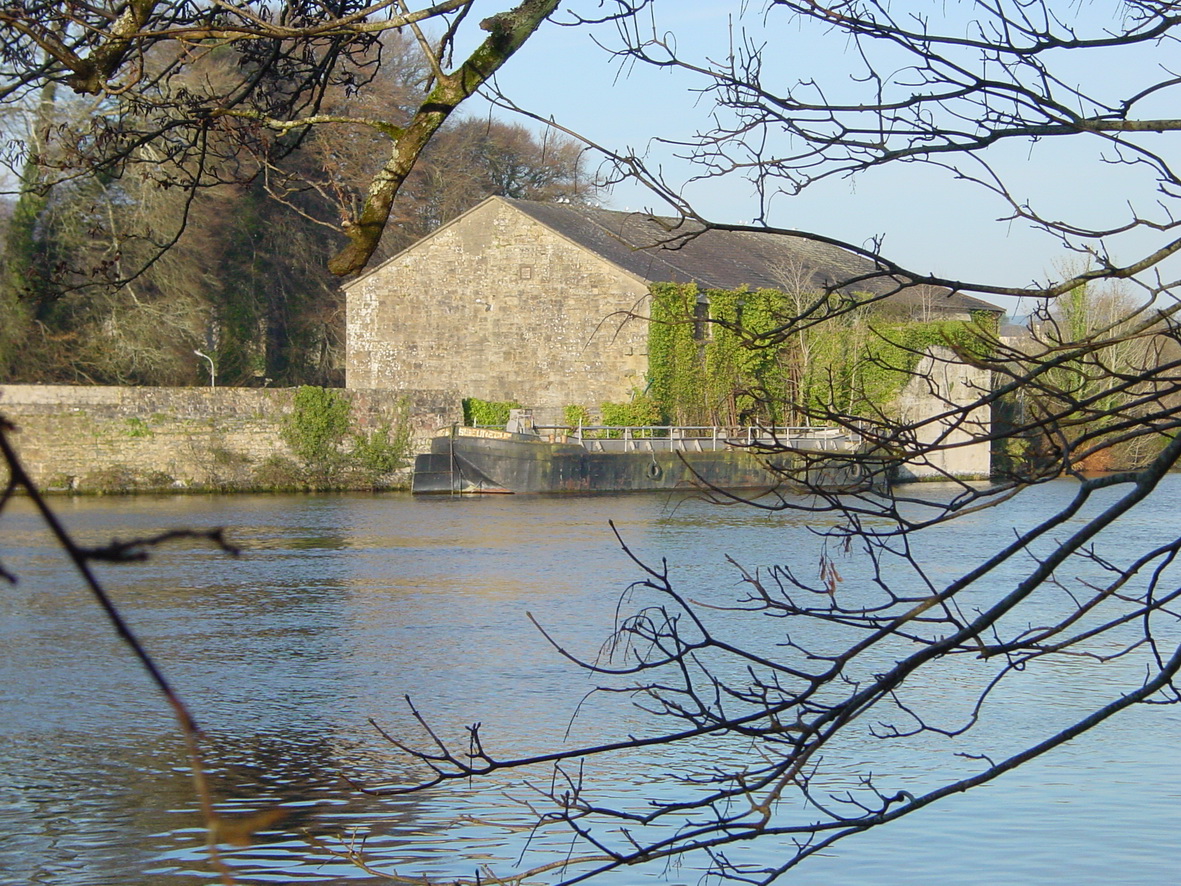
Marble from Killaloe

KILLALOE MARBLE WORKS

The marble mill in Killaloe

The marble mill in Killaloe

W & W Manderson

Beg respectfully to inform the Nobility, Gentry, and the Public in general, that they have (from their Practical experience) made considerable and most important improvements in the working and Polishing of Marble at the above Establishment, so that every variety of work is executed in a superior style hitherto unprecedented, and which has enabled them to offer at such Reduced Prices, as greatly to facilitate its general use both in public and private Buildings.

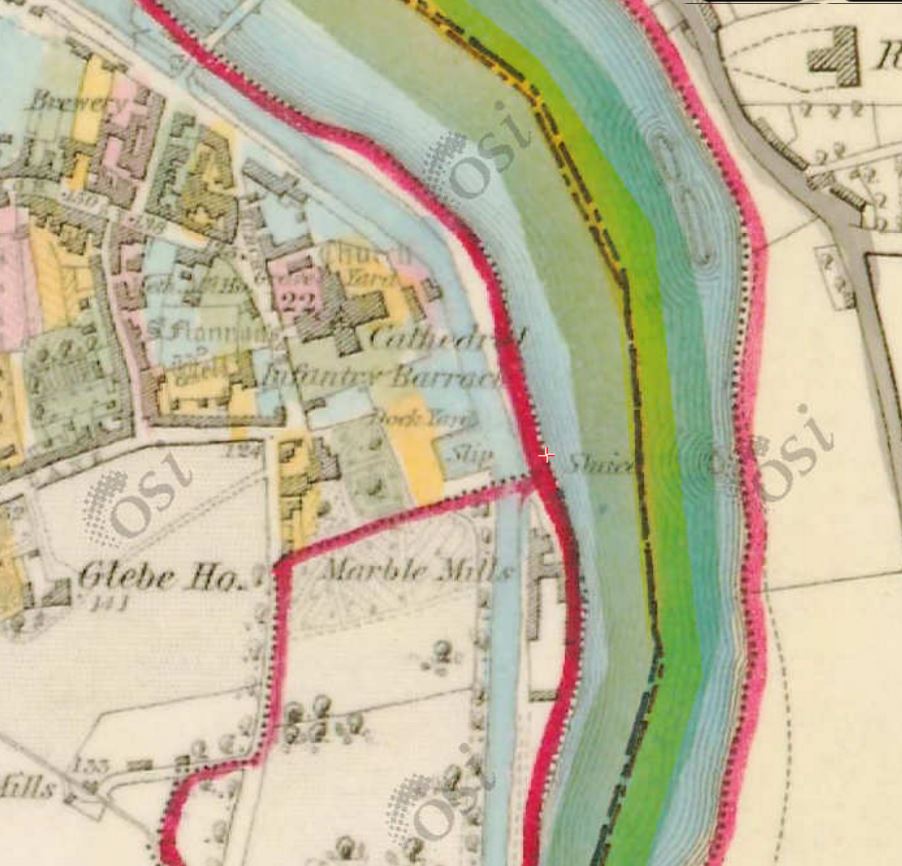
The marble mill at Killaloe (OSI 6" map ~1840)

The marble mill at Killaloe (OSI 6″ map ~1840)

They have for Inspection an Extensive Stock of Irish and Foreign MARBLE CHIMNEY PIECES (of various designs, suited for every description of rooms).

In STATUARY, ELABORATELY, SCULPTURED and CARVED, of exquisite designs and good material.

In VEIN, DOVE, BLACK AND GOLD, ST ANN, BURDILLA, SHANNON SIENNA, IRISH PORPHYRY, FOSSILS, GREY AND BLACK.

MONUMENTS, TABLETS, COLUMNS, BUST PILLARS, WASH AND DRESSING TABLES, TABLE TOPS, BATHS, PAVEMENTS, SLABS FOR DAIRIES, and various other Ornaments.

Also an Extensive Stock of MILL RUBBED, AND SQUARED FLAGS, WINDOW SILLS, BARGE AND EAVE COURSES, TOMB, HEADSTONES, &c &c.

The safe conveyance and fixing of work guaranteed if required.

July 28, 1842

Nenagh Guardian 6 August 1842

My OSI logo and permit number for website


Transport history

Tyler Cowen of Marginal Revolution quotes an interesting extract today from a new book on the history of India:

…the most important technological change for the transportation of heavy goods in nineteenth-century India was not the arrival of the quick, expensive railway: it was the move from pack animals to carts pulled by two or four beasts in the first half of the century.  This was the process historian Amalendu Guha calls ‘the bullock cart revolution’.  Throughout the 1860s and 1870s railways found it impossible to compete not only with bullock carts, but also with human-powered river transport.  Rowing boats along the Ganges and Jamuna won a price war with the railways over the cost of transporting heavy goods.  Vessels powered by human beings were able to undercut steam vessels elsewhere.

There is a description of the book (which I have now ordered) here.

How did transport in Ireland compare? In the first half of the century, road transport using Scotch carts dominated carrying. Within about 55 miles of Dublin, eastward of Mullingar on the Royal and Tullamore on the Grand, canal carriers did little business except in the heaviest goods: the Scotch carts, each drawn by one horse and carrying about one ton, dominated the trade. But the Scotch carts relied on there being good roads, which in many cases required government intervention of one sort or another.

But rowing boats do not seem to have been serious contenders on Irish inland waterways. They might have been used on the Shannon, to tow canal boats, and the idea was mooted, but nothing seems to have come of it. The problem, I suspect, was that there was little or no trade: when it did arrive, it did so because the steamers created it. And the capital cost of a large pulling boat might have been beyond the means of a small-scale entrepreneur who might have been able to afford a cart.

On the other hand, vessels powered by sail retained certain markets, including traffic across the Irish Sea, until the middle of the twentieth century.

Much about Irish transport history remains unclear to me.

Trolley canal boats

Fascinating page here; h/t TC/R&CHS. IIRC someone wrote to the Editor of the Irish Times in about 1906 suggesting an electric system for the canals in Dublin, but I cannot find the reference at the moment.

Cussane lock

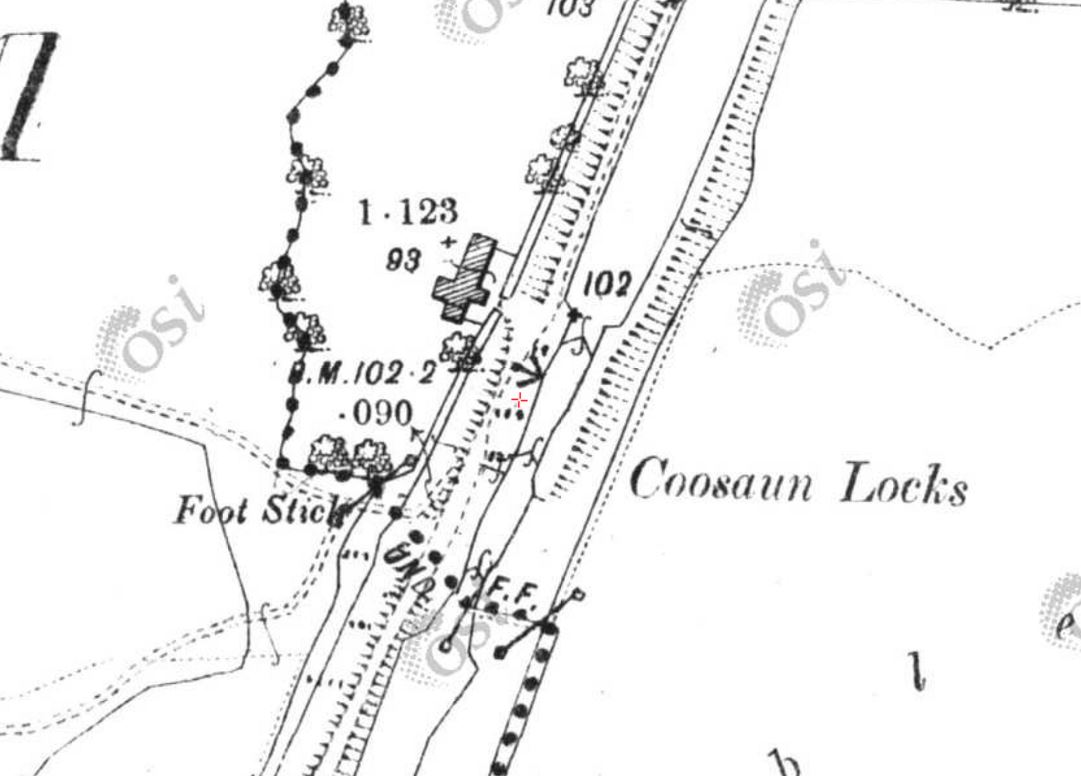
Cussane or Coosaun Lock was the lowest of three on the Killaloe Canal, which was the uppermost section of the Limerick Navigation. It was a double lock or “staircase pair”.

Cussane Lock (OSI ~1900)

Cussane Lock (OSI ~1900)


You can see what the lockkeeper’s house looked like in 2015 in the article “A Flooded Landscape Revealed“, written by folk who surveyed the area last year for Irish Water.

My OSI logo and permit number for website

An aerial view of the Shannon

I had much pleasure in availing myself of an ascent in Mr Hampton’s Balloon on Monday, accompanied by that gentleman and Mr Townsend. At two minutes to five, all the necessary arrangements being made, the bridling was cast off, and we ascended (apparently to us in the balloon gradually), but having relieved the car of five bags of ballast, which was thrown over, our ascent then became much more rapid.

The course taken by the balloon being at first almost due north we glided beautifully across the Shannon, and found ourselves at twelve minutes after five, at the north side of the river. The balloon, in this position, rested for some minutes, giving us an opportunity of gazing on the grand and magnificent panorama beneath us.

The prospect of Limerick was very extraordinary, every street, lane, and building, being at the same moment distinctly visible, but so apparently diminished in size that it assumed more the appearance of a beautiful miniature model than the actual city; the expanse of view was vastly greater than I anticipated, the various windings of the Shannon, with little interruption, being visible to Killaloe, above which the grand and noble expanse of water on Lough Derg was a prominent feature, flanked on either side with a lofty range of mountains. The view of the lower Shannon was also very attractive, extending far below the Beeves’ tower, and on which was visible one of the river steamers towing, I will not say a large ship, for it appeared no bigger than a turf boat.

We now bent our course towards Cratloe Wood, and at 22 minutes after 5, found ourselves standing right over its centre, the appearance of which was very extraordinary, the trees appearing more like a beautiful mantling of richly-coloured heath, or of short brushwood. Here I took an indication of a barometer, brought up at the request of Mr Wallace, the proprietor of the Observatory, for the purpose of getting for him its indication at the greatest altitude, and by which I found we were still ascending, soon getting us into another current, floating the balloon gradually towards the Shannon; and, at 30 minutes after 5, we found ourselves over the north bank of the river, opposite the Maigue.
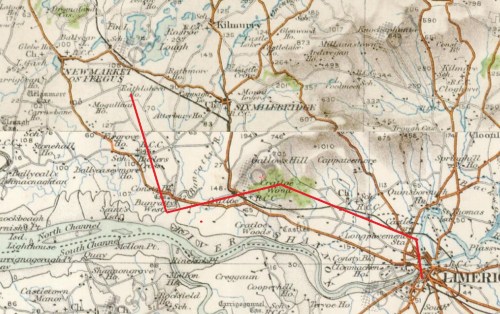
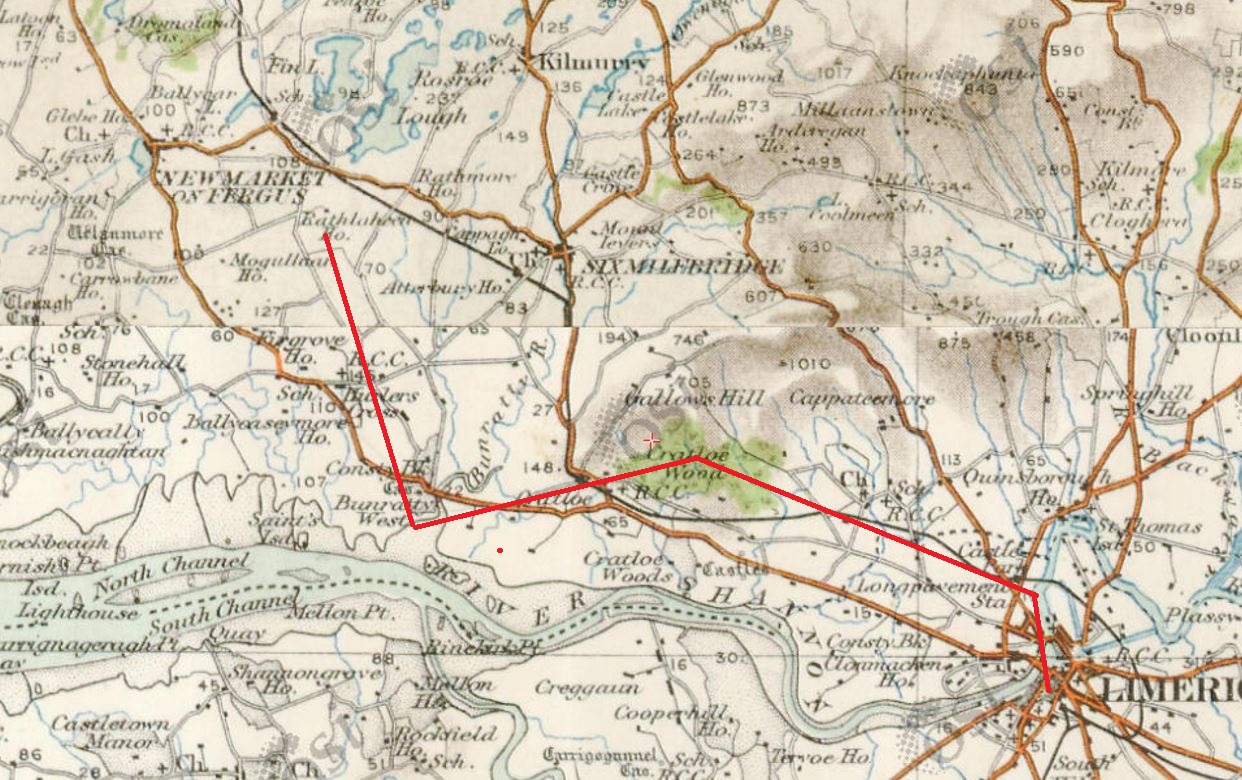
The flight of the balloon (OSI ~1840)

The flight of the balloon (OSI ~1840)

There, by indication of the barometer, it appeared we attained our greatest altitude, being then 4261 feet above the level of the river. The country beneath, from this great height, much resembled one of the Ordnance Survey maps. Undulations of the ground, except hills and mountains at a distance, not being visible, and large fields looking not much bigger than pocket-handkerchiefs; nor could I help thinking what a sad waste of land there was under stone walls, making such varied subdivision of property, and being much more numerous than I had any idea of.

At this altitude the atmosphere was so rarified that Mr Townsend felt his respiration considerably affected, which, under such circumstances, is very usual, though I did not experience it.

I was particularly attracted in this place, as would be supposed of perfect tranquillity, removed from the busy world, to find the buzz or murmuring sound of those beneath us (though, I need hardly say, invisible) ascend and fall on the ear distinct, though faintly, being different from any sound I ever before experienced, and but ill-conveyed by my inadequate description.

I found we had now got into another current diametrically opposite to what had been our last travelling, having taken a rapid course in the direction of Ennis. The barometer indicating a gradual descent, at 45 minutes after 5, Mr Hampton deemed it advisable to prepare for his descent, the country wearing a favourable aspect for doing so, and here he first worked the valves for that purpose; so that our descent and progressive movement now became very rapid.

And at two minutes to six we once more came in contact with terra firma; the car first striking obliquely two walls about 5 feet high, of dry masonry, being at either side of a road or bye way, through which it made a clean breach to the very foundation; the car, after passing through the breach, again oscillated, and found its resting place in a pasture field at the foot of Ralahine demesne, about three miles from Newmarket-on-Fergus, where we were quickly surrounded by a large peasantry, showing forth their true national characteristic generosity, for they not alone gave their most anxious aid in the saving of the balloon, and its various appendages, but many offered their horses to bring us into Limerick. Mr Creagh, I should also add, was most polite, having invited us to Ralahine, to partake of his hospitality.

I hope it may not be considered presumptive of me to state, from my slight knowledge of mechanical operations, that I consider Mr Hampton a perfect master of the management of a balloon, so far as practicable, and is, I feel, owed a debt of gratitude by the citizens of Limerick, for the very great treat which he has afforded them.

Hampden W Russell

Limerick and Clare Examiner 8 September 1849 in the British Newspaper Archive

Background

On Tuesday 21 August 1849 the Southern Reporter and Cork Commercial Courier announced that “Mr Hampton, the aeronaut” had arrived in Limerick and was preparing to ascend thence in his balloon, the Erin go Bragh. It was not his first flight from Limerick: he had ascended in October 1846, when the necessary gas (£14 worth) seems to have been sponsored by the “Limerick Gas consumers company” [Limerick Reporter 6 and 13 October 1846].

The 1849 ascent was on Monday 3 September from Mr Marshall’s Repository, Upper Cecil Street, and was advertised in advance. According to the Limerick and Clare Examiner of 29 August 1849, the “Splendid Band of the 3d Buffs” was to attend. Ladies and Gentlemen could watch from reserved seats [2/=; children 1/=] in a gallery; Second Places cost 1/=, children 6d.

Mr [John] Hampton offered seats in the balloon’s car to ladies or gentlemen who wished to accompany him; the balloon could lift six people and had two cars, one for descending over land and the other “for Sea-ports, in case the wind should be for Sea”. Those interested could find the fares by applying to himself at 12 Cecil Street or to Mr G Morgan Goggin at 34 George Street.


My OSI logo and permit number for website

From the BNA

RoI Budget 2016 for 2017

The Irish government’s Expenditure Report 2017 Parts I to III is available here [PDF]. The Department of Fairytales [aka Arts, Heritage, Regional, Rural and Gaeltacht Affairs] gets a 1% increase for Programme D, North-South Co-operation, subject to the approval of the North/South Ministerial Council.

This programme includes certain language bodies and, more importantly, Waterways Ireland. The estimate for capital expenditure, almost all (if usual patterns prevail) for Waterways Ireland, is the same as for 2016, at €2799000, which suggests that the good people of Clones won’t be getting a sheugh any time soon, although judging by today’s Irish Times [possible paywall], they don’t seem to be expecting one.

The Programme D estimate for current spending is up from €34925000 to €35166000, making for an overall increase of one per cent.

The department’s overall capital allocation is down, but changes in departmental functions and the ending of the special anniversary funding make it impossible to say anything useful about that. Looking forward, the department’s Gross Voted Capital Expenditure is shown as €119 million for 2017, €115 million for 2018 and €118 million for 2019.

Waterways are funded only in order to promote northsouthery:

The aim of this Programme is to maintain, develop and foster North-South co-operation in the context of the implementation of the Good Friday Agreement. Under this Programme, the allocation for 2017 will:

– Through Foras na Gaeilge and the Ulster-Scots Agency, promote the Irish and Ulster Scots language and culture; and
 Through Waterways Ireland, maintain the waterways for some 15,000 registered boat users.

I presume Waterways Ireland will get extra funding to work out a system of border controls for the Shannon–Erne Waterway.

More budget stuff here.


Shifting the deckchairs on the Titanic

Fianna Fáil, an Irish political party, has published what it describes as a “new Bill to help tackle River Shannon flooding“.

In fact, of course, the bill, if enacted, would do nothing of the sort, as the party itself admits. It proposes to add even more idiotic measures, including subsidies to encourage people to live in flood plains. But at the core of its thinking is that no interests, other than those of the inhabitants of flood plains, should carry any legal weight, and that that can be assured by placing a single body, the Electricity Supply Board, in charge of everything to do with the Shannon. Perhaps it was inspired by the ESB’s success in dealing with the salmon and eel fisheries — although some might prefer that the ESB concentrate on reducing electricity prices instead.

Blithering idiocy of this kind is not confined to Fianna Fáil and it is, I suggest, a reflection of the generally low level of ability and experience of Irish politicians. They are, I suggest, simply unable to think usefully about large and complex problems.

I tried to find CVs for all members of the current Dáil. I looked at Wikipedia entries, personal websites and party websites, as well as a few other sites that I hoped might have information.

I was looking for TDs whose CVs indicated significant experience in running large organisations or large projects: projects as large and complex as, for instance, managing Shannon floods, hospitals or the water supply.

I found nobody whose experience came anywhere near those levels (although it is of course possible that some TDs have such experience but choose to keep quiet about it). There were a few who had worked in medium or large organisations, but at junior levels, and some who had worked at senior levels in small organisations. Some of those with relevant experience had gained it in public or third-sector bodies: I was not looking solely for private-sector experience. But there were far too many who had worked in “professions” or as lobbyists of one kind or another, whose proudest boasts were of involvement in local bodies and of a desire to help individual constituents.

I’m sure they’re all very nice people. But I don’t believe that they have any conception of what it takes to analyse complex data, cost alternative policies or set up and run large organisations carrying out difficult tasks. Hence their focus on nit-picking and on the personal: they are simply unable to cope with anything more difficult. And  hence too their fondness for setting up new organisations, reallocating functions and passing laws: they can do all of those things (and perhaps find places on boards for their mates) without having to get to grips with the real, the complex issues. They don’t even have to cope with the chaos their meddling causes — and they then have a new set of people they can shout at.

Some of them might just about be able to organise a piss-up in a brewery; few if any of them could organise the construction and fitting out of anything as complex as a large brewery or could manage the operations of such a brewery. That might not matter if they worked on policy analysis instead, but few of them seem to have any abilities in that sphere either. The problem is one of scale: organising a successful parish bingo night, or an election campaign, is not sufficient preparation for running a large project or organisation.

I see that wiktionary defines “shifting the deckchairs on the Titanic” as

To do something pointless or insignificant that will soon be overtaken by events, or that contributes nothing to the solution of a current problem.

That about sums it up.