Category Archives: Engineering and construction

Asleep at the wheel

I see from one of the blatts that some boating folk are complaining about the prospect of reduced taxpayer subsidies for their canal-and-Barrow holidays. I’ll deal with the burden of their song later, but I was struck by the lack of foresight suggested by Mr Drennan, the author of the Indo story:

[…]  concern is growing about the shortness of a consultation period, which will close on February 3.

The timetable for consultations on proposed Waterways Ireland byelaws is set out in the Maritime Safety Act 2005, which amended the Canals Act 1986 and the Shannon Navigation Act 1990, giving people 21 days to submit objections to proposals. I cannot see why anyone should now be surprised or concerned that Waterways Ireland is obeying the law.

Furthermore, it’s not as if Waterways Ireland’s intentions were not known. For instance, on 25 September 2012 WI said in a press release:

Waterways Ireland has proposed a small number of draft amendments to the current Bye-laws which date from 1988. These include proposals to provide a range of charges for mooring permits that reflect the location and services provided throughout the canals and also will take into account the size of boat. These proposals include low cost rural moorings on soft banks to ensure the canals are accessible for everyone who owns a boat and requires a mooring. Boat owners allocated an extended mooring location in key areas in villages or towns or with services should be aware that if the new Bye-laws are approved Waterways Ireland will increase the charges for moorings in the future to reflect the location, services, and size of boat.

Anyone who has been paying attention to waterways affairs for the past few years must have been well aware of the direction of change. There has been plenty of time for folk to formulate their objections — or even to come up with sensible alternative long-term strategies.

Who he?

Question 3651, put to George Halpin, Inspector of Works at the Ballast Board, Dublin, at a session of the House of Commons Select Committee on the Dublin and Kingstown Ship Canal on 16 July 1833, Daniel O’Connell in the chair:

Who is Captain Bligh?

A very eminent nautical surveyor. […]

I thought everyone would have known about Bligh: wasn’t he famous for his breadfruit?

Lowering Lough Ree

I reported in October and in November on the lowering of the level of Lough Ree, in advance of heavy rain, to see whether that would help to manage flooding on the Shannon Callows further downstream.

The interim data from the experiment is available on the OPW website here [seven-page PDF]. The conclusion is:

Conclusion
From the water level records, it is apparent that the closing of the gates at Athlone weir in anticipation of a rise in water levels on Lough Ree led to a temporary lowering of the Shannon water levels immediately downstream of Athlone. This possibly delayed inundation of the Shannon callows downstream of Athlone by a number of days. To determine whether the extent or depth of eventual inundation was in any way reduced by the experiment will require more detailed analysis by the CFRAM consultants. Data is available on request from Hydrometric Section if required.

It should be stressed that this is an interim report. This CFRAM background document [PDF] is still useful.

It is not clear to me why the state should spend any money improving the value of privately owned riverside land that is of marginal benefit to the economy.


Cutting and pasting

One of the problems with all this newfangled technology is that some things — like, for instance, copying a block of text from one document into another – are so easy that folk may forget to check their work afterwards.

Consider, for instance, the Office of Public Works, which seems to have a block of boilerplate text ready for answering written boilerplate questions from midlands TDs who have discovered that things get wet when it rains.

On 22 January 2014 Denis Naughten [Ind, Roscommon/South Leitrim, which — let it be admitted — The Lord intended to be rather boggy and sad] had this question:

To ask the Minister for Public Expenditure and Reform the steps being taken to address flood risks within the Shannon basin; and if he will make a statement on the matter.

The answer tells Mr Naughten about CFRAM — nothing he didn’t know before he asked, I imagine — but it included this sentence:

On foot of discussions between my colleague, Minister of State Hayes and the IFA, and with the cooperation of both the ESB and Waterways Ireland, a water level monitoring exercise is being carried out as part of the CFRAM process which will allow for analysis of water flows and levels at key points around the Lough Ree and Callows areas.

The highlighting is mine: it seemed a bit odd because this written answer was allegedly being given by Mr Hayes.

Mr Naughten had another Q&A here, but it’s not very interesting.


Horace Kitchener and the peat briquette

I commented recently on the posthumous honour awarded to Kerryman Horace Kitchener, born at Ballylongford near Saleen Quay on the Shannon estuary. Part of the cost of building Saleen was paid by the College of the Holy and Undivided Trinity of Queen Elizabeth neare Dublin (whose present gaffer wants to change its name to something more snappy and brand-like, probably with an exclamation mark or a number in it (maybe he would like something modern: L33T or D00dz!, perhaps). The College of the Holy and Undivided Trinity of Queen Elizabeth neare Dublin owned large bogs in the area and sent turf to Limerick by boat.

Another turf connection has just come to my notice. Donal Clarke, in Brown Gold: a history of Bord na Móna and the Irish peat industry (Gill and Macmillan, Dublin 2010, but it is no longer on their website), says that in the 1850s Horace’s father experimented at Ballycarbery [which seems to be a long way from Ballylongford] “with the production of peat charcoal for se in the manufacture of gunpowder” and, in the process, discovered a way of making peat briquettes.

Not a lot of people (apart from Donal Clarke’s readers) know that.

Incidentally, Kitchener appears in this trip around the world with Irish waterways.

Matters of minor importance

Some recent(ish) discussions amongst the People’s Representatives. I haven’t time to analyse them all. All links courtesy of the estimable KildareStreeet.com.

Brendan Smith [FF, Cavan-Monaghan] wants a sheugh in Clones; he got the usual answer. And he allowed Jimmy Deenihan [FG, Kerry North/West Limerick] to announce, on 19 December 2013, the death of the suggested extension of the Erne navigation to Lough Oughter [loud cheers]:

Brendan Smith: To ask the Minister for Arts, Heritage and the Gaeltacht if he has received the feasibility study on the proposed extension of the Erne navigation from Belturbet to Killeshandra and Killykeen; and if he will make a statement on the matter.

Jimmy Deenihan: I am informed by Waterways Ireland that it commissioned a Strategic Environment Assessment for the possible extension of the Erne Navigation from Belturbet to Killeshandra and Killykeen.

On reviewing the environmental information from this process, Waterways Ireland considers that the environmental designations of this lake complex make the feasibility of the proposed navigation extension highly unviable. For that reason, I am advised that Waterways Ireland does not propose to pursue this project any further at this time.

Well, that’s one minor victory for sanity. Here’s how a dredger got to Lough Oughter in 1857.

Maureen O’Sullivan is anxious to recreate the economy of the eighteenth and nineteenth centuries by using canals for carrying cargoes. Especially on the Shannon–Erne Waterway, where commercial carrying was so successful before. [What is it about the Irish left?] Thank goodness that the sainted Leo Varadkar gave not an inch: someone should make that man Taoiseach, President and Minister for Finance. And Supreme Ruler of The Universe and Space.

The web-footed inhabitants of the midlands, who have discovered that they live in a flat area with rivers, keep wittering on about Shannon flooding, failing to realise that it is a message from The Lord, telling them to either (a) move to higher ground, eg Dublin, or build arks. On 15 January 2014 Brian Hayes told Denis Naughten, inter alia, that info from the recent OPW/CFRAM monitoring of water levels on Lough Ree (which I think was when the levels were lowered) would be placed on the OPW website “in the coming days”; I haven’t been able to find it yet so I’ve emailed the OPW to ask about it. And on 21 January one James Bannon said that he intends to introduce a bill setting up a Shannon authority, which will have magical powers. Well, if it doesn’t have magical powers it won’t be able to stop the Shannon flooding, but perhaps it’s designed to allow the unemployed landowners of Ireland another forum in which to demand taxpayers’ money to prop up their uneconomic activities.

Finally, a senator called John Whelan wants a longer consultation period on the proposed amendments to the canals bye-laws. I suppose I’d better read them  myself.

Reading list

Waterways Ireland has been putting out more and more stuff on its website.

If you haven’t already seen them, you can get the full set of Product Development Studies, in PDF format, here.

Even more interesting, to this site, are the waterway heritage surveys. Those for all waterways other than the Shannon are available here. The Shannon study was done some years ago (I remember making some comments on it at the time) and will be uploaded “in due course”.

I was in a WI office yesterday and had a quick look at the Lower Bann survey, which was done by Fred Hamond (so we know it will be good), and I’m looking forward to learning more about the waterway I know least about. It is done thematically and has lots of illustrations: Fred is able to see and present the bigger picture, but a full database, with all the supporting information, is available on request.

Maureen O’Sullivan asks sensible questions …

I am happy to report that Maureen O’Sullivan TD [Ind, Dublin Central] asked some sensible written questions in the Dáil on 15 January 2014.

Under the rather odd heading “Waterways Ireland Remit“, she asked Jimmy Deenihan [FG, Kerry North/West Limerick; Minister for the City of Culture]

[…] if he will include work on land maps to determine what land abutting the canals is owned privately, by Waterways Ireland, the Railway Procurement Agency, Iarnrod Éireann, Dublin City Council, Office of Public Works or other; and if he will make a statement on the matter.

The minister replied:

I am informed that Waterways Ireland already has an ongoing programme to modernise historic canal ownership maps and register navigation property in its ownership.

She put another question to Jimmy Deenihan under the same heading; you can see the link between the two questions:

[…] having regard to the prospective re-opening of the Royal Canal towpath at Portland Place in Summer 2014 further to the refurbishment of the collapsed wall at Portland Place and having regard also to the Spencer Dock Greenway Project and the re-lining works to be carried out at the sixth level, if he will direct Waterways Ireland to commission a strategic environment assessment for a new canal-side walkway along the south side of the sixth level of the Royal Canal at Phibsborough from Shandon Gardens to the railway bridge at the seventh lock with a new pedestrian crossing (details supplied); and if he will make a statement on the matter.

The only problem with this is that even getting an environmental assessment done is likely to strain WI’s budget at the moment, so it’s not a good time to be suggesting new expenditure. However, it didn’t matter in this case, as Jimmy Deenihan explained:

I am informed by Waterways Ireland that it does not own the lands on the southside of the Royal Canal between Shandon Gardens and the 7th lock, at Liffey Junction and therefore will not be commissioning a Strategic Environment Assessment for a new canalside walkway.

She also asked Alan Kelly [Labour, Tipperary North] about that:

[…] noting that it is the intention of the National Transport Authority to pursue a cycling and walking greenway along the Royal Canal in Dublin city, if he will ask Iarnród Eireann, the Railway Procurement Agency and Dublin City Council to assess the viability of opening a new walkway along the Royal Canal, 6th level, from Shandon Gardens to the 7th lock with a new footbridge at the 7th lock railway crossing linking to the existing Greenway route; if, in particular, this option will be explored alongside any re-lining work that might be undertaken by Waterways Ireland along that level.

He said:

The development of walking and cycling facilities within the Greater Dublin Area is a matter for the National Transport Authority (NTA) in conjunction with the relevant local authority, which is Dublin City Council in this case.

The NTA provides funding to local authorities for a range of schemes to benefit pedestrians, including new walkways, under the Sustainable Transport Management Grants Programme. Accordingly, I have sent your request to the NTA and have asked them to reply to you directly in relation to the above matter.

I’m all in favour of getting money from other people to pay for waterways.

Finally, under the heading of Inland Waterways Development, she had another question for Jimmy Deenihan:

[…] if he will explore all possible options within current fiscal constraints to advance and develop the potential of the Royal and Grand canal lines that pass through Dublin city; if he will establish an inter-agency group on the Dublin City reaches of the Royal and Grand canals; if he will explore ways to advance their development, examining funding options, including existing funding streams and the leveraging of funding from other sources and the possibility of EU funding which may be available.

I might say at this stage that I don’t see why TDs are asking ministers about stuff that they could find out themselves by asking WI directly. It’s not as though they’re going to get a lot of favourable publicity by doing so: this isn’t the PAC grilling a hospital or charity board and the meeja aren’t really interested.

Anyway, Jimmy Deenihan replied:

As the Deputy may be aware, the Dublin City Canals Study [PDF] was launched on 20th July 2010. This was prepared by consultants on behalf of Waterways Ireland, Fáilte Ireland, Dublin Docklands Development Authority and Dublin City Council. The study examined the existing activities on the Royal and Grand Canals and identified an overall vision for the development of the City Canals within the M50. I am advised that following on from the study an Operations Liaison Group plus two sub-groups (one for the Royal Canal and one for the Grand Canal) were established and continue to meet to deliver the recommendations identified, within the current fiscal constraints.

I am informed that to complement the above study, Waterways Ireland engaged additional consultants to carry out a detailed study of Grand Canal Dock and Spencer Dock with the objective of producing a Master Plan, currently at draft stage, that realises their potential as a recreational amenity and a living, vibrant part of Dublin and its Docklands. Waterways Ireland will continue to work collaboratively to unlock the pivotal role of these two major docks and to attract funding to develop a maritime quarter within the city of Dublin.

I wasn’t very impressed by the Dublin City Canals Study, which didn’t seem to me to be rooted in actual conditions in Dublin. I will look forward to seeing the master plan for the two dock areas.

Anyway, that was a more sensible set of questions from Maureen O’Sullivan, and it kept her off the subject of Effin Bridge.

Waterways Ireland’s pensions burden

Let us suppose that you are an Irish civil service department, whose staff are employed on standard Irish civil service terms.

And let us suppose that your Secretary General’s 65th birthday was on 31 December 2013, by which time she had 40 years’ pensionable service. Her salary was €250,000 a year, so that’s the amount you (the department) paid to her in y/e 31 December 2013. Because of cutbacks, she is replaced, from 1 January 2014, by someone earning half that amount. So what is the cost of SecGens in 2014? Keep it simple: ignore employer’s PRSI and allowances and travel expenses and anything else.

Civil service pensions

In 2014, you will pay the new SecGen €125,000, half the old rate, but you will pay the retired SecGen €500,000, so your total expenditure on SecGens will rise from €250,000 to €625,000. [The timing may not be quite thus, but never mind.]

In 2015, the new SecGen will continue to get €125,000, but so will the old SecGen. So, even though your new SecGen gets half what the old one earned, the total cost to you remains the same.

And so on until the old SecGen dies. But if the new SecGen retires before that, you will have two retired SecGens drawing pensions and one even newer SecGen getting a salary ….

Under ordinary Irish civil service terms, someone who retires is entitled to a pension of one eightieth of final salary for every year of service, up to a maximum of forty years. So a SecGen who started, say, as a graduate entrant at the age of 25, stayed in the civil service and retired at age 65, would be entitled to a pension, for life, of half her final salary.

She would also be entitled to a lump sum of one and a half times her final salary. That’s why, on retiring, she gets an amount equal to twice her final salary: 1.5 times salary as a once-off lump sum plus 0.5 times as pension.

You could argue that that is an absurdly generous arrangement, but that’s not my point here: someone who started work 40 years ago under those conditions can’t be criticised for taking the money they’re entitled to, and it will be a long time before any revisions could take effect.

These pensions are defined benefit, non-contributory and unfunded: no money is put aside by either employees or the employer to meet pension payments in future years. It is assumed that the taxpayer will continue to meet the increasing costs.

Now, that’s all very well for the main-line civil service: it has been in existence for a long time; it’s very large, with a large pay bill; it has had SecGens retiring before and another retirement or two won’t greatly affect the overall cost.

But if you’re a relatively small organisation, dependent on the exchequer for most of your income but without any of getting extra money to pay for pensions, the retirement of one or two senior officials, or of larger numbers of lower-paid employees, could significantly increase your costs while doing nothing to improve your income or the amount of work you do.

That is happening to Waterways Ireland at the moment. I’ll give some details shortly, but first I want to get the pension scheme out of the way.

The woodchuck pension fund

Here is Wikipedia’s version of the tongue-twister about the woodchuck:

How much wood would a woodchuck chuck
if a woodchuck could chuck wood?
A woodchuck would chuck all the wood he could
if a woodchuck could chuck wood!

Coverage of the Waterways Ireland pension scheme in its annual reports reminds me of the woodchuck. I should say immediately that that is not a criticism of WI: it’s down to an accounting standard called FRS 17.

As far as I can make out, this standard requires WI to show in its accounts the entries that it would make for its pension fund, if it had a pension fund, even though it doesn’t have one. It does have a pension scheme, which I imagine sets out the rules about who is entitled to get what, but there is no pot of money put away, guarded by fierce trustees, to ensure that the pensioners of the future will get their money. Here is how I understand it; if I’m wrong (which wouldn’t be surprising), do please correct me in a Comment below.

WI’s balance sheet shows (for 2011) a liability of €66,432,000 and a balancing asset of the same amount; both of them are imaginary figures. Similarly, the income and expenditure account shows the amount that WI (in theory) should have paid in 2011 for the pension benefits that its staff accumulated in that year, along with an imaginary interest charge on its total liability. Those are then balanced by a figure called “Net deferred funding for pensions” which, at €4385000, is by far the largest component of WI’s “Other operating income”.

Obviously that lot would look better if it had corroborative detail to provide artistic verisimilitude, so the accountants or the pensions bods or someone did other calculations of currency translation charges and transfers in and out of the scheme and service costs and so on, all on a non-existent pension fund.

Now, as far as I can see, we can ignore all that. But there are two cash figures that are real and important:

  • one is that WI staff paid (was it under the public service pension levy? or something else?) €230,000 in contributions in 2011, for which they will receive benefits of €2,744,000, ie twelve times what they put in
  • the other is that in 2011 WI paid out €934,000 in actual pension
    benefits to people who had retired by then. That presumably includes
    any retirement lump sums.

Incidentally, WI’s 2011 accounts (the most recent available) make no mention of the North South Pension Scheme (see below), of which WI is a member. Perhaps the stuff in WI’s accounts is about its imaginary portion of a combined but equally imaginary fund under the North South Pension Scheme. The meetings of the NSPS CEO Pension Committee, which “exercises trustee-like functions” [seriously: see below], must be fun.

Not being an accountant (I feel I lack the necessary creativity), I am interested in the actual cost to WI of the benefits it pays out to folk who retire.

Retirements

I asked WI how many people retired in 2012 and 2013 and how many were expeected to retire in the next three years.

WI retirements 2012–2016

Figures for 2012 and 2013 are actual; those for later years are expected. Source: Waterways Ireland

Those who retired were:

  • 2012: 3 lockkeepers, 1 boatperson, 1 director of marketing, 1 mechanical fitter, 1 general operative [GO] plant operator B, 1 preserved pensioner
  • 2013: 1 chief executive, 1 clerical officer, 1 GO, 2 GO chargehands, 3 GO plant operator As, 1 GO plant operator B, 1 boatperson, 1 boatperson/skipper, 1 lockkeeper.

WI could not say what grades were expected to retire in 2014, 2015 and 2016. If they did, of course, I’d be able to guess which senior managers were about to retire; as it is, I have to rely on rumours. WI was able to predict the lump sum and pension payouts for 2014–2016, so I suspect it has a good idea who intends to retire.

The total number retiring in those five years is 81, which is about a quarter of the entire WI staff (currently 325). That’s a big proportion of the staff. No doubt it reflects the age profile of staff who transferred into the organisation but the figure may be boosted by the Hutton Push [see below].

Lump sums

Here is what WI expects to pay out in retirement lump sums in 2014, 2015 and 2016, and what it actually paid out in 2012 and 2013. Note the big increase in 2014. These sums are paid on retirement and are not recurring: in other words, they are made only to those who retire in the year in question.

Actual amounts for 2012–2013; predicted amounts for 2014–2016. Source: Waterways Ireland

Actual amounts for 2012–2013; predicted amounts for 2014–2016. Source: Waterways Ireland

If all lump sums are 1.5 times final salary [something of which I can’t be certain], then we can work out the total of the final salaries of the retiring employees.
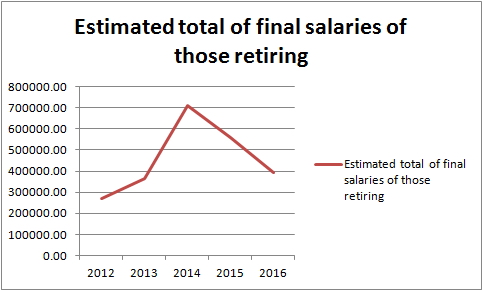
Source: actual and forecast lump sum payments divided by 1.5

Source: actual and predicted lump sum payments divided by 1.5

And, as we know the number of people expected to retire in each year, we can work out the average final salary for each year.
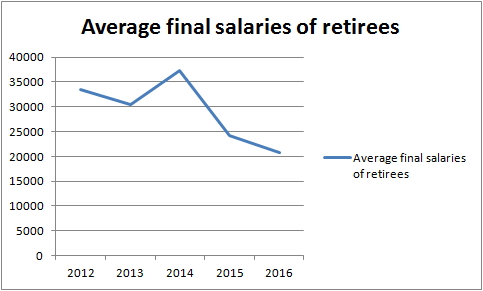
Source:  estimated total final salaries divided by expected numbers of retirees

Source: actual and predicted total final salaries divided by numbers of retirees

It looks as if some senior staff may be expected to retire in 2014.

Annual pension payments

The lump sum amounts are paid only to those retiring in the year in question, whereas the annual pension payments include those to people who started drawing pensions in 2011 and earlier years. But the lump sums are once-off, whereas the annual payments will continue to increase as more people retire.

Source: Waterways Ireland figures for total pension pay-outs less lump sums

Source: Waterways Ireland figures for actual and predicted total pension pay-outs less lump sums

The effect on WI’s finances

The totals of the lump sums and annual pension payments show how much WI has to pay out in each of the five years.
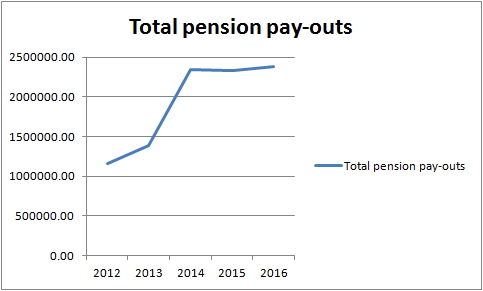
WI totals of actual and predicted pension pay-outs

Totals of actual and predicted pension pay-outs. Source: Waterways Ireland

The figure shown in the 2011 accounts was €934000. By 2016, the total will be two and a half times that: €2377000.

Remember that this is an unfunded pension scheme, so the increase comes out of WI’s ordinary allocation of money from its sponsor departments. And that allocation will not be increased: both governments want to cut WI’s income, although one government wants to cut more than the other does. If the RoI government has its way, by 2016 WI’s income will be just under 66% of the 2010 figure: a cut of one third in six years.

According to the last available accounts, WI’s main cost is staff: €21,903,000 in 2011. But that figure includes €5769000 in pension costs, €934000 of which was benefits paid out while the rest was special magical imaginary payments to the pension fund; the real staff cost (excluding agency staff and employer PRSI/NIC contributions) was €14411000.

Between 2011 and 2016, the increase in pension costs means that an extra €1443000 has to be found and, as staff costs form the main element of WI’s expenditure, it is likely that the staff budget will bear much of the burden.

The Hutton push

One factor that may be prompting some WI staff to retire as soon as they can, thus pushing up the lump sum payments in 2014, is the possibility that some changes, recommended by the UK’s Independent Public Services Pensions Commission [the Hutton Commission], might be applied to the North South Pension Scheme that covers Waterways Ireland. On 30 April 2013 Martin McGuinness [SF, Mid-Ulster, Deputy First Minister] reported to the Northern Ireland Assembly on the North/South Ministerial Council [NSMC] institutional meeting held on the previous day.

Jim Allister [Traditional Unionist Voice, Antrim North] asked him about the pension scheme:

The pension scheme for those bodies entails lavish employer contributions. In one case, over 31% of salary is contributed by the employer and a mere 1·5% is contributed by the employee. When will that lavish squander be addressed by bringing the scheme into line with what exists in the Civil Service scheme? Is it good enough for it simply to be pushed back for another six months? Why not address it now instead of looking at it further down the road?

The ever-patient Martin McGuinness responded:

At the NSMC meeting on 28 March 2013, we noted that the NSMC approved an amendment to the North/South pension scheme, which means that increases to the scheme for benefits paid in the northern currency will be in line with the consumer price index. Prior to that, they were increased in line with the retail price index. The amendment ensures that the North/South pension scheme follows public sector pension policy, as agreed by the Executive.

We also noted that the two Finance Departments are in discussion about how to further amend the scheme. These amendments will ensure that northern members are not immune from pension reform. The first amendment will increase employee contributions on average from 1·5% by 3·2 percentage points. That will align with the employee rates payable from April 2014 in the principal Civil Service pension scheme here in the North. The second amendment will introduce, by April 2015, the wider Hutton reforms, such as the introduction of a career average revalued earnings scheme and a linkage between the North/South pension scheme age and the state pension age.

The scheme was raised in the Dáil on 17 December 2013 in a written question to the Department of Public Expenditure and Reform.

Dara Calleary [FF, Mayo] asked the minister:

[…] the discussions he has had in relation to the North/South pension scheme; if the proposed amendment rules as notified from officials in the Department of Finance and Personnel and his Department will apply to southern based employees of Waterways Ireland; and if he will make a statement on the matter.

The minister, Brendan Howlin [Labour, Wexford] replied:

Five of the six North/South Implementation Bodies, including Waterways Ireland, along with Tourism Ireland, operate the North/South Pension Scheme (NSPS). The Scheme is unique in covering public sector staff employed on both sides of the border; staff of the affiliated employers in this jurisdiction are automatically members of the Scheme. The Chief Executive Officers of the relevant NSPS bodies and Tourism Ireland meet as the NSPS CEO Pension Committee, which exercises trustee-like functions in relation to the Scheme.

As Minister for Public Expenditure and Reform, I am jointly responsible, along with the Northern Ireland Minister for Finance and Personnel, currently Mr Simon Hamilton, for the rules of the North/South Pension Scheme, and in particular for approving amendments which may be proposed to those rules. In exercise of my responsibilities in relation to the Scheme, I and my officials have engaged in correspondence and discussion about reforms to the NSPS rules with my counterpart Northern Ireland Minister and his officials.

Review and reform of existing pension arrangements, including public sector pension arrangements, has been an ongoing feature of the pensions landscape in Ireland and the UK over recent times. In this context it is natural that reforms to the North/South Pension Scheme would arise for consideration, and proposals in this regard have been discussed with the NSPS CEO Pension Committee.

Pending further development of these proposed reforms, and mindful that there is ongoing discussion with trade union interests on the proposed changes, I do not intend to elaborate at this juncture on the possible final specific content of the rule amendments which may arise. I can however confirm to the Deputy my intention that the changes will, to the extent that is consistent with legal norms in each jurisdiction, apply to southern and northern NSPS members alike, including staff of Waterways Ireland in this jurisdiction. This uniformity of application would reflect the fundamental all-Ireland character of the Scheme, to which successive Governments have been committed.

That doesn’t tell us much about the likely effects on the take-home pay of WI staff, or the pensions and lump sums of retired staff, and I have no inside information about what is proposed or likely. But you can see why WI staff who are near retirement age might be tempted to get out before their conditions are worsened.

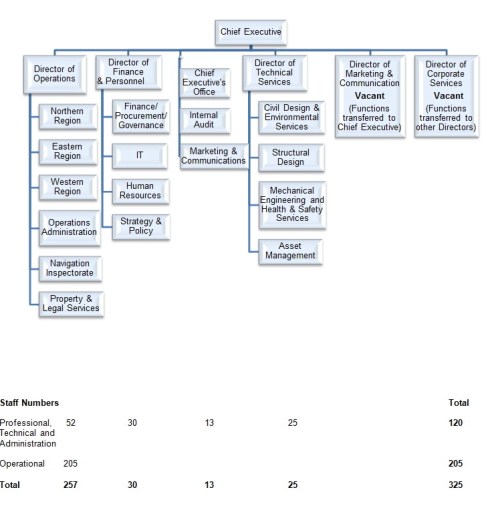
 

Waterways Ireland organisation chart

Here, courtesy of Waterways Ireland, is an organisation chart, revised on 13 November 2013, showing the numbers of employees in each division. Click on the chart to expand it.

Waterways Ireland organisation chart November 2013

Waterways Ireland organisation chart November 2013