Category Archives: Foreign parts

Why rural Ireland is doomed?

Lewis Davis says:

Empirically, I find a robust negative correlation between rainfall variation, a measure of exogenous agricultural risk, and a measure of individual responsibility. Using rainfall variation as an instrument, I find that individual responsibility has a large positive effect on economic development.

Abstract on Tyler Cowen‘s site. You can rent the whole article for $6.


The danger of carbon monoxide

At Christmas 1839 the 150-ton schooner Lansdowne, owned by the Limerick Shipping Company, sailed from Limerick for Glasgow.

The Limerick Shipping Company

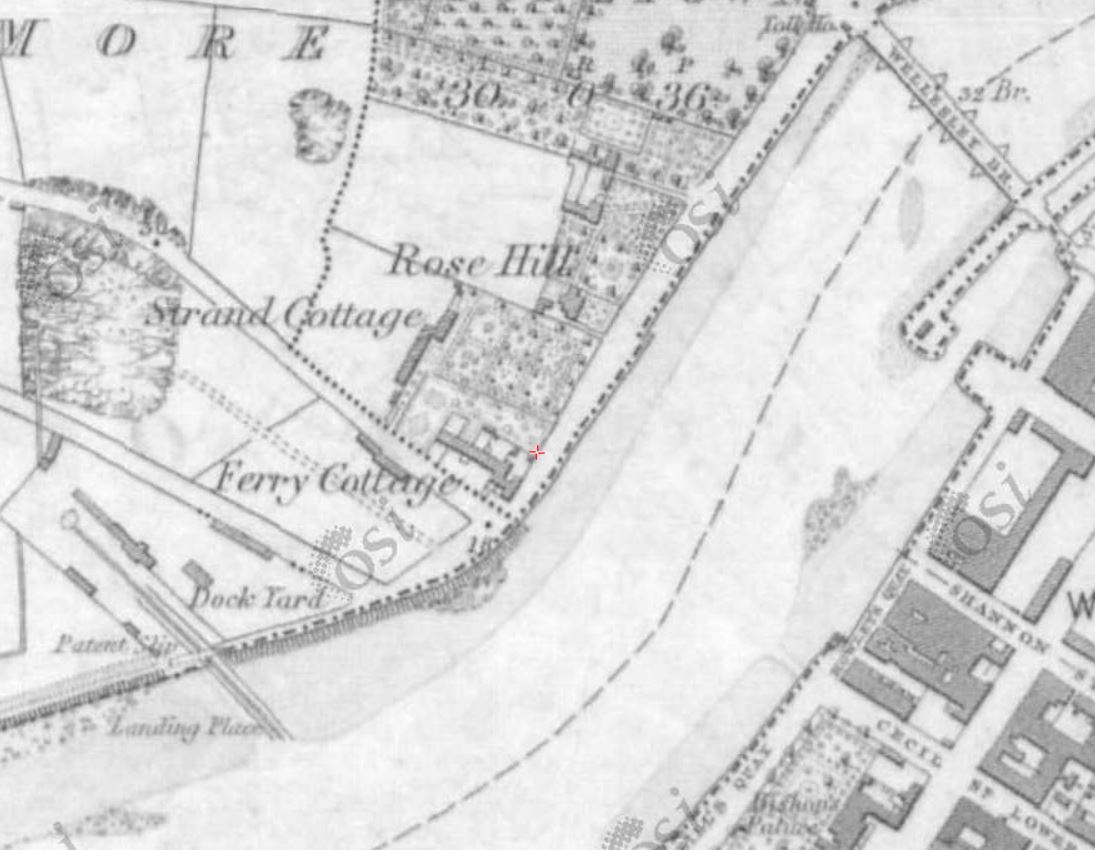
The Marquis of Lansdowne had been built at the company’s yard at North Strand, Limerick, downstream of the Wellesley Bridge and on land owned by the noble Marquis. She was named by Miss Russell, daughter of John Norris Russell, a principal shareholder, and launched on Tuesday 5 November 1839, in the presence of Sir William Macbean, Col Mansel and most of the officers of the garrison. The other merchant vessels in port had “colours flying from stem to stern” and “frequent discharges of artillery” welcomed the new schooner to the “world of waters”.

The Limerick Shipping Company's ship-building yard

The Limerick Shipping Company’s ship-building yard (OSI ~1840)

My OSI logo and permit number for website

The yard, which was equipped with a patent slip, had another schooner on the stocks at the time. According to Commander James Wolfe

There is a patent slip and yard at Kilrush, as well as at Limerick. At the latter place the slip is proved for vessels of 400 tons, at the former only for those of 250 tons. Repairs to any extent may be done at either of these places; and at Limerick some fine vessels have lately been built.

The Limerick Shipping Company had ten schooners by 1834 and, in 1838, bought a steam tug, the Dover Castle, which also competed in the passenger-carrying trade on the Shannon Estuary. By 1842 it had thirteen schooners and was offering regular weekly sailings between Limerick and London.

At no period were the Commercial interests of the Port of Limerick so prosperous, this spirited Company having now at their command a squadron of vessels equal, if not superior for all sailing qualities, to those of any other port in Ireland.

Death at the Broomielaw

John Brown, aged 27 or 28, got married one day before the Lansdowne sailed at Christmas on what must have been one of its first voyages. In Glasgow, the schooner berthed at the Broomielaw, and in mid-January Brown went drinking with William Bennet and John Anson, both aged about 20. When they returned to the schooner, they lit the stove in the forecastle, closed the hatch and went to bed.

The port regulations banned fires on vessels after nine o’clock; the newspaper said [without citing any evidence] that the three men closed the hatch “so as to prevent a single ray being seen outside” by the police on the quay.

The unfortunate men went into their sleeping berths, and as might have been anticipated, the consequence proved fatal to all the three, the action of carbonic acid having done its deadly work long before morning.

About seven o’clock they were found dead, their countenances as calm as if they had still been under the influence of sleep. One of them was in a half sitting posture.

Two doctors inspected the bodies and “corroborated the accidental nature of the causes which led to death; and liberty was granted to have the bodies interred.”

The Lansdowne herself survived for only another three years: she was wrecked on the Scottish coast in January 1843.

Sources

Clare Journal, and Ennis Advertiser 7 November 1839

Sailing Directions for the Lower Shannon, and for Lough Derg; with some Hydrographic Notices of Lough Ree and Lough Erne. By Commander James Wolfe RN; being the result of Surveys made by Order of the Lords Commissioners of the Admiralty

Clonmel Herald 25 January 1840 quoting Glasgow Courier

Limerick Reporter 17 January 1843

All newspapers from the British Newspaper Archive:

From the BNA


Lakelands

According to the Irish Times of 27 August 2016

Fáilte Ireland has tendered [sic] for a company to help it develop a new tourism strategy for the swathe of land running down the middle of Ireland that falls outside the Wild Atlantic Way and Ireland’s Ancient East, the two linchpins of the State’s tourism marketing strategy.

The area, generally referred to in tourism marketing circles as “Ireland’s Lakelands” district, takes in parts of east Galway, Roscommon, Leitrim, much of north Tipperary, and runs down as far as the northern reaches of Cork. […]

The tender made no mention of the Lakelands moniker, but Ms Carroll [of Fáilte Ireland] […] said the Lakelands term, which is also used in the Programme for Government’s tourism strategy, may not end up being the final slogan that is used for the region.

I wonder what that does for Waterways Ireland’s Lakelands &  Inland Waterways marketing and product development Initiative and what it says about the success of the Lakelands Strategic Plan [PDF]. I note too that the Irish Times refers to “the State’s tourism marketing strategy” whereas WI’s initiative was a cross-border one and included the Erne as well as the Shannon.

Trigonometry and obfuscation

Every so often Waterways Ireland (whom god bless and preserve) sends out a Marine Notice to warn people of sporting activities, so that they can avoid them, and of one or other of the hazards of the navigations. One such, No 68 of 2016, issued on 9 June 2016, says (inter alia):

The attention of all is drawn to the dangers associated with overhead power lines in particular sailing vessels, sailing dinghys and workboats with cranes or large airdrafts.

Vigilance is required especially in the vicinity of slipways and dinghy parks, while voyage planning is a necessity in order to identify the location of overhead lines crossing the navigations.

ESB Networks emergency number is (353)1850 372 999 and Northern Ireland Electricity Networks is (44) 0800 616 817.

Then on 21 July 2016 Waterways Ireland issued Notice No 89 of 2016, which was specific (as far as WI is concerned) to the Northern Ireland navigations. Extracts:

Many sailboats have masts of 9m (30ft) or more and, as most of these masts are made of aluminium, they are an excellent conductor of electricity. If an aluminium mast or rigging come into contact with or too close to power lines, it could result in a fatality.

NIE Networks advises all boat owners to take some simple precautions to stay safe.

  • Plan your route carefully when transporting your boat to or from where it is being launched, making sure you have adequate clearance under overhead power lines. When you are stepping the mast or erecting long aerials, be sure to do so in an area totally clear of overhead power lines.
  • Once out on the water, if you are sailing on inland waterways or near islands or headlands, you should still look for overhead lines as they do cross over waterways. You must ensure that your mast or aerial has proper clearance from any power lines.
  • Always check your charts when underway to ensure you are aware of the location of overhead power lines.

In order to avoid hitting an overhead power line with a mast, it would be useful to know how high off the water, perhaps at Ordinary Summer Level, the power line was. Then you could subtract from that the height of your mast, and some safety factor, and decide whether you could safely sail under the line.

If you don’t know how high the power line is, you have to resort to trigonometry. My recollection of these matters has perhaps faded a little, but as I recall you stand a small boy of known height on your cabin roof and, with your eye level with his feet, you measure (a) the horizontal distance from his feet to your eye and (b) the angle from the horizontal to a line from your eye that touches the top of the boy’s head and the bottom of the power line. Then the small boy falls off the roof, you have to tack, your pencil falls overboard and it all seems much more difficult than finding the height of a tree. And of course you can’t measure the distance to the power line without sailing up to it, which is what you’re trying to avoid until you can decide whether you can safely do so. [Note: this paragraph is not to be used for navigation.]

Life would, therefore, be much easier (and safer) if you knew the minimum clearance under the power lines. Happily, NIE Networks is happy to tell people what it is; I emailed and a speedy response including this:

The clearance on all NIE Networks overhead power lines which cross over navigable waters is 10.5m (lower bank to line or earth). All overhead power lines are marked on navigation charts for the Erne and Lower Bann waters.

However, it should be noted that this is the clearance for NIE Networks overhead power lines and applicable to Northern Ireland only. Clearances for overhead power lines in the Republic of Ireland may be different and would require confirmation from the Electricity Supply Board (ESB).

Big it up for NIE Networks, then. But over several years I tried unsuccessfully to get the ESB to give me the equivalent information for lines crossing navigable waterways in the republic; it would not do so. Without that information, boaters cannot “ensure that [their] mast or aerial has proper clearance from any power lines”, so ESB’s advice is useless blather.

It is some time since I last asked ESB for information, and perhaps it has since been made available, but I see no sign of it on the ESB website. I would be glad to hear from anyone who can supply reliable information.

A canal song

On Youtube, a thing on tinterweb, music on a narrowboat on the Union Canal in Edinburgh.

Irish waterways in context

More than 25,000 barges were being used on Britain’s inland waterways in the middle decades of the nineteenth century.

Philip S Bagwell The Transport Revolution from 1770 B T Batsford Ltd, London 1974

I wonder what the figure for Ireland was. My guess is that, including small turf boats and cots, it was probably less than one tenth of the British figure.

The PS Clarences

A steamer called the Clarence served on the Shannon estuary in the 1830s. There are different accounts of when she left the Shannon. Here is an attempt at resolving the problem.

Clydebuilt

According to the Clydebuilt database of ships on www.clydesite.co.uk, a paddle steamer called the Clarence was built in 1827 and “launched on” by Robert Napier of Govan. A note to the entry says that this was presumably the same vessel as that listed for Denny.

The Denny entry says that a 70-ton wooden paddle steamer called the Clarence was “launched on” in 1827 by William Denny and A McLachlan of Dumbarton for R Napier. Its owners are listed as R Napier and, from 1829, “Inland Steam Nav Co, Limerick”; it is said to have run between Limerick and Clare Castle on the River Shannon between 1829 and 1840.

Clydeships

The Clydeships database has one entry for Clarence, a wood paddle steamer launched in 1827 by Messrs Lang & Denny of Dumbarton. A passenger vessel, its tonnage is given as 60 nrt, 70 om, 60 nm. Its dimensions are given as

Length 92′ 0″
Breadth 16′ 3″
Depth 8′ 0″
Draft —

Its 45hp beam engine was supplied by Robert Napier & Sons and its first owner was Robert Napier of Glasgow; it served Glasgow, Greenock and Helensburgh. It is said to have been owned by the Carlisle Canal Company (The Carlisle and Annan Steam Navigation Company) from 1839 and used for passenger tendering and for towing between Annan Water-Foot and Port Carlisle. Its dimensions in 1839 are given as 96.9 x 15.1 x 8.0 ft. It went on fire in 1846 and, after repair, was used on the Eastham Ferry service on the Mersey. The Clydeships site does not mention any service in Ireland.

McNeill

D B McNeill, in Irish Passenger Steamship Services Volume 2 South of Ireland (David & Charles, Newton Abbot 1971) says that the Clarence, built in Dumbarton in 1827, was the first steamer on the Shannon estuary [he omits the Lady of the Shannon, the Mona and the Kingstown], having been reported in 1829 as working between Limerick and Clare Castle. He says

Trade must have been bad, for in 1833 she was back on the Clyde working from Gareloch.

He agrees that Clarence was a wooden paddle steamer built in Dumbarton; he gives her dimensions as 92 ft by 16 ft, with a single-expansion steam engine; he says she was broken up around the 1840s.

McRonald

Malcolm McRonald, in his invaluable The Irish Boats Volume 1 Liverpool to Dublin [Tempus Publishing Limited, Stroud 2005], says that the City of Dublin Steam Packet Company operated the Mona on the Shannon estuary in 1829 and the Kingstown in 1830, then abandoned the estuary later in 1830 and resumed it in 1832 [the Kingstown operated on the estuary until at least the end of November 1830 and was there in April 1831]. The service was resumed, McRonald says, “using the chartered Clyde steamer Clarence“, which also operated there in 1833 and 1834.

Clarence was back on the Clyde in 1835, but returned to Limerick by 1837, to operate a service from Limerick to Clarecastle and Ennis. […] Clarence was sold to the Carlisle Canal Co in 1838, but there is conflicting evidence over her date of departure from the Shannon. She was advertised on the Clare service as late as April 1840, although the local Carlisle newspaper had expected her in service there in June 1838. [page 20]

In the fleet lists, McRonald shows the Clarence as having been 96′ 10″ X 15′ 2″ X 8′ 0″, 70 gross tons, made of wood, with a 45hp condensing steam engine. She was built, he says, in 1827 by James Lang of Dumbarton, for Robert Napier of Glasgow, who also provided the engines. She was chartered to the City of Dublin Steam Packet Company from 1832 to 1839, then sold to the Carlisle Canal Co.

One or two?

The accounts by McNeill and McRonald suggest that there was a single steamer called the Clarence, which moved to the Shannon in 1829 [McNeill] or 1832 [McRonald], then to the Clyde in 1833 [McNeill] or 1835 [McRonald], then back to the Shannon in 1837 before being sold to the Carlisle Canal Company in 1838 or 1839 [McRonald]. McRonald does note, however, that the Clarence was advertised as running on the Shannon in 1840.

Steamers did move between stations and owners or operators, and could thus serve in two areas in the same year. However, I think that the evidence of the Clarence‘s activity on the Shannon is strong enough to show that there must have been two steamers with that name: one which started on the Clyde and was bought by the Carlisle Canal Company in 1839, the other serving on the Shannon until 1841.

The years 1833 to 1837

McNeill says that the Clarence was back on the Clyde in 1833. The Morning Post of 27 August 1833 quoted the Limerick Chronicle of 21 August 1833, which said that the Clarence had carried Captain Brown’s company of the 28th Regiment from Limerick to Kilrush on the previous day; it had also carried some detachments to the forts of Tarbert and Carrig Island. There are similar reports for July and September.

McRonald says that the Clarence operated on the Clyde between 1835 and 1837. Yet she is shown operating on the Shannon in City of Dublin Steam Packet Company ads for June, July, August and October of 1835, for every month in 1836 and for every month in 1837.

From 1838 onwards

To judge by the local newspapers, it was in 1839, not 1838, that Carlisle acquired a Clarence steamer. The Carlisle Journal of 12 January 1839 said that the canal company and the two steam companies had purchased a steamer called Clarence from Robert Napier of Glasgow: 96′ X 16′ X 8′ depth of hold, with a 45 hp engine and very handsome cabins, being “fitted up entirely for passengers”, although she was intended to tow lighters too. She was having an overhaul and a new boiler and was expected in Carlisle in two or three weeks.

On 23 February 1839 the Carlisle Patriot carried an ad seeking a master for the Clarence; it seems that Thomas Maling got the job, as the Patriot named him as master in its report, on 20 April 1839, of a collision involving the Clarence. On 1 July 1839 she took fifty gentlemen — the Managing Directors of the Carlisle and Newcastle Railway, the Commissioners of the Nith Navigation, the members of the two Carlisle and Liverpool steam navigation companies, all invited by the Commissioners of the Carlisle Canal Company — on a voyage of inspection of the buoyage of the Solway. Dinner was provided by Mr Gray of the Coffee House but, after the meal, the toasts and the speeches, several of the gentlemen were seasick on the way home. The voyage was reported in the Ayr Advertiser, or West Country Journal on 4 July 1839 and in the Carlisle Journal on 13 July 1839.

It is clear, then, that there was a Clarence on the Solway Firth in 1839. However, both during and after 1839 the Clarence continued to be advertised as serving on the Shannon. A long-running series of ads promoted “Cheap travelling between Dublin and Limerick” using the boats of the Grand Canal Company from Dublin to the Shannon and the steamers of the City of Dublin Steam Packet Company on the inland Shannon and its estuary. The estuary section began

GARRYOWEN, KINGSTOWN AND CLARENCE
Steamers on the Lower Shannon

The ads appeared in many Irish newspapers and the series ran until 13 March 1841 when it appeared in the Warder and Dublin Weekly Mail. The ads were not updated to reflect seasonal changes in the estuary steamers’ sailings, but a paragraph about the service from Limerick to the town of Clare [now Clarecastle, near Ennis] was dropped in 1840. That presumably signified the ending of the service, but the Clarence continued to be listed amongst the estuary steamers until the ad’s final appearance in March 1841.

Up to December 1840, the City of Dublin Steam Packet Company ran its own series of ads, promoting its Irish Sea as well as its inland services, and listing its vessels. The list included the Clarence and the Kingstown amongst those “Plying on the Shannon”, for instance in the ad in the Dublin Weekly Herald of 12 December 1840. That ad does not seem to have been used in 1841.

The company also advertised in local newspapers: in 1839 the Clarence was mentioned in ads in the Clare Journal, and Ennis Advertiser on 2 May, 2 September, 7 October and 16 December. The same paper mentioned the Clarence in news reports on 30 May 1839 and 7 May 1840.

In 1841 the City of Dublin Steam Packet Company bought the Dover Castle from a rival operator on the Shannon estuary; its new-built iron steamer Erin go Bragh also joined the estuary fleet. The Clarence and the Kingstown seem to have left the estuary service at or around that time, the Clarence going first: the company’s ad in the Limerick Reporter of 9 March 1841 mentions the Kingstown and the Garryowen but not the Clarence.  By 11 May 1841, ads in the same paper listed the Garryowen and the Erin go Bragh; the Kingstown was no longer mentioned.

I have not been able to find any information about the history of the Clarence before it came to the Shannon estuary or after it left the estuary service. However, because there is so much evidence that a Clarence was still in service on the estuary after a Clarence was bought by the Carlisle Canal Company, I cannot accept that the two Clarences were the same vessel. I believe that there must have been a Shannon Clarence as well as a Clyde/Carlisle Clarence.

Sources

The newspapers referred to here were found on the British Newspaper Archive, a service is owned and run by Findmypast Newspaper Archive Limited in partnership with the British Library.

Lough Neagh to Carlingford Lough

Thanks to David Davis for the link to this video, following the water route from Lough Neagh by the Upper Bann, the Newry Canal and the Newry Ship Canal to Carlingford Lough.

A man, a plan, a canal …

Panama.

h/t Tyler Cowen

Northern enterprise

On Friday, 25th ult, the Antrim and Tyrone Lough Neagh Steam Ferry Company’s first boat, the Enterprise, was launched from Port Armagh, on the Tyrone side of Lough Neagh. She is a most beautiful boat, and does great credit to Mr Hiram Shaw, of this town, for his exertions in bringing her out in such fine style. Her engines were built by M’Adam, Currell, and Company, of Belfast.

The Vindicator, Belfast 7 August 1839

From the British Newspaper Archive run by Findmypast Newspaper Archive Limited, in partnership with the British Library.

[Notes: I do not know where Port Armagh is or was. The Enterprise is not mentioned in D B McNeill Irish Passenger Steamship Services Volume 1: North of Ireland Augustus M Kelley Publishers, New York 1969]
