
Category Archives: Historical matters

Royal Canal November

I said here that I did not know whether there was a plaque to commemorate the drowning of fifteen people on the Royal Canal in 1845. I am grateful to both Ewan Duffy and Niall Galway for telling me that there is a plaque and for sending photos of it. Ewan’s, which I show below, was taken in 1997.
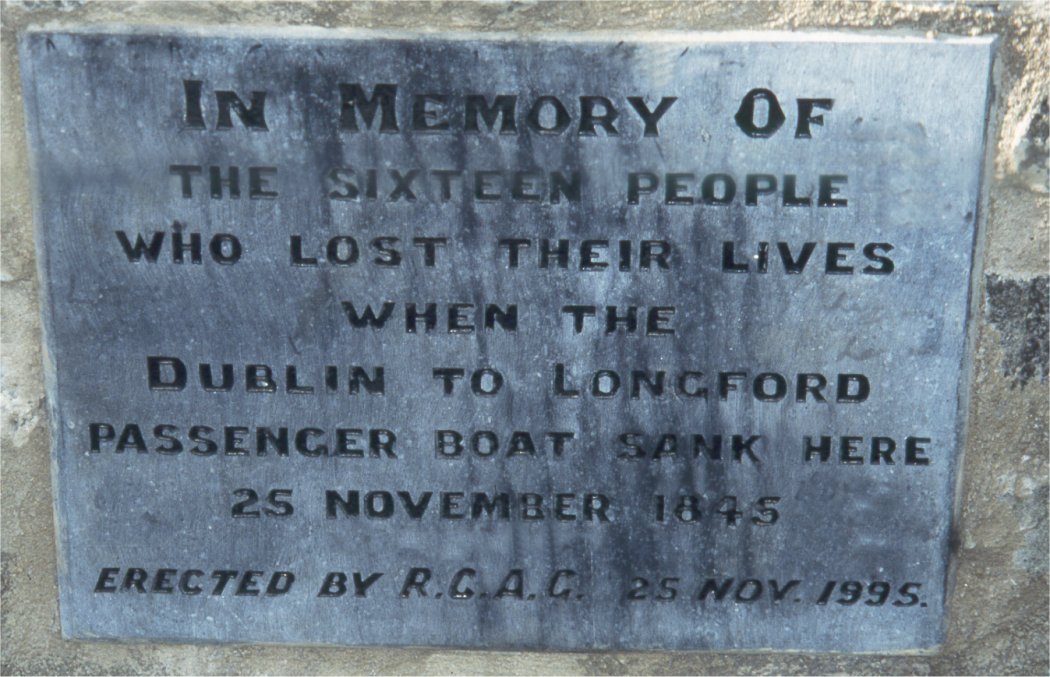
Porterstown Plaque

The plaque in 1997 (copyright industrialheritageireland.info)

Niall has sent on a message from the Royal Canal Amenity Group chairman:

A Mass in memory of the 16 people who lost their lives on 25 November 1845, when a passenger boat sank on the Royal Canal at Clonsilla, will be
held in St Mochta’s Church, Porterstown Road, at 10.00 am on Friday next 27 November 2015. After the mass you are invited to Porterstown (Kennan) bridge to lay a wreath and afterwards to the Clonsilla Inn for a tea/coffee.

I know that Ruth Delany gives the figure of 16 deaths, but all the newspaper reports that I have read say that 15 people died: 7 men, 6 women and 2 children, all from the second-class cabin.

Addendum 23 November 2015: I have now read some more newspaper reports and I think the discrepancy arises because early press reports of the accident itself, notably that carried in the Freeman’s Journal, said that sixteen people had died, but reports of the inquest gave the number as fifteen. The pre-inquest reports were inaccurate in other respects too: the total numbers of passengers were wrong and the chain of events that led to the accident was not properly described.


Remember, remember the twenty-fifth of November

25 November 2015 will be the 170th anniversary of the sinking of the Royal Canal passage-boat Longford and the deaths of fifteen people.

This was not (pace Ruth Delany in Ireland’s Royal Canal 1789–2009 Lilliput Press, Dublin 2010) “the worst accident ever to happen on the Irish waterways”: that melancholy distinction belongs to the drowning at Carrick-on-Suir of about 111 people in 1799 [see “The cries at the bridge” on this page], while the second-worst was the drowning of twenty people on Lough Corrib in 1828, the event commemorated by Antoine Ó Raifteiri in his poem Eanach Dhúin.

But the 1845 accident, between Porterstown and Clonsilla Bridges, was the worst to occur on an Irish canal. Evidence at the inquest and subsequent trial suggests great laxity in the management of the Royal Canal Company’s affairs, even if the immediate cause was an act of insane irresponsibility on the part of the boat’s temporary steerer.

I do not know whether any plaque or other artefact commemorates the event.

The Groody turnpike

The River Groody flows into the Shannon downstream of Plassey, where the University of Limerick is located.

Groody 04_resize

Groody and Plassey (OSI ~1840)

The river itself may be hard to see, but the green wriggly line follows the course of the Groody except just north of Groody Bridge, where the river takes a more direct course towards the Shannon.

The road crossing Groody Bridge was the main road from Dublin to Limerick and the route followed by the mail-coaches. And, just to the west of the bridge, the 6″ Ordnance Survey map (of about 1840) shows a Turnpike, presumably controlling access to the road to Dublin. The road between Naas and Limerick, in other words most of the way to Dublin, was controlled by the Bourne family, who also ran the Dublin to Limerick mail coaches (which were amongst the few in Ireland to achieve an average of eight miles an hour).

Groody turnpike 03_resize

Groody bridge and turnpike (OSI ~1840)

I met a man who told me that his family owned this building, which is opposite the Aldi shop on the Dublin Road, Limerick.

Groody turnpike 01_resize

The building 1

It had been a shop at some stage and had had an extra window inserted, but he said it was originally a toll cottage. I don’t think it was for collecting the Limerick tolls [I don’t know where they were collected on the “Groody approach”, but I suspect it may have been near Pennywell]; I think it was for collecting the turnpike charges. Its position seems to match that of the turnpike building shown on the map.

However, I haven’t been able to find evidence on the matter one way or the other. I can’t find the building on the Griffith Valuation, perhaps because its value was too low to be recorded. And the Land Registry’s information doesn’t go back beyond 1982.

Groody turnpike 02_resize

The building 2

I would therefore be grateful to anyone who can provide evidence on whether this building was the turnpike cottage for the road to Naas.

My OSI logo and permit number for website


Broadstone Luas works

Thanks to Niall Galway for these photos of work under way at the Broadstone for the new LUAS line.

Broadstone October 2015 (Niall Galway) 01_resize Broadstone October 2015 (Niall Galway) 02_resize Broadstone October 2015 (Niall Galway) 03_resize Broadstone October 2015 (Niall Galway) 04_resize Broadstone October 2015 (Niall Galway) 05_resize Broadstone October 2015 (Niall Galway) 06_resize Broadstone October 2015 (Niall Galway) 07_resize


Fish in canal shock

I see from the blatts (or at least from the Cork Examiner) that there is much free food to be had in the Tralee Ship Canal, which has, it is said, “Literally millions of sprat and mackerel” as well as eels, baby ray and shrimp. According to the story,

Kerry County Council said engineers were meeting yesterday to find a resolution and to organise a clean up.

Perhaps a call to Captain Birdseye?

Placing Percy

Back in May 2013, I wondered whether 53 Percy Place, Dublin 4, which Waterways Ireland was being forced to sell to dig the Clones Sheugh, would still be on its hands in a year or two. And so it was, but in August 2015, I noted that the property was for sale to fund Saunderson’s Sheugh, which we’re all pretending is the Clones Sheugh (aka the Ulster Canal).

The interesting point was that Messrs CBRE wanted over €1.6 million for the site, which was the valuation put upon it in 2008. The 2012 valuation was €650,000 and the 2013 €800,000. I wrote:

On the basis of its asking price for Percy Place, WI seems to believe that the property collapse is over; perhaps it is even now in negotiation to develop Plot 8 and build a sheugh all the way to Clones. In the meantime, if it gets €1.6 million for Percy Place, that will help to alleviate the damage caused by the smash-and-grab raid carried out by the Department of Fairytales to pay for Saunderson’s Sheugh.

Well, it seems that the boom is back. According to the respectable people’s Sunday newspaper, the Sunday Business Post, of 18 October 2015, WI got over €2 million for the site. The SBP is paywalled and I can’t find online confirmation elsewhere, but it’s a high price.

I did note on the CBRE site that the Twelfth Lock Hotel, that haunt of Stakhanovite homoeroticism on the Royal Canal in Blanchardstown, is for sale again. I haven’t been there for some years, so I don’t know whether the mural is still extant.


Swimming in the Naller

On 22 September 2015 Eric Byrne [Labour, Dublin South Central] put a written question to the Minister for Fairytales:

To ask the Minister for Arts, Heritage and the Gaeltacht her plans to review the no swimming in locks and harbours under the by-law within the Canals Act by-laws of 1988 in view of the fact that there is no penalty for ignoring such signs; and if she will make a statement on the matter.

The minister replied:

I have been informed by Waterways Ireland that while it has not determined a need for an associated penalty with this by-law at this time, the matter is being kept under review. I am advised also that the locks, docks and harbours are manned and/or frequently visited by Waterways Ireland Operations and Inspectorate Authorised Officers. Where swimmers are encountered, they are made aware of the by-law provision and the dangers of swimming in or near canal infrastructure and they are requested to remove themselves from the navigation. Such requests are normally acceded to. In the event of persistent offender(s) unwilling to obey direction from Waterways Ireland Authorised Officers, the assistance of An Garda Síochána is sought to remedy the situation.

Sometimes I wonder whether politicians have any grasp on reality. Swimmers in the Naller are a force of nature and are as far beyond the control of Waterways Ireland, the police and indeed politicians as hurricanes, the economy or Mick Wallace. People have been swimming in the canals, in Dublin and no doubt elsewhere, for generations, and nothing or nobody has been able to stop them.

I suspect that more people have swum in the canals than have ever boated on them; swimming is therefore a legitimate topic for waterways studies. Here is a preliminary contribution to the field.

Smell of coffee …

wafts over Clones.

I still have no idea why Sinn Féin thinks the Clones Sheugh would cause any significant increase in tourism, or any other economic benefit.

Tidal passage boats on the Suir

So late as the year 1807 the mail bags between Waterford and Clonmel were carried in a common cart and there was no public mode of conveyance between Carrick-on-Suir and Waterford but passage boats, the chief of which is well remembered as Tom Morrissey’s boat. These dropped from one town to the other as the tide served, fare fourpence a head, distance twelve miles, time occupied seven hours.

George Lewis Smyth Ireland: Historical and Statistical Vol II Whittaker and Co, London 1847, Chapter 14

Water charges

I see from the blatts that Limerick [City & County] Council had a “metropolitan district meeting” recently to discuss how the Shannon might be used to “attract tourism and offer water activities”. I thought it did have such activities: I’m almost sure I’ve seen people in boats, people fishing and so on. But the councillors want something sexier and they intend to pester the unfortunate folk in Waterways Ireland about it.

One Paul Kelleher, described as “(AAA)”, wants an “an Oxford/Cambridge style boat race between UL and LIT” and, alas, “a water bus, with tours down as far as Foynes.”

Unfortunately, since the Lord Lieutenant enjoyed a trip from Limerick to Foynes via Kilrush in 1856, many of the villa residences, mansions and other gentlemen’s seats have become unoccupied and demonstrations of loyalty are unlikely to greet the municipal water bus. Of course any such vessel will be enormously expensive to run, will have a short season and only a few years of popularity and will lose a lot of money. If it were likely to be profitable, private enterprise would already be offering such a service; it isn’t, so a subsidy or some form of sponsorship would be required.

Perhaps Irish Water could sponsor it from its surplus income.