Category Archives: Industrial heritage

GCC inspection launch

Under the heading

GRAND CANAL COMPANY’S ENTERPRISE

the Irish Times reported, on 21 December 1909, on the trials of a launch newly built by the Grand Canal Company in their own docks at James’s Street Harbour.

The launch was 40′ long and 6½’ wide, screw propelled and driven by a Daimler 12-15 hp petrol engine. This engine was placed in the forward part of the launch

… and is worked in the manner which is usual with road motor cars: the driver or steersman sitting at the wheel having a clear view ahead.

That part of the launch was open; in the centre was a “deck-house or saloon, constructed principally of teak wood”. Aft of that was another open area. The launch could carry 20 people.

The saloon had “a sliding weatherproof door at the fore end, and two removable swing doors in the aft end”. It was lit by electric lamps and had cushioned seats at each side, with storage lockers underneath. A “table of novel design” was lowered from the ceiling when required, then pushed back up to leave a clear passage through the saloon. The launch, which was fitted up very tastefully, and

… the creditable manner in which the work of turning out the launch as a whole has been accomplished reflects great credit on the company’s workmen, and promises well for the future of local industries.

The trials were attended by the GCC General Manager George Tough and its Engineer Harry Wayte. The launch left James’s Street at 10.30am for Ringsend, travelled up the Liffey to Kingsbridge and back down again, before going out into Dublin Bay two miles beyond the Poolbeg lighthouse. On a measured mile in the Liffey, between the Pigeon House and the lighthouse, she managed 12 mph against the tide. She returned to James’s Street Harbour after arousing “considerable interest amongst spectators along the route”.

The launch was intended as “an officers’ inspection boat, to travel all over the company’s extensive system” of waterways routes.

The boat in every respect worked very satisfactorily, and reflected great credit on its designers. […] The success which has attended this experiment may lead to the establishment of fast or express goods boats all over the system.

I had not been aware of the existence of a GCC inspection launch later than the gondola of 1795. I would be glad of information from anyone who knows more about it: please leave a Comment below if you can help.

From the BNA

Railway progress

It is proposed that six cwt should travel on the Rail-road between this City and Waterford, ten miles an hour, urged by the propelling and locomotive engines. Thus, on the sixth day, the heaviest goods will reach London from Limerick; the fourth, Liverpool; and the third, Bristol.

In case the navigation of the Suir should be found inapplicable, an extension of the Railway to Dunmore is intended.

The undermentioned are expected to form the Committee, some of whom have already signified their intention to that effect:—

The Duke of Devonshire, the Marquis of Lansdowne, Earls Darnley, Glengall, Kenmare, Charleville, Kingston, and Ennismore; Lords Oxmantown and Lismore; Messrs T S Rice MP, J Smith MP, R Wellesley MP, Captain Maberly MP, Sir C Flower, Alderman Heygate &c.

Dublin Evening Post 3 February 1825

From the BNA

Some later information here.

Nowadays, the average duration of the eight daily trains between Limerick and Waterford is four hours and five minutes, for say eighty miles, so speeds have doubled since the 1825 proposals were made.


Mr Monks’s plan for inland navigation

According to Mr Monks‘s plan for the intended northern line of navigation, great accommodation and advantages would be afforded to the inhabitants of that part of the kingdom that lies north of the city of Dublin, particularly to those of the province of Ulster, who are so numerous — for all the sea ports, all the considerable towns and villages would have a cheap and secure interchangeable communication with each other, and the metropolis, in peace or war, safe from enemies and storms, most desirable objects to that extensive manufacturing country.

The design is to run a canal from Dublin to Blackwater-town (about 68 miles); the river Blackwater is navigable from thence to Lough Neagh — and with very little expence afterwards the following great general navigable canal communication would be opened:

  • to the east coast of Ireland by the river Liffey to the bay of Dublin
  • by the Boyne Navigation (which the northern line would intersect near Navan) to the bay of Drogheda
  • from Lough Neagh, by the Newry Navigation to Carlingford bay
  • to the north east coast from Lough Neagh by the Belfast canal to Belfast lough, or Carrickfergus bay
  • to the north coast from Lough Neagh by the river Bann to Colerain
  • and by off-branching along the Ballyhays river about 10 miles, to the east end of Lough Erne, which is nearly navigable to the town of Ballyshannon, would open a communication with the bay of Donegall to the west
  • and by the Grand Canal and Barrow Navigation to the south to Waterford harbour
  • by the western branch of the Grand Canal, which will be shortly completed, to the Shannon, and the Limerick Navigation to the south west of Ireland.

And we understand (in order that the inland towns and villages should reap every advantage by this general plan) he proposes that canals of very small dimensions (which are made at very little expence) should be extended from the great lines to them for boats of only four tuns burden, where water cannot be obtained to answer canals of a larger scale; and wastage of locks, in place of which he would substitute machinery on a plain simple construction, to raise and lower them on inclined planes at the rate of 100 feet in four minutes, and which would also answer instead of aqueducts and embanking across wide valleys, one horse would be sufficient to draw, and one man to attend ten of these boats chained together, the whole carrying forty tons with great ease.

Thus not only the wealthy merchant and manufacturer, but the most inferior tradesman would have an opportunity of attending and disposing of his goods at the best market (let the quantity be ever so small) on equal terms, which would be a great means to defeat and put down forestalling — a most destructive species of dealing in a manufacturing country,

Dublin Evening Post 19 January 1797

From the BNA


Hibernia

I see that P&O Cruises [about which there is a not-very-accurate Wikipedia page here: not very accurate, I mean, about the history of the P&O Line] will seek public suggestions for a name for its latest vessel, which they call “the nation’s ship”:

P&O has also previously run a similar exercise, coming up with the stately Britannia for a ship that launched last year. The company hopes for something similarly dignified and patriotic this time round […].

I do hope there will be a concerted campaign to have it named Hibernia, to recognise that

  • the single most important person in the formation of the P&O Line, Richard Bourne, was Irish
  • four of the eight original directors were Irish (and one was Spanish)
  • 83% of the company’s original capital of £304,600 in ships, exchanged for paid-up shares, was Irish owned.

Of course, as this great Irish company expanded, it took on more British shareholders and directors, training them no doubt in how to run scheduled steam shipping services, but it is about time that the Irish role was acknowledged.

See Freda Harcourt “Charles Wye Williams and Irish steam shipping 1820–1850” in The Journal of Transport History Third Series Volume 13 Number 2 September 1992, Manchester University Press, and Freda Harcourt Flagships of Imperialism: the P&O Company and the politics of empire from its origins to 1867 Manchester University Press 2006 [ebook now also available].

Scots wha hae nae rummelt eggs

The steamer Foyle, Captain Wyse, from Londonderry, arrived at the Broomielaw on Sunday morning, after a boisterous passage.

Among the other freight the Foyle has brought over 25 tons of eggs, which, at eight to the pound, amounts to 448,000, or 37,333 dozens; and at 6d a dozen, are worth about £933. On Saturday evening scarcely an egg was to be had in Glasgow.

Southern Reporter and Cork Commercial Courier 13 March 1834 quoting the Caledonian Mercury

From the BNA

Marble from Killaloe

KILLALOE MARBLE WORKS

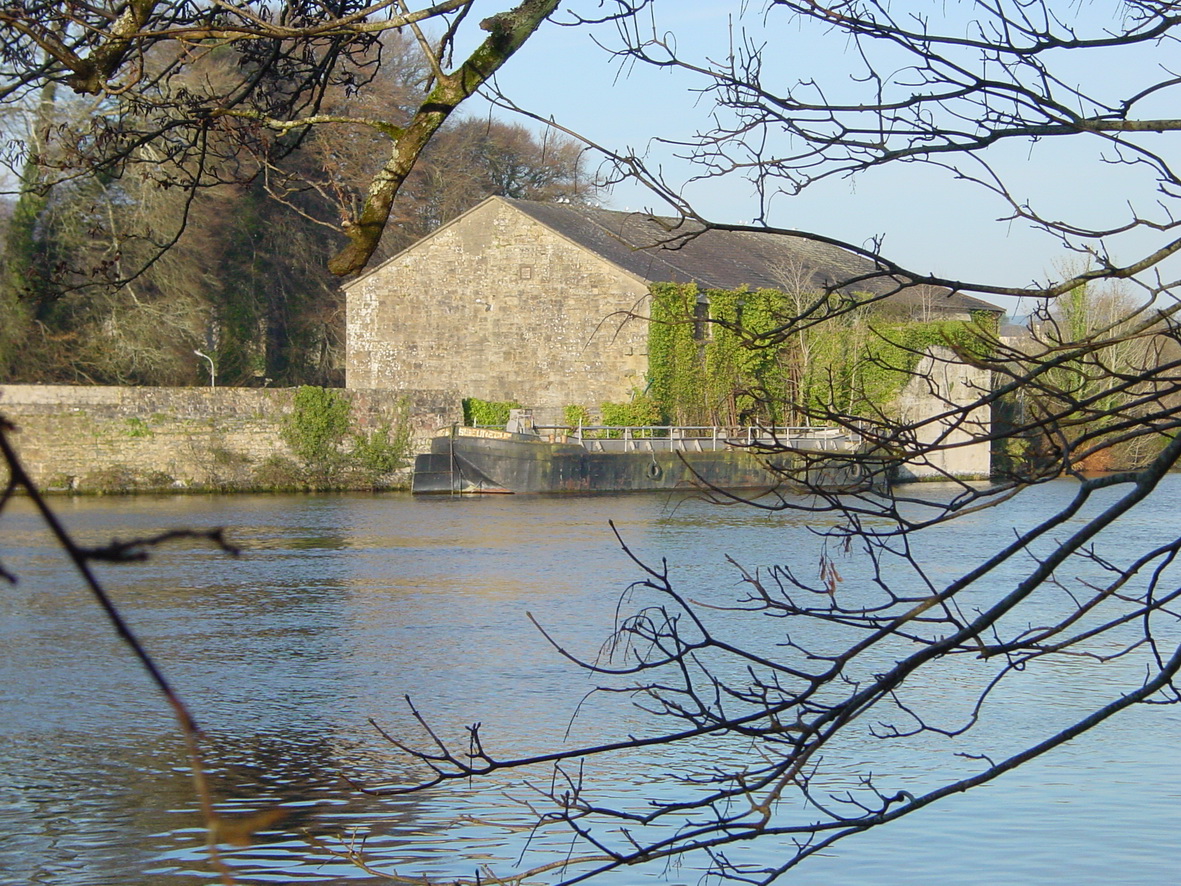
The marble mill in Killaloe

The marble mill in Killaloe

W & W Manderson

Beg respectfully to inform the Nobility, Gentry, and the Public in general, that they have (from their Practical experience) made considerable and most important improvements in the working and Polishing of Marble at the above Establishment, so that every variety of work is executed in a superior style hitherto unprecedented, and which has enabled them to offer at such Reduced Prices, as greatly to facilitate its general use both in public and private Buildings.

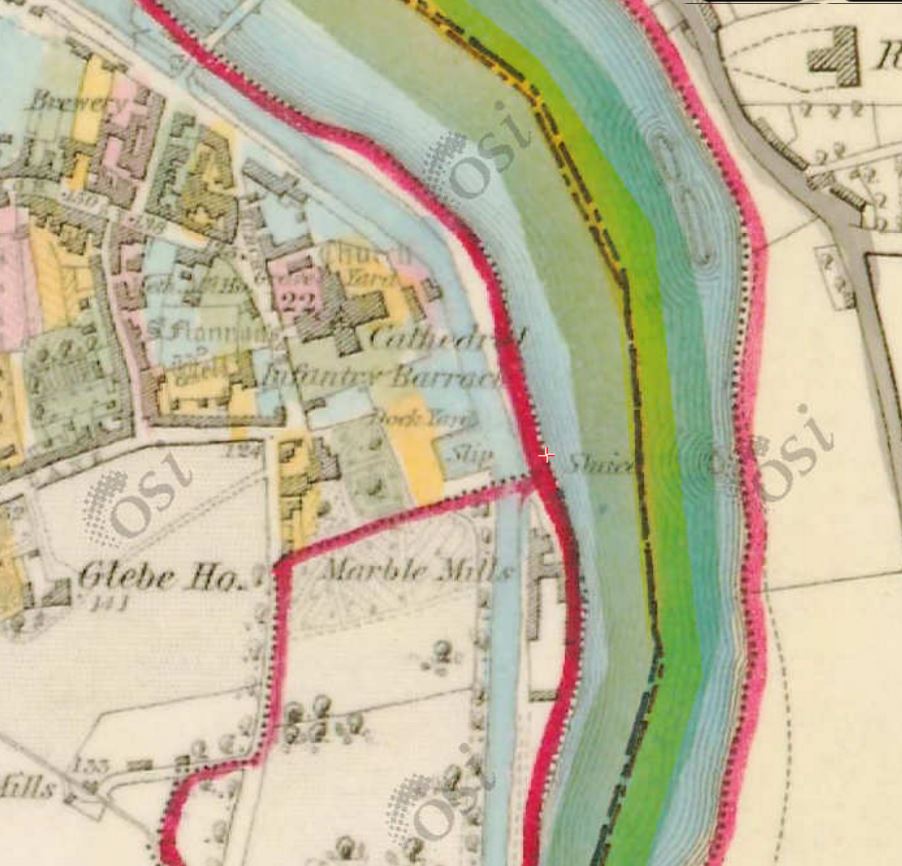
The marble mill at Killaloe (OSI 6" map ~1840)

The marble mill at Killaloe (OSI 6″ map ~1840)

They have for Inspection an Extensive Stock of Irish and Foreign MARBLE CHIMNEY PIECES (of various designs, suited for every description of rooms).

In STATUARY, ELABORATELY, SCULPTURED and CARVED, of exquisite designs and good material.

In VEIN, DOVE, BLACK AND GOLD, ST ANN, BURDILLA, SHANNON SIENNA, IRISH PORPHYRY, FOSSILS, GREY AND BLACK.

MONUMENTS, TABLETS, COLUMNS, BUST PILLARS, WASH AND DRESSING TABLES, TABLE TOPS, BATHS, PAVEMENTS, SLABS FOR DAIRIES, and various other Ornaments.

Also an Extensive Stock of MILL RUBBED, AND SQUARED FLAGS, WINDOW SILLS, BARGE AND EAVE COURSES, TOMB, HEADSTONES, &c &c.

The safe conveyance and fixing of work guaranteed if required.

July 28, 1842

Nenagh Guardian 6 August 1842

My OSI logo and permit number for website


Transport history

Tyler Cowen of Marginal Revolution quotes an interesting extract today from a new book on the history of India:

…the most important technological change for the transportation of heavy goods in nineteenth-century India was not the arrival of the quick, expensive railway: it was the move from pack animals to carts pulled by two or four beasts in the first half of the century.  This was the process historian Amalendu Guha calls ‘the bullock cart revolution’.  Throughout the 1860s and 1870s railways found it impossible to compete not only with bullock carts, but also with human-powered river transport.  Rowing boats along the Ganges and Jamuna won a price war with the railways over the cost of transporting heavy goods.  Vessels powered by human beings were able to undercut steam vessels elsewhere.

There is a description of the book (which I have now ordered) here.

How did transport in Ireland compare? In the first half of the century, road transport using Scotch carts dominated carrying. Within about 55 miles of Dublin, eastward of Mullingar on the Royal and Tullamore on the Grand, canal carriers did little business except in the heaviest goods: the Scotch carts, each drawn by one horse and carrying about one ton, dominated the trade. But the Scotch carts relied on there being good roads, which in many cases required government intervention of one sort or another.

But rowing boats do not seem to have been serious contenders on Irish inland waterways. They might have been used on the Shannon, to tow canal boats, and the idea was mooted, but nothing seems to have come of it. The problem, I suspect, was that there was little or no trade: when it did arrive, it did so because the steamers created it. And the capital cost of a large pulling boat might have been beyond the means of a small-scale entrepreneur who might have been able to afford a cart.

On the other hand, vessels powered by sail retained certain markets, including traffic across the Irish Sea, until the middle of the twentieth century.

Much about Irish transport history remains unclear to me.

Cussane lock

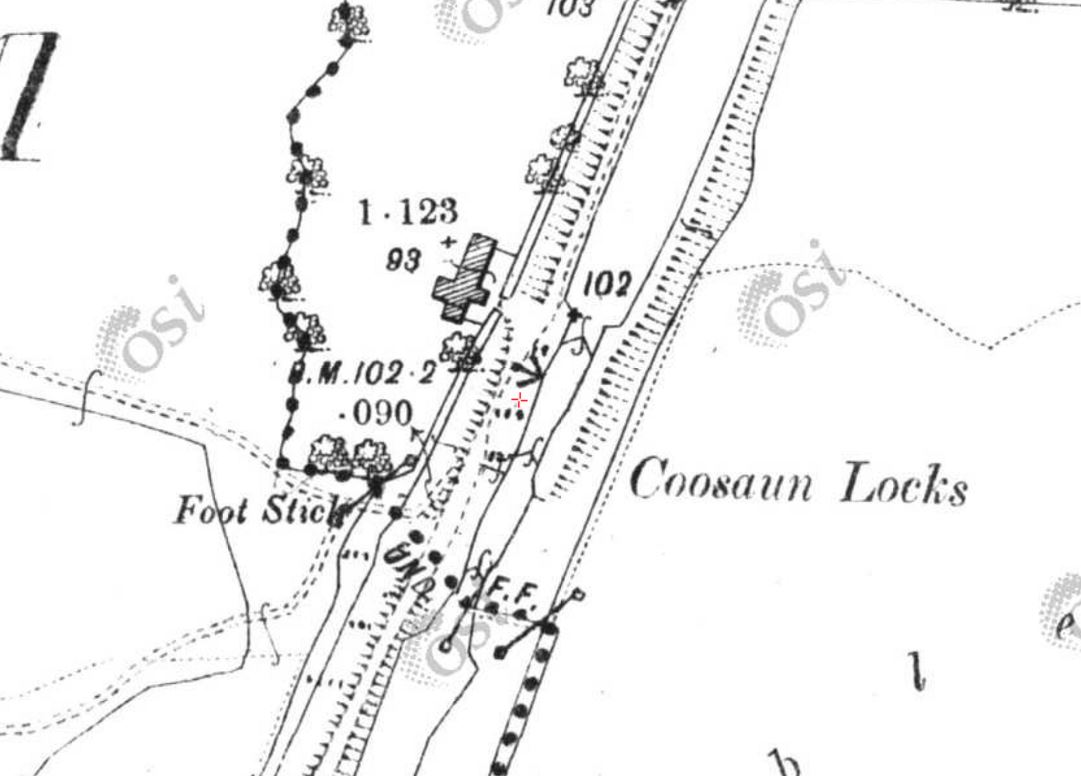
Cussane or Coosaun Lock was the lowest of three on the Killaloe Canal, which was the uppermost section of the Limerick Navigation. It was a double lock or “staircase pair”.

Cussane Lock (OSI ~1900)

Cussane Lock (OSI ~1900)


You can see what the lockkeeper’s house looked like in 2015 in the article “A Flooded Landscape Revealed“, written by folk who surveyed the area last year for Irish Water.

My OSI logo and permit number for website

An aerial view of the Shannon

I had much pleasure in availing myself of an ascent in Mr Hampton’s Balloon on Monday, accompanied by that gentleman and Mr Townsend. At two minutes to five, all the necessary arrangements being made, the bridling was cast off, and we ascended (apparently to us in the balloon gradually), but having relieved the car of five bags of ballast, which was thrown over, our ascent then became much more rapid.

The course taken by the balloon being at first almost due north we glided beautifully across the Shannon, and found ourselves at twelve minutes after five, at the north side of the river. The balloon, in this position, rested for some minutes, giving us an opportunity of gazing on the grand and magnificent panorama beneath us.

The prospect of Limerick was very extraordinary, every street, lane, and building, being at the same moment distinctly visible, but so apparently diminished in size that it assumed more the appearance of a beautiful miniature model than the actual city; the expanse of view was vastly greater than I anticipated, the various windings of the Shannon, with little interruption, being visible to Killaloe, above which the grand and noble expanse of water on Lough Derg was a prominent feature, flanked on either side with a lofty range of mountains. The view of the lower Shannon was also very attractive, extending far below the Beeves’ tower, and on which was visible one of the river steamers towing, I will not say a large ship, for it appeared no bigger than a turf boat.

We now bent our course towards Cratloe Wood, and at 22 minutes after 5, found ourselves standing right over its centre, the appearance of which was very extraordinary, the trees appearing more like a beautiful mantling of richly-coloured heath, or of short brushwood. Here I took an indication of a barometer, brought up at the request of Mr Wallace, the proprietor of the Observatory, for the purpose of getting for him its indication at the greatest altitude, and by which I found we were still ascending, soon getting us into another current, floating the balloon gradually towards the Shannon; and, at 30 minutes after 5, we found ourselves over the north bank of the river, opposite the Maigue.
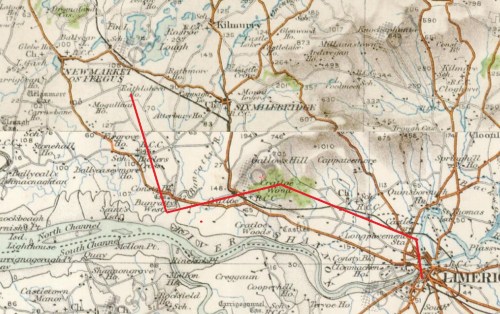
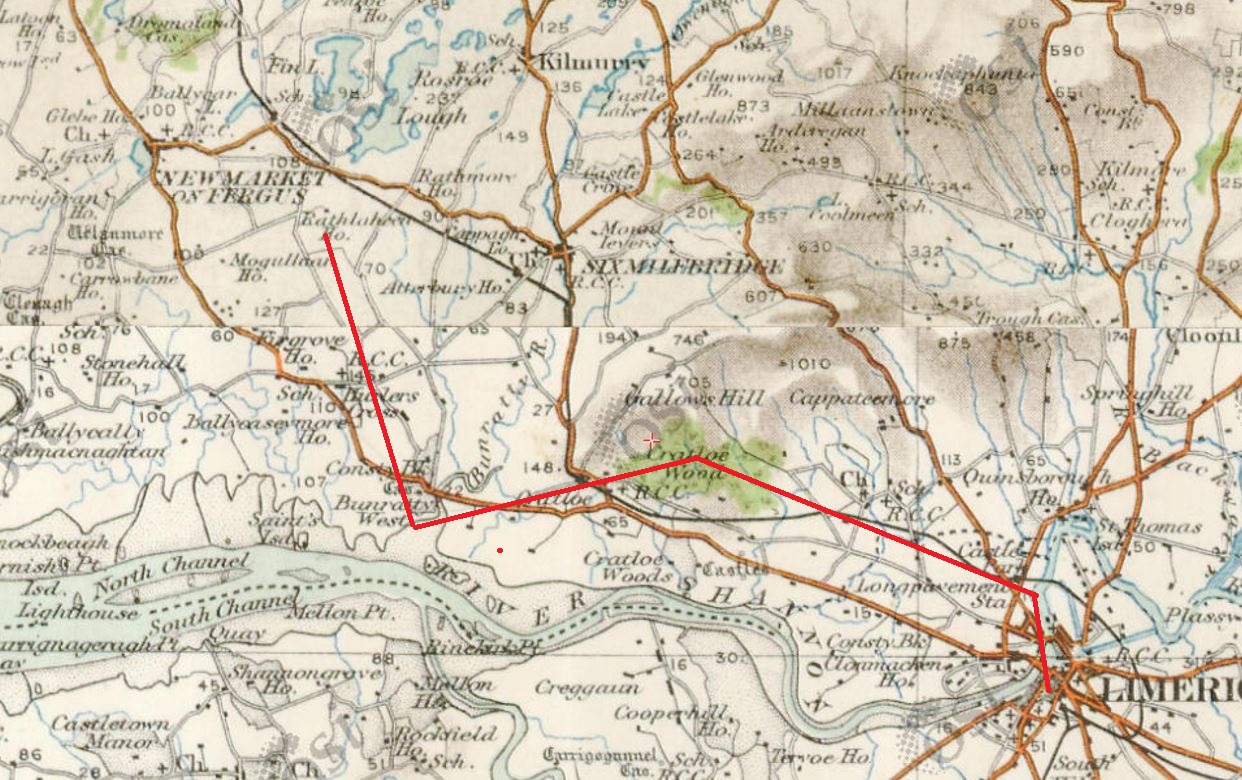
The flight of the balloon (OSI ~1840)

The flight of the balloon (OSI ~1840)

There, by indication of the barometer, it appeared we attained our greatest altitude, being then 4261 feet above the level of the river. The country beneath, from this great height, much resembled one of the Ordnance Survey maps. Undulations of the ground, except hills and mountains at a distance, not being visible, and large fields looking not much bigger than pocket-handkerchiefs; nor could I help thinking what a sad waste of land there was under stone walls, making such varied subdivision of property, and being much more numerous than I had any idea of.

At this altitude the atmosphere was so rarified that Mr Townsend felt his respiration considerably affected, which, under such circumstances, is very usual, though I did not experience it.

I was particularly attracted in this place, as would be supposed of perfect tranquillity, removed from the busy world, to find the buzz or murmuring sound of those beneath us (though, I need hardly say, invisible) ascend and fall on the ear distinct, though faintly, being different from any sound I ever before experienced, and but ill-conveyed by my inadequate description.

I found we had now got into another current diametrically opposite to what had been our last travelling, having taken a rapid course in the direction of Ennis. The barometer indicating a gradual descent, at 45 minutes after 5, Mr Hampton deemed it advisable to prepare for his descent, the country wearing a favourable aspect for doing so, and here he first worked the valves for that purpose; so that our descent and progressive movement now became very rapid.

And at two minutes to six we once more came in contact with terra firma; the car first striking obliquely two walls about 5 feet high, of dry masonry, being at either side of a road or bye way, through which it made a clean breach to the very foundation; the car, after passing through the breach, again oscillated, and found its resting place in a pasture field at the foot of Ralahine demesne, about three miles from Newmarket-on-Fergus, where we were quickly surrounded by a large peasantry, showing forth their true national characteristic generosity, for they not alone gave their most anxious aid in the saving of the balloon, and its various appendages, but many offered their horses to bring us into Limerick. Mr Creagh, I should also add, was most polite, having invited us to Ralahine, to partake of his hospitality.

I hope it may not be considered presumptive of me to state, from my slight knowledge of mechanical operations, that I consider Mr Hampton a perfect master of the management of a balloon, so far as practicable, and is, I feel, owed a debt of gratitude by the citizens of Limerick, for the very great treat which he has afforded them.

Hampden W Russell

Limerick and Clare Examiner 8 September 1849 in the British Newspaper Archive

Background

On Tuesday 21 August 1849 the Southern Reporter and Cork Commercial Courier announced that “Mr Hampton, the aeronaut” had arrived in Limerick and was preparing to ascend thence in his balloon, the Erin go Bragh. It was not his first flight from Limerick: he had ascended in October 1846, when the necessary gas (£14 worth) seems to have been sponsored by the “Limerick Gas consumers company” [Limerick Reporter 6 and 13 October 1846].

The 1849 ascent was on Monday 3 September from Mr Marshall’s Repository, Upper Cecil Street, and was advertised in advance. According to the Limerick and Clare Examiner of 29 August 1849, the “Splendid Band of the 3d Buffs” was to attend. Ladies and Gentlemen could watch from reserved seats [2/=; children 1/=] in a gallery; Second Places cost 1/=, children 6d.

Mr [John] Hampton offered seats in the balloon’s car to ladies or gentlemen who wished to accompany him; the balloon could lift six people and had two cars, one for descending over land and the other “for Sea-ports, in case the wind should be for Sea”. Those interested could find the fares by applying to himself at 12 Cecil Street or to Mr G Morgan Goggin at 34 George Street.


My OSI logo and permit number for website

From the BNA

There is sanity in the world

Here, with more details here. Although actually forming a club seems, somehow, rather over-energetic.

H/t, as so often, to Tyler Cowen who, as a polymath, probably wouldn’t be allowed in.