Category Archives: Ireland

Barrow cot

The Kildare Nationalist tells us that folk in Athy intend to build replicas of a cot formerly owned by Cassidy’s of Monasterevin.

They say that

The whiskey and beer was transported to Dublin on canal boats and the Barrow Cot Boat would have been used to keep the river and canal clear for the bigger boats.

I don’t understand that. First, the bigger boats wouldn’t have needed to enter the river en route from the distillery to Dublin. Second, keeping the canal clear was the job of the Grand Canal Company, not of carriers or traders on the canal. I would be grateful for more information about this.

Cassidy’s actually operated until around 1921, early twentieth rather than early nineteenth century. Perhaps the Edgar Holmes who owns the cot is related to the Samual Edgar Holmes of the engineering firm said to have taken over the premises in 1934.


A new book

Andy Wood’s Abandoned & Vanished Canals of Ireland, Scotland and Wales [Amberley Publishing, Stroud 2015] is now available. It is a companion to his Abandoned & Vanished Canals of England.

Many (but by no means all) of the Irish canals are covered on this site; the author sought and was granted permission to draw on this material and has generously acknowledged that.

I have not yet had time to read the book but I did note that the author seems to have confused Grand Canal Harbour and Grand Canal Docks.

Deadlock?

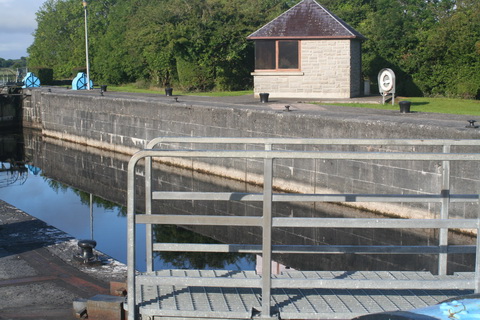
Victoria Lock, Meelick

Victoria Lock, Meelick

I like spending the night above the lock at Meelick: a pleasant, sheltered and quiet place. But there is a mystery about it.

Last time we were there, several groups of young folks came down to the lock after the keeper had knocked off for the night and gone home. It had been a warm day and I imagine that they were there to swim below the lock. Afterwards, some of them stayed around, chatting and hitting balls with their hurling mallets. They were quiet and caused no annoyance to anyone (although they might have removed their rubbish, in accordance with Waterways Ireland’s Leave no Trace policy).

But I did wonder what would have happened if there had been any horseplay, or even a mild slip, and someone had fallen into the lock chamber.

Both sets of gates were closed for the night, so the victim (even if conscious and uninjured) would have been unable to swim out and no rescue boat could get in.

There are no ladders in the lock chamber, so the victim could not have climbed out and any rescuer could only dive in, which would mean two people in the chamber rather than one. Nor was there anything in the chamber on which the victim might rest.

There was no information (that I could see) at the lock to tell the victim’s friends what to do, how to summon help or to get the gate opened. Any boater present might use VHF to call the Coast Guard and request a helicopter, but non-boaters might not think of that (or even of asking for the Coast Guard on ringing 999 or 112).

So that’s the mystery: if someone falls into a closed lock after operating hours, how is that person to be rescued? And how are others present to know what they should do? It would be nice if Waterways Ireland were to make information available on the spot.



Not just kayakers

Now rowers propose to use the Shannon.

I hadn’t realised that the Limerick [non-salmon] weir had affected rowers.

Waterways Ireland draft heritage plan

Boogie on over to the WI website for a copy of the WI draft heritage plan, and send WI your comments by 6 November 2015.

WI staff have put a lot of work into this and consulted various people, including me. I argued for a more activist approach, with more history and less about communities, and I would have let the twitchers and other nature-lovers look after themselves and their little feathered friends …

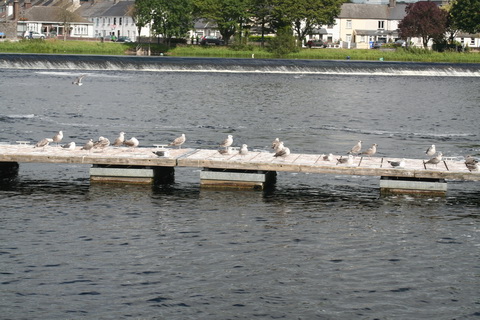
Birds hijacking facility at Athlone intended for (and paid for by) humans

Freeloading birds hijacking facility at Athlone intended for (and paid for by) humans. And who’s going to have to pay for cleaning it? Humans, that’s who. Human rights, that’s what we need …

… but I quite appreciate that Waterways Ireland has to be polite to all these people and can’t disobey the law, no matter how insane the legislation is.

But I digress. Get some comments in, preferably plugging industrial and transport heritage and economic history.

Pssst! Wanna buy a …

marina [slightly used]?

Royal Canal closure

I don’t usually report WI marine notices, but the current closure of the Royal Canal at Abbeyshrule is the result of one of the more unusual incidents I can recall.

Carlow Distillery

THOMAS HAUGHTON and CO., (being about to withdraw from the Trade,) are ready to receive proposals to Let with a fine, or Sell the Interest in their Concern, consisting of Distillery, Water-mill, Malt-house, Corn-stores, extensive Vaults for bonding Stores, with an excellent Dwelling-house; the whole situate at Carlow, on the bank of the navigable river Barrow.

The Copper Works and Utensils having been lately erected are all in perfect order, and there being a home Sale at the door for the entire produce, renders this Concern a most eligible investment for any competent person (or Company,) with a moderate capital.

The Dublin Mercantile Advertiser, and Weekly Price Current 16 December 1833

From the BNA

Stamping out cancer

ADHESIVE LABELS. — It cannot be too generally known that the very numerous cases of cancer which have lately prevailed are attributed by the faculty and scientific men to moistening the adhesive postage stamps with the tongue and lips. A little new milk is much preferable, and also causes them to stick faster particularly on glazed and smooth letter paper.

Waterford Chronicle 19 December 1840

From the BNA

Not a lot of people know that.

Portumna drawbridge

BORRISOKEEN, July 14. — The Solicitor-General, Mr Doherty, will arrive here to-morrow for the purpose of investigating the late unfortunate occurrences of this town on the 26th and 28th ultimo. This measure of the Government seems to restore some confidence to the minds of the people. Had this investigation not been granted, no person could calculate on the consequences of the expressed resolution of the peasantry to come into Borrisokeen, in a body of 50,000 or 60,000, to have vengeance for the loss of their relatives and neighbours.

On Saturday last a person named Dagg, a Protestant, residing in Borrisokeen, but who left it on account of the late occurrences, was apprehended at the mountains of Thoreebrien, when the country people held a consultation on the most effectual mode of putting him to death. Disregarding his entreaties and professions of innocence, he was dragged along by about 500 persons, and, on coming to Portumna, they determined to tie his legs to one part and his arms to the other part of the drawbridge across the Shannon, and then open it, that he might be drawn asunder. Fortunately at the time a gentleman from Borrisokeen passed by, and by his interference, with that of the parish priest, the life of the unfortunate man was spared.

Salisbury and Wiltshire Journal 27 July 1829

From the BNA

Newspaper accounts at the time suggest that there was an affray in Borrisokane at the end of the fair. Five mounted police either attacked or attempted to disperse the crowd; stones were thrown; Captain Dobbyn, a Stipendiary Magistrate, read the Riot Act and ordered the police to fire, which they did, killing two people. Two days later, during the funeral of one of those shot, one John L—, an Orangeman, and four companions, fired on the mourners from behind portholes on his house, or sallied forth to fire, killing four immediately and mortally wounding another. There is nothing to suggest that the unfortunate Mr Dagg was in any way involved.