Category Archives: Irish inland waterways vessels

The sinking at Moyvalley

FINAL SALE

Of the Extensive Stock of Woollen and other Shop Goods, including Blankets, Flannels, and Stuffs, Cotton Cords, Hosiery, Muslins, Trimmings, &c, &c, all more or less injured by fresh water, caused by the sinking of Boat No 49, at Moyvalley, on the Evening of Monday the 9th instant, by the Night Passage Boat.

TO BE SOLD BY AUCTION, Store No 6, Royal Canal Harbour, Constitution Hill, on THIs DAY (Friday), 20th Nov, 1846 (weather permitting), for account of whom it may concern, the residue of the large Stock of partially damaged Shop Goods, in Lots suitable to purchasers.

Sale to commence at half-past Eleven O’Clock.

The Sale will finally close To-Morrow. There are a quantity of Pack Sheets and Boxes to be disposed of.

JOHN LITTLEDALE, Auctioneer,
9, Upper Ormond-quay.

The Freeman’s Journal and Daily Commercial Advertiser
20 November 1846

Mr Roberts and his basin

To complement my page on the Eglinton Canal in Galway, here is one about the Claddagh Basin.

Crossing the Barrow

The trackway [towing-path] on the River Barrow changes from the east {left) bank to the west at Leighlinbridge and back again at Graiguecullen/Carlow.

It seems to me that there may have been some difficulties in getting horse-drawn boats from one side of the river to the other and I have found no evidence on how it was done, so here is some speculation instead.

Nobody boats on the canal in winter?

Sallins 20150308 01

Rounding Soldier’s Island

Sallins 20150308 02

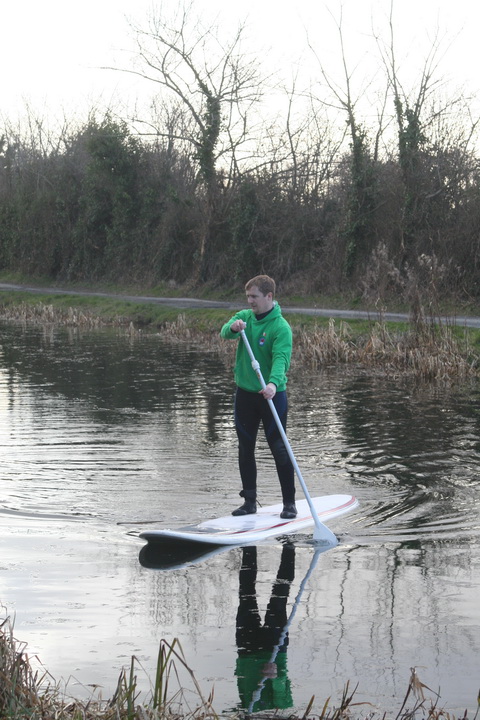
SUPper at the dry dock

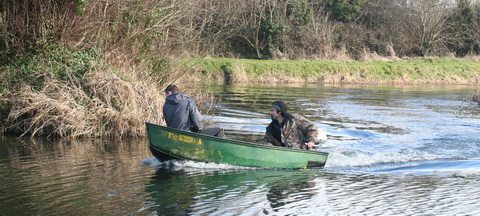
… and a two-man racing kayak that I didn’t photograph. All in the space of about half an hour at Sallins.

Shannon history

Folk interested in the history of the Shannon Navigation, and in particular in the work of the Shannon Commissioners in the 1840s, may like to get hold of an article “Steam, the Shannon and the Great British breakfast”, published in the Journal of the Railway & Canal Historical Society Vol 38 Part 4 No 222 March 2015.

Waterways Ireland and Erne Bye-laws

Waterways Ireland gets slightly tougher. Basil McCrea will be disappointed.

What has happened to Harbour Flights?

The successful air transport company Harbour Flights, which had a base at Mountshannon, announced some time ago that its level of success was such that it was suspending operations but that it would be back early in 2014, “fully operational again” with a fleet of aircraft “operating from [sic] destinations nationwide”.

Alas, my request for reports of sightings of the fleet produced neither information nor photographs and my own visits to Mountshannon in 2014 did not coincide with any aircraft movements. And now the website at http://www.harbourflights.com/landing.php has disappeared.

Surely nothing can have happened to the firm.


Belleek to Tralee in 10 hours by inland waterway

Learned Readers are undoubtedly familiar with Design-Driven Innovation, but I’m afraid I hadn’t come across it until I read a conference paper: S McCartan, P Murphy, R Starkel, A Sánchez González and M López Cabeceira “Design-Driven Innovation: Sustainable Transport Opportunities for the Inland Waterways of Ireland”, read at the fifth annual conference of the Irish Transportation Research Network at the University of Limerick from 3 to 5 September 2014.

The paper [PDF] can be downloaded free from Sean McCartan’s page on the academia.edu site, though you have to be registered with the site; the paper is also available, I think, from researchgate.net, but I’m not registered there so I haven’t tried the download.

As I understand it — and I am a Bear of Very Little Brain, and Long Words Bother me — Design-Driven Innovation means that a lot of clever chaps and chapesses come up with new and brilliant ideas and then ask people what they think of them:

The process of Design-Driven Innovation is an exploratory research project, which aims to create an entirely new market sector for a given product through changing the design meaning the user has for the product.

It seems that, in Ireland, 99.1% of freight travels by road, leaving just 0.9% for rail; 82.8% of passenger traffic is by car and 14.4% by bus and coach, leaving just 2.8% by rail. Waterways transport could use existing ports and canals; once the canals had the right bridges and automatic locks, running costs would be low. West coast ports could be used by a “coastal cruiser service”; people could travel by fast boat from Donegal right around the west and south coasts to Rosslare. All of this would reduce the carbon dioxide footprint (assuming, of course, that folk on the west coast wanted to travel, or needed to send goods, to anywhere else on the west coast rather than to Dublin).

On the inland waterways, 139 catamaran CLF vessels (Cruise Logistics Ferries) could run from Belleek to Tralee. Travelling at 22 knots, and ignoring lock times, they would complete the journey in only 10 hours; they could carry freight but also carry passengers in green luxury. These CLFs would be 81 metres long and 25 metres wide; each could carry 20 TEUs. At sea, 26 high-speed (40-knot) CLFs could each transport 12 TEUs from Cork to Dublin in just under four hours. And solar-powered catamarans on the Shannon and Erne could carry 64 passengers at 12 knots.

Meanwhile, the Grand, Barrow and Royal would not be forgotten. They would have a fleet of 1549 unmanned canal catamarans, with autonomous control systems, powered either by batteries or by fuel cells, ultimately fed from wind farms. They would each carry two TEUs but could also be converted for tourist cruising.

The overall aim, with those numbers of boats, is to replace half of the amount carried by road.

The paper concludes:

This is a first step in the analysis of the potential of the coastal and inland waterways of Ireland, to meet the EU targets for transport. State aid has been identified as a potential funding mechanism to support the realisation of these proposals.

Sometimes I wonder.

 

Canals conference 7 March 2015

Information posted at the request of the organisers


Inland Navigations of Ireland Historical Society
in partnership with
The Heritage Boat Association

The Canals of Ireland

Saturday 7 March 2015

Hugh Lynch’s Function Room, Tullamore, Co Offaly

Programme

Memorial Slides Conor Nolan 09.30
Welcome Gerard Bayly 09.55
Session 1 Chairperson Judie Lambert
The Canals of Europe Mike & Rosaleen Miller 10.00
The Canals of Ireland Colin Becker 10.20
Coffee break 10.40
Saving the Royal Niall Galway 11.00
Fighting for the Grand Mick Kinahan 11.20
Living on a Canal Eric Kemp 11.40
Morning Question Time 12.00
Lunch break 12.30
Session 2 Chairperson Kristina Baker Kenny
Newry Canal Geraldine Foley 13.30
Limerick Navigation Raymie O’Halloran 13.50
John’s River Brian Simpson 14.10
Grand Canal Kilbeggan Branch James Scully 14.30
Boyne Navigation Seamus Costello 14.50
Coffee break 15.10
The Future Joe Treacy 15.25
The Future Brian J Goggin 15.45
The Future Nigel Russell 16.05
Evening Question Time 16.25


Details

Admission:                          €12
Breaks:                                Tea/coffee included
Lunch in room:                   Soup and sandwiches included
Music:                                 Live music session during lunch
HBA:                                   Merchandise for sale
IWAI:                                  Merchandise for sale
Authors:                              Books for sale

Directions

Hugh Lynch’s Pub, Kilbride Street, Tullamore, Co. Offaly

087 250 5422


The Corrib dredger

Drainage and Navigation Works: Construction of dredging machinery

The Commissioners having authorized the purchase of one of the iron dredgers used in the execution of the Shannon works, and then on that river at Athlone, the operation of removing her to Galway was commenced on 1st of March.

This was effected by first clearing her of all machinery, and then cutting up the hull or shell into pieces suited for carriage by land, in which manner every portion of her was removed to Galway.

In reconstructing this boat, considerable improvement and thorough repairs have been effected. A flat iron plate, three-fourths of an inch thick, has been substituted for the hollow iron keel, which lightens her draft of water five inches without any diminution of her steadiness, and an alteration of the position of the steam-pipes has been judiciously arranged. The keelsons were pieced, and whenever any materials were unsound they have been replaced.

The time occupied in the breaking up, transfer, and reconstruction of this dreder, weighing 200 tons, was five months and eleven days, and the whole work was executed at a cost of £803/8/11.

Four scows or decked barges have been constructed for the conveyance of the material raised by the dredger to spoil. Two of these boats are capable of carrying 30 tons, and the other two 45 tons.

Extract from the Annual Report of Mr S U Roberts CE, District Engineer for the year 1851 in Twentieth Report of the Commissioners of Public Works 1852