Category Archives: Operations

White flour

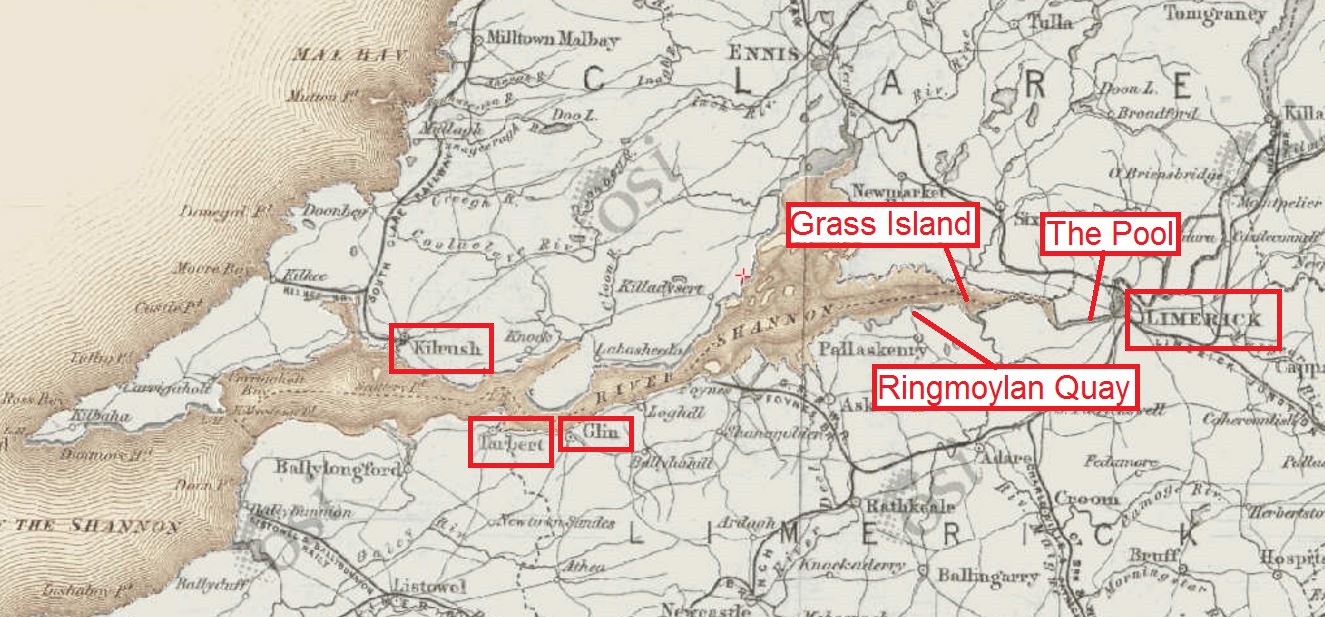
A few minutes past two o’clock in the evening of Wednesday, the 6th instant, the Dover Castle left Glin [that should read Limerick] for Tarbert, with between 30 and 40 persons on board, including some of the Glin police.

shannon-estuary-osi-02

The route of the Dover Castle (OSI 25″ ~1900)

When she reached the pool, she took a large brig and a schooner in tow, which she took as far as Grass Island. She then continued her course, and when about three miles west of Ring Moylan quay, a thick fog came like a wall upon her, so that it was impossible to see half the length of the deck.

Captain White immediately dropped anchor, and was obliged to remain so. The fog continuing all night and the next day.

About two o’clock on Thursday, there being no appearance of the fog clearing off, and several persons on board having eaten nothing since Wednesday morning, two women fainted, and the circumstance having been communicated to the captain, he immediately ordered the steward to open a bag of flour, and served it out in large buckets to the women, who, in a short time, had large cakes made, and baked them for the passengers.

At half-past four o’clock the fog began to clear, and at five the steamer weighed anchor, and reached Kilrush in safety.

Statesman and Dublin Christian Record
19 January 1841 quoting Limerick Standard

My OSI logo and permit number for website

From the BNA

A Suir thing

Some weeks ago Redmond O’Brien left a comment here; later he very kindly sent some photos. I have interspersed comment and pics here.

Today, while cycling on the Greenway along the Suir, I noticed a small pier and harbour by Mount Congreve.

Pier @ Mount Congreve

Pier at Mount Congreve (copyright Redmond O’Brien)

Is anything known about this? Possibly used by Mount Congreve at some time? A rather unusual design. The pier/quay is rectangular with stone steps on the upriver side.

Pier @ Mount Congreve

Stone steps (copyright Redmond O’Brien)

On the downriver side of the pier is a small rectangular harbour with a wall enclosing the side opposite the pier.

Boat Dock @ Mount Congreve

Enclosure at Mount Congreve (copyright Redmond O’Brien)

I wondered whether the pier or quay might have anything to do with the Christmas Canals, which Anthony M Sheedy said were “a joint effort between the Two Estates to bring irrigation into the Mount Congreve Estate”. I emailed the Mount Congreve Estate to ask if they knew anything about it, but I had no reply.

I also wondered whether the enclosed area might be for smaller boats, which might be transhipping cargoes to or from larger vessels tied at the end of the pier, quay or wharf. However, all of that is speculation.

The pier or wharf is shown on the 6″ Ordnance Survey map.

suir-whard-1840_resize

The pier on the 6″ Ordnance Survey map ~1840 (copyright Ordnance Survey Ireland)

It also appears on the 25″ map of around 1900.

suir-whard-1900_resize

The wharf and the wall on the 25″ map (copyright Ordnance Survey Ireland)

Here’s a close-up.

suir-whard-1900-close-up_resize

The wharf ~1900 (copyright Ordnance Survey Ireland)

I have found nothing about this in Charles Smith’s The Ancient and Present State of the County and City of Waterford or anywhere else, save for one possible clue in an article “Rambles by Road and by Rail” published in the Waterford Mail on 3 December 1862 and in the Waterford News on 12 December 1862 (both on the British Newspaper Archive), but originally from the Farmers’ Gazette. The article, part of a series, is about Mount Congreve. It begins:

There is scarcely an individual in Waterford or Tramore who does not know Mount Congreve, the beautifully situated residence of John Congreve Esq, in consequence of the free permission given by that gentleman to those who may wish at any time to visit his grounds. It is, consequently, the regular resort during summer and autumn of pleasure parties from Waterford and Tramore, those visiting it from Waterford generally preferring to sail up the Suir to the place, handy quays being erected at different parts of the grounds for the accommodation of visitors.

No doubt the quays could accommodate visitors, but a later part of the article offers a more plausible explanation for the existence of the handy quays:

Four large lime kilns are kept constantly at work during summer, one of them being generally working all the year round, not so much as a matter of profit, as for the purpose of affording employment and of supplying Mr Congreve’s tenants and others in the neighbourhood with lime at moderate rates. The limestone is brought from Mr Congreve’s property on the county Kilkenny side of the Suir, as there is no limestone on the county of Waterford side, and the navigable capabilities of that river enables vessels to discharge their cargoes of culm just at the kilns, thereby effecting a considerable saving in point of carriage. One way or other, a considerable number of people are employed by Mr Congreve in connection with his lime works, besides being of great service to the neighbourhood.

The 6″ OSI map shows what may be the handy quays here (they’re easier to see on the black and white version). And if you switch to Historic 25″ you’ll see even more round objects, with the legend LK, which I take to mean Lime Kiln.

However, the kilns are some way downstream of the wharf, and it has no LK legend or round objects near it. There are, though, some LKs just a little way up the Christmas canals.

But this is speculation, and I would be glad to hear from anyone who knows anything about the wharf on the Suir.

My OSI logo and permit number for website


From the BNA

Celebrating Ireland’s floating heritage

Waterways Ireland
MARINE NOTICE No 126 of 2016

SHANNON NAVIGATION

Large Vessels Berthing  at Floating Moorings

Waterways Ireland wishes to advise all masters and owners of vessels with an overall length in excess of 11m, particularly those constructed in steel, of the following points in relation to berthing at floating moorings and also on finger jetties having a length of 9m:

  1. These vessels cannot be secured properly over their entire length thereby placing extra strain on the pontoon mooring cleats as mooring lines are doubled up.
  1. The large overhang of these vessels creates an obstruction to other vessels trying to manoeuvre onto the berth especially for novice recreational boaters and hire boat crews with limited experience.
  1. In adverse weather conditions of high winds and /or flood conditions with high flow rates there is a greater risk of breaking free of the mooring and causing damage to other vessels and the mooring infrastructure especially as these large vessels are primarily constructed in steel and are very heavy.
  1. The 9m finger mooring is designed for vessels with a max overall length of circa 10-11m.
  1. The fixings attaching the floating mooring to the main spine can be compromised due to excessive forces induced by inappropriate sized craft leading to premature wear.
  1. Such vessels place excessive strain on the mooring piles and anchor chains as water levels rise especially where masters have secured to both the cleats and the mooring piles themselves.

Masters of such vessels are requested to berth on appropriate lengths of fixed quay wall only. Waterways Ireland thanks its customers for their cooperation in this matter.

Charles Lawn, Inspector of Navigation. 23 rd September 2016


A bicycle boat

On Limerick’s Life here.

Lough Gill

Mr Kernaghan’s steamer is navigating Lough Gill, which has increased the value of country produce in Sligo market 15 per cent, and it is proposed to connect the Lough with the Shannon four miles distant.

Roscommon & Leitrim Gazette 11 May 1844

From the BNA

Lakelands

According to the Irish Times of 27 August 2016

Fáilte Ireland has tendered [sic] for a company to help it develop a new tourism strategy for the swathe of land running down the middle of Ireland that falls outside the Wild Atlantic Way and Ireland’s Ancient East, the two linchpins of the State’s tourism marketing strategy.

The area, generally referred to in tourism marketing circles as “Ireland’s Lakelands” district, takes in parts of east Galway, Roscommon, Leitrim, much of north Tipperary, and runs down as far as the northern reaches of Cork. […]

The tender made no mention of the Lakelands moniker, but Ms Carroll [of Fáilte Ireland] […] said the Lakelands term, which is also used in the Programme for Government’s tourism strategy, may not end up being the final slogan that is used for the region.

I wonder what that does for Waterways Ireland’s Lakelands &  Inland Waterways marketing and product development Initiative and what it says about the success of the Lakelands Strategic Plan [PDF]. I note too that the Irish Times refers to “the State’s tourism marketing strategy” whereas WI’s initiative was a cross-border one and included the Erne as well as the Shannon.

Rescue services

With the VHF on Channel 16, I can hear the Coast Guard but not (usually) the boats talking to them. As a result, I get one side of the conversation and have to piece the story together from that.

One day, the Coast Guard acknowledged a message from a private boat which had reported a cruiser aground at a named part of Lough Ree. The Coast Guard didn’t have a map of the lake and didn’t know where that was [why not?] but it seemed that the private boat was able to explain matters. It was also able to say, in response to questions, that three people were visible on board and that one was wearing a lifejacket or buoyancy aid.

The Coast Guard, after a while, reported that it had asked the Lough Ree RNLI lifeboat to go to the rescue, gave an estimate of when it would get there and asked the private boat to remain on station. The private boat evidently agreed to do so.

Some time later the Coast Guard reported that the lifeboat was on its way.

And some time later again the Coast Guard called the lifeboat and told them they were being stood down and could return to base, as the hire firm was arranging for a boat to be sent to the rescue. The private boat was told that it could leave the scene.

If I were the skipper of the private boat, I would be very pissed off and, next time I saw a boat aground, I’d be inclined to ignore it. That would not be good.

The problem here is that there are two competing rescue services. The official service [PDF] is the one that was called into operation by the private boat, which did the right thing in reporting the grounding. And the system worked perfectly after that.

It should be noted that a private boat cannot know what, if anything, is happening through the unofficial rescue service operated by hire companies on the Shannon: “unofficial” in that its boats are not Declared SRUs (Search and Rescue units), the hire firms (and IBRA) are not listed as Irish Search and Rescue Organisations and their operations are not coordinated by the Coast Guard.

According to the Carrick Craft Captain’s Handbook [PDF/Flipbook]

You will be given breakdown and emergency telephone numbers when you check in.

It also says

Running aground

In all cases immediately contact your hire boat base for advice using the number provided. In the interests of safety do not accept an offer of help from a passing boat. If needed, assistance will be quickly available either from your hire boat company or one of the associate hire boat companies who may be located closer to you. Your hire boat company will alert the necessary authorities to deal with any incident that may arise.

The bit about not accepting help from passing boats is OK, I suppose, until the water reaches your ankles.

But I suspect that the advice to hirers is based on experience: groundings are probably the most common form of accident, it is unlikely that the boat will sink, it is likewise unlikely that anyone will have been injured and it is probable that a dory or other workboat will be able to make any necessary checks and repairs, haul the boat off and admonish the crew.

However, there may be an element of self-interest in this too: if the hire firms look after these incidents themselves, they won’t find them covered in press releases from voluntary rescue bodies, with videos shot by boat-mounted cameras. I have heard it said that some folk — including private boaters — feel that rescuers’ press releases give the wrong impression of the inland waterways, suggesting that they are more dangerous than they really are, especially given that few rescues involve any threat to life. [That’s something I’ve heard, not my own view.]

It is entirely possible that I misunderstood, and have thus misrepresented, what was happening. But if I haven’t, it seems to me that there is a problem in the relationship between the official and unofficial rescus systems for hire boats. If hire company staff, who are paid for the job, can rescue afflicted boats, without having to impose on the volunteer rescue services, then that’s a good thing. But it would not be good to have private boaters ignore all hire boats in trouble because, some day, the trouble might be serious.

I do not know whether the hire firms and the Coast Guard have discussed these matters and reached some understanding or produced some protocol about when the firms will call in the official services. If they haven’t, it might be nice if they did.

And, in individual instances, the firms might tell the Coast Guard, and ask them to broadcast the fact, that there is a boat aground and that they’re on their way, perhaps asking private boats to keep an eye out just in case. Everyone with VHF will hear the news, but that’s still more private than having press releases and videos on websites.

 

Sewage

Having a boat with a holding tank and no bypass system, we take a keen interest in the availability of pump-outs on the Shannon. We used that at Dromineer before heading upriver, but then found that:

  • that at Castle Harbour, Portumna, seemed to have disappeared, probably as part of the harbour renovations; no doubt it will return eventually
  • that at Banagher was not working. There was no notice to say so and the Waterways Ireland patroller who visited the harbour was not aware of the fact. We notified WI but a repair team did not arrive
  • that at Shannonbridge was blocked by a private cruiser. A hire-boat tried to use the pump-out but the hose would not stretch to any position other than that occupied by the private boat. The hire-boat folk even tried to tie their boat to span the gap between the cruiser and the boat behind it, but the hose would not stretch far enough
  • at Athlone the pump-out on an outside hammerhead pontoon had been disconnected as the berth was now allocated to a trip boat. There was a pump-out at the inner end of the pontoon fingers but, while it might be possible to get in safely, getting out would have been pretty well impossible without hitting someone else’s boat.

We were not inconvenienced by this: we went to Quigley’s at Killinure and got pumped out there. But I was struck by the fact that the only other boats we saw trying to use the pump-outs were hire boats, so I looked at the Carrick Craft Captain’s Handbook [PDF/Flipbook] where I found, on page 8, that hirers are given pretty definitive advice about using their holding tanks and the pump-outs:

All boats are equipped with holding tanks for sewage. Tanks should only be emptied at pump-out stations. It should be noted that it is illegal to dispose of sewage overboard. Never moor alongside pump-out stations for longer than required to empty the holding tank.

There is more detailed advice on page 26.

The poor benighted foreigners take all of this seriously, not realising that, in Ireland, illegality is no reason not to do something — an instance perhaps of what Brian Lucey called a “preference for discretion“. But the point is that those I saw were taking considerable trouble to obey the Irish laws and were being frustrated in doing so. It seems unfair that they should waste an hour or so in trying to get a pump-out — or should endanger themselves in trying to get near the pump.

Some suggestions:

  • hirers might be advised to use the facilities at IBRA bases as much as possible, but not to rely on being able to do so on change-over day
  • Waterways Ireland patrollers might check the condition of pump-outs (and other harbour facilities) when checking boat numbers; they might report to the appropriate engineers
  • keeping pump-out locations free at all times would be a waste of space, but they might have markings asking boaters to move when someone does want to use the facilities
  • the operators of the Athlone marina might be asked to put a pump-out on an outside berth.

Oh, and folk might be advised not to swim in harbours ….

Weather

I had not realised that the times of the Met Éireann inland lakes weather forecasts, broadcast by the Coast Guard on VHF, had been changed. The times are now

06:15
10:15 repetition
13:15
16:15 repetition

MRCC Dublin, to whom I am grateful for confirming the new times, says

Standby on VHF Channel 16 for your local working channel.

In bygone days the Lough Derg and Lough Ree forecasts were five minutes apart, but now the initial call on Channel 16 is at the same time everywhere.

I found the new 10:15 broadcast to be particularly convenient.

Forecast format

However, one aspect in which I thought the Met Éireann forecasts (also available here) less useful than those from other sources (eg Windguru) is the absence of a forecast for wind gusts. On several occasions this year, the gusts were (a) almost continuous and (b) much stronger than the forecast wind speed. They thus had more influence on our trip planning than did the base wind speed. It would be nice if Met Éireann, and thus the Coast Guard, could include a forecast for gusts.

Hire boats

The hirers’ training materials I mentioned here give good advice about rough weather on lakes but, after seeing several hire boats cross Lough Ree in weather that kept us in harbour, I wondered whether the lakes forecasts are readily available to hirers. If they’re not, perhaps they could be transmitted daily by text message?

I should stress that I did not hear of any accidents caused by stress of weather, but some folk may have had uncomfortable trips.


A distinguished visitor to the Shannon

Dwarkanauth Tagore, of Calcutta, the distinguished and princely East Indian, who is making a tour of the United Kingdom, arrived in this city, on Tuesday evening with his suit [sic], in an elegant drag with four horses, and he put up at Cruise’s hotel.

The native Prince merchant partook of a dejeune at Killaloe on Tuesday. The City of Dublin Steam Company placed all their vessels on the Upper Shannon, at his command, and they were gaily decorated with flags, in compliment to the distinguished stranger, who left Limerick this day on a visit to Killarney Lakes, and is expected to call at Derrynane, the seat of Mr O’Connell.

Dwarkanauth Tagore dined and slept at Lord Rosse’s, on Monday night, where he examined the prodigious telescope — drove to Banagher, on Tuesday morning, and embarked on board the Lansdown [sic] steamer, proceeded through Victoria Locks Meelick, accompanied by Colonel Jones, and Mr Rhodes CE, also by Mr Howell, Secretary to the Dublin Steam Company. He was much pleased with the new works at Meelick, and also with the operations of a diver in a helmet, who exhibited the mode of using that apparatus.

The dejeune on board the Lansdown was provided by the Steam Company. Several ladies and gentlemen came up by the Lady Burgoyne to join the party of [at?] Portumna in the Lansdown. After partaking of the good cheer, they had dancing and music on deck till they reached Killaloe, much to the amusement of the stranger guest, who felt edlighted, not only with the scenery of the lake, but also with the company of the ladies.

Limerick Reporter 5 September 1845

From the BNA
