Category Archives: Operations

Tepid baths

1823

KILRUSH HOTEL, AND TEPID BATHS

This Elegant Establishment is fitted up in a superior style for the accommodation of Visitors, on the reduced terms of last Season.

The House adjoining the Hotel, now occupied by Mrs Colonel Stammers, of Cahernelly, will be Let, from the 12th of June, for the remainder of the Season; it has ample accommodation for a large Family, who can be supplied with any thing they may require from the Hotel; they will also have the use of the Bathing Machines and Bathing Houses — from this House to the Tepid Baths there is a covered passage.

The Lady of the Shannon steam packet sails from Limerick for the Hotel, on Tuesdays, Thursdays and Saturdays, and returns on Mondays, Wednesdays and Fridays, making her passage in five hours.

Kilrush, May 15th, 1823

Dublin Evening Post 20 May 1823. From the British Newspaper Archive run by Findmypast Newspaper Archive Limited, in partnership with the British Library.
1829

[…] The hotel and baths, for which this Town was remarkable, have been suffered to go to decay — at least, are not occupied as such at present.

Limerick Evening Post 8 May 1829. From the British Newspaper Archive run by Findmypast Newspaper Archive Limited, in partnership with the British Library.

The crimefighting Shannon steamer

Limerick, May 26. This morning the Lady of the Shannon steam yacht towed up, in grand style, the Fox cutter, captured by the Vandeleur Revenue cruizer, Capt Hopkins, as stated in our last. She lies at the Custom-house quay, is a very fine vessel, clinker built, pierced for eight guns, which were thrown overboard, in chase, and is remarkably well found. Her cargo is supposed to consist of 1000 gallons of highly rectified Geneva, in 10 gallon casks — 20 hogsheads of tobacco, in bales and half-bales — and a large quantity of teas — amount not yet ascertained.

Public Ledger and Daily Advertiser 5 June 1818 [quoting Irish Papers]. From the British Newspaper Archive run by Findmypast Newspaper Archive Limited, in partnership with the British Library.

Mr Mullins’s steamer

Here is a little information about the steamer Cupid, which was owned or used by the contractor Bernard Mullins on the Shannon in the 1840s.

Launch at Messrs Bewley and Webb’s yard

The first of two new steel canal boats which the above firm are building for the Grand Canal Company was successfully launched on Wednesday.  These boats are 60 ft long by 13 ft 2 in beam, and 5 ft 9 in depth of hold, and are designed to carry forty tons on a light draught of water. They are of improved design and construction, and expected to tow very easily. The Canal Company have expressed themselves well pleased with the time of delivery and workmanship, and it is to be hoped no more orders of this kind will go across the water in future. The firm appear to us to be well able to deal with the work of the port. The ss Magnet, of the Tedcastle Line, which had an extensive overhaul at this yard, we believe, gave every satisfaction, and had a most successful trial trip a few days ago. It is to be hoped that more of our local steamship companies will follow the lead of Messrs Tedcastle, and have their work done in Dublin.

The Freeman’s Journal 1 September 1893. From the British Newspaper Archive run by Findmypast Newspaper Archive Limited, in partnership with the British Library.

Some context here.

A Grand Canal mystery

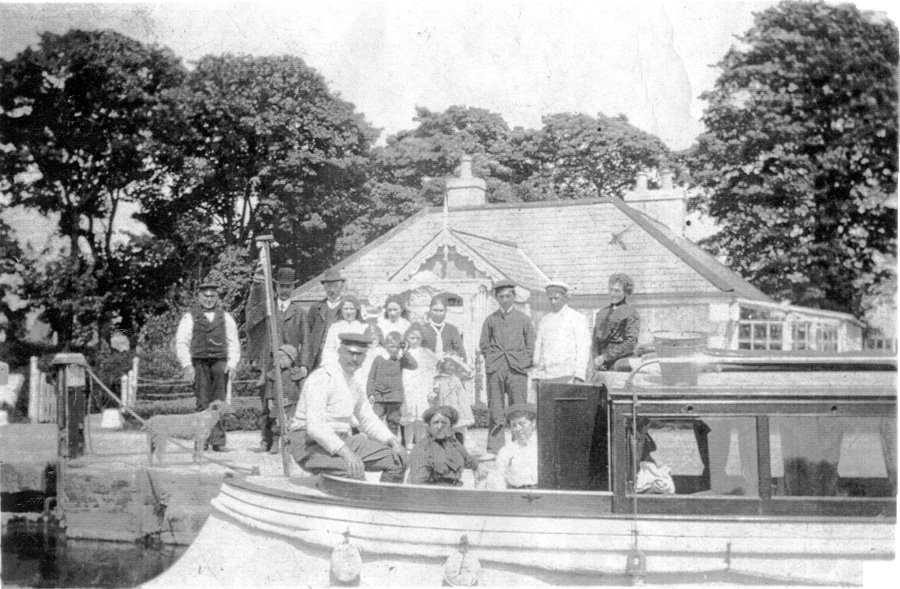
Passenger boat over lock1

Boat at Lowtown

Alan Lindley has very kindly sent me, and permitted me to publish, this photograph.

It was taken at Lowtown lock, on the Grand Canal, in 1911 or 1912.

Alan says that the man on the left of the group — with cap, waistcoat and watch-chain, and with a dog standing in front of him — is the lock keeper, Murtagh Murphy, the great-grandfather of the present incumbent, James (Jimmy) Conroy. Murtagh was born in Ballycowan, near Tullamore, Co Offaly, in 1849 and, after working on a Grand Canal Company boat, married a Kildare girl and took the job at Lowtown.

The boat had been described as a passenger flyboat but, as the Grand Canal Company had ceased carrying passengers in 1852, that seems unlikely. And the boat looks much more like a pleasure vessel than a working boat.

If the Grand Canal Company had an inspection launch, this might be it, but I have found nothing to indicate that it did. The boat does, though, seem to have been designed for canal travel: it seems (from the twenty feet or so we can see) to have straight sides and to be well equipped with fenders. It might therefore have been designed to travel on the canals (as well as on other waters).

At least one director of the Grand Canal Company, Henry Samuel (aka Harry Samuel) Sankey, of Fort Frederic, Virginia, Cavan and of 64 Wellington Road, Dublin, did have a launch or pleasure craft on the canal, the Aja, which you can read about here. Incidentally Mr Sankey, who died on 5 December 1925, directed “that no Roman Catholic shall take any benefit” under his will.

Further information about the boat and the people shown in the photograph, and about Mr Sankey’s launch, would be very welcome; please leave a Comment below.

A canal caterpillar?

Robertson’s chain propeller system on the Bridgewater and Grand Canals in 1859 and 1860.

Grand Canal Company 1861

Sailing of the company’s trade boats,
commencing Saturday, 1st June, 1861

The Company’s Swift Trade Boats start with the strictest punctuality daily to the following stations, viz: — Athlone, Ballinasloe, Limerick, Tullamore, Kilbeggan, Mountmellick, Philipstown, Monasterevan, Portumna, Dromineer, Williamstown, Killaloe, Shannon Harbour and Banagher, Belmount, Naas, Corbally, Sallins, Portarlington, Rathangan.

Sailing Bills containing all particulars may be had upon application at the Company’s Offices, JAMES’S-STREET HARBOUR or WILLIAM STREET.

The Company’s Boats do not trade to Carrick-on-Shannon or Lanesborough.

By Order, John M’Mullen, Grand Canal House, 29th May, 1861

Freeman’s Journal 1 June 1861. From the British Newspaper Archive run by Findmypast Newspaper Archive Limited, in partnership with the British Library.


And the prize goes to …

… Niall Galway, who identified the Cong Canal. bjg

Transhipment

At the Grand Canal Company’s half-yearly meeting on 22 February 1890, a Mr Geoghegan

[…] said he had heard from a gentleman interested in the trade between Dublin and Limerick that it often took six days for Guinness’s porter to be carried by canal from the former of these cities to the latter. The cause of this he believed was the necessity for trans-shipment at Shannon Harbour.

The Chairman disagreed:

As to the delays at Shannon Harbour there had been some, but he believed these had been caused by floods and storms in the river.[1]

The company had commissioned Mr E Lloyd, engineer and general manager to the Warwick and Birmingham Canal Company, to inspect the Grand Canal and to advise the board. It was estimated that his survey would cost between £100 and £120. The chairman accepted that there were

[…] many matters […] which demanded immediate steps, and these entailed considerable outlay. It has been evidenced that before the property of the company could be stated to be in a thoroughly satisfactory condition some further exceptional outlay would be advisable from time to time.[2]

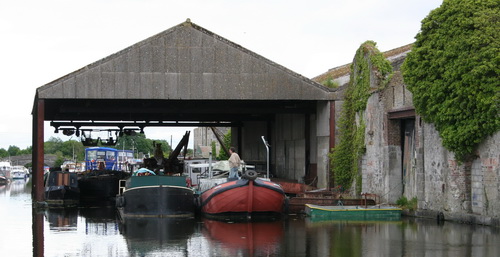
At the next half-yearly meeting, held on 23 August 1890, the chairman said that the company was considering investing in a more rapid transhipment system “from our barges to the Shannon steamers” at Shannon Harbour, in accordance with Mr Lloyd’s suggestion.[3]

Shannon Harbour June 2008 02_resize

The transhipment shed at Shannon Harbour in June 2008, before its canopy was removed

I do not know whether the transhipment shed at Shannon harbour, and the gantry mechanism on which goods could be loaded and unloaded under cover, was built on Mr Lloyd’s suggestion. It would be interesting to know more of the building’s history.

Sources


[1] The Freeman’s Journal 24 February 1890

[2] ibid

[3] The Freeman’s Journal 25 August 1890

From the British Newspaper Archive run by Findmypast Newspaper Archive Limited, in partnership with the British Library.

Thon Sheugh and WI’s budget

A Sinn Féin MLA, whose party colleague is one of two ministers responsible for Waterways Ireland, has expressed concern about WI’s financial position:

Phil Flanagan: Is the [North South Ministerial] Council aware of the stark financial difficulties facing Waterways Ireland as a result of not only sustained budget cuts but the currency fluctuation because of the weakened euro? Let me point out some of the figures: compared with 2013, the 2014 budget was down by €290,000; and, in 2015, it was down by €875,000, solely because of the weak euro. Was that matter discussed? What potential solutions may ensure that Waterways Ireland is returned to a sustainable financial footing?

I had not realised the extent of the problems caused by the euro.

Replying, Martin McGuinness — also Sinn Féin — said

The fluctuation of the euro was not discussed at the meeting.

Obviously, it does represent a serious challenge, given the fact that the euro has been very weak over recent times. I note that it has strengthened over recent days. Certainly, on foot of the Member highlighting this, we can give it further consideration.

Mr McGuinness went on to provide some information about Saunderson’s Sheugh (which we’re pretending is the Ulster Canal):

It is important to point out that the work of Waterways Ireland is nearing completion, including the dredging of the River Finn between Upper Lough Erne — that will be of interest to the Member — and Castle Saunderson as part of phase 1 of the restoration of the Ulster canal.

Design plans for the new bridge at Derrykerrib are also at an advanced stage. I understand that there are some contractual issues with the site that, combined with high water levels, have led to delays.

However, Waterways Ireland is working with local councils and other interested parties to secure EU funding under the INTERREG sustainable transport programme. The proposed greenway would run from Smithborough village to the Monaghan town greenway and on to Armagh. The point that the Member raised is important and will be considered by the Council.

Given that that was irrelevant to the question, I presume that Mr McG wanted to get this information on the record.

I would like to know more about the “contractual issues with the site”. I do hope they won’t mean that we miss getting photos of the northern and southern ministers, wearing yellow hard hats and lifejackets, claiming credit for the work. After all, there is an election coming up.