
Commercial traffic on all waterways in Ireland ended during the first half of the 20th century.
For certain values of “half”.
Waterways Ireland gets slightly tougher. Basil McCrea will be disappointed.
Posted in Economic activities, Extant waterways, Foreign parts, Irish inland waterways vessels, Operations, People, Politics, Sources, Tourism, Water sports activities, waterways, Waterways management
Tagged Basil McCrea, bye-laws, dcal, department of culture arts and leisure, Erne, Ireland, Operations, Sinn Fein, vessels, waterways, Waterways Ireland
I originally had a rather more rude heading …. The Minister for Waterways and Other Stuff has decided to have the River Finn dredged to aid her reelection campaign shut up the Shinners promote peace and prosperity. The “shutting up the Shinners” bit means pretending that this is a restoration of the Ulster Canal, whereas it avoids the canal altogether in favour of dredging the river as far as Castle Saunderson, in Co Cavan, instead of going to Clones, in Co Monaghan. According to NorthernSound
Minister Heather Humphreys says the project will provide a wonderful recreational facility for local communities and will act as a significant draw for tourists.
That, minister, is a load of old bollocks: the locals have plenty of waterway already and the tourists are not going to be drawn by another bit of river. Still, Saunderson’s Sheugh is better than the Clones Sheugh, but it is worrying that
The project is expected to cost in the region of €2 million euro and will be funded by Waterways Ireland.
According to its Business Plan 2015, approved by the North South Ministerial Council on 18 December 2014, Waterways Ireland’s budget for sheughery in 2015 is €1000. So, if it is to spend €2 million on Saunderson’s Sheugh, and if the Treasure-Seekers have failed to find any money, will this mean that WI’s budget for maintaining and repairing the existing navigations will be cut?
I see that
The Minister says construction should begin in the final quarter of 2015.
I wonder when the next election is.
Posted in Canals, Economic activities, Engineering and construction, Extant waterways, Foreign parts, Natural heritage, Operations, People, Politics, Restoration and rebuilding, Sources, Tourism, Ulster Canal, waterways, Waterways management
Tagged Cavan, department of arts heritage and the gaeltacht, Department of Community Equality and Gaeltacht Affairs, Heather Humphreys, Killaloe, Monaghan, North South Ministerial Council, River Finn, Saunderson's, sheugh, Ulster Canal, waterways, Waterways Ireland
The Canal & River Trust have a useful PDF Boater’s handbook available for download, free of charge, from this page; there is also a video thingie.
The handbook naturally concentrates on British inland waterways, with narrowboats on canals and rivers but not on lakes, but there is nonetheless much useful material. Even experienced boaters might find it of interest, if only for briefing any non-boaty friends they’ve invited along for a trip.
The successful air transport company Harbour Flights, which had a base at Mountshannon, announced some time ago that its level of success was such that it was suspending operations but that it would be back early in 2014, “fully operational again” with a fleet of aircraft “operating from [sic] destinations nationwide”.
Alas, my request for reports of sightings of the fleet produced neither information nor photographs and my own visits to Mountshannon in 2014 did not coincide with any aircraft movements. And now the website at http://www.harbourflights.com/landing.php has disappeared.
Surely nothing can have happened to the firm.
Posted in Economic activities, Extant waterways, Ireland, Irish inland waterways vessels, Operations, Safety, Shannon, Tourism, Uncategorized, Water sports activities, waterways, Waterways management
Tagged aircraft, amphibian, Clare, float plane, Harbour Flights, Ireland, Lough Derg, Mountshannon, Operations, seaplane, Shannon, Waterways Ireland
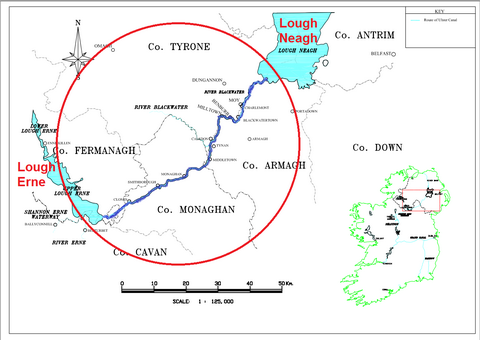
Studies 1994–2000
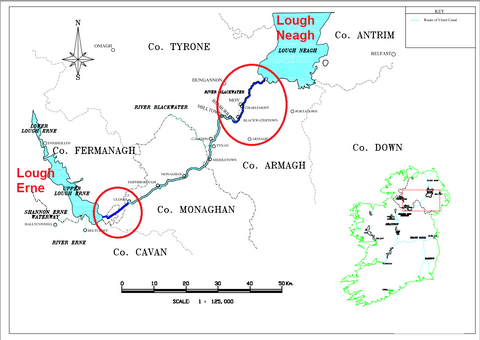
Socio-economic summary report and feasibility study 2006
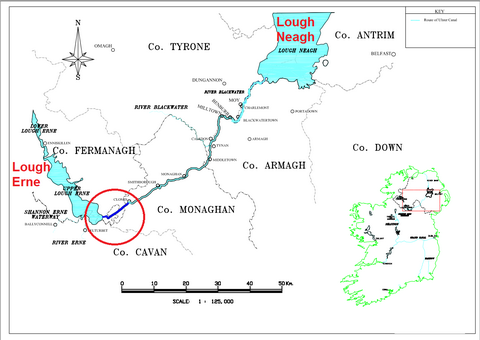
North/South Ministerial Council agreement 2007, with the Irish government to pay the full cost
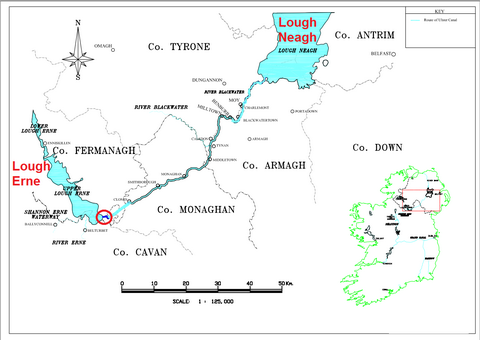
DCAL business case to DAHG 2015
Exhaustive coverage begins here but use the search facility for updates. More to come.
Posted in Built heritage, Canals, Economic activities, Engineering and construction, Extant waterways, Foreign parts, Industrial heritage, Ireland, Operations, Politics, Restoration and rebuilding, Sources, Tourism, Ulster Canal, waterways, Waterways management
Tagged boats, canal, Clones, dcal, department of arts heritage and the gaeltacht, department of culture arts and leisure, Erne, Ireland, Lough Neagh, North South Ministerial Council, Ulster Canal, Waterways Ireland
I am grateful to Waterways Ireland for sending me the Shannon traffic figures for the last three months of 2014. They sent them last month but I didn’t have time to deal with them until now.
All the usual caveats apply:
On the other hand, the figures do include the Shannon’s most significant tourism activity, the cruiser hire business. And they are our only consistent long-term indicator of usage of the inland waterways.
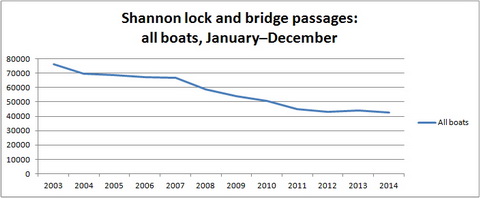
Total (private + hired) traffic for the full year
As we saw in September, traffic is down on 2013, but there has been little change over the last three years.
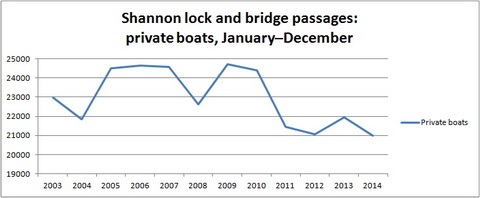
Private-boat traffic for the full years 2003 to 2014
The vertical scale on this chart is different from that for hired boats so the changes in private boating from one year to another are exaggerated (by comparison). The good weather did not prevent a fall in activity.
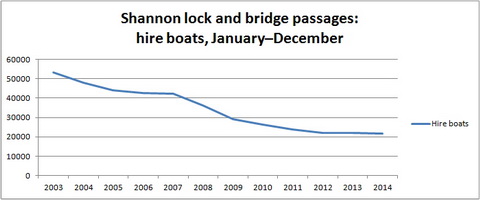
Hire-boat traffic for the full years 2003 to 2014
Again, the lowest figure in my records, but the drop was small; perhaps the hire trade is bouncing along the bottom (as it were). I wonder whether anyone has a Grand Plan for recovery or rejuvenation.
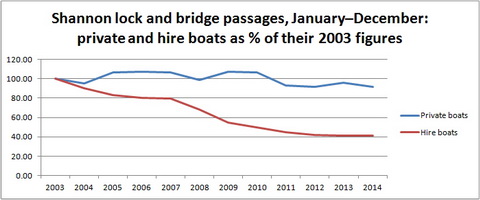
Percentages of 2003 levels
Private traffic at just over 90% of 2003 levels, hire traffic at just over 40%.
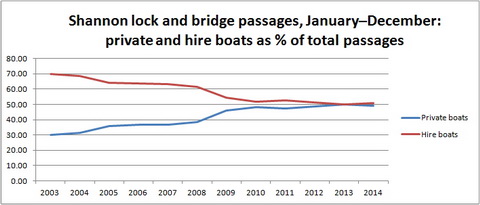
Still roughly 50:50
In the five months January, February, March, November and December, there were 385 passages altogether, less than 1% of total boat movements for the year. If money can be saved by ceasing to operate the locks and bridge during the winter, they should be closed except, perhaps, for one Saturday per month, to be arranged for a non-flood day.
Here is the order of popularity.
| ALBERT LOCK | 7205 |
| ATHLONE LOCK | 5775 |
| CLARENDON LOCK | 5650 |
| ROOSKY LOCK | 5565 |
| PORTUMNA BRIDGE | 5395 |
| VICTORIA LOCK | 4934 |
| TARMONBARRY LOCK | 3885 |
| POLLBOY LOCK | 1222 |
| CLONDRA LOCK | 1020 |
| BATTLEBRIDGE | 835 |
| DRUMLEAGUE | 797 |
| DRUMSHANBO LOCK | 387 |
| SARSFIELD LOCK | 97 |
Lough Allen is a delightful place but it is not popular.
Posted in Built heritage, Canals, Economic activities, Engineering and construction, Extant waterways, Ireland, Operations, Restoration and rebuilding, Shannon, Sources, Tourism, Water sports activities, waterways, Waterways management, Weather
Tagged Albert Lock, Athlone, Battlebridge, boats, bridge, canal, Clarendon lock, Clondra, Drumleague, Drumshanbo, floods, Ireland, Jamestown, Limerick, lock, Lough Allen, Lough Derg, Lough Key, Meelick, Operations, Portumna, Rooskey, Roosky, Sarsfield, Shannon, Tarmonbarry, Victoria, waterways, Waterways Ireland, Wellesley
Some links to info about the Castle Saunderson estate, to which DCAL is trying to persuade DAHG to construct a sheugh.
Cavan County Council owns it, I think.
There is an International Scout Centre, although I’m not clear whether the scouts occupy the entire site or just part of it. For instance, do they control the church where services take place, at least occasionally?
There was an Orange parade to the site last year.
It is close to Belturbet, where the County Council has a River Project. Was that completed?
Posted in Ashore, Built heritage, Economic activities, Engineering and construction, Extant waterways, Foreign parts, Industrial heritage, Ireland, Operations, People, Politics, Restoration and rebuilding, Tourism, Ulster Canal, Uncategorized, Water sports activities, waterways, Waterways management
Tagged Belturbet, Castle Saunderson, Cavan, Clones, Erne, Ulster Canal, waterways, Waterways Ireland
Phil Flanagan [SF, Fermanagh and South Tyrone]:
AQW 42148/11-15 To ask the Minister of Culture, Arts and Leisure what consideration has been given to establish a forum to discuss policy around the management of Lough Erne.
AQW 42149/11-15 To ask the Minister of Culture, Arts and Leisure how Waterways Ireland work with Rivers Agency to ensure that, during times of changing waters levels as decided by Rivers Agency, Lough Erne remains navigable for cruisers.
I thought the ESB had something to do with that last one.

 Irish waterways history