
Category Archives: People

Scarriff

Both the OSI and Logainm.ie show the spelling as Scarriff, but the version with one R seems to be common in the area and is used on the area’s website. I’m sticking to the longer version, so that I can at some future time work up a joke about Scaelbowiff.

Scarriff is a small town in County Clare, a little distance upriver from the end of Lough Derg’s western arm.
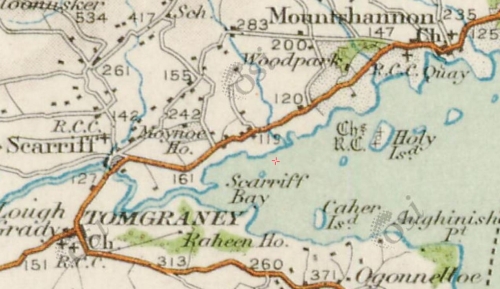
Lough Derg’s western arm (OSI ~1900)

In the 1840s the Shannon Commissioners made the river navigable to the town: before then Reddan’s Pier at Tuamgraney seems to have been the head of the river, at least for larger boats.
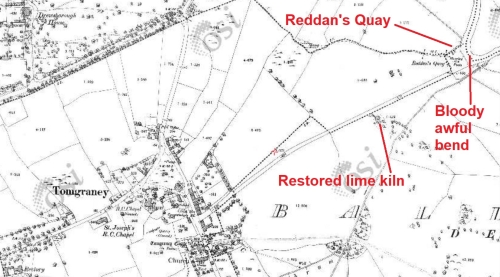
Reddan’s Quay at Tuamgraney (aka Tomgraney) (OSI ~1900)

Tuamgraney is a pleasant spot. A short distance up the road to the village is a restored limekiln.

However, Reddan’s Quay is on a bloody awful bend in the river. Large boats may have difficulty in making the turn without assistance, especially if they’re coming downstream with a flow. Anyone moored at Reddan’s Quay in such circumstances might need a new paint job afterwards.
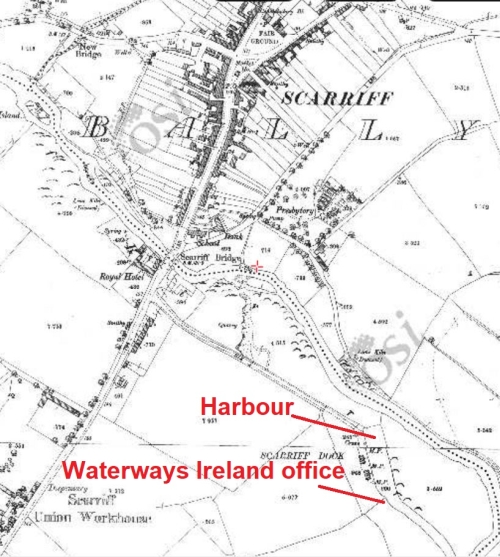
Scarriff Harbour (OSI ~1900)


harbour facilities

Scarriff Harbour was expanded in recent times by the addition of concrete finger jetties, which provide more mooring spaces for modern cruisers. The jetties don’t touch the old quay: I gather that this was to preserve the ancient monument or something [perhaps, Gentle Reader, you can correct me on that]. The quay still sports a Shannon Commissioners crane (no longer working) . Two long berths were provided during the expansion: half of one long berth is occupied by a boat (one of three such) that was not occupied last weekend and the other is the pump-out berth.

At the inner end of the harbour are some floating pontoons suitable for open boats and for launching kayaks and canoes. However, despite the presence of a lock-up cage for the safe storage of kayaks and canoes, indicating that small-boat activity is welcome, low barriers (only 1.8m) at the entrance to the harbour require those arriving by car to unload the kayak or canoe outside the harbour and carry it in, then return to drive the car in and unload the vessel’s equipment and cargo.

There is no slipway.

The barriers might deter camper-vans, alas: another example of discrimination against RV-users.

The harbour has a toilet-and-shower block, a pump-out, two double-socket mains electricity pillars, lights and a supply of water, which latter is used by persons arriving by car with numbers of plastic containers.

However, the harbour has not a single bin of any kind. Thus, late-evening carousers are forced to jettison their empty bottles and cans and their cardboard containers around the harbour, smashing some on the concrete in the process. A civic-minded citizen might try to sweep up the broken glass but then has nowhere to put it. [Incidentally, the carousers had left by about midnight and there was none of the threatening atmosphere that is sometimes to be felt: apart from their regrettable habits in the matter of rubbish disposal, these seemed to be quite civilised carousers.]

But back to bins. A civic-minded dog-owner who cleans up after Fido must then carry the remains around. In hot weather, dog poo on a boat begins to smell after a while; any outbreaks of cholera can be attributed to what Waterways Ireland calls its “Leave no trace” policy, which might better be termed “Pay no local authority bin charges”. As a policy, “Leave no trace” is simply an encouragement to dog-owners not to clean up: it’s far, far less trouble to leave the stuff for someone else to walk in.

The exiles

In 1997 Síle de Valera, a local TD, became Minister for Fairytales. Waterways Ireland was set up during her reign and cursed by being given several regional offices; the Western region (ie Shannon) office was built at the harbour in Scarriff, in Ms de Valera’s constituency, and some unfortunate staff were sentenced to transportation to East Clare.

However, with a high population of yoghurt-knitting yurt-dwellers, East Clare is quite an interesting place. The Friday smallholders’ market had lots of good breads and cakes, jams, preserves and mushroom salt, as well as a stock of African decorative items. The fruit and veg shop on the same side of the road had a good range, while across the way the Graney sells healthfoods, veg, good cheeses, chocolate and much other stuff. No doubt other shops in Scarriff are equally good in their own fields, but I didn’t get to visit them.

Boats

On a sunny weekend (and no doubt at other times too) Scarriff was an extremely pleasant place to be, yet there were very few boats there (apart from the three unoccupied boats). [In the next photo, taken early on Friday, the unoccupied boats are out of shot to the left.] One occupied boat left at lunchtime on Friday when we arrived; one more came later, so there were two occupied boats in the harbour that night.

Saturday was slightly busier: the boat that had arrived on Friday left, but two other private boats arrived and, between 2230 and 2245, two large Emerald Star hire boats arrived too, making five occupied boats in the harbour.

Some small boats, mostly of the zoomy variety, visited briefly on Saturday. I realise that drivers may find it exciting to travel fast on a narrow, winding river where they can’t see what’s coming, but paddlers of canoes and kayaks may find less amusement in dealing with the wash from the speedsters. They in turn might find it less amusing were they to collide with 45 tons of steel coming downriver. Perhaps purchasers of fast boats should be required to demonstrate the possession of IQs in at least double figures before being allowed to take the wheel.
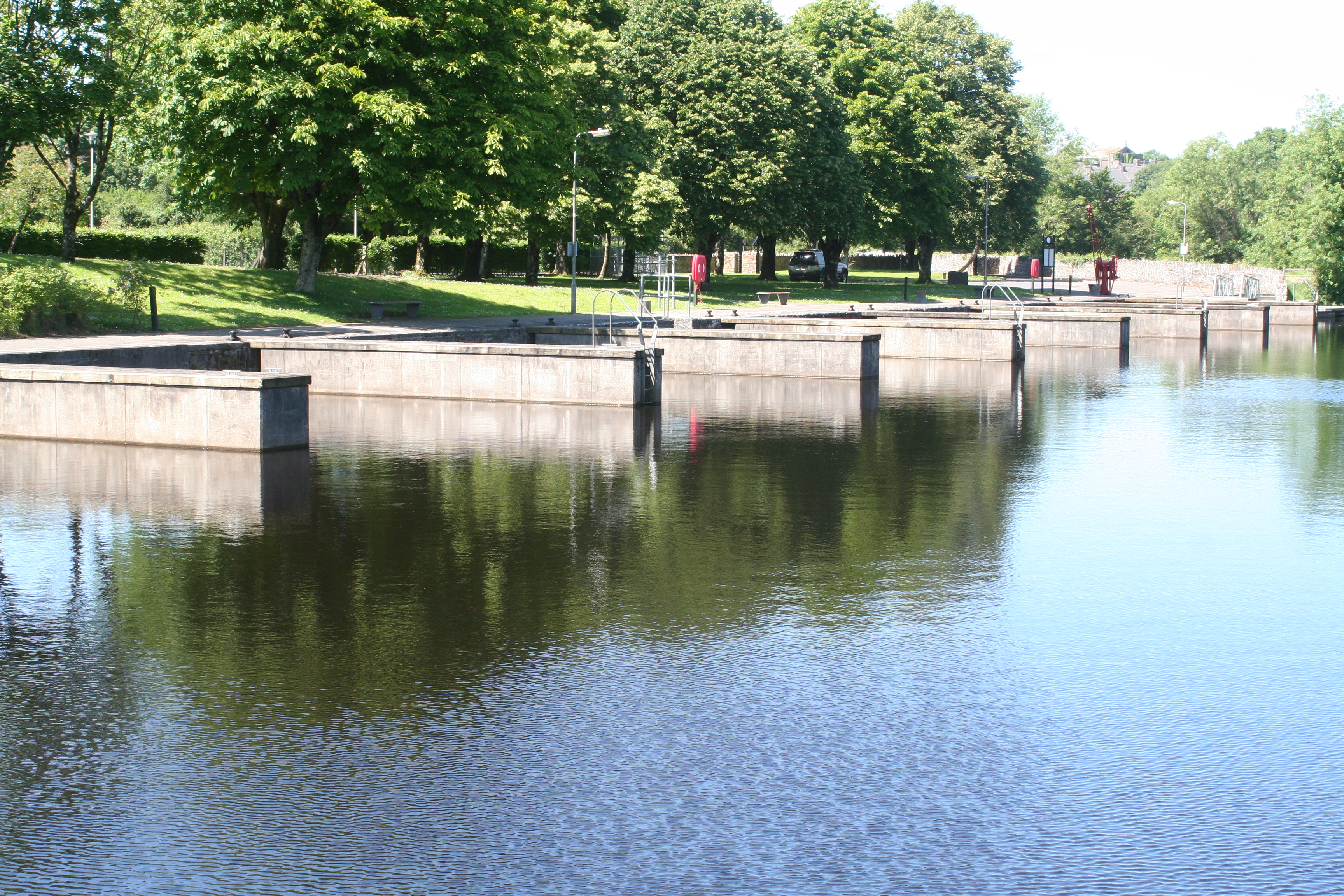
Scarriff June 2017


Make more use of Scarriff

The small numbers of boats made it seem that a fine facility was being wasted (although it is dangerous to make generalisations on the basis of a single visit). It also seemed that local people made little use of the facility: I saw two anglers, a few dog- or baby-walkers and one or two others.

Here are some (cheap-to-implement, I hope) suggestions to bring more life to the harbour by encouraging both residents and visitors to use it.

  1. Encourage camper-vans. At weekends, they could use the Waterways Ireland staff car park (which had only two cars in it over the weekend). The office has cameras watching it; one or two could be redirected to monitor the vans.
  2. Encourage canoeists and kayakers. Sell them special smart cards (or something) that would allow them to open the barriers to get closer to the launch pontoons. If there isn’t a local canoe club, encourage one.
  3. Encourage camping.
  4. Build a basketball court or a play area or something for local young people (and visitors).
  5. Provide barbeque facilities, seats and tables.
  6. Provide bins. Perhaps the local off-licence might sponsor them.
  7. Encourage local businesses and activity-providers to advertise their wares and happenings at the harbour.
  8. Persuade the operators of the Scariff.ie website to do more to encourage boat-borne visitors. As it stands, the site doesn’t even acknowledge that you can get there by boat. And [at time of writing] it has no information about a 2017 Scarriff Harbour Festival; I don’t know whether there is to be one.
  9. Improve the chart of the river: it’s too small to provide useful warning of the twists and turns.

On the same weekend, Dromineer seemed to be packed with boats and with non-boat people; Scarriff didn’t have many of either, and it seems a pity.


The Shannon: navigation -v- drainage

Then an exceedingly important step was taken, which was the foundation and immediate cause of all the measures which have since been adopted, which was the project for opening the navigation of the Shannon, and draining the adjoining lands.

The primary object of that great work was opening the navigation, but it was put forward as a secondary object to improve what are called the Callow Lands, bordering on the Shannon, that is the alluvial lands adjoining the river, which ought to be valuable meadow lands, and which, properly improved, would be extremely valuable, but which in the then unimproved and neglected state of the river were annually overflowed for several months in the year, and were rendered of little value, affording only occasional pasturage, and uncertain crops of coarse grass.

That was a secondary object of the Shannon works; and the Shannon undertaking was founded on a compromise between those two objects,
namely, between the navigation and the drainage.

The point endeavoured to be attained was, to have the greatest amount of drainage which was consistent with the improvement of the navigation. That great work was ably carried through, and, in my opinion, was perfectly successful.

I do not mean that it is a perfect drainage work, or a perfect navigation work, but that it is the best compromise between the two that could have been effected, and showed how much could be accomplished when drainage only was the object. But however that may be, it furnished the model for, and gave a stimulus to all that has been done since […].

Evidence of Sir Charles Edward Trevelyan KCB, Assistant Secretary to the Treasury, to the House of Lords Select Committee on the Drainage of Lands (Ireland), on 4 June 1852 in Report from the Select Committee of the House of Lords appointed to inquire into the Operation of the Acts relating to the Drainage of Lands in Ireland, as administered by the Board of Works; and to report thereon to the House: together with the Minutes of Evidence, and Appendix Session 1852 Ordered, by The House of Commons, to be Printed, 22 November 1852 [10]

The usefulness of the Oireachtas …

… lies in its library, which has been collecting, digitising and publishing interesting stuff. A quick search found material about the Ballinamore and Ballyconnell drainage district, the drainage of the Shannon and of the Maigue, the dissolution of the Lough and River Erne Drainage and Navigation Board (which I’d never heard of), railways in Donegal and an extraordinarily long poem about a steam boat (page 61, after some other stuff about Cork or Cobh).

Big it up for the Oireachtas librarians.

Giving confidence to our Lady friends

The water has also been kept at a proper level by lowering the river bar at Galway, and constructing a regulating weir there. At some time the navigation channel in the narrow rocky portions of the lake was deepened, the rocks raised; and by buoying and marking with pillars, rocks, and irons, the steamer’s track, it has been rendered navigable from Galway to Cong, and also to Oughterard, and to within a couple of miles of Maam hotel.

All the marks on the eastern side of our upward course from Galway are coloured white, and those on the western side dark.

It will help to give confidence to our Lady friends, who can almost touch some of these marks, triangles, and gridirons, from the Eglinton, to know that all these rocks were lifted by the present captain of the vessel, who was formerly employed here as a diver.

Sir William R Wilde MD Lough Corrib, its shores and islands: with notices of Lough Mask McGlashan & Gill, Dublin; Longmans, Green, and Co, London 1867

Who stole the technology?

I was thinking of buying a (secondhand) copy of Juliana Adelman and Éadaoin Agnew eds Science and technology in nineteenth-century Ireland Four Courts Press, Dublin 2011. But, even though the secondhand copy was much, much cheaper even than the publishers’ reduced price, I thought I should check what I’d be getting for my money. I therefore had a look at the contents list, which I reproduce here having nicked it from the publishers’ web page:

The list of contents


Is it just me, or is there a big gap there? How can you discuss nineteenth-century technology without an extended discussion of steam power, whether in ships, on railways, for drainage or in mills and other manufactories?


The origins of the Royal Canal

The Royal Canal’s origins have never been satisfactorily explained: a later legend even seeks to explain its origins in an obscure dispute between a retired shoemaker and other members of the Grand Canal Company. But in fact its origins were political. As the Grand Canal Company was taken over by the conservative La Touche clique, the opposition launched a new venture: its patron was the duke of Leinster; businessmen and opposition politicians rallied to it; and Gleadowes, rivals of the La Touches, were bankers to the company. In other words, there was to be a left-wing as well as a right-wing way to reach the Shannon. Almost symbolically on its more northerly route to the Shannon, it passed through the duke of Leinster’s land.

L M Cullen “Politics and Institutions, 1731–1835” in Economy, Trade and Irish Merchants at home and abroad, 1600–1988 Four Courts Press, Dublin 2012

Float Bridge

I have added some information to the post The Avarice of the Ferryman about Float Bridge. The Comments too contain useful points.

Up the Inny

The navigation of the River Inny from Ballynacarrow upriver to Lough Sheelin.

The opening of the Royal Canal

On 27 May 2017 the Royal Canal Amenity Group and Waterways Ireland are to commemorate the fact that

In May 1817 the Royal Canal was officially opened from Dublin to the Shannon ….

[Unfortunately I am unable to find anything about the commemorative event on WI’s website, although they did send me some information about it.]

I wondered how the opening might have been celebrated in 1817, but I haven’t been able to find out anything about it. I am hoping that some more knowledgeable person might be able to provide information: please leave a Comment below if you can help.

Ruth Delany gives 26 May 1817 as the date on which the contractors said that the western end of the canal (to the Shannon at Richmond Harbour) would be ready to hand over to the Directors General of Inland Navigation, who were running the show after the Royal Canal Company collapsed under the weight of its debts.

However, as far as I can see, the British Newspaper Archive contains no mention of any opening ceremony at any time in 1817. The Lanesborough Trader, the first boat to travel from the Shannon to Dublin did so in January 1818 [Saunders’s News-Letter 2 February 1818] and in May Mr Peel moved that a further £15000 be granted for completion of the navigation, where “shoals were
found to interfere” [Dublin Evening Post 23 May 1818].

Traffic increased later in 1818: in October the directors of the New Royal Canal Company went by boat

… from Dublin to Tarmonbury, and thence to the termination of the Canal, near the river Shannon, to inspect the works and give every necessary direction for the entire completion of that great and important undertaking ….
[Dublin Evening Post 20 October 1818]

The same newspaper reported that several boats of coal, found on the banks of the canal near Tarmonbury, had arrived in Dublin. It seems, therefore, that the canal was usable even if not entirely finished.

Later that month Christopher Dillon of Athlone, who had been trading on the Grand Canal and the Shannon, announced that he was moving his boats to the Royal Canal — but the western terminus for his boats was at Ballymahon, from which (although he did not say so) goods could be carried by road to Athlone: just the situation the Grand Canal Company had feared. [Dublin Evening Post 27 October 1818]

I have found no evidence of an opening ceremony in 1817; nor have I found evidence that the canal was actually open from the Shannon to the Liffey (or the Broadstone) in 1817, in that no boat seems to have travelled between the Shannon and the Liffey. At least one boat did so in 1818, but again I have no evidence of any opening ceremony.

There is one further mystery. The Royal Canal harbour at the junction with the Shannon is called Richmond Harbour. I presume that that is a compliment to the Lord Lieutenant of Ireland, His Grace Charles Lennox, 4th Duke of Richmond, 4th Duke of Lennox, 4th Duke of Aubigny, KG, PC. But he had ceased to be Lord Lieutenant in 1813 and was presumably unable to dispense favours after that, so why was the harbour named after him? I don’t know when the construction of the harbour was begun or finished.

I have not visited the National Archives in Dublin to look at the papers of the Directors General of Inland Navigation, which may have something on the events of 1817 and 1818. Perhaps WI’s archive has something relevant too. I would therefore be glad to hear from anyone who has searched those archives or found other evidence about the period.

Newspapers cited here were accessed through the British Newspaper Archive.


Waterways History Conference

The ninth Waterways History Conference will be held at the University of Birmingham, UK, on Saturday 24 June 2017. The programme and other details are available here. The theme is Waterways Research? and one of the topics is the Cong Canal.