Category Archives: People

Royal Canal water supply

On 26 November 2012 I noted that

The Royal Canal water supply applications have been approved by An Bord Pleanala. There were two separate applications […] but they were in effect treated as one.

There were conditions attached, but I concluded that

If I remember correctly, the amount of water available from Lough Ennell will not always provide enough (eg in a dry season) to keep the canal full. Still, this is a significant advance for Waterways Ireland and for Royal Canal enthusiasts.

So here we are, almost two years later, and the work of providing a supply from Lough Ennell to the Royal Canal, reckoned to be about a five-month job, has doubtless been long completed, no?

No.

The work has not yet started and Waterways Ireland will be lucky if it gets done within the next year.

As I understand it — and if, Gentle Reader, you have more information, do please leave a Comment below (your name can be kept out of public view if you like) — there are three sources of delay:

  • first, I understand that there is a technical issue about one of the conditions attached to the approval; it is felt that the condition is unworkable, but that getting it changed might take some time. I presume it’s one of the conditions 2(a) to 2(d) that I quoted two years ago and, looking at the proposed orders published in the press [PDF], I suspect it might be the requirement to maintain the lake level at or above 79.325 mOD Malin Datum. However, I don’t really know
  • second, Waterways Ireland took over Clonsingle Weir, at the outlet from Lough Ennell, by Compulsory Purchase. Owners of mills, who generate electricity from the Brosna, have submitted claims for compensation. I understand that an arbitration hearing, lasting four days, is scheduled to be help in May 2015
  • third, responsibility for the scheme has moved from Westmeath County Council to Irish Water. Which may have other things on its mind.

Irish Water has published its proposed Capital Investment Programme [PDF] but Appendix 1, the Investment Plan Project Summary, is in a separate file [PDF]. Category B is headed Review Scope and Commence Construction and it includes

Mullingar Regional Water Supply Scheme (G) … Lough Ennell Abstraction.

I can’t work out what “(G)” means. A few items are so marked; a few others are marked “(H)”; most items have neither.

The Capital Investment Programme [CIP] document says:

 The CIP is dominated by contractual commitments entered into previously by Local Authorities, and which have now transitioned to Irish Water. In the 2014-2016 period, Irish Water will fund these contracts to completion and bring forward programmes and prioritised projects to commence. At the same time, it will progress a large portfolio of projects that are at the planning and design stage, reviewing their scope, budgets and, where appropriate, timing to favour maximising the performance of the existing assets through intensified capital maintenance that might allow deferral of major capital investment.

Emphasis mine. So that raises the possibility that Irish Water will decide not to fund the abstraction scheme but will rather opt to pay for continued pumping.

It is, of course, quite possible that I have misunderstood these difficult matters, so I will be glad to hear from anyone with better information.

Incidentally, reviewing Irish Water’s documents suggests to me that there are people there who know what they are doing and who have the expertise to manage large and complex operations. That differentiates them from the politicians in government and opposition, few of whom (as far as I can see) have any experience of running anything more complex than a parish social.


Airholes

My attention was recently drawn to an article [PDF] by Mike Clarke about airholes.

The article is in Clogs and Gansey, the newsletter of the Leeds & Liverpool Canal Society, of which Mike is Founder and President. He is an extraordinarily knowledgeable person and it is well worth while looking around his website: for instance, there’s some material of Irish interest here, a list of publications here and material about the Leeds & Liverpool Canal here including a really excellent document about locks [PDF].

But back to the airholes.

Not being an engineer, or at all technically competent, I’m always reluctant to try explaining these mysteries, so I’ll welcome corrective Comments from any more technically-minded folk.

Water levels

If the water level on the upstream side of a lock gate is higher than that on the lower, the gate will be difficult to open. If the gate is the tail gate [bottom or lower gate] of a lock, you can raise a rack [paddle] and allow water to flow from the upstream side, which is the chamber of the lock, to the downstream side, thus making a level and allowing the gate to be opened easily.

If the gate is the breast gate [head or upper gate] of a lock, the same applies: you can lift a rack [paddle] in the upper gate, allowing the excess water to flow into the lock chamber.

However, the relationship between the heights of the two gates (or pairs of gates) then becomes important: if the breast gates are higher than the tail gates, the water level in the lock chamber will not be able to reach the height of the water above the lock (at least until you’ve drained down the entire level [pound] back to the next lock upstream).

But for efficient operation, you want to reduce the amount of adjustment that has to be done after the boat reaches the lock but before it can enter the lock chamber. You want a system that is, as far as possible, automatically self-adjusting. That means, in particular, one that ensures that the level of water above the lock is not too high.

Byewashes

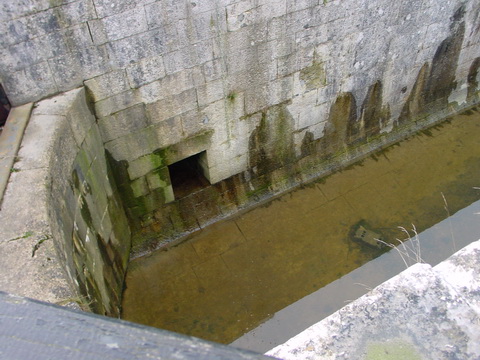
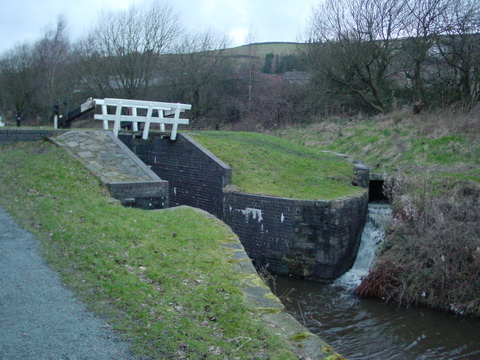
On many English canals, that is done by using byewashes.

Byewash on the Huddersfield Narrow Canal (E) at Marsden

Byewash on the Huddersfield Narrow Canal (E) at Marsden

As far as I know, though, few Irish canal locks have them, and I have heard British boaters comment on their absence. If memory serves, the canal (Leitrim) end of the Shannon–Erne Waterway does, but I have no suitable photo. I should confess that I have no idea what proportion of Irish and English canal locks are so equipped; I will be glad if anyone who can supply, or point to, the information will leave a Comment below.

Airholes

Mike Clarke’s PDF article, to which I pointed at the top of this page, provides a possible explanation for the absence of byewashes on Irish canals. He says that airholes were used instead on canals “built or influenced” by William Jessop. Jessop worked on the Grand Canal as assistant to John Smeaton from 1773 and was consultant engineer to the Grand Canal Company until 1802 [Ruth Delany The Grand Canal of Ireland David & Charles, Newton Abbot 1973].

Mike Clarke also says that Jessop trained John Killaly: Killaly joined the Grand Canal Company in 1794 and became its engineer in 1798 [Delany op cit]; furthermore, his designs were used on the Royal Canal from Coolnahay to the Shannon [Ruth Delany and Ian Bath Ireland’s Royal Canal 1789–2009 The Lilliput Press, Dublin 2010].

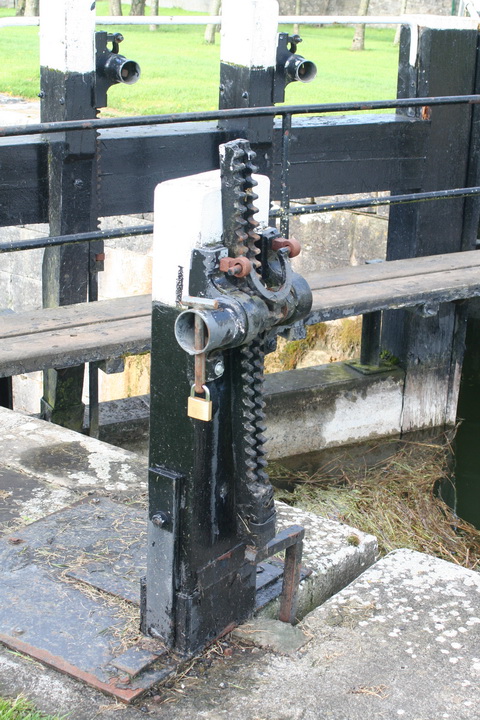
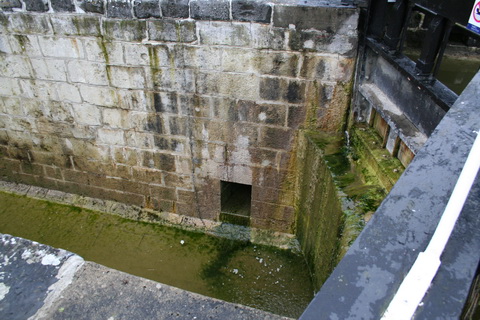
If I’ve understood Mike Clarke’s article correctly, the airhole system uses the channel for the ground paddle [land rack] sluice instead of building a separate byewash channel. From his photograph, I gather that there is a separate letterbox-like slot in the recess for the rack mechanism: I presume that excess water flows in through the slot, falls to the level of the sluice or channel from there to the lock chamber and thus flows into the chamber. If the tail [lower] gates are left open, or with one rack [paddle] lifted, the water can then flow out into the lower level.

Questions about Irish locks

Is my understanding correct?

What proportion of locks on each Irish waterway are equipped with airholes?

Are they still maintained and used?

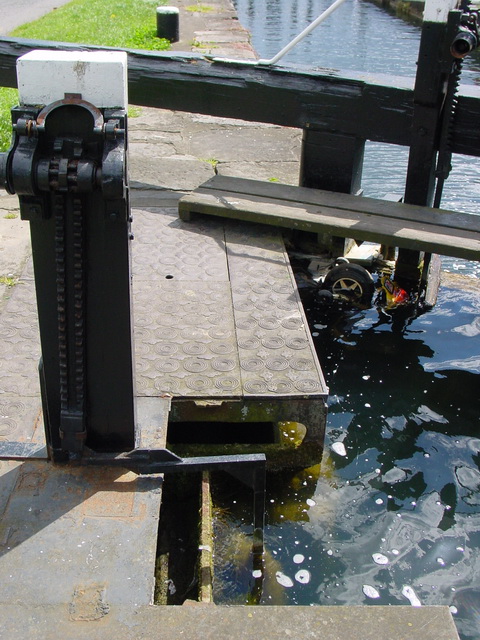
Belmont Lock May 2009 IHAI 5_resize

Land rack [ground paddle] outlet, Belmont Lock, Grand Canal

Royal Lock 43 Killashee 18-02-2007 01_resize

Ground paddle [land rack] outlet, Lock 43 Killashee, Royal Canal

Royal Lock 6 02_resize

Possible inlet, Lock 6, Royal Canal

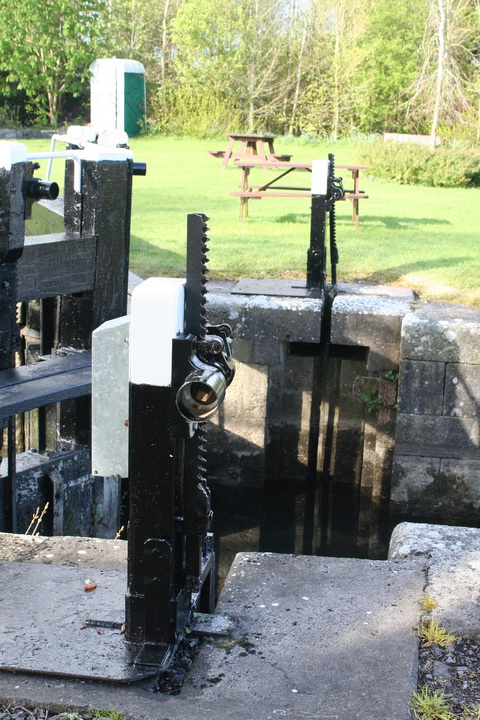
The next three photos were taken at Coolnahay, on the Royal Canal, during the period of very low water levels in 2012.

Coolnahay in drought April 2012 08_resize

Letterbox-like slot at Lock 26, Coolnahay, Royal Canal. I must look for similar features on Grand Canal locks and photograph them (if they exist)

Coolnahay in drought April 2012 19_resize

A second slot forward of the first (hidden by the land rack mechanism in the previous photo)

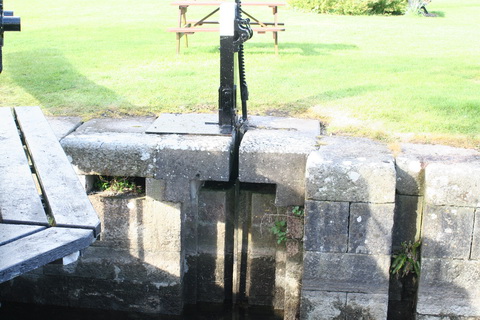
Land rack locked open at Lock 35_resize

Land rack mechanism locked slightly open: the slots were well above the water level at the time

It is of course entirely possible that all of this is so obvious that everybody else already knows all about it, but that I just didn’t understand what I was looking at. I read WI’s Heritage Survey of the Royal Canal [PDF], but it didn’t say anything about this sort of thing: or at least if it did I didn’t spot it. The report uses some non-standard terminology [eg “head gates”] so I may have missed its identification of the canal’s water-management features.

If, Gentle Reader, you know of the existence of papers or other published materials on these arcana, do please leave a Comment and, if possible, relevant links to online sources. It seems to me that there is a shortage of information about these technical matters as they apply to Irish waterways; it would also be nice if we were able to say which technologies were applied when to which waterways. I do not know whether, for example, we can assume that the lock gate designs in use today were always used on all Irish waterways.

The captain and the perjurer

Mary Meehan’s was a dramatic story.

In April 1847 she had gone to the house of William Dwyer at Cuphaunhane [Cappanahanagh?]. She heard voices inside and stopped to listen. The door opened and William Dwyer ran out. She went in and saw William’s wife Mary dragging the seemingly lifeless body of Ellen Dwyer, William’s sister, into the room. Mary Dwyer then ran off and Mary Meehan raised Ellen’s head; she saw blood on the left side of the head.

She went home and told her husband about it; he told her to say nothing. About two hours later she was in the haggard and saw William and Mary Dwyer digging at the brink of the ditch. She gave a deposition to Edward J Bell RM on 8 October 1849, adding on 16 December 1849 that, if Bell were to dig in the field near the Dwyers’ house, or in the nearby quarry, he would find the remains of a human body.

Bell, with Mr Head and the Castleconnell police, dug more than forty times in the field in question, but with no success. They then drained four feet of water from the quarry and found a skull and some human bones in the mud. Constable Swan delivered them to Dr Thomas Travers Riordan at Castleconnell.

Dr Riordan thought that the skull was more likely to be that of an old woman than that of a fifteen-year-old girl. The bones had been in water or earth for much more than two years and belonged to a tall muscular person: the skull and the bones were almost certainly from two different people. The church at Abington was close to the quarry.

On 14 March 1840 Mary Meehan was indicted …

… for that she with felonious intent to injure William Dwyer …

… did swear to an untrue story. She was described as …

… a woman of about forty years of age, […] dressed in a blue cloth cloak, clean white cap, and white woollen shawl, as the wife of a farmer in comfortable circumstances. Her appearance was not unprepossessing, but there was a peculiarly sinister expression about the eyes.

Mr Bell had taken depositions from William and Mary Dwyer; they contravened Mary Meehan’s statements but she stuck to her story. No witnesses supported her.

William Dwyer said that he had sent his sister to England [en route to America?] that April: his wife had accompanied her to Killaloe and seen her aboard one of the [City of] Dublin Steam Packet Company’s boats. He had not heard from her since then.

Mary Dwyer said that she and her sister-in-law had slept at the house of Mary’s father Michael Healy, in Killaloe, the night before Ellen’s departure. The following morning they went to the house of Nancy Preston, who accompanied them to the steamer to help Ellen get a cheaper fare. Michael Healy confirmed that evidence, as did Nancy Preston. Mary Dwyer said that she was on board with her sister-in-law until the boat left.

The final witness was the steamer’s captain, Captain Winder. He said he remembered the circumstances perfectly and had charged Ellen only 4s 3d for the passage to Dublin.

His Lordship charged, expatiating on the enormity of the prisoner’s offence, and the revolting exhibition of the remains of the skull and bones of a human being on the table, and adding that from the evidence they could hardly hesitate in finding a verdict of guilty.

The Jury returned a verdict of Guilty accordingly.

The Limerick Reporter and Tipperary Vindicator 15 March 1850

Carpenters Road Lock in London

Carpenters Road Lock in 2003

Carpenters Road Lock in 2003

Here is a page about an art (craft?) project happening at Carpenters Road Lock on the Bow Back Rivers in London: the lock has changed quite a bit since I took the photo (above) in 2003.

I should warn you that the link is to a very long web page, but the section headings stay on top so you can move around. However, if you allow Javascript, you’ll find that two places on the page show those very annoying sequences of photographs that change automatically.

What I thought was most interesting was the set of events organised at the lock. Canals of Dublin organises canal walks in, er, Dublin, but what about Waterways Ireland having lockkeepers doing talks and demonstrations?

Here are some links to sites with more information about the Bow Back Rivers in London:

London Canals and associated blog

An extensive Wikipedia article with schematic diagram

A political view from Mick Hartley

London’s Lost Rivers on pre-Olympic scenery (black background makes the text hard to read but the photos are good)

The most informative page I found: a superb piece of work. Well done Richard Thomas, to whose Steamers Historical site I have a permanent link.

h/t celr

Canal gets government go-ahead

In Egypt.


Urgent message for Athlone folk

If you’re anywhere near Athlone, hie thee to the Lough Ree Yacht Club at 8.00pm on Wednesday 22 October 2014 for the Old Athlone Society meeting. It features Paul Clements, who has just written a biography of Richard Hayward, author (amongst many other roles) of (amongst many other books) Where the River Shannon Flows, a book that should be in every Irish waterways person’s library.

The evening includes a showing of the film of the same name, which (though short) is highly evocative. WW2 was declared as the filming team reached Portumna. There is some very good footage of the Foynes flying-boats.

h/t gjb

The Slaney cot: photos

I wrote here about a Slaney cot, built by Larry Duggan, which we had spotted on its way to Wales. The owner has very kindly sent some more photos of the cot’s construction, of Larry Duggan and of the cot on the Usk; I have put them on a separate page here.

Longford

Longford is a town about five miles from Clondra, the junction of the Royal Canal with the River Shannon near Tarmonbarry.

Some of the local cargo-cultists seem to believe that, if the Longford branch of the Royal Canal is restored, fleets of vessels (probably from Limerick) will bring untold prosperity to the town. And the unfortunates of Waterways Ireland have been told to produce a feasibility study on the matter. According to the minister for waterways, the study will be available on the Waterways Ireland at the end of October.

Irrespective of whether the restoration is feasible, the question is whether it would be sensible. I see two possibilities:

(a) some of the thousands of vessels already using the Royal Canal will be attracted to Longford, where the attractions of the night-life will entice them to spend more money than they would otherwise have spent in, say, Clondra. If they don’t spend more than they would otherwise have spent, the spending is simply displaced from one place (eg Clondra) to another (Longford). If that is so, it might be worth the while of the publicans of Longford to pay for the restoration, because they will benefit from it, but there is no benefit to the taxpayer in paying for it because the spending is simply moved from one place to another

(b) the attractions of Longford are so great that thousands of visitors who would not otherwise have visited the Royal Canal will now do so. Again, the displacement argument applies, so these thousands of visitors must come from overseas, attracted by the reputation of Longford for metropolitan sophistication. Or something. Now, if that reputation were enough to attract overseas tourists, they would already be visiting Longford in their droves. Are they?

I am sure that Longford has many attractions apart from the alternator repair shop.


Heritage outside the box

I was not entirely complimentary about Waterways Ireland’s online survey on the contribution of boating to the economy. However, its latest online survey seemed to me to be better designed.

It’s part of a consultation seeking opinions about a Heritage & Biodiversity Plan. I was afraid that the survey might limit the scope of responses to a small number of prepackaged options, but in fact I found it easy to make suggestions that might be outside the range of those expected. The response boxes expand as required, although I didn’t test the upper limits.

I encourage readers to complete it.

St John’s Pill: an update

I have found a little more information about the involvement of George Lane Fox with the upper reaches of St John’s Pill; I have written about it here.