Category Archives: People

M’Gauley’s mysterious mechanism

In 1851 Alex Thom, Printer and Publisher of Dublin, produced the third edition of Lectures on Natural Philosophy by the Rev James William M’Gauley, Canon &c, Professor of Natural Philosophy and one of the Heads of the Training Department to the National Board of Education in Ireland. [The Morning Post of 9 October 1840 suggests that the first edition seems to have been in 1840: Longman, Orme & Co in London, W Curry, jun & Co in Dublin and Fraser and Crawford in Edinburgh.]

You can read the third edition of the Lectures here, paying special attention to any electro-magnetic apparatus, given that the Rev James read papers on the subject to the meetings of the British Association for the Advancement of Science in Dublin in 1835 and in Liverpool in 1837.

But I can find nothing, there or elsewhere, about his contributions to steam propulsion on canals. Several British newspapers copied this story from the Dublin Pilot in 1837:

We understand that the Rev Mr M’Gauley, of Marlborough-street, in this city, has completed a series of experiments upon a subject which for some time has occupied his attention — the application of steam to canal boats, with perfect success.

Our readers are aware that the great obstacle to the application of steam to packet boats on canals is caused by the great injury which would arise to the banks from the wave created by the paddles. He has, it seems, adopted a paddle on an altogether new principle; one of great simplicity and of such a nature that the injury to the banks shall not be greater than what is produced by the ordinary boat.

He gets rid entirely of backwater, his paddles work without noise, and require for their application a steam engine of the simplest construction.

It is said that Mr M’Gauley contemplates a velocity which to seem possible would require his working model to be understood. We hope and indeed believe, that Mr M’Gauley will not have to contend with apathy and want of enterprise in the introduction of so important an application of steam in Ireland, one which would render our canals incalculably more profitable and more useful than at present, and to give us an opportunity of consuming to advantage the turf with which so large a portion of the country is covered.

And in its issue of 29 December 1838 [No 803] the Mechanics’ Magazine, Museum, Register, Journal, & Gazette carried this story from the Dublin Post:

Steam-boats on Canals. — The Rev J W M’Gauley, Professor of Natural Philosophy to the Board of Education, we understand, has at length succeeded in fabricating a machine for propelling boats on canals without raising a surge, which has been very detrimental to the banks, causing a considerable annual outlay to keep them in repair.

The power will be derived from a steam-engine; but instead of the usual paddle-wheels, there will be a machine immerged in the water underneath the centre of the boat, the working of which will not cause the least ripple on the surface of the water. There will be a public test of the invention on the Grand Canal about a fortnight hence, with a boat fitted up under the immediate inspection of the Rev gentleman.

But I have found nothing after that: no report of the success or otherwise of the machine. I would be grateful for information from anyone who knows anything about it.

By 1840 the Rev M’Gauley’s attention had returned to electro-magnetic apparatus with a practical application. In November and December of that year several British newspapers reproduced this report from the Dublin Monitor [I take this from the Leicester Chronicle, which was so excited that it reported the news twice, on 21 November and 12 December 1840]:

Important improvement. — The Rev Professor M’Gauley, whose scientific experiments in electro-magnetism excited so much interest in the philosophic world some time ago, has communicated to some of the principal Railway Companies in England a valuable invention, which will be attended with most important results in the preservation of life and property from almost all the casualties to which they are at present subjected in railway travelling.

His object is to render the stoppage of the train entirely independent of the engine conductors; so that, should they, as was lately the case, fall asleep, get drunk, or otherwise become incapacitated for the discharge of their responsible duties, the steam can be turned off, and the train stopped, totally independent of them. The simple announcement of the object of Mr M’Gauley’s invention is sufficient to render its vast importance obvious to every man who has bestowed one moment’s thought upon the subject. We have been favoured with an examination of the invention, and consider it at once simple, ingenious, and admirably adapted to effect the desired end; its cost is trifling.

This important improvement has been submitted to the directors of some of the first lines of railway in England, to the Dublin and Kingstown and Ulster Railway Companies who are giving it their best consideration, and, we presume, will test its utility by experiment.

Addendum April 2017:  could this be relevant?

More on M’Gauley (lots of variant spellings) in Wikipedia and here in a short notice at the bottom right of page 376 of The Engineer for 1 November 1867 [PDF courtesy of Grace’s Guide]. Who knew that folk left the priesthood and got married in the nineteenth century?

A further brief mention here [January 2019].
Big it up for the OPW

I’ve just been reading some particularly nitwitted Dáil discussions and I need some time to calm down enough to report on them to the Learned Readers of this site. Let me just say that anyone who thinks that politicians cannot distinguish fact from fiction is absolutely right. But enough of that for the moment.

I reported earlier on an oddity in the results from the OPW’s Athlone waterlevel gauge. I emailed the OPW about it and a helpful chap got back on more or less immediately.

He explained that the data we see on the waterlevel.ie site is, as it were, live: raw unfiltered data with nothing added, nothing taken away. The same data goes in to the OPW and they spotted that the Athlone gauge was reading too high. They found the sensor was faulty; they have now adjusted it and the new, lower readings are correct.

The disappearance of the placenames is because of some work in progress on improving the website; they will be back.

He kindly pointed me to a list, in .xlsm format, downloadable from here; it shows all hydrometric stations in Ireland. It shows who operates them, whether they’re active and whether they use telemetry (which I take to mean that they can be monitored remotely). Unfortunately OPW itself doesn’t seem to have any gauges on Lough Derg and nor does Waterways Ireland. OPW does have a rather excitable gauge at Scarriff and gauges upstream of Meelick Weir and Meelick (Victoria) Lock. The ESB has gauges with telemetry at Ballyvalley (25073) and Killaloe (25074) but I can’t find any website giving the levels. If, Gentle Reader, you can find one, perhaps you would let us know.

The consoling part of dealing with the OPW is that you get the distinct impression that they know some useful stuff. Unlike, say, some folk working in Kildare Street ….

Doonbeg

It seems that this chap has bought the glof course near the (proposed) Doonbeg Ship Canal. I’m sure that any further development will be in the best possible taste.

More Pathé

A train ferry, claimed to be in service on the Liffey

Fishing at Ringsend the hard way

Turf by canal

Launching the Irish Elm in Cork

A Boyne regatta

Making and using a Boyne currach in 1921 (you can learn the art yourself here)

A non-watery film: Irish Aviation Day 1936


Canal tourists or canal pensioners?

The Village at Lyons 265_resize

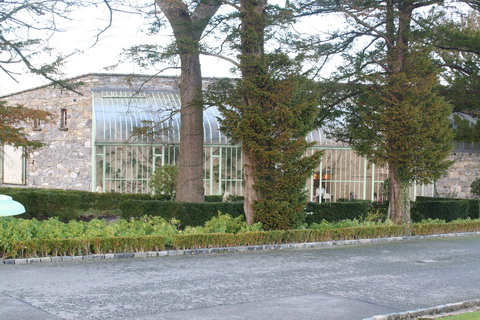
La Serre

Nibbling yesterday on a morsel of cured salmon, with fennel and apple salad, lemon crème fraiche and lavender jelly, at the excellent La Serre restaurant at the Village at Lyons, I looked forward to walking outside afterwards, on to the canal bank, to view the many boats that would undoubtedly be moored there, above the thirteenth lock, as their owners lunched at La Serre’s sister institution, the Canal Café.

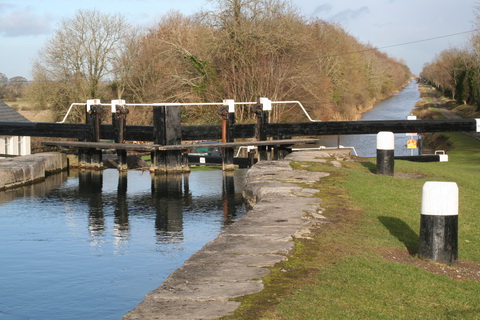
The thirteenth lock (and its wonderful O)

The thirteenth lock (and its wonderful O)

Judge of my surprise, then, when I found not a single boat outside. I realised, though, that boaters probably walked from nearby Hazelhatch and even from Sallins. For we know, do we not, that boaters are vital to tourism? Even Joe Higgins of the Socialist Party tells us so, which means that they must be out and about along the canals, spending money (and where better to spend it than at the Canal Café?).

The Canal Café, mere feet from the canal bank

The Canal Café, mere feet from the canal bank

But a difficulty has struck me. Mr Higgins’s position is that boaters have money available for discretionary expenditure, but Senator John Kelly tells us that most boaters are “retired couples from England who are receiving small English pensions”. So one politician tells us that boaters have disposable incomes and that they should not pay money to Waterways Ireland because they spend money in pubs and restaurants along the canals; another politician tells us that boaters should not pay money to Waterways Ireland because they have none to spare.

I find it difficult to reconcile these two positions.


Scrap the damn thing

The Irish Times reports today, in an article that will probably disappear behind a paywall sooner or later, that some folk don’t want the Naomh Éanna, a decrepit former ferry cluttering up the Grand Canal Dock, to be scrapped.

There seems to be a reluctance to accept that things, like people, have a lifespan. Keeping them alive indefinitely costs a lot of money. And none of those quoted in the article has put forward any good reason for keeping the damn thing, never mind any reason that would justify the spending of very large amounts of money on it.

Yes, it had some interesting (if minor) historical associations, but the best way of recording them would be to write a book, or create a website, or even make a movie, about the ship’s history. Money spent that way would be a far better investment than money spent on keeping the Naomh Éanna afloat. Its heritage or historical value lies in the associated information, not in the steel.

As it is, the vessel has been hanging around for about twenty-five years, since it failed a survey in 1986 or 1988 (I have found different dates). I don’t know how much it has done since then to advance appreciation of industrial or cultural history, or whatever it is that the complainants think is being vandalised, but I would have thought that anyone who wanted to gaze on an elderly vessel has had plenty of opportunity to do so.

Addendum: it seems some folk want to draw up an investment plan.

Send for the lifeboat

I read here that some folk want to remove the retired lifeboat Mary Stanford from Grand Canal Dock (a laudable aim, especially if it saves Waterways Ireland money), transport it to Ballycotton, Co Cork, and restore it.

It is to be hoped that their efforts will be more successful than those of the group that intended to restore the Clogherhead lifeboat Charles Whitton.

Snails

Snails may save us from restoring the Longford Branch of the Royal. Industrialheritageireland has the story.

Might be an idea to start breeding these snails for judicious use elsewhere.

Shinners losing patience over sheugh

Caoimhghín Ó Caoláin [SF, Cavan-Monaghan] in the Dáil on 5 February 2014:

There is no excuse for either the British or the Irish Governments to stand over any delay in advancing with key cross-Border infrastructural projects such as the Carlingford Narrow Water bridge and the Ulster Canal. With regard to the Ulster Canal, I have been in touch with the office of the Northern Ireland Minister for Culture, Arts and Leisure, Carál Ní Chuilín MLA, my party colleague. She assures me that both she and her counterpart here, the Minister for Arts, Heritage and the Gaeltacht, Deputy Jimmy Deenihan, are fully committed to this project, and I welcome that affirmation. As I pointed out in the debate on the Six Counties last year, the North-South Ministerial Council agreed to proceed with the Ulster Canal project in 2007. In the intervening period, we have seen the economic collapse in this State and a parallel contraction in the North. Despite this, the Ulster Canal project was kept alive.

Permission was granted last year for the Northern section by Environment Minister, Alex Atwood, and by Clones Town Council and Monaghan County Council for the section in this jurisdiction.

The Minister for Arts, Heritage and the Gaeltacht, Deputy Jimmy Deenihan, has advised that the earliest the contract could be awarded would be late 2014 with a completion date in spring 2017. I urge the Minister to do all in his power to expedite this process and to encourage his colleagues to do so. I also urge him to maximise the possible EU funding for the project from the Peace IV programme.

The Ulster Canal project is about greatly enhancing one of the finest landscapes in Ireland for locals and tourists alike, regenerating rural areas that have long been neglected and delivering a tangible peace dividend to Border communities that were neglected for far too long. It is time to get the work on the ground under way.

Yes …. Sinn Féin’s faith in the economic potential of canals is touching, if slightly worrying for anyone who believes that the world economy has changed since the late eighteenth century.

But wait: as far as I can see, SF is one of the few groups that has not asked Jimmy Deenihan about Waterways Ireland’s proposed new byelaws, which might force boaters to pay slightly more of the cost of their hobby. Perhaps SF is secretly hoping that user charges on the Clones Sheugh will be high enough to pay at least the interest on the construction cost? That would be nice.


Sallins speculation

I emailed Waterways Ireland on 4 February 2014:

I would be grateful if you could tell me whether any person applied, under byelaw 38q, for permission to hold an aquatic event on the Grand Canal at or near Sallins on or after Friday 24 January 2014.

WI said:

No-one applied to hold an aquatic event on or around that date on the Grand Canal.

If I were Waterways Ireland, and I heard a rumour (or got a tip-off from the NSA) to the effect that some boaters were going to hold a demo at Sallins, and if nobody had asked permission to hold the demo, or made any arrangements with me about it, and if I expected work to start shortly at Sallins, I might be worried that the demo might turn out to be more than a photo opportunity: that it might turn into an occupation or moor-in, one that would delay the work and possibly expose me to additional costs.

So I would do what I could, within the byelaws, to prevent the holding of the aquatic event. I would note byelaw 18 (2) (b):

(2) The Commissioners, or any authorised officer, may prohibit navigation on the canals or any part thereof from time to time for the purposes of—

( a ) an emergency, or

( b ) preventing the passage of a boat in respect of which a permit has not been issued under these Bye-Laws, or has been withdrawn, or is not displayed in the manner prescribed in Bye-law 40 of these Bye-laws.

If I were not Waterways Ireland, then, but a would-be demonstrator, I would make a note to inform the authorities next time I planned a demo so that there would be no surprises on either side.

I am, however, neither WI nor a would-be demonstrator, so (apart from the information I gleaned from WI) I know nothing of what either side may have done or not done, thought or not thought.