Category Archives: Restoration and rebuilding

The Nore

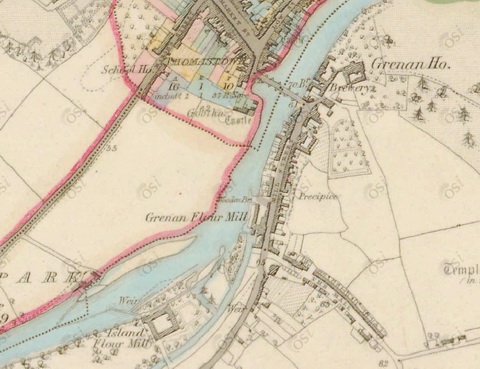
Thomastown ~1840 (OSI)

Thomastown, Co Kilkenny, is offering a month-long programme of events from 1 June to 1 July 2012, including:

  • on 1 June, an evening with singer Iarla Ó Lionáird, Carrick-on-Suir poet Michael Coady hydroelectroacoustic ensemble The Water Project
  • on 3 June, a talk on the archaeology of the River Nore, which will include industrial, transport and commercial heritage
  • on 17 June, poems and talks on mapping the Nore and on the river’s role in the development of Thomastown
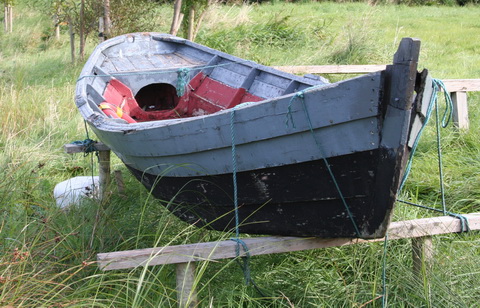
  • on 24 June, talks on cot fishing on the Three Sisters rivers and (by Shay Hurley of Clonmel) on the cot-builder Tom Cuddihy
  • on 1 July, the Thomastown Regatta, including cot racing and cot handling.

There will be exhibitions and other events during the month; download the brochure here [PDF]; read about the Thomastown Weir and the Thomastown Community River Trust here.

We recall that Samuel Lewis wrote of Thomastown in 1837:

A very considerable trade was formerly carried on, and the town was the commercial depot for the county of Kilkenny ; flat-bottomed boats of an aggregate burden of 11,000 tons were constantly employed in conveying goods from this town, besides many others which did not belong to it; but the river is now choked up with deposits of sand. Inistioge has become the head of the navigation of the Nore, and the boats employed on the river at this place do not exceed an aggregate burden of 150 tons; the goods are now conveyed on Scotch cars by land from Waterford to Kilkenny. The improvement of the navigation of the Nore would tend greatly to the revival and extension of the trade of the town, and to the development of the resources of the county, which is rich in marble, coal, culm, slate, and limestone, for which, in addition to its agricultural produce, it would afford facilities of conveyance to the neighbouring ports. It has been estimated that the clearing of the channel of the river, which would open the navigation from New Ross to this town for flat-bottomed steam-boats of 70 tons’ burden, might be accomplished at an expense of £15,000, and effect, by a reduction of the charges for freight and the discontinuance of land carriage, a saving of at least £10,000 per annum. There are several large flour-mills worked by water in the town and its vicinity, and also two breweries and a tan-yard.
Irish Times catches up …

… with this site, reporting on both Seol Sionna and the gandalows, which were covered here and here.


Government stimulus

According to the Irish Times:

Ahead of the summit later this month, Government departments have been told to draw up lists of capital projects with potential to create thousands of jobs for which funding would be sought if EU leaders agree on the package at the meeting to be held a week before polling day here.

Will DAHG be able to resist the temptation of suggesting the Clones canal? I’m sure that, since it discovered the project was going to cost almost one third more than it had originally believed, it has had teams of economists busily reassessing its, er, viability (and I’m expecting a visit from the easter bunny at any moment) so it will have its “business case” ready.

Still, there’s a slightly more cheering take on the matter here, where Michael Taft suggests that the government won’t be able to get much money for “stimulus”. I like the idea of using project bonds for the Clones Canal, though it might be hard to show that it qualified as “key strategic EU infrastructure in transport, energy and broadband” despite the Irish state’s delusions.

Seol Sionna launch

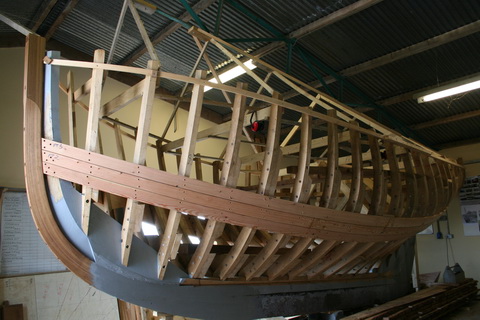
Seol Sionna under construction

The reproduction 25′ Shannon estuary hooker Seol Sionna will be launched at Querrin, Co Clare, on Saturday 19 May 2012, with celebrations continuing at Carrigaholt (home of the sublime Long Dock pub and eatery) on the following day [h/t dbm].

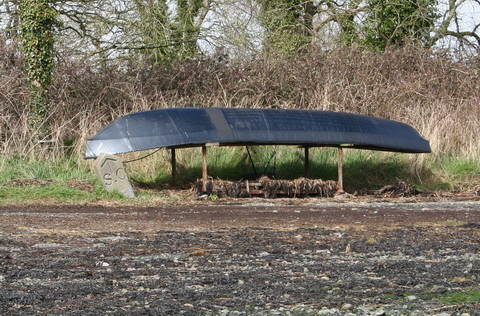
Canoe at Querrin. The second syllable of “canoe” rhymes with “go”

The pier at Querrin was built by the Shannon Commissioners; one of their marker stones (there are four at Querrin) is shown above.

Whaddya mean, you don’t know where Querrin is?

Remember, if the turf boats had not established the tourist traffic to Kilrush and Kilkee, the Shannon estuary steamers might never have got going and there might never have been a P&O line.

Grand Canal harbour

The curved building in March 2011 …

… and in May 2012

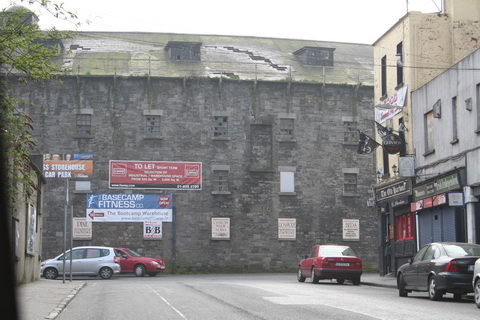
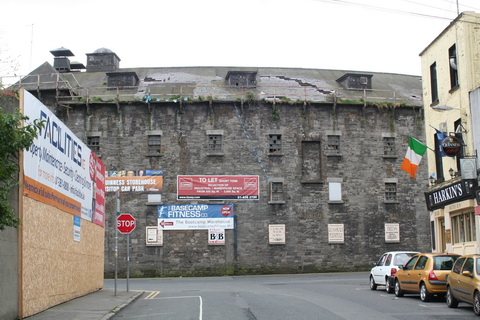
No sign of any improvement or of anything done to protect the building.


The Limerick Gandalow

Bunratty Gandalow 2008

Gandalows (there are several spellings) are boats of the upper reaches of the Shannon Estuary. They come in several shapes and sizes and have been covered in several books. There is an opportunity to see some of them on the water, in Limerick, on Saturday 19 May 2012, when the ILEN School & Network for Wooden Boat Building has organised a day of talks and races. Full details here.

Victoria’s secrets

Her Late Majesty Victoria, by the grace of god of the United Kingdom of Great Britain and Ireland Queen, had at least two locks named after her on this island: one at Meelick on the Shannon and the other at Upper Fathom on the Newry Ship Canal. This page gives a brief account of the canal’s history; it has links at the bottom to six pages (made up almost entirely of photographs) on aspects of the lock and its operation. Several of those aspects are not clear to me and I would welcome enlightenment about both the former manual operations and the current hydraulic operations.

Lough Ennell and the Royal Canal

Here is an account of the background to, and the main features of, the proposed supply of water from Lough Ennell to the summit level of the Royal Canal. It does not discuss the amounts of water involved; I intend to cover that on a separate page.

Sluices and streams

The heading shows I’m trying hard to find a waterways link for this ….

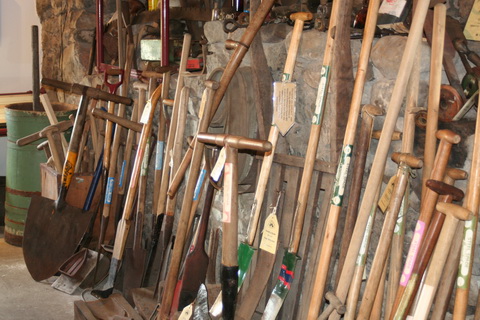
If you’re anywhere near Belfast, visit Patterson’s Spade Mill near Templepatrick on the Antrim Road. The IHAI visited it after the April 2012 AGM and it was quite fascinating. Did you know that there were once 171 different types of spades in use in Ireland, catering for different uses and different types of soils?

Some of the many types of old spades on display

The mill is powered by water, using a turbine, and it’s the last water-driven spade mill in These Islands:

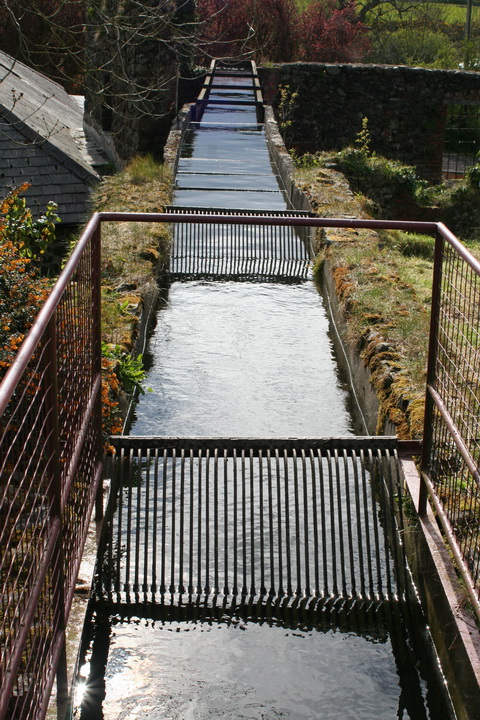
The channel taking water from the stream to the turbine. Part of the channel runs in a trough made by Portadown Foundry

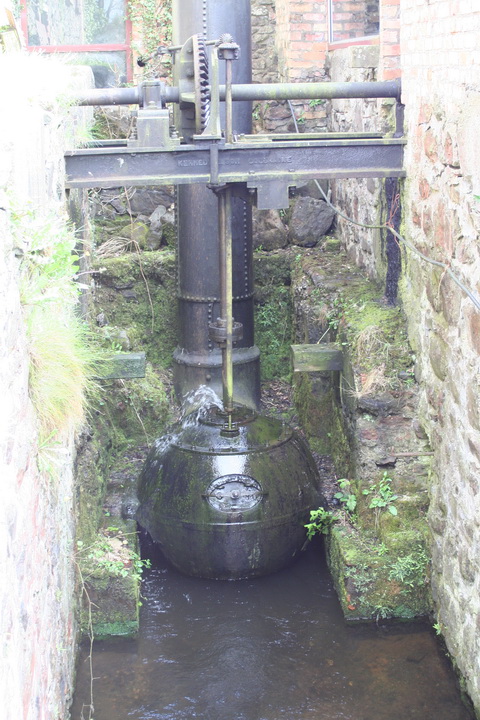
The turbine

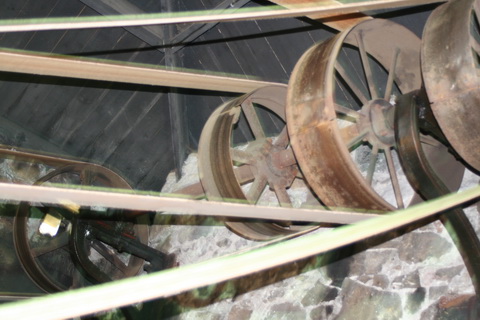
The turbine turns a shaft, which turns these wheels, and the belts power many of the machines in the mill

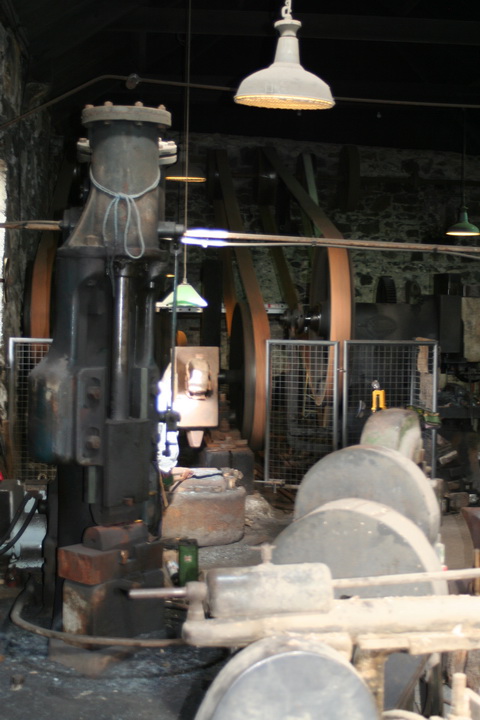
The water-powered trip-hammer towards the back

A spade after being hammered (just one of the many stages in its production)

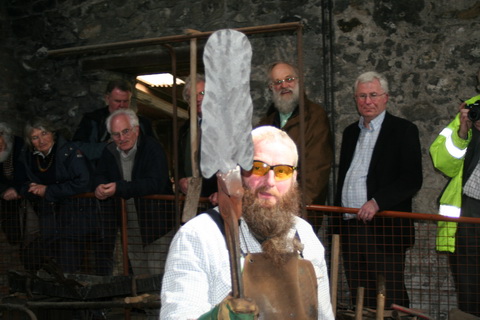
The mill (which is original, not a reconstruction) is absolutely packed with machines and must have been a hellish place to work when in full production, with the heat from the furnace, the noise from the trip-hammer and several workers producing spades at the same time. The spade-maker above is one of the last six in Europe and really knows what he’s talking about: not just the process but the uses to which spades were put. The other guide, who took us around the other parts of the site, was also knowledgeable and helpful.

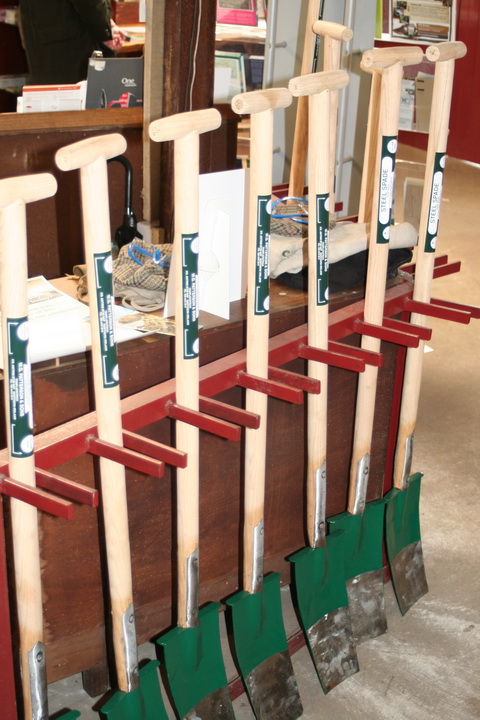
Some new spades

Highly recommended.


Skew arch bridges

The IHAI AGM at the weekend, in Newtownabbey Borough Council’s splendidly restored Mossley Mill,  included a tour of the premises and its museum. Then Professor Adrian Long of Queen’s University Belfast gave a short talk about the FlexiArch bridge, which his team have been developing since the 1990s.

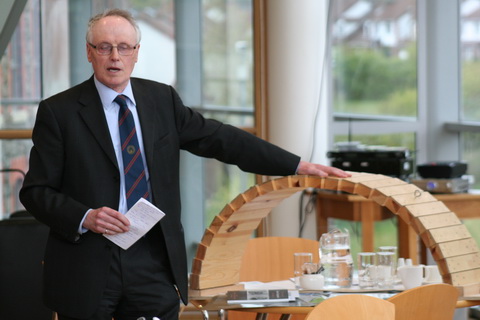
Professor Adrian Long with a wooden model of the FlexiArch bridge

He said that their work started by asking why nobody built arched bridges any more; they developed a system that used pre-cast voussoirs (the wedge-shaped blocks) linked by a polymeric flexible membrane. The voussoirs for any bridge are cast to give the correct taper for the span and rise required for that bridge.

Arch rings arrive on site stowed flat on the back of a truck; when they are lifted off, they fall into the correct shape and are lowered into position on previously-installed footings. Each arch ring is 1m wide; several of them can be placed side by side to give whatever width is required. The end walls are added and the structure is filled and given the appropriate surface (eg tarmac).

FlexiArch is manufactured by Macrete of Toomebridge (beside Lough Neagh); their website shows several examples of installation including one at a name familiar on Irish waterways. There is a brochure [PDF] and there is a video showing the installation of a 15-metre bridge.

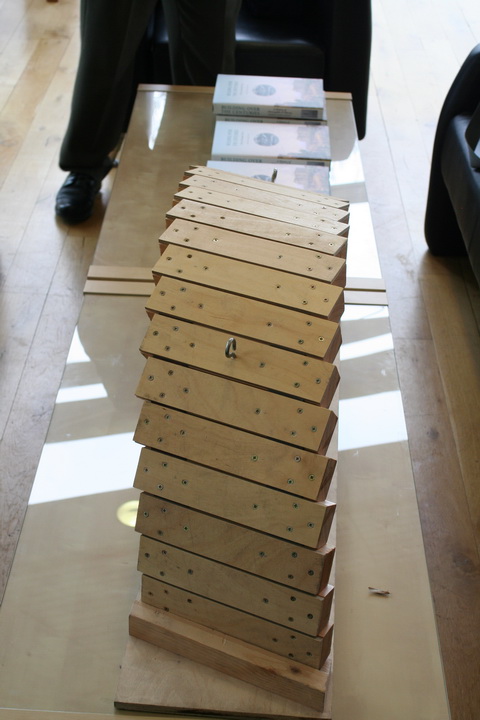
Wooden model as a skew arch

No, I haven’t any shares in it. I just thought it was interesting, for three reasons: first, the speed of construction is very impressive; second, there is a link to Lough Neagh; third, it might encourage the construction of more skew arch bridges over canals.