Category Archives: Scenery

Hands across the water

Another bit of northsouthery seems to be crumbling around its proponents’ ears, according to a report in today’s Irish Times [which will disappear behind a paywall at some stage]. It seems that, in July, TPTB approved the spending of €18.3 million on a bridge at Narrowwater [or Narrow Water], upstream of Warrenpoint and downstream of Newry (and of Victoria Lock). However,

The leading bid has costed the bridge at over €30 million […].

I presume that inflation does not account for the 66% increase but I am surprised that the proponents’ estimate was so far off. Perhaps omitting the opening span (intended to cater for the small number of tall vessels that use the Ship Canal to visit Newry) would save a few quid.

There is a discussion of the bridge project here and some useful information here; there isn’t here, although you might expect it.

It is certainly true that anyone wanting to drive from, say, Greenore or Carlingford to, say, Kilkeel or even Warrenpoint faces a long drive around Carlingford Lough. What is not clear to me is whether very many people want to do that: I haven’t investigated the matter, so I don’t know, but the main north/south traffic passes to the west and there are crossings at Newry.

A ferry service might be cheaper; it might also allow the real strength of demand to be gauged. Ferry terminals might be constructed by the local authorities and leased to an operating company.

And the service would probably be more useful than the Clones Sheugh: I see that yet another member of Sinn Féin got to ask about that in the Dáil recently, as did a Fianna Fáil chap from the area; they elicited the standard answer. The minister may be hoping that the cost estimates for the sheugh are more robust than those for the Narrowwater bridge.

Mountshannon seaplane

News from the Clare Champion about the possible cessation of commercial seaplane activities at Mountshannon. The article reports comments by Mr Emelyn Heaps, chief executive officer of Harbour Flights Ireland Ltd.

Harbour Flights

The Companies Registration Office finds four occurrences of the term “Harbour Flights”, all giving their address as 13 Parnell Street, Ennis, Co Clare. One is a business name; the others are:

  • Harbour Flights (Ireland) Limited
  • Harbour Flights (Couriers) Limited
  • Harbour Flights (BES Nominees) Limited.

According to the B1 Annual Return for Harbour Flights (Ireland) Limited to 30 September 2012 [the most recent available], the directors of the company are:

  • Ronan Connolly of Ennis, Co Clare, who is the Secretary; he holds seven other directorships of companies, two of which are Harbour Flights (Couriers) Limited and Harbour Flights (BES Nominees) Limited
  • Emelyn Heaps of Tulla, Co Clare; he holds nine other directorships of companies, two of which are Harbour Flights (Couriers) Limited and Harbour Flights (BES Nominees) Limited.

In the Clare Champion article, Mr Heaps “said the four directors and five shareholders will meet this weekend”; it is to be presumed that the two extra directors have recently joined the Board. The B1 return does say that the company had five shareholders:

  • Mr Heaps with 300000 ordinary shares
  • Mr Connolly with 300000 ordinary shares
  • Mr Adam Cronin of Cobh, Co Cork with 300000 ordinary shares
  • Mr Stewart Curtis of Bodyke, Co Clare with 100000 ordinary shares
  • Harbour Flights (BES Nominees) Limited with 4152 “A” ordinary shares.

The company’s authorised share capital is €105000 made up of half a million “A” ordinary shares at 1c and ten million ordinary shares, also at 1c; the issued share capital is €10041.52, of which €41.52 is the “A” ordinary shares and the rest the one million ordinary shares at 1c.

The financial statement of Harbour Flights (Ireland) Limited

The company has lodged abridged financial statements for the year ending 31 December 2011 [they refer to the company as Harbour Flights Limited, omitting “(Ireland)”].

The independent auditor said:

There is an excess of liabilities over assets, as stated in the Balance Sheet, and, in our opinion, on that basis there did exist at 31 December 2011 a financial situation which under Section 40(1) of the Companies (Amendment) Act 1983 requires the convening of an extraordinary general meeting of the company.

The abridged balance sheet shows a loss of €103944 in 2010 and €295130 in 2011. The Capital and Reserves section showed

  • Called up share capital 10042
  • Share premium account 26946
  • Profit and loss account (295130)
  • Shareholders’ funds (258142).

The other two companies

The balance sheet of Harbour Flights (BES Nominees) Limited as at 31 December 2011 showed current assets of 100 financed by called up share capital of 100. The company had two directors, Mr Connolly and Mr Heaps, and two shareholders, Mr Connolly and Mr Heaps, each with 50 shares.

The balance sheet of Harbour Flights (Couriers) Limited as at 31 December 2011 showed current assets of 100 financed by called up share capital of 100. The company had four directors, Messrs Connolly, Cronin, Curtis and Heaps, and four shareholders, the same four people, each with 25 shares.

Almost 21 months have passed since then and it is possible that all three companies have prospered greatly since 31 December 2011, especially after flights began in July 2013.

Operations

In January 2013 the Irish Independent reported that the company hoped to acquire a seaplane and its own website suggests that it made its first flight in July 2013 and intended to carry 10000 passengers in its first year. However, it seems that the Air Operator Certificate is held by National Flight Centre, Dublin, which says it will be operating the floatplane (seaplane) “in conjunction with Harbour Flights“.

I know nothing of aeroplanes, but the plane seems to be EI-CFP, a Cessna 172, which is said to carry three passengers. Assuming a seven-month tourist season (April to October) and seven-day-a-week operation, there are 214 days available for carrying passengers. The target of 10000 passengers a year would mean carrying 47 passengers a day, which means 16 flights a day, every day.

However, the first year’s operations do not seem to have started until 10 July, leaving only 113 days to carry 10000 passengers. That would mean 89 passengers a day, which would require 30 flights. The shortest flight time is 20 minutes (at €85 a head; longer flights are available) but I imagine that at least ten minutes are required at start and finish for boarding, so the operation must have been working 20-hour days all summer. I haven’t been in Mountshannon for some time, so I was unaware of the frenetic level of activity, but it must have been exciting.

addendum

I see that RTÉ reported, on 3 September 2013, a “test flight” to Galway. Such “test flights” have taken place to other locations, eg Cork, although it is not clear what distinguishes a test flight from, say, a marketing opportunity. RTÉ said that the flight was by a Cessna 206, which takes five passengers, but the photo shows EI-CFP, which is not (as far as I can tell) a Cessna 206 but a smaller Cessna 172.

There have been earlier announcements of services, eg to Limerick, where services were to begin in summer 2011. This website mentions an earlier proposed start. Some folk don’t seem confident of the soundness of the original business model.

Lakeland Seaplane Tours, based on Lough Erne, seems to have ceased operations.



Landing pills

They had two of them on the Slaney.

Naas

An account of the official opening of the Naas Branch (County of Kildare Canal) in 1788.

After the summer

I don’t really know much about politicians, local or national, but I presume that, in the summer recess, they retire to their country estates for a bit of huntin, shootin and fishin, with breaks for trips to agreeable parts of foreignlandia (Tuscany, perhaps) and with occasional visits from other gentlefolk.

At any rate, something distracts them and keeps them quiet, but summer is now giving way to autumn and, er, innovative suggestions are coming thick and fast from politicos anxious to get other people to contribute to social and economic development in their constituencies (or to get reelected, whichever comes first).

So we have one who wants a walkway across Meelick Weir and another who wants a riverbus service on the Park Canal in Limerick.

Meelick turns up in another story from the past week, by John Mulligan in the Irish Independent. But despite the silly headline and subhead, the body of the article is a thorough and balanced account of flooding on the Shannon. Mr Mulligan is to be commended.


Shannon Navigation Guide 1963

Messrs abebooks.co.uk have drawn my attention to the fact that Sharston Books of Manchester (which is a town or city within Her current Majesty’s Realm) have a copy of this 1963 Shell/BP guide for sale. John Weaving was Navigation Editor. I already have it, so I mention it here in case anyone else is interested.

I have no connection, commercial or otherwise, to the seller.

Bock goes boating …

… on the Shannon Estuary, the second most interesting coast of Clare (the inland coast is the most interesting, the north-west coast the least). Includes nice pics of the Scattery battery.

The mysterious Pill

Some questions and speculations about trade on St John’s Pill in Waterford.

The decreasing importance of cruising

I wrote here about the continuing decline in the numbers of boats recorded as passing through locks (and moveable bridges) on the Shannon. For the first five months of the year, the total number of recorded passages was jusst over half what it was in 2003. Maybe the current hot weather will increase the numbers, but the long-term trend has been downward for ten years, despite a Celtic-Tiger-inspired spike in usage by private boats.

I don’t know to what extent that decline affects Waterways Ireland’s policy-making. Are the hundreds of economists, marketing gurus, MBAs and other high-powered bods in WI’s marketing department engaged in a major search for new and profitable markets? Certainly its sponsorship programme [can’t find info on the WI website], its lists of events and its descriptions of activities are much broader in scope than mere boating, and even within that category small-boat activities are prominent.

WI is cooperating with other official bodies in developing walking [h/t Industrial Heritage Ireland] and cycling routes [h/t KildareStreet] and. with the Irish Sports Council and Irish Leisure Consultants, it has recently published A Guide to Planning and Developing Small Vessel Water Trails in Ireland [PDF]. WI does not, as far as I know, have a strategy for promoting increasing use of its waterways by cruising boats (private or hired), although I’d be happy to be corrected about that if I’m wrong.

All of this is good stuff, and I’m all in favour of widening the, er, user base (apart from those events for which people dress in fluorescent underwear and run around the streets: I share the late Mrs Patrick Campbell’s concern for the horses).

But three points strike me. The first is that the older waterways businesses — hotel boats, hire firms, marinas — involved capital investment and created reasonable numbers of jobs. I do not know whether Waterways Ireland measures employment, or other economic benefits, as an output of its sponsorship, marketing and organisational activities but it seems to me that it would be nice if it were able to show that the benefits outweigh the costs. It would also be interesting to know to what extent the newer activities can profitably attract tourists from overseas: with the water trails, for instance, is it possible for anyone to make a profitable business out of overseas visitors, given the costs of marketing and selling, or are these trails purely for the domestic market?

The second point is that one sector, that of professional event organisers, may indeed be benefiting from WI’s support. But if that disempowers local or voluntary groups, renders them unable to run events without professional assistance or makes the cost of doing so too high, it may not be an unmixed blessing.

The third is that there is a representative body for owners of inland cruising boats, but these new activities do not have inland-waterway-specific user bodies (if they have user bodies at all). That, I think, must make for a different type of relationship between the service provider, Waterways Ireland, and the users: most inland cruiser owners have nowhere else to go, but canoeists or anglers or walkers can easily switch to the sea or to non-WI inland waters, so WI has to compete for their custom.

This piece is written not to provide answers but to ask some questions.


Searching Lough Derg

Last Friday evening, 21 June 2013, was not a good time to be out on Lough Derg. We were heading north, with the waves behind us, and had little difficulty until entering port, but we could hear on the VHF what must have been one of the biggest search and rescue operations on the Shannon in recent years.

We had switched on at what seemed like a fairly early point in the proceedings, and kept listening until the Coast Guard were assured that everybody was accounted for. We weren’t able to attend to the whole thing, as manoeuvres during and after berthing occupied our attention for some time, but we got a pretty clear picture. The Irish Times report (which will probably disappear behind a paywall at some stage) is here; I think it has some minor details wrong but the gist of it is correct; its later report is here. The Clare Herald has a very detailed account here, the Clare Champion account is here and the Limerick Post adds some information here.

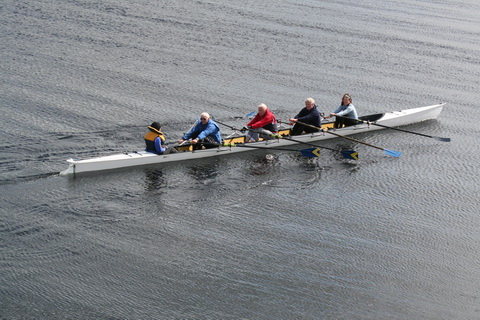
The event was said by the Irish Times to be “hosted for FISA in Ireland by St Michael’s Rowing Club of Limerick” but I can’t see anything about it on either organisation’s website. I presume that the boats were something like this one.

Quad at Clonlara in 2011

It’s a quad, with each rower using two oars; it carries a cox and it’s used for touring rowing, so it’s not as slim as a standard racing shell.

By the way, just to be clear, none of the photos on this page were taken during last Friday’s operation.

RNLI Lough Derg lifeboat

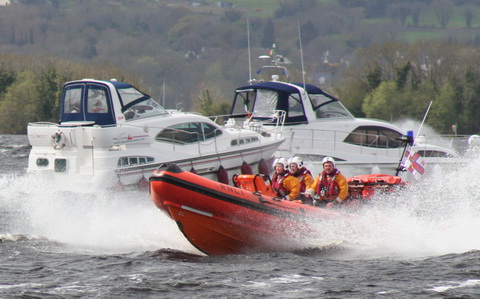
From what we could hear, the operation involved volunteers from Killaloe Coast Guard, the RNLI at Dromineer, the Community Rescue Boats from Mountshannon and Limerick and at least one yacht, which (I think) took one of the rowing boats in tow; that yacht’s participation and careful provision of information to the Coast Guard was admirable.

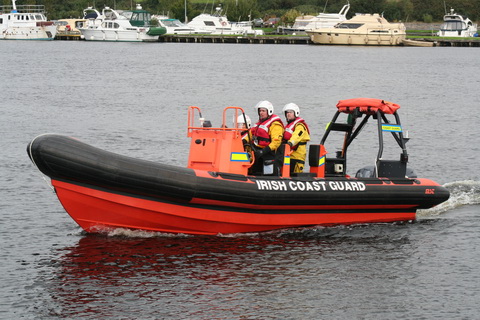
Killaloe Coast Guard RIB

Killaloe Coast Guard RIB

We heard discussion of proposals to ask the Civil Defence to participate as well, and the Clare Herald confirms they did turn out. It seems that the University of Limerick Activity Centre boat was out too, as was Peter Hooker of RNLI in his own boat.

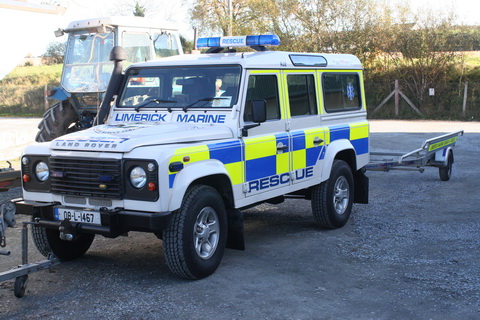
Limerick Marine SAR Land Rover

Limerick Marine SAR Land Rover

That’s just the volunteers, and if I’ve left anybody out I’m sorry; let me know and I’ll amend this.

Then there were the professionals: the Coast Guard staff on VHF, the Gardaí on shore, the helicopter crew. And, again, the Clare Herald makes it clear that lots of other people were involved too: fire brigade and ambulance units, paramedics and a hospital consultant.

All in all, this was a major operation and a lot of people put in a lot of effort that night, in bloody awful weather.

Communications

I formed the impression that communication amongst the members of the rowing fleet, and between them and the rescue services, was poor. It was difficult to establish what rowers were where and how many were unaccounted for. The Clare Herald story seems to support that conclusion: it says that Gardaí had to travel to the rowers’ hotel to make sure that everybody had turned up and that the search was not formally stood down until 11.30pm.

I don’t know what communications equipment and what sort of organisation and safety procedures the rowing group had, so I’m not going to comment on them. Instead, I want to go off at a tangent. It struck me that life would have been easier for everybody if each boat had had a handheld VHF and someone able to operate it. Such sets can be bought for as little as £50 in the UK or €75 in Ireland.

So the technology is now very cheap and, for short range work as on Lough Derg, a handheld VHF should be adequate. But if you want to be legally entitled to use a VHF set, matters are much more complicated. I’ll discuss that in another post.