Category Archives: Shannon

Limerick flooded again

The waves covered the quays in some places to a depth of three and four feet, and rolled in to the adjoining streets with resistless fury. Shannon-street, Charlotte’s Quay, and the Mall were completely inundated, and in the corn stores on Honan’s-quay, Harvey’s quay, &c, the water reached a height of four feet in some instances.

I already had a page about the floods in Limerick in November 2009; here is an account of the floods in Limerick in 1850.

Blueways and traffic

I wonder whether it would be wise to issue some guidance to masters of larger vessels about (a) the likelihood of meeting numbers of canoeists, kayakers, stand-up paddleboarders (SUPpers) and others on particular stretches of water and (b) what to do on meeting them. Guidance to operators of the smaller craft might be useful too. I’m thinking in particular of the restricted visibility on parts of the Camlin and the prospect of encountering a fleet of SUPpers on a tight bend.

The Camlin and the Lough Allen Canal in effect enforce their own speed limits, but I don’t know whether there is any limit on the Shannon between Tarmonbarry and Lough Forbes. If there isn’t, perhaps a limit should be imposed to protect those on small craft.


Blueways

Longford Tourism and Waterways Ireland are holding an information meeting about Blueways in Longford tomorrow. It’s in the Backstage Theatre on Tuesday 24 March 2015 at 7.00pm. The blurb reads:

Are you an activity provider, accommodation provider, walker, boater, canoeist, outdoor enthusiasts?

Longford Tourism, in conjunction with Waterways Ireland is delighted to invite you to a Public Information Meeting regarding exciting new recreation and tourism products called Blueways.

Blueways are a series of innovative, safe and easy to use water and land-based trails. These provide for guided and unguided paddling, walking and cycling. Visitors can opt to paddle along the Shannon Blueway, on a 10km looped trail along the Camlin and Shannon Rivers, while the Royal Blueway provides 16km of off road walking and cycling from Cloondara to Longford Town.

To celebrate this exciting trails development, Longford Tourism will host the inaugural Longford Blueways Festival in April. So, come along and hear how you can get involved. All are welcome to attend.

I wish them well and I hope this initiative works. I think that the Blueways are more likely to be successful than any attempted revival of the cruiser-hire business (although I’d like that to work too). However, I would like to learn more about the Blueways business model (if that’s the right term). Who has to invest how much and who gets what returns? Clearly, Waterways Ireland spends money up front, but far less (I presume) than (say) canal restoration would require. But are there viable businesses, or at least viable supplementary income-generating activities, for small local service providers? How do they reach overseas markets? Or is the focus on domestic markets?

One point that strikes me is that Blueways allow for more interaction between tourists and locals: something that used to be a strength of the Irish tourism offering (I’m trying to keep up with modern marketing jargon here) until we decided we were too busy being rich and successful to waste time chatting to tourists (or, if you prefer, providing unpaid support services to the tourism industry). Indeed we felt that even paid employment in tourist enterprises was beneath us: we could get nice people from overseas to do that work instead. Did we, I wonder, hollow out Ireland, removing the Irishness, the distinctiveness (whatever it was) from the tourist experience?

If so, the Blueways’ opportunities for interaction with small-scale and local enterprises might put them back again. There are difficulties in making a living from small-scale operations, but there are benefits too. And the Blueways might tap into other local, small-scale developments: for instance, the recent startling growth in the number of craft breweries. The Lough Allen and Longford Blueways each have a local brewery — St Mel’s in Longford and Carrig in Drumshanbo — and the products of at least one other brewery, Co Roscommon’s Black Donkey, are available on the North Shannon. Maybe, now that KMcG is back, “Places to find good beer” might be added to places to stay, eat and go on the Blueways website.

A Blueway is defined there as

a recreational water activity trail that is developed for use by non-motorised water activity enthusiasts. It is defined by trail heads, put in and take out points and readily available trail information. Blueways can be developed on canals, rivers, lakes or along the coast and can incorporate other associated land base​d trails adjacent to the water trail.

So what about a Blueway for Lough Oughter, with sailing, canoeing and camping?

[h/t Carthach O’Maonaigh]

The stolen railway

I’ve just been flying by rail: looking over some of the present and former railways that cross[ed], impinge[d] upon or were otherwise related to waterways. They are all on Industrial Heritage Ireland’s new Historic Map of Irish railways.

In the midlands, for example, it shows the line from Clara to Banagher, home of Ireland’s shortest canal: folk visiting Shannon Harbour will know about that. And anyone driving to Shannon Harbour from (say) Limerick will have crossed the Stolen Railway from Birr (then Parsonstown) to Portumna: it’s there too, as are the lines on both sides of the Shannon Estuary, and those near the Suir and Barrow and many many more.

Work has begun on providing links to a database with information about the individual stations: Donegal, which had an extraordinary number of them, was the first area to be done.

Hours of enjoyment; thanks to Ewan Duffy for putting in so much work.


Shannon–Erne Waterway traffic

I have reported regularly on Shannon traffic figures [most recently here] but I have paid relatively little attention to the Shannon–Erne Waterway [SEW]. I am therefore grateful to Waterways Ireland for supplying me with the last five years’ monthly traffic figures for Locks 1 and 16 on the SEW. I had some queries about the figures for certain months and I have put them to Waterways Ireland, but I presume that the annual figures are OK.

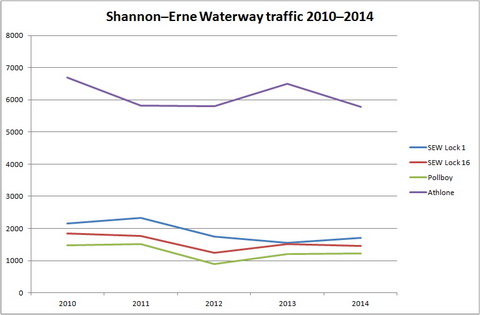
Shannon–Erne Waterway traffic 2010–2014

Shannon–Erne Waterway traffic 2010–2014

Clearly, not all boats go all the way through: if they did, the figures for Locks 1 and 16 might be the same. The hire bases for Locaboat, Riversdale and Corraquill were all on the Erne side of the summit level; does Lock 1’s excess of traffic over Lock 16 suggest that hirers, perhaps wishing to minimise the number of locks they passed through, headed for the Erne rather than the Shannon? The figures, which I presume are gathered automatically, do not distinguish between private and hired boats.

The other point that strikes me is that the level of traffic is actually quite low. I put in the figures for Pollboy and Athlone locks to allow comparison. SEW traffic is greater than that on the Lough Allen Canal, but it is not much greater than that on the River Suck to Ballinasloe. In that case, WI is [according to its Business Plan 2015] considering automating Pollboy Lock to reduce costs.

Pollboy lock passages 2005–2014

Pollboy lock passages 2005–2014

The SEW locks are already automated, but the costs and benefits may have to be re-examined, especially now that Locaboat has moved from Ballinamore to Quigleys Marina at Killinure on Lough Ree: I presume that that will result in less traffic on the SEW.

Pollboy and the CLones Sheugh

In 2006 Pollboy traffic was used as the basis for estimating likely traffic to Clones on the Ulster Canal’s “SW section”:

The total number of boat parties/groups for the SW section is assumed to be 600. This is based on a comparison with another “offshoot” like the Suck Navigation which had around 1,250 boat parties/groups in 2005 (obtained by dividing the passages through Pollboy Lock by 2) in a much busier section of the whole system. So, for the SW section, a level of around 50% (ie. 600) is regarded as a reasonable assumption.

Waterways Ireland Socio economic Summary Report for the NE and SW Sections of the Ulster Canal Final Report February 2006

Now that Pollboy’s traffic is half what it was in 2005, no doubt the estimate for the number of boats that would visit Clones, if a canal ever reached it, has likewise been halved, which would give an average of about ten boats a week over a seven-month season: four boats every Saturday and one a day for the rest of the week. Folk intending to build restaurants to cater for the cruiser traffic might be wise to reassess their investment plans:

In overall terms, the benefits of waterway restoration derive from the fact that these can facilitate a variety of leisure and recreational activity, that the users will benefit from this activity, and that there will also be wider spin-off benefits in the areas, e.g. facilities such as restaurants etc built to service canal traffic.

Department of Arts, Heritage and the Gaeltacht Restoring the Ulster Canal from Lough Erne to Clones Updated Business Case February 2015

There’s not enough business there for a burger van, never mind a restaurant.

The magic of the Shannon–Erne Waterway

But if Pollboy, the River Suck and Ballinasloe are no longer cited as support for the construction of a Clones Sheugh, the Shannon–Erne Waterway is still used as an example, in that and in other contexts. Take, for example, this:
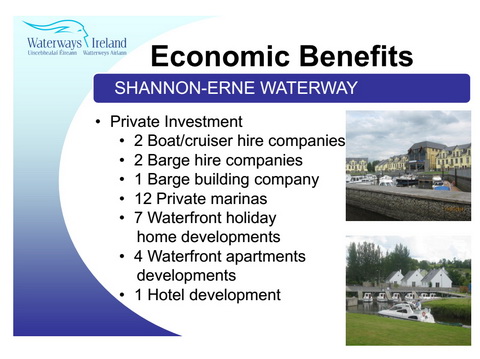
Shannon–Erne Waterway magic

Shannon–Erne Waterway magic

I’ve nicked that from a slide show called Economic, Recreational and Social Benefits of Rural Waterways in Ireland, which was to be delivered [PDF] by Garret McGrath of Waterways Ireland at the World Canals Conference [PDF] in Milan in 2014.

Now, if the Shannon–Erne Waterway had caused all that construction activity, we’d have to drag Waterways Ireland before the Irish banking enquiry. Skipping lightly over the question of the ghost estates, and the departure of Locaboat from Ballinamore, we come to the real problem with this sort of stuff: the post hoc fallacy. We are invited to believe that

  • a waterway was built
  • prosperity followed
  • so the waterway must have caused the prosperity.

Well, maybe it did and maybe it didn’t, but the argument presented in the slide show isn’t sufficient to prove it. You would have to check to see whether there were any other possible explanations: any other changes that might have resulted in all that construction.

Along the Shannon–Erne Waterway, I can think of two other possible factors: Sean Quinn’s business empire and the Upper Shannon Rural Renewal Scheme, a tax dodge that applied in Leitrim, Longford, Roscommon, Cavan and Sligo, five of the six counties that had the highest rates of vacant housing (excluding holiday houses). So there are two problems here:

  • much of that construction activity may have been driven by tax breaks rather than by the existence of a nearby waterway
  • the construction itself may not have had beneficial effects.

You can read more about that here, noting in particular, on the map, the areas around the upper Shannon and the SEW with vacancy rates of over 25%; you might wonder whether Waterways Ireland is wise to claim credit for housing over-development.

But my main concern here is a different one: that, if you want to claim credit for economic benefits that followed waterways development, you have to measure the benefits and subtract those attributable to other factors, such as Sean Quinn and the Rural Renewal Scheme. Then it would be useful if you compared the remaining benefits with the cost of constructing your waterway: it might then be possible to say that waterways development is a good investment.

It may be that such a study has been done on the SEW, but if it has I don’t know where it is; I would like to see it if it exists. Until then, I regard this sort of thing, from DAHG’s Business Case, as drivel:

The broad existence and nature of the potential socio-economic benefits of canals and restored waterways are therefore well established and not really at issue.

Sorry, minister: that’s rubbish. As far as I know no proper evaluation has ever been carried out on the costs and benefits of any restored or new-built Irish waterway. So you’re not getting away with that one.

 

Shannon history

Folk interested in the history of the Shannon Navigation, and in particular in the work of the Shannon Commissioners in the 1840s, may like to get hold of an article “Steam, the Shannon and the Great British breakfast”, published in the Journal of the Railway & Canal Historical Society Vol 38 Part 4 No 222 March 2015.

What DAHG knows about waterways history

Commercial traffic on all waterways in Ireland ended during the first half of the 20th century.

For certain values of “half”.

Shagging the Shannon to shovel the sheugh

On 24 February 2015, the Irish Times published an article headed

First stage of Ulster Canal restoration due to begin in April
Some €2m will be spent on a section of the Shannon-Erne waterway

It ended with these sentences:

The €2 million will be drawn from the funds of Waterways Ireland, a north-south implementation body. It will carry out the dredging of a 2km section of the Erne river and the construction of a new navigation arch at Derrykerrib Bridge to accommodate boat traffic, with a target completion date of April 2016.

It may be that the Irish Times doesn’t know very much about waterways. If it did, it might have been aware that, on 18 December 2014, the North South Ministerial Council approved Waterways Ireland’s Business Plan 2015, which included this Action:

3.6 Progress the restoration of the Ulster Canal on an incremental basis. €1,000

So on 18 December 2014 the North South Ministerial Council — which for all practical waterways purposes consists of Heather Humphreys, the southern minister for waterways and other stuff, and Carál Ní Chuilín, her northern counterpart — approved the allocation of €1,000 to the Ulster Canal in Waterways Ireland’s 2015 plan. Yet, just over two months later, they expect Waterways Ireland to spend about €2 million on the blasted thing, about €1.5 million of it in 2015.

The southern government’s party of treasure-seekers seems to have disappeared entirely: at any rate it doesn’t seem to have found any money. And the two ministers’ departments have presided over successive years of cuts in Waterways Ireland’s current and capital budgets, cuts whose effect has been worsened by the woefully inadequate provision for an ever-increasing pensions bill. Waterways Ireland’s Corporate Plan 2014–2016 shows a cumulative increase of €984,000 in pension costs over the period of the plan, which wipes out a lot of savings in other areas.

I suppose that curiosity is a weakness in journalism. Were it not so, two questions might have struck the Irish Times:

  • how is Waterways Ireland to come up with €2 million out of an ever-decreasing budget?
  • why has Waterways Ireland’s Business Plan been so violently disrupted only two months after it was approved? The €2 million is half WI’s total capital budget spending in for the republic in 2015; it will be recalled that the republic, in a fit of more than usually nitwitted arrogance, undertook to pay for a canal to Clones, which is what the powers-that-be are pretending Saunderson’s Sheugh is.

I can answer the first question, at least for 2015, during which WI expects to spend €1,416,000:

  • €166,000 will come from Heather Humphreys’s department
  • €900,000 will (WI hopes) come from the sale of property assets
  • €150,000 will come from the postponement of an IT programme
  • €220,000 will come from the postponement of non-navigation works on the Shannon
  • €90,000 will come from postponing development of the Barrow Blueway.

I don’t know what property assets WI can sell to bring in the requsite amount. It seems that damage to everyday navigation has been avoided, but the Shannon and the Barrow are to suffer to pay for dredging a river that merely provides a small extension of the Erne navigation.

As for the second question, I suspect that Sinn Féin put a gun to someone’s head: “We’re fed up waiting for our sheugh. Start digging or the baby gets it.” The baby might have been Heather Humphreys’s Dáil seat or it might have been something more important. And the gun was, I suspect, a message accompanying the “business case” prepared by the northern department and sent to the southern. [I have asked both departments for copies and other information.]

Arthur Aughey, then lecturer in politics at the University of Ulster, wrote in Magill magazine in February 2001:

Puritanical republicans grieve at the thought that the hunger strikers [of 1981] died to achieve the Waterways Ireland Implementation Board.

I suspect that the less puritanical republicans, those who operate in the devolved institutions of Northern Ireland, are now demanding that the southern government deliver, through the “Waterways Ireland Implementation Board”, what nitwitted previous governments promised. It’s a pity that Sinn Féin and those previous governments couldn’t have come up with a more sensible list of waterways and other infrastructural projects.


Saunderson’s Sheugh and the border problem

Castle Saunderson and the border

Castle Saunderson and the border

Saunderson’s Sheugh, the latest manifestation of the proposed reconstruction of the Ulster Canal, would run along a border for much of its length. That’s the border between Ireland and Northern Ireland, but there is one important border it does not seem to cross [as far as I can see]: that between counties Cavan and Monaghan.

Has Cavan stolen the sheugh from its northern neighbour? I’m sure that folk in the Monaghan part of the Dáil constituency of Cavan-Monaghan won’t mind, but I wonder whether the Minister for Arts, Heritage and the Gaeltacht, who is a TD from the Monaghan end and is in charge of Sheughery, is concerned that her Monaghan colleague Caoimhghín Ó Caoláin [Sinn Féin] might turn the situation to his party’s advantage. On the other hand, from Sinn Féin’s viewpoint, the question might be whether any sheugh is better than none.

Of course, as soon as a coalition of Sinn Féin and the Éamon Ó Cuív wing of Fianna Fáil takes power, we’ll have the entire Ulster Canal built immediately. And there will be grants for growing flax, carrying corn to Dublin and draining the Shannon [which might mean that there are no southern boats to visit the Ulster Canal].

I should say, though, that Davy, in two reports out today, is not very worried about what Sinn Féin might do: Finfacts story here; Davy here; the two reports here and here [each of which should open as a PDF; if that doesn’t work, use the links on the Davy or the Finfacts page].

Map: OpenStreetMap; copyright explained here.

What has happened to Harbour Flights?

The successful air transport company Harbour Flights, which had a base at Mountshannon, announced some time ago that its level of success was such that it was suspending operations but that it would be back early in 2014, “fully operational again” with a fleet of aircraft “operating from [sic] destinations nationwide”.

Alas, my request for reports of sightings of the fleet produced neither information nor photographs and my own visits to Mountshannon in 2014 did not coincide with any aircraft movements. And now the website at http://www.harbourflights.com/landing.php has disappeared.

Surely nothing can have happened to the firm.