Category Archives: Shannon

Big it up for the OPW

I’ve just been reading some particularly nitwitted Dáil discussions and I need some time to calm down enough to report on them to the Learned Readers of this site. Let me just say that anyone who thinks that politicians cannot distinguish fact from fiction is absolutely right. But enough of that for the moment.

I reported earlier on an oddity in the results from the OPW’s Athlone waterlevel gauge. I emailed the OPW about it and a helpful chap got back on more or less immediately.

He explained that the data we see on the waterlevel.ie site is, as it were, live: raw unfiltered data with nothing added, nothing taken away. The same data goes in to the OPW and they spotted that the Athlone gauge was reading too high. They found the sensor was faulty; they have now adjusted it and the new, lower readings are correct.

The disappearance of the placenames is because of some work in progress on improving the website; they will be back.

He kindly pointed me to a list, in .xlsm format, downloadable from here; it shows all hydrometric stations in Ireland. It shows who operates them, whether they’re active and whether they use telemetry (which I take to mean that they can be monitored remotely). Unfortunately OPW itself doesn’t seem to have any gauges on Lough Derg and nor does Waterways Ireland. OPW does have a rather excitable gauge at Scarriff and gauges upstream of Meelick Weir and Meelick (Victoria) Lock. The ESB has gauges with telemetry at Ballyvalley (25073) and Killaloe (25074) but I can’t find any website giving the levels. If, Gentle Reader, you can find one, perhaps you would let us know.

The consoling part of dealing with the OPW is that you get the distinct impression that they know some useful stuff. Unlike, say, some folk working in Kildare Street ….
Thump it on the thirteenth

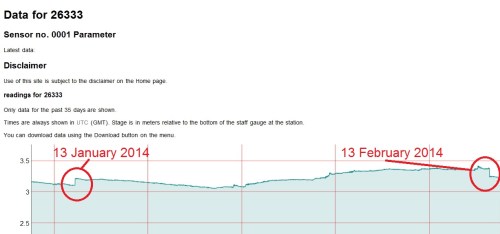
Here is a screenshot from the OPW’s online waterlevel gauge for Athlone Weir. It shows the levels for the past 35 days. In recent days the waterlevel website has ceased to show the names or locations of the gauges, but 26333 is Athlone Weir.

Athlone waterlevel: 35 days to 14 February 2014

Athlone waterlevel: 35 days to 14 February 2014

Note the odd discontinuities: the level jumped up on 13 February and fell back on 13 February. Does the gauge get stuck every so often and have to be thumped to free it?

I do not know. I have reported both the discontinuities and the disappearance of the station names to the OPW.


Limerick Boat Club

Video. NB I have no information on this myself and have no intention of going to inspect the site: it’s windy and wet in Limerick.

Pathé on Shannon

Shannon floods 1959 1

Shannon floods 1959 2

Pylons!

The Carrick-on-Suir creamery chimney (Shannon Scheme electrification)

Building the headrace


Relieving Athlone

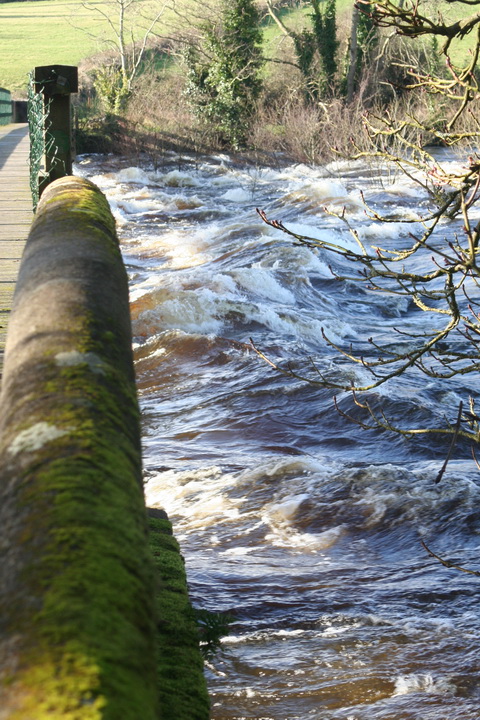
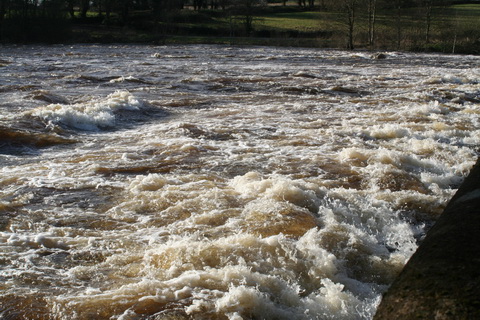
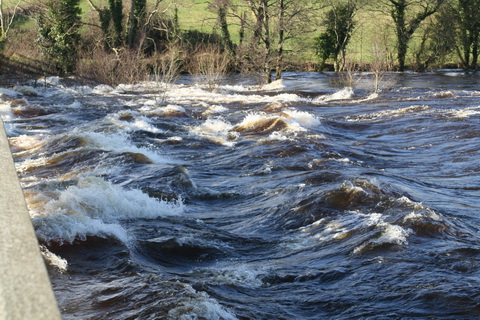
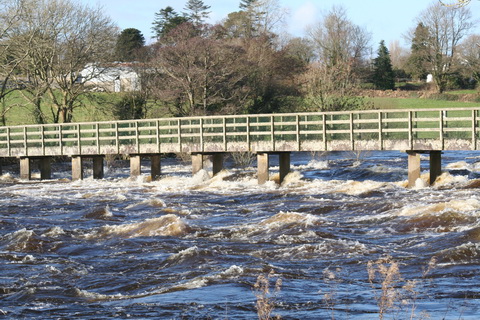
Parteen Villa Weir is sending large amounts of water down the original channel of the Shannon, and over the Falls of Doonass, to draw water off from the upper reaches of the river.

Castleconnell water level 20140210 264_resize

The footbridge at Castleconnell

Castleconnell water level 20140210 267_resize

Above the bridge

Castleconnell water level 20140210 269_resize

The downstream side of the bridge

Castleconnell water level 20140210 271_resize

A bumpy ride

Castleconnell water level 20140210 273_resize

At normal levels the bottom of the wall is several feet above the water


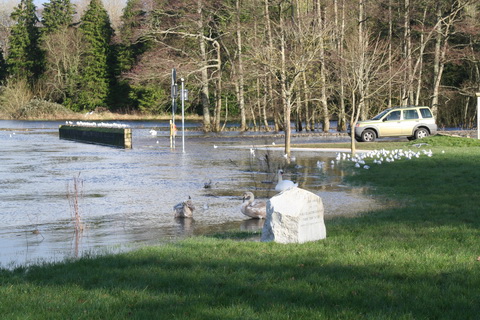
Levels below Parteen Villa have not yet reached those of 2009 and the channel can probably take more before folk get flooded.

The Old River Shannon site has some photos taken at Parteen Villa Weir.

Snails

Snails may save us from restoring the Longford Branch of the Royal. Industrialheritageireland has the story.

Might be an idea to start breeding these snails for judicious use elsewhere.

An eels update, updated

Pat Rabbitte’s reply to Michael Colreavy; thanks to KildareStreet.

Update 6 February 2014: Fergus O’Dowd [FG, Louth] responded to the Dáil’s most famous canoeist, Ming Flanagan [Ind, Roscommon/South Leitrim], the Rockville navigator, with some more information about eels.

A sense of proportion

Waterways Ireland’s funding comes from Ireland [RoI] and Northern Ireland [NI] in the ratio 85:15. I understand that the ratio reflects the length of WI-run waterway in each jurisdiction, although I am not sure how length is measured on lakes.

The proportions of boats in the two jurisdictions are not 85:15. As of December 2013 there were 5570 boats on the Erne Register and 8816 on the Shannon Register. These numbers may or may not reflect the numbers of boats on the waterways as (a) there may be unregistered boats and (b) folk may not always deregister boats that have moved off the navigation. I do not know how many boats there are on the Lower Bann; boats on the Shannon–Erne Waterway should be on either the Erne or the Shannon Register.

Waterways Ireland reckoned that there were 520 boats on the Grand, Royal and Barrow at the end of 2013. Adding them to the Shannon number gives us

  • RoI 9336
  • NI (excl Lr Bann) 5570.

The ratio is RoI 63, NI 37.

On programme costs, though, matters are otherwise. Granted that the 2011 figures, the most recent available, may not be representative of long-term average costs: the Royal has not been reopened long enough for us to get such a long-term average, and the 2011 figure may be unusually high.

The other difficulty is with the allocation of the costs of the Shannon–Erne Waterway. I have arbitrarily divided it 50/50 between the two jurisdictions, although they probably exaggerates the proportion attributable to NI.

Shannon + Royal + Grand + Barrow + ½ SEW = €7275000

Erne + Lower Bann + ½ SEW = €807000

The ratio is RoI 90%, NI 10%.

So:

  • funding: NI 15%
  • number of boats: NI 37%
  • spending: NI 10%.

All subject to caveats.

No particular point: I just thought it was interesting.

Drawbacks of canals

There was a proposal in the 1830s for a ship canal along the coast, outside the railway embankment, from Dublin to the asylum harbour at Kingstown. A preliminary report was provided by William Cubitt after the House of Commons Select Committee on the Dublin and Kingstown Ship Canal had reported in July 1833.

Henry E Flynn was opposed to the idea and, in his A Glance at the Question of a Ship Canal connecting the asylum harbour at Kingstown with the river Anne Liffey at Dublin &c &c &c [George Folds, Dublin 1834], dedicated to Daniel O’Connell, he wrote eloquently of the drawbacks of the proposal, which included this:

Be it remembered, that the whole coast from Ringsend to Merrion is the bathing ground for the less affluent classes of the Citizens; and hundreds get their bread by attending on and bathing the females who frequent it.

And are the patriotic Would-be’s who support a Ship Canal equally reckless of the health, the morality, and the existence of those persons? Would they have no objection to expose their mothers, wives, sisters and daughters to the immediate wanton gaze, the scoffs, the jeers, the immodest jest, the filthy exposure and indecent exhibitions which the most abandoned race of men [ie sailors] could find in their dissolute minds to perpetrate in their view, and within their hearing? And yet, all this must be the consequence of a Ship Canal in the immediate vicinity of the female baths and bathing ground along the line.

Happily, the canal was never built.

Join the elite while saving the nation

One of the most exclusive groups in Ireland is that of the boat-owners who pay Mineral Oil Tax on the diesel they use for private pleasure navigation. My own view is that, if you make payment of a tax effectively optional, most people won’t pay it. I have been providing supporting evidence for some time here, here, here and here, from which last I can say that there were 23 law-abiding boat-owners in Ireland last year (and 8816 boats registered on the Shannon, not to mention those based on other waters).

Clearly, this ridiculous system should be abolished: boats using diesel for private pleasure navigation should be forced to use non-marked fuel and pay the full non-rebated rate. Until that happy day comes, those who wish to join the respectable classes can download the return form for 2013 here [PDF]. Mineral Oil Tax on fuel used in 2013 is to be paid by 1 March 2014.