Category Archives: Sources

Leisure industries in Mullingar

From the Waterford Chronicle 21 October 1843 quoting the Athlone Sentinel:

An unfortunate female was thrown over the bridge at Mullingar into the canal, on Friday night, by some of her unfortunate companions, and was drowned. An inquest was held on the body, when a verdict of wilful murder was returned against six females, three of whom have been taken.

From the BNA

Grand Canal passage-boat

Here is an account, published in 1862, of what it was like to travel from Portobello, in Dublin, to Ballinasloe by the Grand Canal Company’s passage-boats — and of why rail travel was much to be preferred.

The Barrow Navigation Company’s fleet

Here is an account of the October 1871 half-yearly meeting of the Barrow Navigation Company. It is interesting for the information it provides about the company’s finances and in particular about the size of its fleet and the number of horses required.

A new book

Andy Wood’s Abandoned & Vanished Canals of Ireland, Scotland and Wales [Amberley Publishing, Stroud 2015] is now available. It is a companion to his Abandoned & Vanished Canals of England.

Many (but by no means all) of the Irish canals are covered on this site; the author sought and was granted permission to draw on this material and has generously acknowledged that.

I have not yet had time to read the book but I did note that the author seems to have confused Grand Canal Harbour and Grand Canal Docks.

Carlow Distillery

THOMAS HAUGHTON and CO., (being about to withdraw from the Trade,) are ready to receive proposals to Let with a fine, or Sell the Interest in their Concern, consisting of Distillery, Water-mill, Malt-house, Corn-stores, extensive Vaults for bonding Stores, with an excellent Dwelling-house; the whole situate at Carlow, on the bank of the navigable river Barrow.

The Copper Works and Utensils having been lately erected are all in perfect order, and there being a home Sale at the door for the entire produce, renders this Concern a most eligible investment for any competent person (or Company,) with a moderate capital.

The Dublin Mercantile Advertiser, and Weekly Price Current 16 December 1833

From the BNA

Hamilton Lock

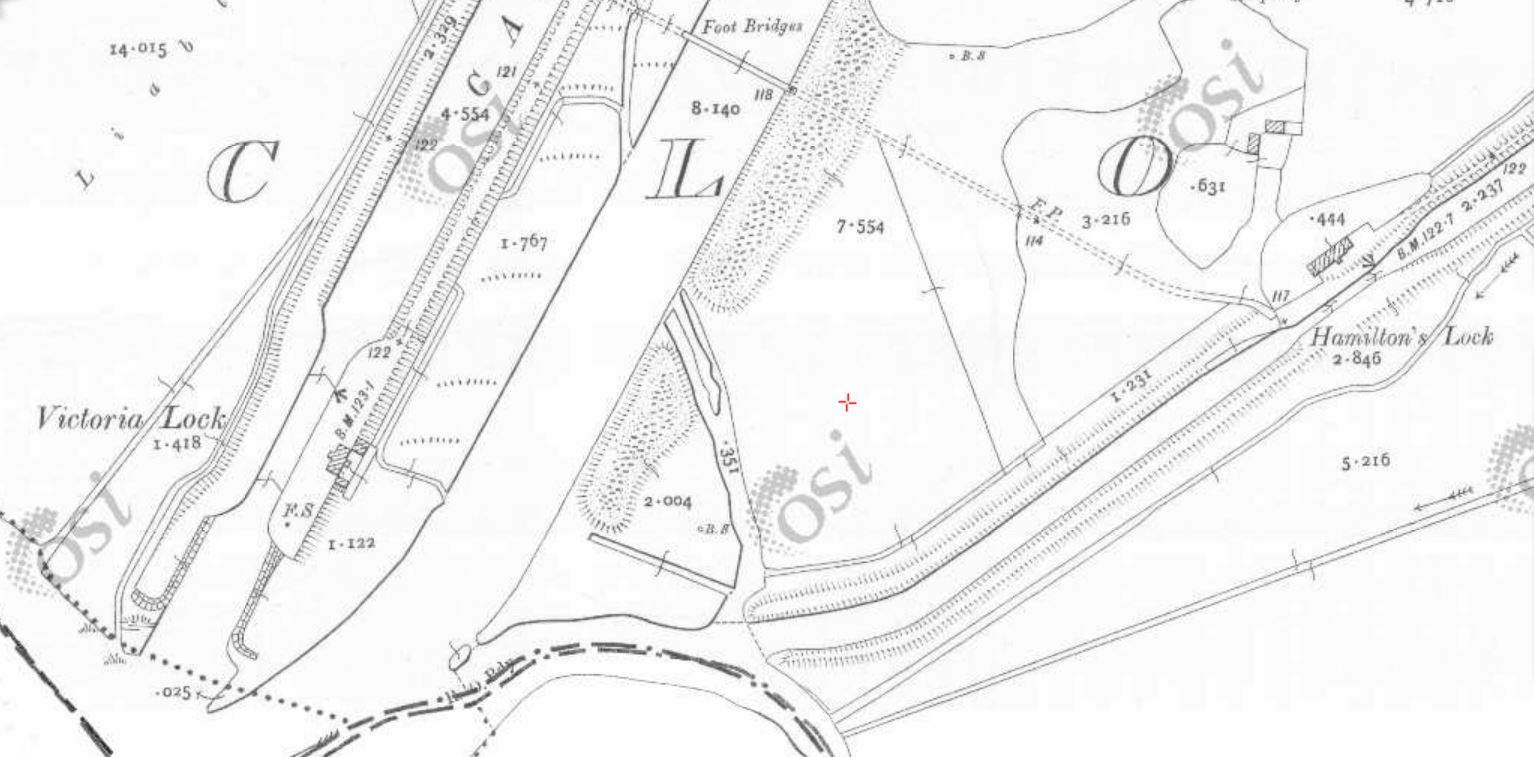
Victoria (Meelick) and Hamilton Locks (OSI ~1900)

Victoria (Meelick) and Hamilton Locks (OSI ~1900)

Lord Dunkellin: Do you know the Victoria lock at Meelick?

Sir Richard Griffith: I do.

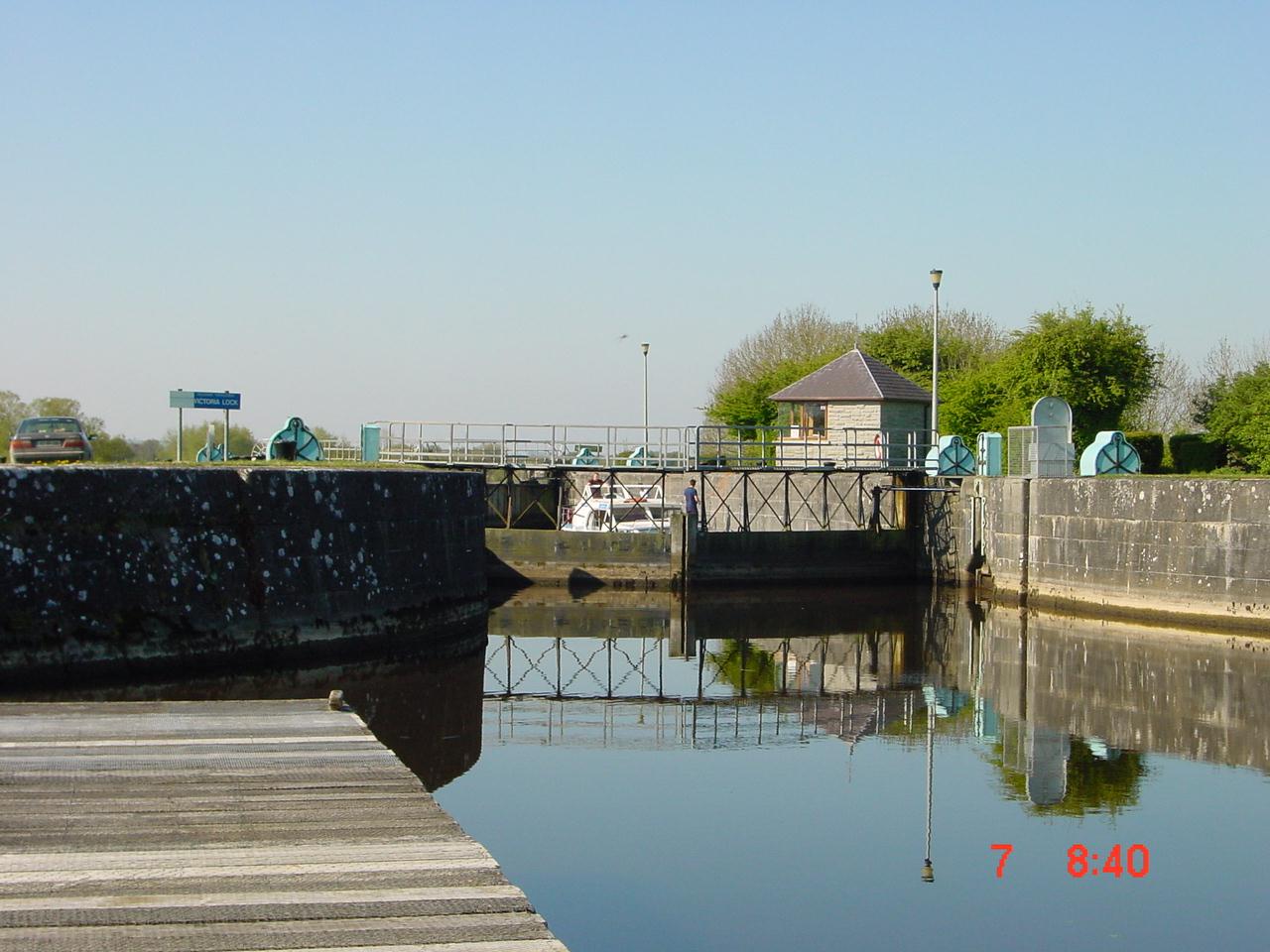
Victoria Lock, Meelick

Victoria Lock, Meelick

Dunkellin: Do you know what is called the Old Cut, the old canal?

Griffith: Yes.

Dunkellin: The Victoria lock is a new work, is it not?

Griffith: It is.

Dunkellin: Should you be surprised to hear that vessels do not use that frequently, but go by the old cut?

Griffith: In times of very high flood I am aware that the canal boats find it advisable and beneficial to go by the Hamilton lock, on the old cut, in preference to the other.

Dunkellin: Prima facie, one would have thought that a new work like the Victoria lock would have the effect of regulating the state of things?

Griffith: It arises from the Counsellers’ Ford, as it is called, above Meelick; it has not been sufficiently excavated, and there is a strong current, and the boats are not able to get up to it in times of high flood.

Dunkellin: Then the boats made use of the old canal instead of the new lock?

Griffith: Under those peculiar circumstances they did.

Evidence of Sir Richard Griffith to the Select Committee on the Shannon River 12 June 1865

My OSI logo and permit number for website

C&RT and waterways history

I mentioned earlier that Waterways Ireland intends to promote the collection, archiving and use of waterways oral history. Across the water, I gather that the Canal & River Trust is setting up a Canal Research Network:

Canal & River Trust is the charity entrusted with the care of 2,000 miles of waterways in England and Wales. Our canals are home to over 2,700 listed structures, 50 scheduled ancient monuments and five UNESCO world heritage sites. The National Waterways Museum in Ellesmere Port is home to the Waterways Archive, an internationally significant collection of historic records relating to Britain’s waterways and the people who built, used, and lived on and near them both within Britain and as connections to the sea and the world beyond.

We are keen to establish a scholarly research network for academics and researchers in other organisations to connect with the Canal & River Trust and with each other, sharing their research and finding opportunities for collaboration. The reach of our organisation and the quality of resources available means that there is real scope to develop meaningful, impactful projects together.

We would very much like to invite you to the inaugural meeting of the Canal Research Network at the Rolt Conference Centre at the National Waterways Museum on Wednesday 22nd July from 11am – 2pm. There will be an opportunity to hear about future plans for the museum and archive —  including a proposed collaborative doctoral award between Canal & River Trust and the University of Huddersfield. We are unable to cover travel
costs, but lunch will be provided.

RSVP john.benson@canalrivertrust.org.uk by Monday 13 July. Full details of the programme will be sent in due course.

Please feel free to pass this invitation on to colleagues in your organisation or elsewhere who may be interested in coming — please ask them to RSVP to the email above. And if you would like to be part of the network but cannot make that date, let us know and we will add you to the mailing list for future events.

With all best wishes
John Benson
Archivist
The Waterways Archive
National Waterways Museum
South Pier Road
Ellesmere Port
Cheshire
CH65 4FW
Tel: 0151 373 4378 […]

That reached me on the same day as the Railway & Canal Historical Society’s Journal Number 223, July 2015, which contains an article by Joseph Boughey “Waterways history research: progress, prospects, problems and limits”, in which he says

What is now needed, I submit, is a Waterways Study Centre (WSC), or rather two, one in physical form, one provided and accessed by electronic means. […] I would envisage that [the WSC] would need to be located in, or close to, an established archive of documents and other artefacts. (Given this, only one or two current locations seem appropriate, but ideally existing facilities could be expanded!)

WI and oral history

I learn from the Heritage Council that Waterways Ireland is seeking tenders for a pilot oral history project. The winner is to

  • Undertake a minimum of 3 interviews per waterway under our jurisdiction (see list above in Introduction). Any interviews relating to the Ulster Canal will be included as part of the Lough Erne Collection for the purposes of this pilot project. […] The interview questionnaire (to be agreed with Waterways Ireland) should endeavour to elicit material that adds to our existing archive, would be beneficial in our schools education programme and used in a broader promotion capacity.

  • Devise an oral history handbook for Waterways Ireland so staff members and community groups can advance this project in years to come.

  • Deliver training on best practices and guidelines in oral history interview skills and techniques. All training to be delivered in Waterways Ireland offices.

This is very interesting for several reasons. Let me get two quibbles out of the way first:

  • Why is the Clones Sheugh treated as part of the Erne? And why mention that specifically? What sensitivity is being addressed here?
  • Why is this tender not mentioned on WI’s Tenders page or the Current tenders page to which it links or anywhere else that the WI search engine can find?

I think there are four important points about this.

First, it is good that WI is devoting resources to the collection of oral history.

Second, it is good that it has applications in mind for the material: it may be used both in WI educational programmes and in marketing.

Third, the requirement for a training programme and a handbook is yet more evidence [on top of Éanna Rowe’s appointment to manage the Shannon] that the balance of skills required within Waterways Ireland nowadays is different from that of the past. While engineering will always be important, given the extent of the waterways infrastructure that has to be maintained, WI needs a higher proportion of people engaging with users, potential users and communities or devising product variants to attract such users. The marketing department can’t do all the work by itself.

Fourth, it is good that “community groups” as well as “staff members” will be able to use the oral history handbook. I hope that the term “community groups” won’t be interpreted too strictly — that individual amateur historians, for example, will be able to use the handbook — so that all waterways oral history can follow a common format, that the records are conserved properly and that the appropriate consents to the use of the material are collected at the time of the interview.

I should perhaps make a declaration of non-interest: I am much occupied with the waterways of the early nineteenth century but have not, so far, found any survivors from that time whom I could interview. But I might, perhaps, be allowed to express the hope that WI won’t altogether neglect such earlier history, about which there is much yet to be learned.

 

Shannon traffic figures to May 2015

I am grateful to Waterways Ireland for letting me have the Shannon traffic figures for the first five months of 2015. All the usual caveats apply:

  • the underlying figures do not record total waterways usage (even for the Shannon) as, for instance, sailing, fishing or waterskiing on lakes or river stretches, which did not involve a passage through a lock or Portumna Bridge, would not be recorded
  • the passage records would not show, for instance, a change in the balance of types of activities from those in larger cruising boats to those in smaller (sailing, fishing, waterskiing) boats
  • figures like these will not necessarily be representative of those for the year as a whole. The winter months, January to March, see little traffic in any year; for April, May and June, the weather can have a large influence on the amount of activity especially, I suspect, in private boats.

On the other hand, the figures do include the Shannon’s most significant tourism activity, the cruiser hire business. And they are our only consistent long-term indicator of usage of the inland waterways.

The big news is that there is an increase in the amount of hire-boat traffic and a decrease in the amount of private traffic. [Personal observation suggests very little activity on Lough Derg, apart from the sailing bods.]

Shannon traffic Jan to May 2015 all boats

All boats. Note the slight increase in total traffic — or is it a dead-cat bounce?

Shannon traffic Jan to May 2015 hire boats

The increase comes from hire-boat traffic …

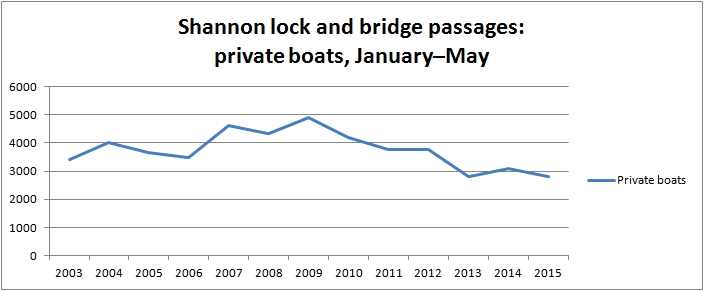
Shannon traffic Jan to May 2015 private boats

… as private-boat traffic is down on last year

Shannon traffic Jan to May 2015 compared with 2003

Nonetheless, hire-boat traffic is still close to 40% of what it was in 2003, with no sign of a major recovery

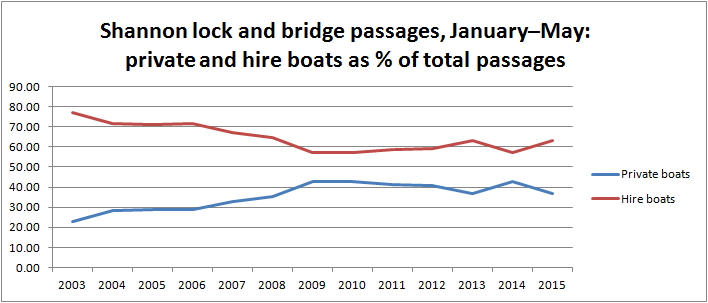
Shannon traffic Jan to May 2015 private -v- hire

But, at least for April and May, hire boats are the major users of the Shannon

In January, 18 boat passages were recorded, 9 of them at Portumna Bridge. There were 20 passages in February and 362 in March. Is there any point in keeping the Shannon open throughout the winter?

In the first five months, 11 boats used Sarsfield Lock, the sea-lock in Limerick. There were 88 passages through Pollboy Lock on the River Suck. On the Lough Allen Canal, 96 boats went through Battlebridge Lock, 95 through Drumleague and only 38 through Drumshanbo. These branches can’t be paying their way.


ESB and the Shannon

I wrote here that I had written to the ESB, on 27 May 2015, to ask about navigation on the Shannon from Castleconnell downstream. One month later, I have not yet received a reply.

I did hear this weekend that ESB had contacted certain boat-owners to inform them that they were not to moor to the ESB embankments between Portumna and Meelick. As a riparian landowner, ESB is no doubt within its rights, but it would be interesting to know how much of the bed of the Shannon it claims to own in that area.

I have still not been able to find out, from the ESB, the clearance under its high-voltage lines crossing the Shannon (and other navigations). I gather that the ESB works on the principle that, if it provides no information, it can’t be blamed if owners of masted vessels electrocute themselves, whereas if it did provide information it might be sued. Strange that a public sector body should have such a blasé attitude to the prospect of the electrocution of the citizenry.

Perhaps if I asked questions under the Access to Information on the Environment Regulations 2007/2011 I might get replies.