Category Archives: Sources

Kerrygold

It is, no doubt, well known that the first transatlantic steam shipping company was founded by a Kerryman and was to be based in his home county: indeed on his own estate at Valentia Island. The transatlantic steamers would run thence to Halifax, Nova Scotia: that was amongst the shortest possible ocean crossing, which was important in the early days of steam navigation, when inefficient engines required prodigious quantities of coal. There were to be feeder services at both ends of the route, thus linking London with New York, and a second line from Valentia to the West Indies.

The Kerryman was Sir Maurice Fitzgerald MP, the 18th Knight of Kerry.  A meeting of supporters was held in London in June 1824 and, a year later, an Act of Parliament permitted the formation of a joint stock company with limited liability for its shareholders. However, the American and Colonial Steam Navigation Company did not last long: it softly and suddenly vanished away in 1828, its single steamer, the Calpé, sold to the Dutch government before completing a single voyage (although, under her new ownership, she ran a successful transatlantic mail service to Surinam and Curacao).

The prospectus, published before the meeting in June 1824, said of Valentia:

Ballast cargoes may be obtained there in slates, butter, and coarse linen, for the American markets.

However, Alexander Nimmo, writing to Fitzgerald, said

Remember, your whole peninsula only affords 100 tons of butter per annum, and all Kerry would not provide for a constant trade.

The gallant knight would therefore, I am sure, be delighted with the news from the Americas that “Irish Butter Kerrygold Has Conquered America’s Kitchens“. I hope he would have known enough to realise that “[…] Ireland’s landscape and economy, which both remain dominated by agriculture” may be true of the landscape but is not true of the economy.

Sources

John Armstong and David M Williams “The Perception and Understanding of New Technology: A Failed Attempt to Establish Transatlantic Steamship Liner Services 1824-1828” in The Northern Mariner/le marin du nord XVII no 4 [October 2007]

Letters and papers of Maurice FitzGerald in Public Record Office for Northern Ireland ref MIC639/6

Public Ledger and Daily Advertiser 28 June 1824

Expected benefits of the Ulster Canal (aka the Clones Sheugh)

The members for Donegal, Cavan, Fermanagh, Monaghan, and Tyrone, assisted by the leading gentry of each county, have joined in the grand object of improving the navigation of Lough Erne, and are at present in communication with sseveral experienced civil engineers, the Board of Works, and Colonel Burgoyne. Mr Saunderson, of Castle Saunderson, is indefatigable in improving the Upper Lough, and it is probably his exertions will be met and well seconded by John Creighton Esq, Crom Castle.

Already have several gentlemen been summoned from Enniskillen to value the land at Newtownbutler through which the Ulster Canal is to pass; and when its junction with Lough Erne is effected, and a stream of Commercial communication is opened between Ballyshannon and Belfast, the central point of which must be Enniskillen, enterprising individuals will not be wanted to establish steamboats and vessels of large tonnage upon the lake, which will render such encouragement to manufacturers and commerce by the quick and cheap transmission of goods and mails, as will in a few years render this a most flourishing town.

Ballyshannon Herald 20 April 1838

Cupid at Athlone

Aquatic Excursion (from a correspondent)
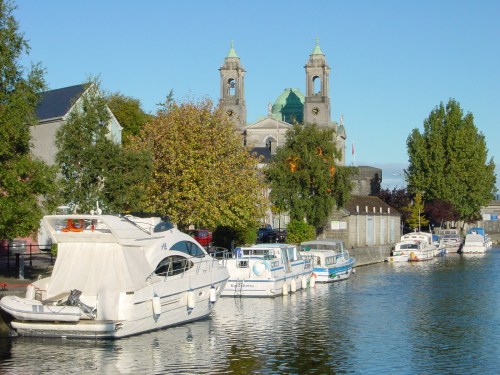
Athlone (2003)

September 17, 1846 — The Amateur Band of St Peter’s, who deserve so much from the inhabitants of Athlone for the many opportunities they seize upon, to amuse them, having provided — on a large scale — for themselves and guests a sumptuous and plentiful feast, with the necessary teetotal drinks, sailed up the lake on last Sunday in the Cupid Steamer. The day was beautiful and inviting and the placid stream of the noble Shannon — as if in harmony with the circumstance — opening wide its expansive bosom to receive them, displayed in gorgeous grandeur, the verdant beauties of its multitudinous islands and grove-covered promontories of its indented coasts.

I never saw the lake to such advantage as on that occasion. We had about eighty persons on board, amongst whom were the Rev Mr Philips CC and RW, Mr Keating and family, and other pic-nic parties, with viands and refreshments in abundance. As the steamer made the lake and swept through an Archipelago of islands — namely, Carbery, Kid, the Wren, and Crow Islands, &c, having the wood-embosomed Hare Island, the present insulated residence of my Lord Castlemaine, on the right and the grove-crested cape of the Yeu or, as some call it, the Loo Point on the left — then it was that she breasted the serene bosom of this inland ocean not as Byron says, “walking the waters like a thing of life”, but bounding over its mirrored surface like an impetuous courser she seemed to devour the distance, while she tossed a road of foaming surges from her heels.

On each side appeared emerging from wood and grove beautiful villas and noble ruins, towers and antiquated telegraphs, with their declivous lawns sweeping to the water’s edge. As we passed between Inchmore, Innisbofin, the Nun’s Island, the cultivated and rich callows of the Longford coasts, and Warren’s Point, St John’s and Mount Plunket on the Roscommon side, hill and dale land and water reverbrated with the dulcet tones of our excellent band under their inimitable instructor, Mr Keating, while at intervals the gay and cheerful dance on deck, to the music of the violin, enlivened the enjoyment of the exhilirating prospects that accumulated around us.

One or two objects which I observed, struck me very forcibly, and reminded me of the left-handed, nay, monopolising policy of former days, and the state of vassalage under which we yet groan and which “Ireland for the Irish” would never tolerate. In a beautiful valley, and modestly peeping from the clustering foliage of circumnambient trees and in accommodating contiguity to the “big house” stood the snug and aristocratic church of the minority, styled in legal parlance “the Established”, while at a distance on the bleak hill of Newtown, exposed to wind and weather, a chapel dedicated to the worship of the millions, displayed all the frigid isolation of a step-mother’s care.

We now arrived at Quaker’s Island, and having tacked about, we made for Warren’s Point, on our way home, and went on shore at St John’s Castle. With feelings of deep melancholy mingled with admiration, we viewed the venerable ruins of this once majestic pile (huge masses of which lay scattered here and there), its dismantled bastions, deep fosse, and the roofless walls of its antiquated chapel, while on a neighbouring hill stands the shell of its watch-tower to give timely warning of the approach of the feudal rival who would dare contest sovereignity with its lord. We then warmly and eagerly discussed the viands abundantly spread on the verdant sward at the base of

These ivy crowned turrets, the pride of past ages,
Tho’ mould’ring in ruins still grandeur impart.

After which the merry dance commenced, unconstrained laughter and encouraging shouts accompanying the performers, bringing the memory back to the times of rural felicity; when under the fostering tutelage of a domestic legislature, every family had its own quern to grind its own grain, every peasant could drink his own beer and the daily toil of virtuous industry being over, the children of simplicity, to the sounds of the oaten reed or the violin, or the more national bag-pipes, tripped it gaily on the “light fantastic toe”. And this was the happy and tranquil state of “Old Ireland” before the importation into it of such exotic materials as Sir Walter Raleigh and his rotten potatoes. To return to the ruins. I wish Lever, Carlton, or some one of those compilers of Irish legendary lore, had visited Lough Ree, he would find there more traditionary facts connected with the pristine magnificence of the different localities, than very many of those which have been already noticed in Magazines.

Having embarked once more we soon arrived home, and thus ended to the satisfaction of all parties, one of the most amusing days I, at least, ever spent in my life. To Bernard Mullins Esq, the young men composing the band return their sincere acknowledgements, for his kindness in accommodating them with the Cupid for this very pleasant excursion.

O’B

Athlone Sentinel 18 September 1846

Irish slobs

The word “slob” is a provincial term, and applied to banks of mud in the same way that the word “warp” is used to signify similar formations in the River Humber.

Second Report of the Commissioners appointed pursuant to the Act 5 & 6 William IV cap 67 for the improvement of the navigation of the River Shannon; with maps, plans, and estimates HMSO, Dublin 1837

Staffing the Shannon

According to the eleventh and final report of the Shannon Commissioners, published in 1850 but covering the year 1849, each of the quays built by the commissioners on the Shannon Estuary had an officer stationed at it to collect tolls and other charges. Five of the six — Querrin, Saleen, Kilteery, Kildysart [aka Cahircon] and Clare [now Clarecastle] — had Second Class Collectors; Kilrush, being busier, had a First Class Collector.

Cappa [Kilrush] pier

Moving upriver, Limerick was one of only two places on the Shannon to have an Inspector; it also had a First Class Collector and a Lock-keeper. Park, the next lock up on the Limerick Navigation, also had a keeper, as did five of the six locks on the Plassey–Errina Canal — Plassey [aka Annaghbeg], Gillogue, Newtown, Cloonlara [so spelt] and Errina. Presumably the Cloonlara keeper also locked after the nearby Monaskeha Lock. Preusmably, too, the keepers collected any tolls or charges due at the locks: there were no separate collectors, yet from other evidence we know that tolls and wharfage were collected at Plassey [Annaghbeg] and Errina.

O’Briensbridge modern [ie 1830s] navigation arch

Back on the river, O’Briensbridge had a Second Class Collector. On the Killaloe Canal, each of the three locks — Cussane, Moyse [sic] and Killaloe — had a keeper; the Cussane keeper must have collected tolls and wharfage. Killaloe had a First Class Collector.

On Lough Derg, Scarriff and Portumna each had a Second Class Collector. Portumna, like several places upstream, had an opening bridge, but the Shannon Commissioners did not employ a bridge-keeper: the bridge was not built, owned or operated by the Shannon Commissioners.

Back on the river, on what used to be called the Middle Shannon, the commissioners employed both a Second Class Collector and a lock-keeper at Victoria Lock (Meelick). There was another Second Class Collector, and a bridge-keeper, at Banagher. At Wooden Bridge, the crossing of the Shannon from the Grand Canal’s main line to its Ballinasloe line, the commissioners employed two ferry boatmen: by that stage the bridge no longer existed and the commissioners had installed a ferry to carry horses and tow boats between the canals.

Shannon Bridge had a Second Class Collector and a bridge-keeper; Athlone had a bridge-keeper but earned itself a First Class Collector. On Lough Ree, Lecarrow and Lanesborough each had a Second Class Collector but Tarmonbarry had nobody: a First Class Collector was assigned to Cloondragh [so spelt] but presumably had to look after Clondra and Tarmonbarry locks, the weir, Tarmonbarry bridge and the collection of tolls. Mighty men they had back then.

The second Inspector was based at Rooskey, along with a lock-keeper who presumably also operated the bridge and did anything that needed doing on the weir. Albert Lock on the Jamestown Canal had a lock-keeper but Kilbride, the quay at the upper end of the canal, had a wharfinger, the only one on the Shannon.

Fermate at Kilbride Quay

The collection of tolls (presumably by the wharfinger) did not begin at Kilbride until March 1849 but in that year it took in £6 in tolls and £1 in wharfage, compared with £1 + £2 at Drumsna and £0 + £0 at Jamestown. Perhaps the road beside the quay made it a suitable place for cargoes from Roscommon to transfer from road to water transport.

Carrick-on-Shannon, not an important station on the Shannon, had just a Second Class Collector; there was a lock-keeper at Knockvicar for the Boyle Water and another at Battle Bridge who presumably looked after all the locks on the Lough Allen Canal.

Cranes were provided at several places but there is no mention of designated crane-operators.

Source: Eleventh and Final Report of the Commissioners under the Act 2 & 3 Vict c61 for the improvement of the Navigation of the River Shannon, Ireland; with an appendix Ordered, by The House of Commons, to be Printed, 3 June 1850 [407]


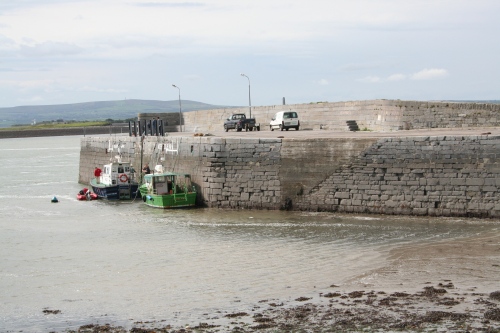
Kilteery

The current header photo shows Kilteery Pier on the Shannon Estuary. Here is a page about the building of the pier.

What Éanna Rowe might say

In the minor arrangements made by us, and the rates fixed for small boats, we have been influenced by the same general principles already mentioned, and have been guided by the further principle of making every class of traffic or boat, however small, liable to some rate of toll, in order to establish a useful and beneficial control over the navigation.

Second Report of the Commissioners for improving the Navigation of the Shannon; with an appendix Ordered, by The House of Commons, to be Printed, 26 February 1841 [88]

The Boundary of Jurisdiction

The Shannon Navigation Act of 1839 required the Shannon Commissioners to define the boundaries of the navigation. They did so, describing the limits in a manuscript with illustrations and showing the Shannon and all structures therein in a series of 45 maps. Here is a brief piece about the undertaking.

Shannon water levels

According to the Indo, which may or may not know anything about the matter itself but probably got a press release from someone [to whom the same qualification may apply], farmers along the Shannon Callows are concerned about rising water levels at Clonown, an area on the west bank below Athlone.

The level in that area is held up by the weir at Meelick. But according to Waterways Ireland today,

[…]  low water levels exist on the upstream approaches to Meelick and Victoria Lock. Water levels are currently below Summer levels.

According to the OPW gauges at Athlone, the water level is below the 50th percentile and is falling. The same applies at Banagher, although it did exceed the 50th percentile for some days.

Three lessons suggest themselves:

  • farmers might need to get used to the idea that, when it rains, it gets wet — and that, if they choose to farm on a floodplain, their land might get wet too
  • politicians might refrain from issuing nonsensical panic-laden press releases to gain free publicity [but I suppose that’s too much to ask for]
  • journalists might like to check stuff for themselves instead of reprinting press releases unquestioningly [but that too is probably too much to ask for].

Limerick Navigation lockkeepers

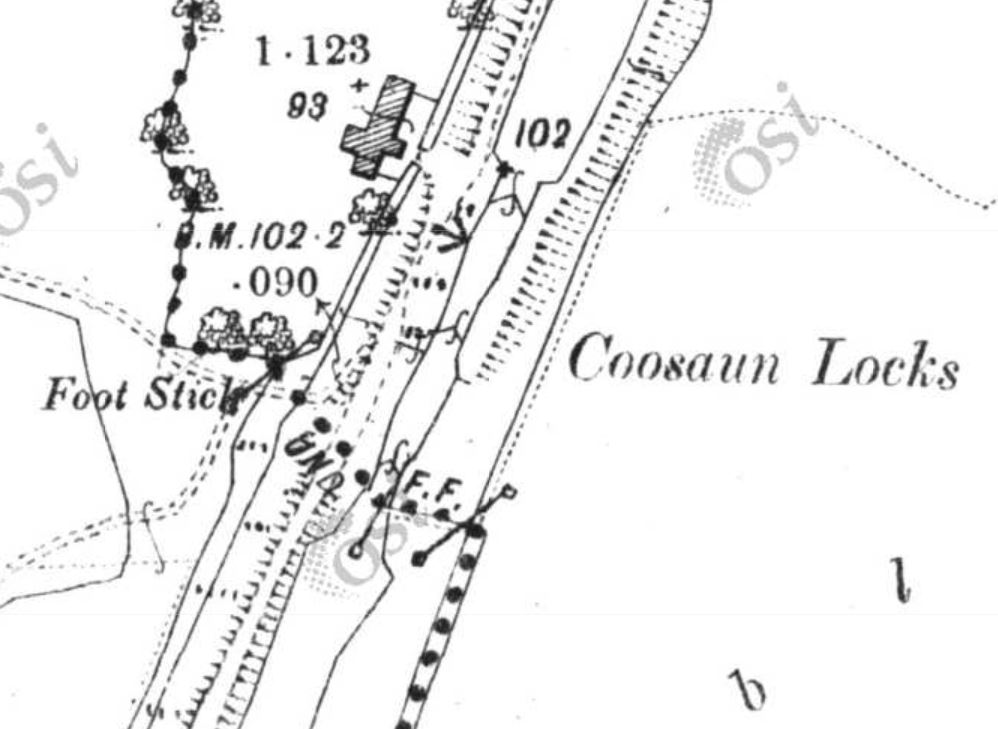
The Limerick Navigation was in five sections — three canals with river sections in between — and joined Limerick to Killaloe and the rest of the inland Shannon. The canal sections had locks, each controlled by a lockkeeper who lived on site. The job passed from generation to generation: some of the lockkeepers’ cottages are still inhabited by descendants of the lockkeepers.

Cussane lock (OSI 25″ ~1900)

Cussane was the furthest downstream of the three locks on the Killaloe section of the canal. It was covered by water when the Ardnacrusha hydroelectric scheme created the “flooded area” below Killaloe. If memory serves, Cussane was known as Crowe’s Lock.

In the online searchable catalogue of the Registered Papers of the Chief Secretary’s Office in the National Archives, there is a letter dated 15 February 1830 [CSO/RP/1830/815]

[…] from James Saurin, Henry R Paine, and John Radcliffe, [Directors General of Inland Navigation], Board of Control, [Dublin], to Hugh Percy, 3rd Duke Northumberland, [Lord Lieutenant of Ireland, Dublin], recommending Denis Crow to succeed Lott Corboy sheriff as lockkeeper on the Limerick Navigation.]

There is also a letter dated 2 June 1830 [CSO/RP/1830/836]

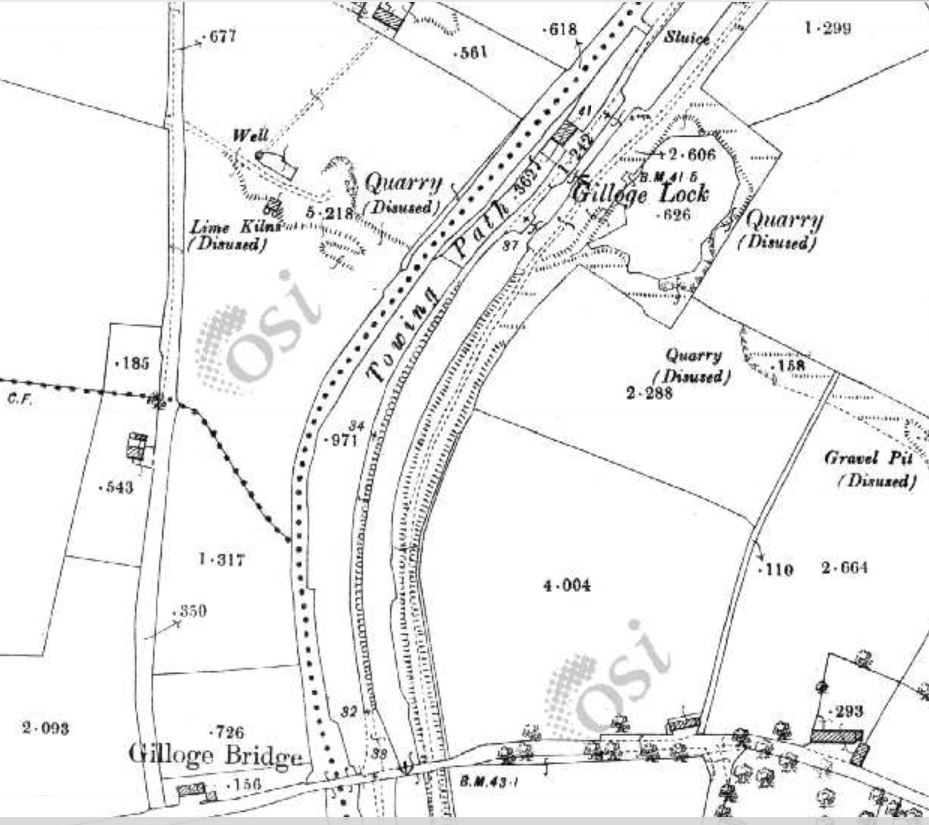
from James Saurin, J Armit, and Henry R Paine, [Directors General of Inland Navigation], Navigation Office, [Dublin], to Hugh Percy, 3rd Duke Northumberland, [Lord Lieutenant of Ireland, Dublin], recommending dismissal of Simon Johnston, lockkeeper on the Limerick Navigation, for irregularities and for deception; asking to employ Michael Gully in his stead, for Stg£9-4-9 per annum.

Gully’s Lock is at Gillogue, on the central canal section known as the Plassey–Errina Canal.

Gillogue lock (OSI 25″ ~1900)