
-

Waterways and Means by Brian J Goggin available now -
Join 584 other subscribers
RSS links
Pages
- Waterways & past uses
- Saving the nation
- Turf and bog navigations
- The Bog of Allen from the Grand Canal in 1835
- John’s Canal, Castleconnell
- The Canal at the World’s End
- The Finnery River navigation
- The Lough Boora Feeder
- The Little Brosna
- The Lullymore canal as wasn’t
- The Roscrea canals
- The Monivea navigations
- Lacy’s Canal
- The Rockville Navigation page 1
- The Rockville Navigation page 2
- The Rockville Navigation page 3
- Rockingham
- The Colthurst canals
- The Inny navigation
- The lower Shannon
- The piers, quays and harbours of the Shannon Estuary
- Nimmo’s non-existent harbour
- The Doonbeg Ship Canal
- Querrin
- Kilrush and its sector lock
- The Killimer to Tarbert ferry
- The Colleen Bawn at Killimer
- Knock knock. Who’s there?
- Cahircon: not at all boring
- Ringmoylan
- The hidden quay of Latoon
- The stones of Kilteery
- The Maigue
- Sitting on the dock of the Beagh
- Massy’s Quay, Askeaton and the River Deel
- Saleen Pier
- The Lord Lieutenant’s Visit to Limerick — trip down the Shannon [1856]
- The Fergus
- The Limerick Navigation
- The boundaries of the Shannon
- The power of the Shannon
- The locks on the Limerick Navigation
- Plassey
- Worldsend, Castleconnell, Co Limerick
- The bridge at O’Briensbridge
- The Limerick Navigation and the Monmouthshire Canal
- The Limerick Navigation (upper end) in flood November 2009
- The Limerick Navigation (lower end) in flood November 2009
- The Limerick Navigation (tidal section) in flood November 2009
- Floods in Limerick (1850)
- Limerick to Athlone
- The piers, quays and harbours of the Shannon Estuary
- The middle and upper Shannon
- The Grand Canal
- Monasterevan, the Venice of the west
- The Grand Canal lottery
- Grand Canal carrying: some notes
- The dry dock at Sallins
- The Naas Branch
- The Mountmellick Line of the Grand Canal
- Dublin to Ballinasloe by canal
- The Ballinasloe Line
- A Grand Canal lock: Belmont
- South of Moscow, north of Geneva
- Water supply to the Grand Canal
- The Grand Canal Company strike of 1890
- The Royal Canal
- Water supply to the Royal Canal: the feeders
- The Lough Owel feeder
- The proposed Lough Ennell water supply to the Royal Canal
- From Clonsilla to Clew Bay
- Kinnegad and the Royal Canal
- The sinking of the Longford in 1845
- Steamers on the Royal Canal
- Leech of Killucan: horse-drawn boats on the Royal
- Horses on board
- Royal eggs
- Prothero on the Royal
- The whore who held the mortgage on the Royal Canal
- Waterways in Dublin
- The Naller
- Visit Dublin. Walk canals. Drink beer.
- The Broadstone Line of the Royal Canal
- Effin Bridge: its predecessors
- Between the waters
- The abandoned Main Line of the Grand Canal 1
- The abandoned Main Line of the Grand Canal 2
- The abandoned Main Line of the Grand Canal 3
- The abandoned Main Line of the Grand Canal 4
- Waterways of the south-east
- Waterways of Cork and Kerry
- Waterways of the west
- Waterways of Ulster and thereabouts
- People
- Systems & artefacts
- Irish waterways furniture
- Irish waterways operations
- Miscellaneous articles
- Irish inland waterways vessels
- Cots -v- barges: defining Irish waterways
- Waterways Ireland workboats
- Wooden boats on Irish inland waterways
- Traditional boats and replicas
- Non-WI workboats
- Older Irish working boats
- The barge at Plassey
- Dublin, Athlone and Limerick
- Waterford to New Ross by steam
- The steamer Cupid
- Liffey barges 1832
- Steam on the Grand Canal
- The Mystery of the Sunken Barge
- Steam on the Newry Canal
- Guinness Liffey barges 1902
- Up and under: PS Garryowen in 1840
- Watson’s Double Canal Boat
- The Cammoge ferry-boat
- The ’98 barge
- Late C19 Grand Canal Company trade boats
- Chain haulage
- Ballymurtagh
- The Aaron Manby and the Shannon
- A sunken boat in the Shannon
- Sailing boats on Irish inland waterways
- Some boats that are … different
- Square sail
- 4B mooring
- Irish waterways scenery
- Engineering and construction
- Irish navigation authorities
- Opinion
- The folly of restoration
- The Ulster Canal now
- The Ulster Canal 00: overview
- The Ulster Canal 01: background
- The Ulster Canal 02: the southern strategic priority
- The Ulster Canal 03: implementation
- The Ulster Canal 04: Ulster says no
- The Ulster Canal 05: studies and appraisals
- The Ulster Canal 06: the costs
- The Ulster Canal 07: the supposed benefits
- The Ulster Canal 08: the funding
- The Ulster Canal 09: affordability
- The Ulster Canal 10: kill it now
- The Ulster Canal 11: some information from Waterways Ireland (and the budget)
- The Ulster Canal 12: departmental bullshit
- The Ulster Canal 13: an investment opportunity?
- The Ulster Canal 14: my search for truth
- The Ulster Canal 15: spinning in the grave
- The Ulster Canal 16: looking for a stake
- The Ulster Canal 17: the official position in November 2011
- The Ulster Canal 18: Sinn Féin’s canal?
- The Ulster Canal 19: update to February 2012
- The Ulster Canal 20: update to April 2013
- The Ulster Canal 21: update to August 2018
- The Barrow
- A bonfire at Collins Barracks
- Living on the canals
- Waterways tourism
- Guano
- The Park Canal: why it should not be restored
- The Park Canal 01: it says in the papers
- The Park Canal 02: local government
- The Park Canal 03: sinking the waterbus
- The Park Canal 04: the Limerick weir
- The Park Canal 05: cruisers from the Royal Canal
- The Park Canal 06: What is to be done? (V I Lenin)
- The Park Canal 07: another, er, exciting proposal
- Accounting for risk
- Tax-dodging boat-owners
- Rail
- Waterways & past uses
Blogroll
boats
- Canal steamers [UK]
- Chris Deuchar's boating page
- Douglas Self retrotech and steam
- Grace's Guide: British Industrial History
- Heritage Boat Association
- Historic Inland Working Boats
- Irish maritime history
- irish shipwrecks database
- Kilrush & District Historical Society
- Lough Corrib charts and scans
- Railway and Canal Historical Society
Book sales
Industrial heritage
Inland waterways
Ireland
Overseas
Seafaring
Sources
Category Archives: Sources
Marked fuel
The European Commission is taking the UK government to court because it
… does not require fuel distributors to have two separate fuel tanks to distinguish between the lower tax marked fuel and the fuel subject to the standard rate.
As a result, owners of pleasure craft sometimes (poor dears) find themselves with no choice but to buy red diesel and they may not pay the right amount of tax, which is no doubt a cause of great sadness to them.
As I (and the Irish Examiner) reported some time ago, the Commission is also coming after Ireland’s ludicrous arrangement. Ireland was to respond to the Reasoned Opinion by 16 June 2014; the Revenue Commissioners have not told me how (or indeed whether) they responded.
Posted in Economic activities, Extant waterways, Foreign parts, Ireland, Irish inland waterways vessels, Non-waterway, Operations, People, Politics, Sea, Sources, Tourism, Water sports activities, waterways, Waterways management
Tagged boats, European Commission, green diesel, Ireland, marked gas oil, mineral oil tax, Operations, red diesel, UK, waterways
Tullamore in 1947
T W Freeman “Tullamore and its environs, Co Offaly” in Irish Geography (Bulletin of the Geographical Society of Ireland) Vol 1 No 5 1948 (based on material collected in 1947):
The original geographical advantage lay in the canal, which placed it on the main line from Dublin to Limerick around 1800, but canal traffic, though still important, is no longer crucial.
However …
Social activities in Tullamore include a wide range of clubs for athletics, dances, bridge, a modern cinema, and the occasional extra shows and matches that mean so much to the people of a country town and its surroundings. On the athletic side the new swimming pool is the most attractive recent addition (but no mixed bathing) ….
Posted in Ashore, Built heritage, Canals, Economic activities, Engineering and construction, Extant waterways, Industrial heritage, Ireland, Operations, People, Politics, Sources, Water sports activities, waterways
Tagged Dublin, Grand Canal, Ireland, Limerick, mixed bathing, Operations, swimming pool, Tullamore, waterways
The best-value CEO
Mary Lou McDonald [SF, Dublin Central] asked Jimmy Deenihan [FG, Kerry North/West Limerick], before his departure from the waterways (and other stuff) department,
… if he will provide in tabular form a list of the annual salaries of the chief executive officers of all non-commercial State sponsored bodies under his remit.
Which he did; you can see it here.
I thought it might be interesting to see how the salaries of the CEOs relate to the numbers of staff and the budgets they control. It’s not easy to compare them. The salary figures are presumably current; the various bodies offer, on their websites, accounts for years ending anywhere from 31 December 2011 to [well done, the National Concert Hall] 31 December 2013. In some cases I could find no proper accounts, but at least the Crawford Art Gallery gave a figure for its income, which is more than the Chester Beatty Library did [as far as I could see].
There were several other minor difficulties, but the big problem is that some bodies distribute grants to others, so their business is processing money: as a result, their income (usually from, or mostly from, the state) is higher than it would be for non-grant-distributing bodies. I have made no attempt to allow for that.
To make comparisons easier, I divided the number of staff in each body by the CEO’s salary (converted to euro where necessary) and multiplied the result by 1000 to remove leading zeroes. That tells you how many employees you get managed for each euro of CEO salary. Waterways Ireland is by far the biggest organisation, but has the second-lowest CEO salary.
Similarly, I divided the organisation’s income by the CEO’s salary to provide a crude measure of how much activity you get for each euro of CEO salary. Bodies dispensing grants look better than they otherwise might using this measure.
This is then a very crude comparison, with many caveats, but I think that Dawn Livingstone of Waterways Ireland is the best-value CEO of those running bodies under the aegis of the Department of Arts, Heritage and the Gaeltacht.
| Organisation | Staff | Budget (m) | CEO salary | Staff X 1000/salary | Budget/salary |
| Arts Council | 48[1] | €63.9[2] | €85,750 | 0.56 | 745.19 |
| Chester Beatty Library | 37[3] | ?[4] | €90,591 | 0.41 | ? |
| Crawford Art Gallery | 15 | €1.1[5] | €72,124 | 0.21 | 15.25 |
| Foras na Gaeilge | 64[6] | €21.5[7] | €113,429 | 0.56 | 189.55 |
| Heritage Council | 18[8] | €7.8[9] | €113,123 | 0.16 | 68.95 |
| Irish Film Board | 15[10] | €20.2[11] | €97,981 | 0.15 | 206.16 |
| Irish Museum of Modern Art | 83[12] | €8.3[13] | €85,720 | 0.97 | 96.83 |
| National Concert Hall | 103[14] | €4.6[15] | €101,056 | 1.02 | 45.52 |
| National Gallery of Ireland | 117[16] | €9.5[17] | €93,297 | 1.25 | 101.83 |
| National Library of Ireland | 93[18] | €9.5[19] | €81,080 | 1.15 | 117.17 |
| National Museum of Ireland | 176[20] | €17.6[21] | €96,148 | 1.83 | 183.05 |
| Údarás na Gaeltachta | 86[22] | €40.2[23] | €126,200 | 0.68 | 318.54 |
| Ulster-Scots Agency | 20[24] | €3.4[25] | €61,997[26] | 0.32 | 54.81 |
| Waterways Ireland | 328[27] | €41.0[28] | €77,071[29] | 4.26 | 531.98 |
I’m sorry the table spreads so far to the right; I can’t work out how to narrow the column widths.
[1] 41 full time and 7 part time WTEs, according to note 2c to accounts in Arts Council Annual Report 2012
[2] Total income y/e 31 December 2012 from Arts Council Annual Report 2012. €56.6m was dispensed to other bodies in grants
[3] Excluding volunteers and vacant posts shown in the Staff List in Report of the Trustees Chester Beatty Library 2012
[4] The annual report for 2012 available here http://www.cbl.ie/About-Us/The-Chester-Beatty-Library/Reports.aspx does not include accounts. There is a one-page balance sheet, without the associated notes, from which I am unable to form any idea of the cost of the institution
[5] I am unable to find any accounts on the Crawford Art Gallery’s website http://www.crawfordartgallery.ie/aboutus1.html. Its Annual report 2011, the most recent available, says “The Department of Arts, Sport and Tourism pay allocation to the Gallery for 2011 was €475,000, while the non-pay allocation was €600,000. The capital allocation for 2011 was €275,000.” I have used the (rounded) sum of the first two figures
[6] Staff Costs and Board Remuneration in Foras na Gaeilge section of The North/South Language Body Annual Report and Accounts for 2011
[7] Total income y/e 31 December 2011 from Foras na Gaeilge section of The North/South Language Body Annual Report and Accounts for 2011
[8] Heritage Council website www.heritagecouncil.ie
[9] Total income y/e 31 December 2013 from Heritage Council Annual Report for 2012
[10] Note 6 to accounts in Annual Report 2011
[11] Sum of total income figures from Capital Income and Expenditure Account and Administration Income and Expenditure Account y/e 31 December 2011 in Annual Report 2011
[12] Note 9 to accounts in Irish Museum of Modern Art Annual Report 2011
[13] Total income y/e 31 December 2011 from Irish Museum of Modern Art Annual Report 2011
[14] Note 2 to accounts in National Concert Hall Annual Report 2013
[15] Gross income y/e 31 December 2013 from National Concert Hall Annual Report 2013
[16] Note 7 to accounts in National Gallery of Ireland Annual Report 2012
[17] Total income y/e 31 December 2012 from National Gallery of Ireland Annual Report 2012
[18] Rounded. From Human resource management and development in National Library of Ireland Annual Report 2011
[19] Total income y/e 31 December 2011 from National Library of Ireland Annual Report 2011
[20] Note 13 to accounts in The National Museum of Ireland Financial Statements for 2011
[21] Total income y/e 31 December 2011 from The National Museum of Ireland Financial Statements for 2011
[22] Údarás na Gaeltachta Annual Report and Accounts 2012
[23] Total income y/e 31 December 2012 from Údarás na Gaeltachta Annual Report and Accounts 2012
[24] Staff Costs and Board Members in Tha Boord O Ulster-Scotch section of The North/South Language Body Annual Report and Accounts for 2011
[25] Total income y/e 31 December 2011 from Tha Boord O Ulster-Scotch section of The North/South Language Body Annual Report and Accounts for 2011
[26] £49,244
[27] Excluding student placements and temporary and agency staff (total 19). Note 4 to accounts in Waterways Ireland Annual Report and Accounts 2012
[28] Total income y/e 31 December 2013 from Waterways Ireland Annual Report and Accounts 2012
Posted in Built heritage, Economic activities, Engineering and construction, Foreign parts, Ireland, Operations, People, Politics, Sources, Waterways management
Tagged budget, comparison, Dawn Livingstone, department of arts heritage and the gaeltacht, Dublin, income, Ireland, Operations, salary, staff, Waterways Ireland
Temps
Waterways Ireland has no staff on temporary contracts but has 32 on seasonal contracts.
Posted in Economic activities, Engineering and construction, Extant waterways, Foreign parts, Ireland, Irish waterways general, Operations, People, Politics, Safety, Shannon, Sources, Tourism, Water sports activities, waterways, Waterways management
Tagged department of arts heritage and the gaeltacht, employees, Ireland, Operations, seasonal, staff, temporary, Waterways Ireland
Shannon traffic figures for June
I am grateful to Waterways Ireland for letting me have the Shannon traffic figures for June 2014. All the usual caveats apply:
- the underlying figures do not record total waterways usage (even for the Shannon) as, for instance, sailing, fishing or waterskiing on lakes or river stretches, which did not involve a passage through a lock or Portumna Bridge, would not be recorded
- the passage records would not show, for instance, a change in the balance of types of activities from those in larger cruising boats to those in smaller (sailing, fishing, waterskiing) boats
- figures like these, for a small number of months, will not necessarily be representative of those for the year as a whole. The winter months, January to March, see little traffic in any year; for April, May and June, the weather can have a large influence on the amount of activity especially, I suspect, in private boats.
On the other hand, the figures do include the Shannon’s most significant tourism activity, the cruiser hire business. And they are our only consistent long-term indicator of usage of the inland waterways.
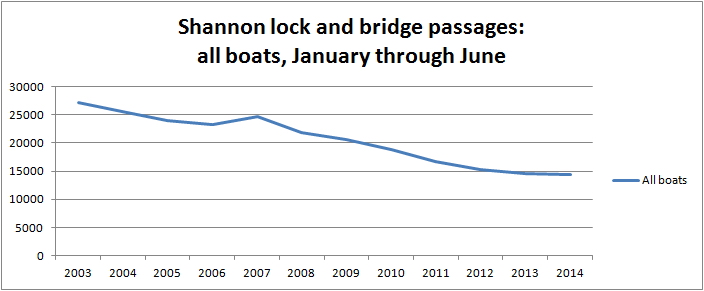
Total (private + hired) traffic for the first six months of each year
Total traffic is down again, but only slightly. The decline does seem to be levelling off and a continuation of the relatively good weather could increase usage.
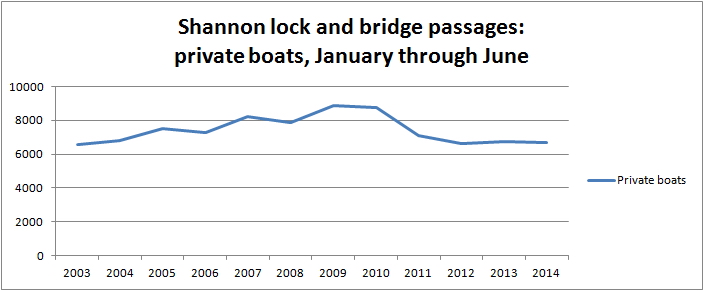
Private-boat traffic for the first six months of each year
Private traffic is down slightly on last year, but it has been pretty much the same for three years. I had thought that the good weather might have caused something of an increase, but on the other hand my own impression of Lough Derg traffic (not reflected in the passage figures) is that it has been fairly light.
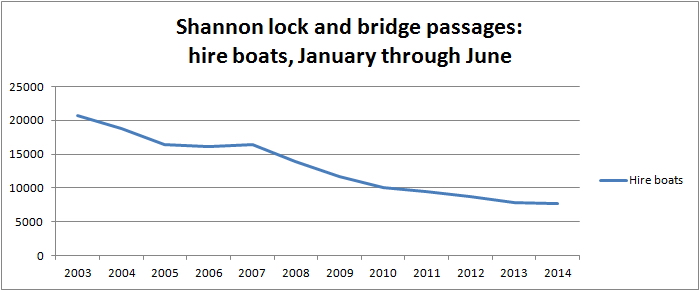
Hire-boat traffic for the first six months of each year
For hire-boat traffic, there is no sign of an upturn, although the drop on last year’s figures is not very large.
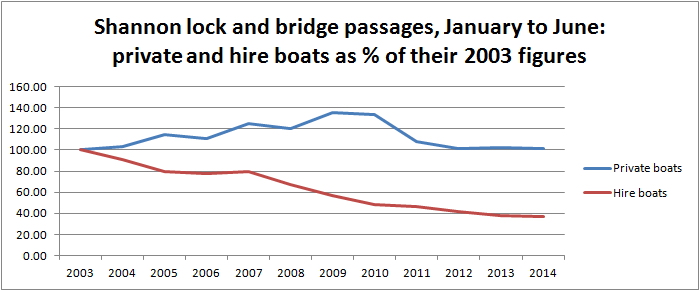
Changes since 2003: private and hired boats
That table amalgamates the two before it, but shows the figures as percentages of the 2003 figures. For private boats, the Celtic Tiger (nach maireann) caused an increase; that effect has worn off and usage has not changed much since about 2011. For hired boats, the decline began long before the Celtic Tiger idiocy.
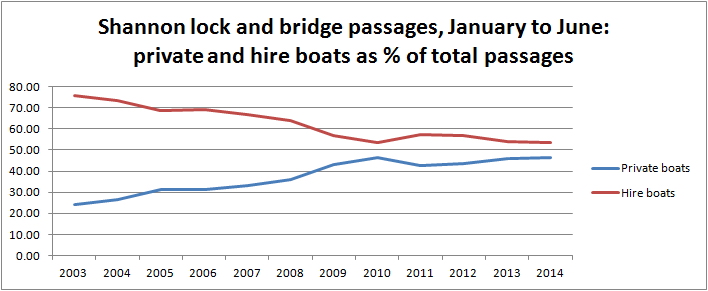
From 75/25 to 50/50
Hired boats were once the major users; private boats have almost caught up.
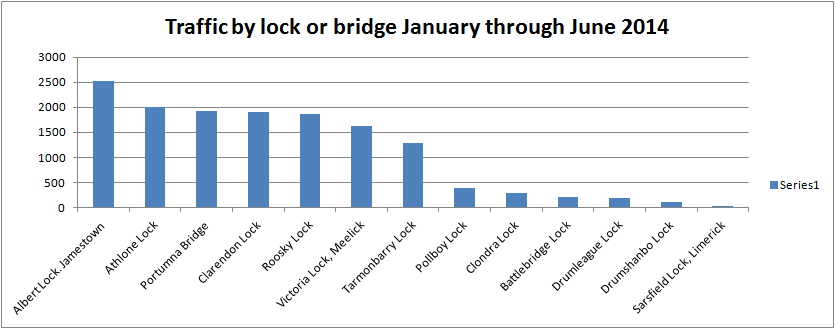
How to save money
I don’t know how much the various locks cost to run, so I can’t work out any measure of value for money, but the sea lock in Limerick and the Lough Allen Canal must surely be candidates for the chop.
Posted in Built heritage, Canals, Economic activities, Engineering and construction, Extant waterways, Ireland, Irish inland waterways vessels, Operations, People, Politics, Restoration and rebuilding, Scenery, Shannon, shannon estuary, Sources, Tourism, Uncategorized, waterways, Waterways management, Weather
Tagged boats, bridge, canal, Ireland, Limerick, lock, Lough Derg, Operations, Shannon, Shannon traffic, vessels, waterways, Waterways Ireland
 Irish waterways history