Category Archives: Sources

WI and the canals

Three important documents [all PDFs] available for download from WI’s site:

  • Action Plan for Grand Canal Dock and Spencer Dock​ here
  • Grand Canal (rural) Product Development Study here
  • Royal Canal (rural) Product Development Study here.

These are lengthy documents [50, 177 and 175 pages respectively] and it will be some time before I can comment on them, but I welcome their publication. I also hope to be able to comment on the presentation Ireland’s Inland Waterways – Building a Tourism Destination which WI made to the recent meeting of the NSMC; I’m told it’s on its way to me but it hasn’t arrived yet.


Waterways [and other] archives

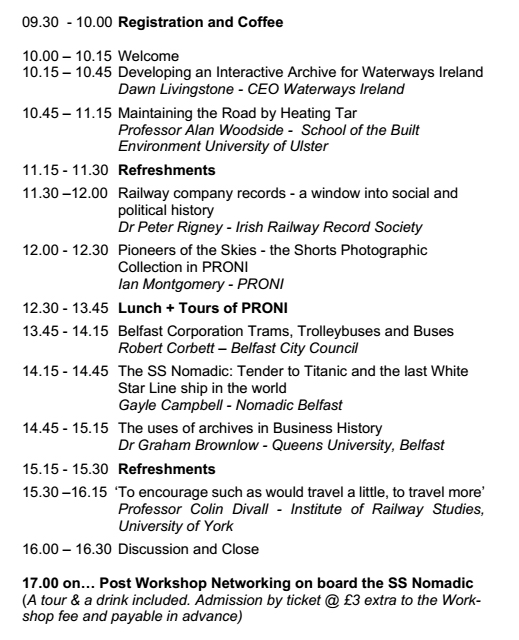
For anyone interested in transport history, there is an interesting-looking workshop scheduled for Belfast on 8 September 2014. It’s being held in the Public Record Office of Northern Ireland [PRONI] in the Titanic Quarter and there’s an optional extra tour and reception on the SS Nomadic afterwards.

The programme covers waterways, roads, railways and flight. For this site, the opening session is of great interest: Dawn Livingstone, CEO of Waterways Ireland, is to talk about an interactive archive for Waterways Ireland.

By air, sea and land

By air, sea and land

The workshop is being organised for PRONI by A²SN, the Archives and Artefacts Study Network, supported by the Historical Model Railway Society, the Business Archives Council and the Postal History Society.

The [two-page PDF] brochure is downloadable here PRONI transport archives workshop. The workshop fee is £20/€25 with an extra £3/€3.50 for the SS Nomadic visit. Sterling cheques are accepted; there is provision for paying in euro by online banking.

While on the subject of archives, I might mention again the Archives & Records Association, Ireland branch, whose [freely downloadable PDF] newsletters often cover topics of interest, and their Learn About Archives site here.

Crossborderality and euroloot

I wrote here about last week’s NSMC meeting. I noted that the inland waterways meeting seemed to have transformed itself into an SEUPB [Euroloot] meeting: it is unusual for spending ministers to represent the government and executive on such occasions and it is also odd that the SEUPB did not have a meeting to itself, given that it is a separate body. I have asked the Department of Public Expenditure and Reform why spending ministers were allowed into the sweetshop unsupervised.

I now learn that this week there will be celebrations of the twentieth anniversary of the reopening of the Junction Canal in the Ballinamore and Ballyconnell Drainage District, now known as the Shannon–Erne Waterway. So watch for messages to the effect that cross-border waterways bring peace and prosperity … improved relationships in these islands … historic visit … peace in our time … as it happens, we have another sheugh up the road … how about it, Angela, another few quid for the other sheugh?


NSMC

The joint communiqué from last week’s North/South Ministerial Council Inland Waterways meeting is now available here. There was an exciting bit:

SECTORAL PRIORITIES

2. Ministers had a discussion on various priorities within their remit and noted that these will be contained in a report to be considered at a future NSMC Institutional meeting as part of the ongoing review into sectoral priorities.

Hmm … what’s cooking there? I do wonder why the NSMC bothers publishing content-free stuff like this. We may have to ask the US NSA to bug the meetings. Oh, hang on ….

Here’s a good bit, though:

PRESENTATION BY WATERWAYS IRELAND

3. Waterways Ireland delivered a presentation to Ministers entitled “Ireland’s Inland Waterways – Building a Tourism Destination”. The presentation provided an overview of the progress being made by Waterways Ireland in placing the waterways and the waterway experience at the centre of the tourism offering both in Ireland and internationally.

Now that is useful and important work. But, as I have pointed out elsewhere [including to Waterways Ireland], the WI draft Corporate Plan 2014–2016 said nothing about tourism. Some years ago, I thought that it was a mistake to have a Marketing & Communications Strategy and a Lakelands tourism initiative that seemed to exist outside the corporate planning process; I am still of the same mind.

I have asked Waterways Ireland for a copy of the presentation, and for a copy of the Strategic Development Plan for the Grand Canal Dock, Spencer Dock and Plot 8 that was mentioned in WI’s progress report. That report also covered:

  • continuing maintenance
  • public consultation on canal bye-laws
  • a Built Heritage Study and a GIS-based navigation guide for the Lower Bann
  • an environmental award for  work in restoring, protecting and promoting the heritage assets that are Spencer Dock and Grand Canal Dock
  • towpath development and work on the cycleway from Ashtown to Castleknock on the Royal
  • donating two barges for “recreational and community use”
  • “partnerships to utilise three unused navigation property for community and recreational use”, which I don’t know anything about.

The important part was this:

BUSINESS PLAN AND BUDGETS 2013 AND 2014 AND CORPORATE PLAN 2014-2016

5. Ministers noted the position with the 2013 Business Plan and budget. They also noted that Waterways Ireland has undertaken a public consultation on the draft Corporate Plan 2014-2016, the preparation of a draft 2014 Business Plan by Waterways Ireland and that the plans will be reviewed after the public consultation is analysed. They also noted that Sponsor Departments will continue to work together with Waterways Ireland to finalise the Business Plans and Budgets for 2014 and the Corporate Plans for 2014-2016 that will be brought forward for approval at a future NSMC meeting.

I read that as showing that the north-south deadlock continues. The 2012 accounts have still not been published and the plans for 2014 won’t be approved until (at the earliest) three quarters of the way through the year.

The NSMC heard something about the Clones Sheugh but has decided not to tell the citizenry anything about it. It agreed to some property disposals and decided to meet again in October. But there was one odd item:

SPECIAL EU PROGRAMMES BODY BUSINESS PLAN AND BUDGET 2014 AND CORPORATE PLAN 2014-16

8. Ministers approved the Special EU Programmes Body Business Plan and Budget 2014 and Corporate Plan 2014-16.

The oddity is that the SEUPB is a separate body and usually gets its own meeting and communiqué. The last six meetings (before this one) have been attended by NI folk from Finance & Personnel and RoI folk from Public Expenditure & Reform (or, before that, Finance).

So who let spending ministers into the sweetshop? And why? Suspicious-minded folk might think that there is a plan to  nick a lot of Euroloot for the Clones Sheugh to get the Irish government off the hook persuade the Europeans of the benefits of investing in the reconstruction of a small portion of the Ulster Canal. We note that, on the previous day, Jimmy Deenihan gave a longer than usual reply to the standard question about the Sheugh, including this:

The Inter-Agency Group has met four times, last meeting on 9 December 2013. The Group continues to examine leveraged funding opportunities for the project. This includes the exploration of EU funding which may be potentially available in the next round of structural funds covering the period 2014–2020.

I have a better idea. Vladimir? There are oppressed Russians in Clones ….



Closing the Shannon in winter

I pointed out some time ago that, in the Dáil on 16 October 2013, Jimmy Deenihan said:

The [budgetary] provision will enable Waterways Ireland to deliver on its core activities and targets, which include keeping the waterways open for navigation during the main boating season and promoting increased use of the waterways resource for recreational purposes.

That was the first time I noticed the suggestion that, in effect, boating in winter might be de-emphasised, as it were; the idea is followed up in the current draft of the Waterways Ireland Corporate Plan 2014–6. The proposal receives some support from the figures for Shannon traffic in the first three months of 2014.

I realise that, as the numbers are small, they can be affected by the high water levels, bad weather or the date of Easter, but those for 2014 are remarkably low. The totals for the first three months [Jan–Mar] since 2003 are:

2003  689
2004  536
2005 2229
2006  683
2007  825
2008 1449
2009  687
2010  567
2011  626
2012  736
2013  753
2014  260

All the usual caveats apply, notably that the figures do not capture boating that is confined to the lakes. Still, the 2014 figure is less than half the next lowest, and it’s the first time since 2003 that the figure has been below 500, 400 or 300.


Eels

An update here and, from across the water, here.

Important topics in Ireland 1845–1850

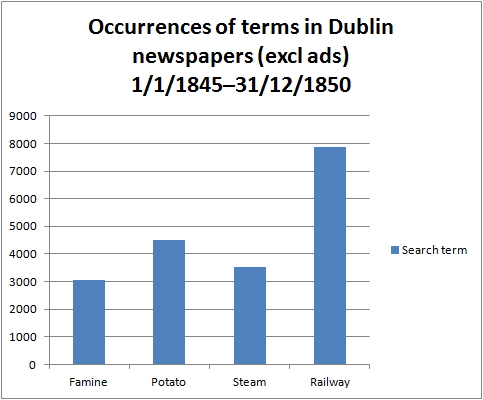
I thought it would be interesting to ask the British Newspaper Archive what people were reading about in newspapers published in Dublin between 1 January 1845 and 31 December 1850. The BNA has scans of two Dublin newspapers for that period, the Freeman’s Journal and the Dublin Evening Mail. I used the archive to search for four different words in those newspapers in that period; I then counted the numbers of results.

On the first round, I included ads and family notices.

Newspaper terms incl ads 1845–1850

Terms in Dublin newspapers (incl ads) 1845–1850

I guessed that the numbers for steam and railway might be exaggerated by their inclusion in ads so, on the second round, I excluded both ads and family notices. The result was as expected.

Newspaper terms excl ads 1845–1850

Terms in Dublin newspapers (excl ads) 1845–1850

I then asked Google’s Ngram machine to count the numbers of occurrences of four pairs of words between 1845 and 1850. I asked it to do a case-insentitive search, but it can’t do that for “compositions” (combinations of words), so it counted:

Ireland+potato
Ireland+steam
Ireland+famine
Ireland+railway.

Here is what it came up with, but whence I know not, other than that it searched the corpus English. The embedding process doesn’t seem to be working, so I’ve left the code here but also cut and pasted the output.

Google Ngram

Google Ngram

I suspect that, in recent times, the amount written about steam and railways of the period 1845–1850 in Ireland has been rather less than that about potatoes and the famine.


Splendid chaps, these arty types

I take it all back: I’ll never say another rude word about art gallery folk.

Well, not many, anyway.

The splendid folk at the National Gallery of Ireland have an online searchable archive that allows you to look at pics, download small watermarked versions and buy larger versions if you would like to do so. And “searchable” doesn’t just mean searchable by artist or type of paint or whatever it is: you can put in important terms like “steamer” and “shannon” and “canal”.

Admittedly you don’t get much back: two steamers, none of interest on this site, nothing about the Shannon and twelve canal scenes, only two of which are in Ireland. One of them, though, is very interesting indeed, and you can see it if you use

P4457

as your search term.

You should get an 1809 pic by one John Henry Campbell entitled “Ringsend and Irishtown from the Grand Canal, Dublin”, showing three wooden canal-boats, not particularly well moored, with their crews settling in (it appears) for the evening with fires lit and some with shelters rigged.

I can’t work out where they are, though. To get Ringsend lined up with Howth in quite that way, you’d have to be pretty close to the Grand Canal Docks, I’d have thought. Any guesses or deductions?


Carrick-on-Suir to Clonmel towing-path

Messrs RPS, consulting engineers, have been asked by South Tipperary County Council

… to design a minimal impact walking & cycling greenway route along the towpath of the River Suir between the towns of Clonmel and Carrick-on-Suir.

I have written about this stretch of the river here, so I was pleased to be asked to submit some comments and I welcomed the proposal. I made three suggestions, commenting more on principles than on details, which local people would know more about than I do.

First, I said that the heritage artefacts along the route should be protected and, if possible, explained. That might be done unobtrusively by making online information available to those equipped with smartphones. Such systems are used by the Canal & River Trust in Britain (here’s an example) and I understand that there have been experiments in using them on the Royal Canal here.

Second, I said that use by walkers requires more than a good trail: walkers also need safe parking places for their cars and information about public transport services that will return them to their starting-points. Car parks themselves need not be along the greenway but the information has to be provided there.

Third, there is scope for more use of the waterway itself, especially by canoes, kayaks and rafts, as well as by anglers. While such uses are (I imagine) outside RPS’s brief, I thought that it would be better to take account now of the needs of such users, and to ensure that the engineering would be able to cater for them in the future (I was not proposing that facilities necessarily be provided now), rather than to have to re-engineer the greenway later. My main concern was provision for enhanced access by rescue services, and Carrick-on-Suir River Rescue would probably be the best people to comment on that. I also suggested that a certain amount of unobtrusive hard edging along the towing-path might be of assisstance to boaters.

If you’ve looked at my page on this section of the Suir, you’ll know that it’s very scenic. Up to now, not all of the route has been accessible and making it so is a Good Thing — and at relatively low cost.


A sheugh would solve it …

… not.

If you’re feeling the need of something to depress you, troll on over to the website of the Northern Ireland Community Relations Council and download the six PDF sections of the third Peace Monitoring Report. Written by Dr Paul Nolan, it is an extremely impressive piece of work — and a welcome counter to the witterings of the peaceprocess feelgoodistas who are so prominent on 2RN these days.

If you would prefer a summary, here is Liam Clarke’s account in the Belfast Telegraph, and here is his commentary; Tomboktu and others pointed to some problems with the headline on the first piece, but I’m more concerned that the focus on education in the headline on Clarke’s account may distort perceptions of what the report and, indeed, the rest of Clarke’s article are really about.

The report uses indicators grouped into four domains:

  • the sense of safety
  • equality
  • cohesion and sharing
  • political progress.

I didn’t find much that was cheering in any of them. Nolan lists ten key points:

  1. The moral basis of the 1998 peace accord has evaporated
  2. The absence of trust has resulted in an absence of progress
  3. There has been some increase in polarisation
  4. A culture war is being talked into existence
  5. The City of Culture year presented a different understanding of culture
  6. Failure lies in wait for young working-class Protestant males
  7. Front line police have been the human shock absorbers for failures elsewhere
  8. The rebalancing of inequalities unbalances unionism
  9. At grassroots level the reconciliation impulse remains strong
  10. No one picks up the tab.

Only the fifth and ninth offer any good news. But, from a waterways perspective, I was struck by the complete irrelevance of the proposed reconstruction of the Ulster Canal, the Clones Sheugh, to solving any of these problems. Yet Waterways Ireland, around whose neck this dead albatross has been hung, is the largest of the cross-border bodies and the sheugh is the largest capital project proposed to be undertaken by any of them. If the Irish government wants to do something to solve the real and continuing problems of Northern Ireland, as outlined in the Peace Monitoring Report, couldn’t it find something more useful to do?

Incidentally, I have not been able to find coverage of the report on the websites of the Irish Times, Irish Independent or Irish Examiner, although that may reflect poor searching on my part rather than any lack of interest on theirs.