Category Archives: Sources

Sinn Féin sheughs again

Sinn Féin demonstrates its continuing commitment to the unification of Ireland reconstruction of the Clones Sheugh. KildareStreet tells us that Sandra McLellan, TD for Cork East, no doubt motivated by the wealth of waterways in her own area, asked a written question on 18 July 2013:

To ask the Minister for Arts, Heritage and the Gaeltacht the position regarding the Ulster Canal restoration project; the remaining steps that must be taken to complete the project; if he will provide an indicative timeline for the completion of the project; and if he will make a statement on the matter.

She got a more or less standard answer from the minister, Jimmy Deenihan [FG, Kerry North/West Limerick]:

As the Deputy will be aware, in July 2007, the North/South Ministerial Council (NSMC) agreed to proceed with the restoration of the section of the Ulster Canal between Clones and Upper Lough Erne. The then Government agreed to cover the full capital costs of the project, which were estimated at that time to be of the order of €35m.

It was always the intention that the Ulster Canal project would be funded from the Waterways Ireland annual allocations, as agreed through the annual estimates processes in this jurisdiction, as well as the deliberations of NSMC in relation to annual budgets. It was a key consideration throughout the process that the Ulster Canal project would be supported by a significant level of projected income from the commercialisation of certain Waterways Ireland assets. However, as the Deputy will be aware, the economic downturn has had a negative impact on those plans.

In the meantime, the Ulster Canal project is progressing on an incremental basis. Planning approvals have recently been secured for the project in both jurisdictions. I welcome these developments, which, I am sure the Deputy will agree, are a significant milestone for the project.

I am continuing to explore all possible options to advance this project within the current fiscal constraints. In this regard, an Inter-Agency Group on the Ulster Canal has been established to explore and examine ways to advance the project and to examine possible funding options for it, including existing funding streams and the leveraging of funding from other sources, including EU funding options.

Isn’t it funny? Every so often the shinners ask a question to remind the minister that they, er, haven’t gone away, you know. They don’t get really aggressive about it and they don’t seem to be organising mass rallies in Clones to demand a sheugh. And the minister is equally polite, saying in effect “we haven’t shot your horse”.

This project is not very important: it’s a waste of money and will be of no benefit to the national economy, and a government seeking savings could easily kill it off. Yet it has refused, over several years, to take that obvious step. Instead, it’s devoting departmental time, and that of other public servants, to (admittedly low-cost) measures that seem to be intended to show that the project will be maintained on life support, even if it never rises from its bed.

Is there something in the St Andrew’s Agreement, or some other bit of northsouthery, that promises a sheugh to Sinn Féin, to enable them to claim credit for some high-profile but non-threatening all-Irelandism? Is the Clones Sheugh the price of SF support for the Police Service of Northern Ireland? I don’t know, but there must be some explanation for the failure to kill off the sheugh.
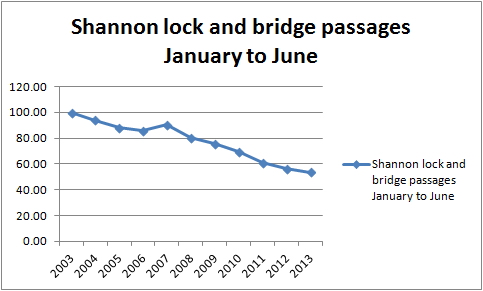
 

Shannon traffic to June 2013

The figures for Shannon lock passages to the end of June 2013 are now available. The decline continues, though perhaps more slowly.

Shannon traffic Jan to June percent

Shannon lock and bridge passages January to June as percentages of the 2003 number

The usual caveats apply: the underlying figures (kindly supplied by Waterways Ireland) do not record total waterways usage because, for instance, sailing, fishing or waterskiing on lakes or river stretches, which did not involve a passage through a lock or Portumna Bridge, would not be recorded. The passage records are our only consistent long-term indicator of usage of the Shannon but they would not show, for instance, a change in the balance of types of activities from those in larger cruising boats to those in smaller (sailing, fishing, waterskiing) boats. It is quite possible, therefore, that overall usage might be increasing while long-distance cruising was declining.

Shannon traffic Jan to June private

Shannon lock and bridge passages by private boats January to June

As it happens, the figures show a small increase over 2012 in passages by private boats. I suspect that July’s warm weather will spur a further increase.

Folk living in Ireland, whether owners or prospective hirers, are likely to be able to react quickly to better (or worse) weather by doing more (or less) boating; folk living abroad may be less able to change their holiday plans. Accordingly, July’s weather might (I’m speculating here) mean an increase in passages by private boats and by boats hired by Irish residents; it might not lead to an increase in hiring from abroad.

Traffic in hired boats continued to decline in June.

Shannon traffic Jan to June hire

Shannon lock and bridge passages by hired boats January to June

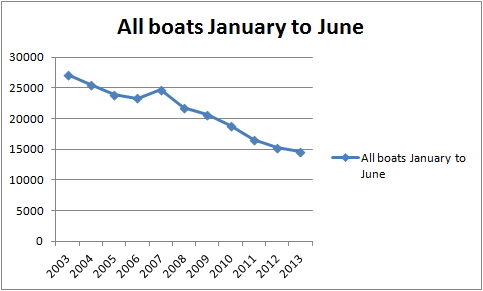
That decline outweighed the small increase in private traffic, leading to an overall decline in the first six months as compared with the same period in 2012, which itself continued the pattern set in 2007.

Shannon traffic Jan to June all

Shannon lock and bridge passages by all boats January to June

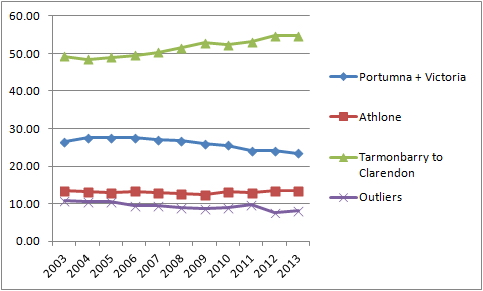
I wondered whether the figures might show any change in the geographical distribution of activity. WI’s reports don’t show separate figures for private and hired boats for the individual locks, but it seems to me that the hire business is becoming more concentrated on northern waters, from Lough Ree upwards. If that is so, then there might be an increase in the proportion of passages through the northern locks, from Tarmonbarry upwards, and a decrease in the proportion passing through Portumna Bridge and Meelick (Victoria) Lock.

I put the WI reporting stations in four groups:

  • Portumna + Meelick
  • Athlone
  • Tarmonbarry, Clondra, Roosky, Jamestown (Albert), Knockvicar (Clarendon)
  • the also-rans: the three locks leading to Lough Allen, Pollboy leading to Ballinasloe, the Limerick sea-lock (Sarsfield).

The figures suggest that the distribution is indeed changing, but gradually rather than dramatically. Athlone’s figures are pretty steady, the outliers are declining slightly and Portumna + Meelick are declining a bit more; the northern locks (Tarmonbarry to Knockvicar) are taking the gains. Comments or alternative interpretations welcome.

Change by region

Lock passages by group

The figures for 2013 are for the six months January to June; those for other years are for twelve months.

The locks could of course be grouped in other ways, and I may try some of them in future months.

Pumping algae

Do algae pass through pumps? I don’t know, but I ask because boating, bathing and animals have been banned in Lough Ennell where blue-green algae have been found. Lough Ennell is to supply water to the Royal Canal, although I presume it will take some time before it begins to do so. But perhaps, even if algae made it through the pumps, they would die in the Royal. If you know, Gentle Reader, do please leave a Comment below.

Waterproof wireless telegraphy

A couple of weeks ago I wrote about wireless telegraphy, concluding that:

At present, the rational decision for a boat-owner is to buy a cheap VHF without bothering to get either a certificate for the operator or a licence for the vessel. This is the rational decision because the official channels for getting certificates and licences are slow, expensive and cumbersome. It may therefore be — who knows? — that the populace has already decided to ignore the regulations.

For leisure boating within some sensible distance of the shore, I suggest that the current regulations be either drastically simplified or, perhaps better, scrapped altogether. That might mean giving the International Telecommunication Union a kick up the transom, but the present system is counterproductive: it seems to limit the use of handheld VHFs in cases where they could be very useful, if only to allow search and rescue volunteers to stand down earlier.

Two reports published today by the Marine Casualty Investigation Board have caused me to reconsider that conclusion.

In the Brownstown Head case [Report no MCIB/229; no 11 of 2013] [PDF], two occupants of a 16′ punt were thrown into the water when the boat capsized. They had a handheld VHF in the boat, but it sank when the boat capsized; one occupant put his mobile phone in his mouth to keep it above the water but it was knocked out. As a result, they were unable to summon assisstance. They eventually tried to swim to the shore, but only one made it; the other was drowned.

In the MacDara’s Island Currach case [Report no MCIB/215; no 10 of 2013] [PDF], a fisherman seems to have fallen overboard from a 6.15m open boat, in which he was alone. It was equipped with flares and a VHF in a watertight container, but as the report says:

5.6. There are unique problems with fishing operations from small open boats by lone fishermen. Once they become separated from their vessel their means of communicating their distress are on board their boat and not accessible to them.

In neither of these cases was the possession of a handheld VHF of any use. The VHF sets would have had to be (a) waterproof and (b) securely attached to the boaters’ lifejackets. The report on the MacDara’s Island Currach case recommends:

6.5. That the “Code of Practice for Fishing Vessels under 15 LOA” section 9.5 Radio Equipment should be amended by the addition of a requirement for undecked vessels where there is a lone occupant that an appropriate beacon should be of the type worn on the person.

In fact, the same recommendation could be applied to cases like Brownstown Head, where there were two people in the boat. That is broadly in line with the actions announced by two ministers on 8 July; note Simon Coveney also said:

I am also establishing a new high level working group on safety in the fishing industry, to look at all aspects of safety on fishing vessels and to report to Minister Varadkar and myself with recommendations before the end of the year. The new working group will be chaired by Mr John Leech current CEO of Irish Water Safety. Because a common thread of comment in recent times has been the need to pay particular attention on issues surrounding the number of small inshore boats that get into difficulty, I have charged the group with focussing to a large degree on this aspect.

So the wider use of handheld VHFs won’t solve every problem. I still think, though, that such wider use should be encouraged by the removal of unnecessary barriers.

Inland lifeboats to be exempt from VAT

Irish Water Safety has issued a press release [PDF] saying that the government is to introduce (or launch or make or pass or something) the Value-added tax (refund of tax) (rescue boats and related equipment) order 2013 which will allow inland community rescue boats to reclaim VAT on their purchases. Under the Value-Added Tax (Refund of Tax) (No 18) Order 1985, coastal community rescue boats have been able to reclaim VAT [PDF] but inland boats have not.

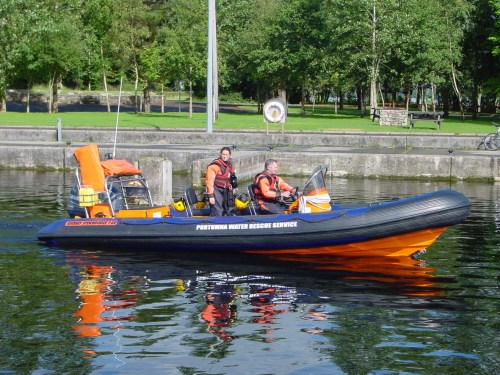
Portumna Water Rescue Service

Portumna Water Rescue Service

Irish Water Safety has a defined role in assessing the eligibility of community rescue boats for VAT exemptions; indeed its checklist and guidelines for community rescue services [PDF] are rather surprisingly headed Inspection for VAT Refund Certificate. The background is explained in another document Inshore Rescue Guidelines [PDF], which will presumably now be amended to include provision for inland boats. The “Declared Facility” boats [those approved and able to claim the VAT exemption] are listed here; there is also a list of other known rescue boats, some of which, being on inland waters, will now presumably apply to IWS for approval. Thus what is already a large rescue service will become even larger and more important.

I have photos of some of these boats on this page. I have none of the Corrib & Mask Rescue service, which I regret as today’s announcement was made on their turf and with their assistance. IWS says:

They will be the first Community Rescue Boat Ireland Lifeboat to be in a position to avail of this financial incentive.

Incidentally, I do not know whether the existing inland lifeboats operated by the Coast Guard and RNLI are affected by this or whether they could already reclaim VAT. If anyone can tell me, I’ll be glad to add the information here.

Dialogue

Some time ago I noted that Waterways Ireland was now down wid da kidz in da hood, doing groovy things like social meeja with a Youtube thingie. It features (inter alia) a flight in a helicopter gunship along a restored Clones Sheugh. At least, that’s what I presume was going on, although I couldn’t work out how to fire the rockets at the suspiciously large number of narrowboats found along the way. The scenic highlight of the journey was Clones.

There’s also a Facebook page, from which I learned that there is now a skippered boat available for hire on the Barrow. And there is a Twitter whatsit, which does two interesting things.

First, it has summaries of marine notices, which will be useful to those cruising on the waterways without internet access.

Second, it shows signs of WI’s engaging in public dialogue with users, even when their comments might be critical. This is very welcome; it will be interesting to see the extent to which such public dialogue is permitted to develop.


How low can you get?

Here’s a report from Hawthorn about Shannon water levels; here is a press statement from a political chap on the matter [PDF]; here is a post showing quite how important agriculture is to the Irish economy.

In brief: it isn’t. As Constantin Gurdgiev says:

[…] Irish agriculture is an extension of the welfare state, in so far as most of the value added in it is provided for by the subsidies.

Given that the sector as a whole includes the relatively small number of productive farms, the value of marginal farms may well be negative. Those occupying such land should be encouraged to abandon it and to take up some more productive activity elsewhere; Mongolia seems like a good bet. Activities designed to help the landlords to continue to pretend to be engaged in an economic activity are a waste of resources.

The decreasing importance of cruising

I wrote here about the continuing decline in the numbers of boats recorded as passing through locks (and moveable bridges) on the Shannon. For the first five months of the year, the total number of recorded passages was jusst over half what it was in 2003. Maybe the current hot weather will increase the numbers, but the long-term trend has been downward for ten years, despite a Celtic-Tiger-inspired spike in usage by private boats.

I don’t know to what extent that decline affects Waterways Ireland’s policy-making. Are the hundreds of economists, marketing gurus, MBAs and other high-powered bods in WI’s marketing department engaged in a major search for new and profitable markets? Certainly its sponsorship programme [can’t find info on the WI website], its lists of events and its descriptions of activities are much broader in scope than mere boating, and even within that category small-boat activities are prominent.

WI is cooperating with other official bodies in developing walking [h/t Industrial Heritage Ireland] and cycling routes [h/t KildareStreet] and. with the Irish Sports Council and Irish Leisure Consultants, it has recently published A Guide to Planning and Developing Small Vessel Water Trails in Ireland [PDF]. WI does not, as far as I know, have a strategy for promoting increasing use of its waterways by cruising boats (private or hired), although I’d be happy to be corrected about that if I’m wrong.

All of this is good stuff, and I’m all in favour of widening the, er, user base (apart from those events for which people dress in fluorescent underwear and run around the streets: I share the late Mrs Patrick Campbell’s concern for the horses).

But three points strike me. The first is that the older waterways businesses — hotel boats, hire firms, marinas — involved capital investment and created reasonable numbers of jobs. I do not know whether Waterways Ireland measures employment, or other economic benefits, as an output of its sponsorship, marketing and organisational activities but it seems to me that it would be nice if it were able to show that the benefits outweigh the costs. It would also be interesting to know to what extent the newer activities can profitably attract tourists from overseas: with the water trails, for instance, is it possible for anyone to make a profitable business out of overseas visitors, given the costs of marketing and selling, or are these trails purely for the domestic market?

The second point is that one sector, that of professional event organisers, may indeed be benefiting from WI’s support. But if that disempowers local or voluntary groups, renders them unable to run events without professional assistance or makes the cost of doing so too high, it may not be an unmixed blessing.

The third is that there is a representative body for owners of inland cruising boats, but these new activities do not have inland-waterway-specific user bodies (if they have user bodies at all). That, I think, must make for a different type of relationship between the service provider, Waterways Ireland, and the users: most inland cruiser owners have nowhere else to go, but canoeists or anglers or walkers can easily switch to the sea or to non-WI inland waters, so WI has to compete for their custom.

This piece is written not to provide answers but to ask some questions.


Lough Derg search: addenda

Some additional information from the Clare Champion and the Limerick Post. The Irish Mirror has one of the few accounts that includes discussions with participants.

More to come.

The Exchequer Bill Loan Commission

I noted the other day that the North South Ministerial Council’s inland waterways meeting discussed how it might get the Irish government off the hook of its rash promise to fund the Clones Sheugh. It noted that:

[…] sponsor departments have agreed to examine the potential social benefits and leveraged funding opportunities in that context.

The interesting point is that the blasted thing wonderful investment opportunity was originally funded, using the same excuse, by a loan from the Exchequer Bill Loan Commission set up under the Poor Employment Act 1817. John Strettell Brickwood, Secretary to the Exchequer Loan Commissioners for Public Works [sic], said* that the Commission’s first £1.5 million was allocated in 1817 and that by 1835 £5.5 million had been advanced.

Of that, £200,000 (at 3¼% interest) was allocated to Ireland in 1827 and the Ulster Canal was allocated £120,000 of that; it drew down £40,000 in 1833 and the same again in 1835. Mr Blackwood said that the Ulster Canal money was issued under an express act of parliament, leaving the commissioners no discretion. There would be no repayment until the canal was complete, with the interest and principal payable only from the prospective income.

Isn’t economic development wonderful?

First and Second Reports from the Select Committee appointed to inquire into the amount of advances made by the Commissioners of Public Works in Ireland with the Minutes of Evidence, Appendix and Index Ordered, by the House of Commons, to be Printed, 26 June and 27 August 1835