Category Archives: Steamers

Reading list

Waterways Ireland has been putting out more and more stuff on its website.

If you haven’t already seen them, you can get the full set of Product Development Studies, in PDF format, here.

Even more interesting, to this site, are the waterway heritage surveys. Those for all waterways other than the Shannon are available here. The Shannon study was done some years ago (I remember making some comments on it at the time) and will be uploaded “in due course”.

I was in a WI office yesterday and had a quick look at the Lower Bann survey, which was done by Fred Hamond (so we know it will be good), and I’m looking forward to learning more about the waterway I know least about. It is done thematically and has lots of illustrations: Fred is able to see and present the bigger picture, but a full database, with all the supporting information, is available on request.

Grace’s Guide and the Brunswick Dockyard

William Watson, of the City of Dublin Steam Packet Company, held patents for a double canal boat, capable of being shortened to pass through locks, and for a form of composite construction for boats, with iron ribs and wooden planking. I found recently that at least one composite boat was built for the CoDSPCo at the Brunswick boatyard in Ringsend, Dublin.

The invaluable Grace’s Guide had no entry for the Brunswick boatyard/dockyard but, when I mentioned the matter, undertook some research and produced a page about it. Grace’s and I would welcome any more information about that yard; as the Guide says:

The precise location of the dockyard has yet to be identified.

Pat Sweeney’s Liffey Ships and Shipbuilding (Mercier 2010) just mentions Henry Teal [sic]; Irish Maritime History’s list is light on early nineteenth century construction.

I would welcome information about other yards that might have built vessels for the CoDSPCo.


Composite construction on Irish inland waterways

I wrote here about Watson’s Double Canal Boat, saying inter alia that, in 1839, William Watson, manager of the inland department of the City of Dublin Steam Packet Company, patented:

an improvement in the construction of ships, and which improvement is also applicable to all kinds of sea-going vessels; and also certain improvements in the construction of boats and other vessels intended to be used on canals and inland navigations. [1]

I quoted the Mechanics’ Magazine of December 1839, which said that:

Three canal barges have already been built upon Mr Watson’s plan of construction, of 60 tons burthen each, and with eminent success.[2]

I said that the size suggested that these canal barges were for the CoDSPCo’s Irish inland operations, but that I had no information about where they were built.  I have now found information about one builder.

SHIP BUILDING

On Thursday, the 22nd instant, a fine new trade boat, built with iron ribs, according to the patent of William Watson, Esq., and belonging to the City of Dublin Steam company, also a new smack, 50 tons measurement, were launched from the Brunswick dock-yard, Ringsend Docks.[3]

I would be grateful for more information.


[1] “List of patents granted for Scotland from 18th March to 18th June 1839” in The Edinburgh New Philosophical Journal , exhibiting a view of the progressive discoveries and improvements in the sciences and the arts Vol XXVII No LIII — July 1839; “List of English patents granted between the 25th of May and the 25th of June, 1839” in The Mechanics’ Magazine No 829, Saturday, June 29, 1839

[2] The Mechanics’ Magazine Vol XXXII No 855 28 December 1839

[3] The Freeman’s Journal Saturday 24 July 1841. An almost identical note appeared in the Dublin Evening Mail of Monday 26 July 1841.

Ballylongford (and Inishmurray/Cahircon)

SHANNON-RIVER. This is by far the most considerable river in Ireland, or perhaps in any known island, not only on account of its rolling 200 miles, but also of its great depth in most places, and the gentleness of its current, by which it might be made exceedingly serviceable to the improvement of the country, the communication of its inhabitants, and consequently the promoting inland trade, through the greater part of its long course, being navigable to a considerable distance, with a few interruptions only of rocks and shallows, to avoid which there are in general small canals cut, to preserve and continue the navigation.

Thus Wm Wenman Seward, Esq [correspondent of Thomas Jefferson], in his Topographica Hibernica; or the topography of Ireland, antient and modern. Giving a complete view of the civil and ecclesiastical state of that kingdom, with its antiquities, natural curiosities, trade, manufactures, extent and population. Its counties, baronies, cities, boroughs, parliamentary representation and patronage; antient districts and their original proprietors. Post, market, and fair towns; bishopricks, ecclesiastical benefices, abbies, monasteries, castles, ruins, private-seats, and remarkable buildings. Mountains, rivers, lakes, mineral-springs, bays and harbours, with the latitude and longitude of the principal places, and their distances from the metropolis, and from each other. Historical anecdotes, and remarkable events. The whole alphabetically arranged and carefully collected. With an appendix, containing some additional places and remarks, and several useful tables printed by Alex Stewart, Dublin, 1795. [Google it if you want a copy.]

Seward was one of many people who saw the Shannon as a valuable resource, even if they were vague on how it was to yield a return. I was reminded of that on reading the Strategic Integrated Framework Plan for the Shannon Estuary 2013–2020: an inter-jurisdictional land and marine based framework to guide the future development and management of the Shannon Estuary. The Introduction includes this:

The Shannon Estuary is an immensely important asset and one of the most valuable natural resources in Ireland and the Mid-West Region in particular — the fringe lands and the marine area both provide space and location for development, activities and opportunities to progress economic, social and environmental growth within the Region.

This report is an attempt to show how the estuary could deliver a return. The core point seems to be that a small number of areas are designated as “Strategic Development Locations for marine related industry and large scale industrial development”, thus protecting them from the attentions of the environmentalists: the whole of the estuary is a Special Area of Conservation and a Special Protection Area.

Almost all the Strategic Development Locations are already industrialied in some way:

  • Limerick Docks (in Limerick city)
  • Ballylongford (of which more below)
  • Tarbert (power station)
  • Aughinish Island (alumina)
  • Askeaton (Nestlé)
  • Foynes Island and land to the rear of Foynes (main port on the estuary)
  • Moneypoint (power station).

There is one more, Inishmurry/Cahircon (which is not boring), which is even more interesting because there is no industry there at present. It was used as a resting place for certain vessels, but it was also proposed as the site for an explosives factory. Perhaps the designation as a Strategic Development Location suggests that that proposal is not dead but merely sleeping.

Ballylongford is equally lacking in industry, despite activity at Saleen in the early nineteenth century. However, Shannon Development assembled a large landbank nearby; the report’s Executive Summary says:

The Ballylongford Landbank benefits from a significant deepwater asset and extant permission for a major LNG bank.

Here is the area in question. Note that the red oval is just to indicate the rough location; it does not show the boundaries of the landbank.

Ballylongford (OSI ~1840)

Ballylongford (OSI ~1840)

You can see a proper map and a marked-up aerial photo in Volume 1 of the report [PDF] on page 73 (77/174).

Shannon Development agreed to give a purchase option on a little uder half of the site to Shannon LNG Ltd, which proposed to build a liquefied natural gas terminal there, to be supplied by ship; much information is available here.

The Commission for Energy Regulation decided to introduce charges that would have increased Shannon LNG’s costs; the company took the matter to court but, yesterday, lost its case. The Irish Times report here will probably disappear behind a paywall at some stage; the Irish Independent report is here and the Limerick Leader‘s here (its photo shows Tarbert and Moneypoint; the Ballylongford site is off to the left).

If the Ballylongford development does not proceed, plans for economic growth on the Shannon estuary may prove to be for the birds.

My OSI logo and permit number for website

Levels

On 9 October 2013 minister Brian Hayes spoke in the Dáil about Shannon water levels, saying:

A meeting between the ESB, Waterways Ireland and the Office of Public Works to review the interim operating regime is due to take place shortly.

On 17 and 18 October 2013, in correspondence with Waterways Ireland, I learned that the meeting had not then taken place and that no date had been set. I have now sent WI another note asking whether the meeting has been held and, if it has, requesting a report on the proceedings and outcome.

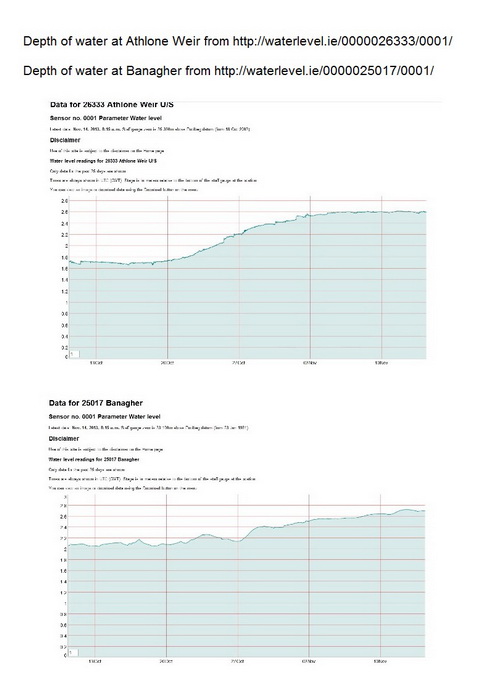
In the meantime, I have put together two charts nicked from waterlevel.ie for Banagher and Athlone:

Athlone and Banagher water levels

Athlone and Banagher water levels

Both of them show the levels for the last 35 days. I’m sure that more data and much more sophisticated analysis would be required to reach any reliable conclusion, but my untutored impression is that, in what has been a fairly dry autumn, keeping Lough Ree low didn’t do much to keep Banagher low. If that is so, and if I’m right in thinking that this autumn was dry (see below), the outcome would not show whether lowering Lough Ree would help in a very wet season; it may be necessary to repeat the experiment next year while performing rain dances. I would be glad, though, to have comments from more erudite folk and, if I get any information from TPTB, I’ll publish it here. In the meantime, this CFRAM PDF provides background reading.

On the dryness: Met Éireann’s monthly report for September 2013 is headed “Dry everywhere; warm and dull in most places” while that for October says “Rainfall was above average except in parts of the West, Northwest and North”. Its report doesn’t, AFAIK, specify any stations in the Shannon catchment (apart from Shannon Airport), but those to the west were generally below average while whose to the east were above; it may be that the Shannon rainfall was moderate.

Ticking all the boxes

Sometimes an idea comes along that is just so good, so right, so advantageous on all counts that it is simply irresistible. This idea comes from the Americas, from the US Coast Guard. Adapted to the Irish inland waterways, and specifically to the Shannon, it could:

  • help to promote industry in recession-hit rural areas
  • create direct employment
  • help to stimulate indirect employment
  • promote Irish energy independence by reducing reliance on imported hydrocarbons
  • counter pollution of water-courses
  • reduce the number of heavy trucks using remote rural roads
  • use environmentally-friendly water transport, by barge along the Shannon
  • honour and promote the industrial heritage of Co Leitrim and the transport heritage of the Shannon
  • help to defray the costs of maintaining the Shannon Navigation
  • solve Dublin’s water supply problem, at least for non-potable water.

How could anybody resist?

The US Coast Guard has proposed that wastewater from fracking [PDF] should be transported by barge, rather than by truck or railway train, from the fracking sites to remote storage or treatment facilities. So, when fracking begins around Lough Allen, the wastewater could be carried down the Shannon by barge and, if necessary, pumped to Dublin.

It sounds like a winner to me.

Up with this sort of thing

Folk interested in the history of the Shannon before 1850 may like to know of a talk …

The smart green technology of the 1830s: the Shannon steamers and the definition of Ireland

… to be delivered to the Thomond Archaeological and Historical Society on Monday 4 November 2013. It’s in Room T.1.17, TARA Building, Mary Immaculate College, Limerick, at 8pm.

A related topic …

Charles Wye Williams and the Anglo-Irish Trade

… will be discussed in one of the papers at the Eighth [British] Waterways History Conference on Saturday 26 October 2013 at the University of Birmingham. Leave a Comment below if you would like contact information for the conference.

Water levels in Athlone

At time of writing, the depth of water at Athlone Weir is 1.7m. “Staff gauge zero is 35.360m above Poolbeg datum”, which means the water level is 37.06m OD (Poolbeg). According to Bob Cullen’s 2002 article for Inland Waterways News [PDF], “The minimum navigation level in Lough Ree is 36.88m OD”, so if the level drops another 0.18m, about 7 inches, there may be a WI Marine Notice.

It seems that the dropping of the level of Lough Ree is intended to provide a buffer against flooding in the area from Athlone downstream to Meelick. According to Brian Hayes “A meeting between the ESB, Waterways Ireland and the Office of Public Works to review the interim operating regime is due to take place shortly.” [I have asked Waterways Ireland for a report on the meeting.]

But, if we are to believe the Dublin Evening Mail, the Shannon Commissioners took a rather more robust attitude to flooding downstream of Athlone: steamers [and PR] came first.

Lough Derg Regatta 1849

The Dublin Evening Mail of 19 September 1849 has come to hand.

LOUGH DERG REGATTA

The Regatta on the above-named beautiful lake came off last week. Monday, the 10th of September commenced the annual aquatic sports: the day was tolerably fine, and at two o’clock, PM, the Commodore, the Right Hon Lord Viscount Avonmore, started four yachts for a 30 Guinea Challenge Cup, with £12 added. After a drifting match (for it fell flat calm shortly after three o’clock), they came in as under:—

Gem, 12 tons, James Spaight, Esq
Hero, 8 tons, Dash Gainor, Esq
Iris, 19 tons, Wills C Gason, Esq
Foam, 24 tons, Lord Avonmore.

This was a time race.

While the yachts were absent several cot races came off.

On Tuesday, the 11th, the yachts sailed down in fleet to Killaloe, but the following day it blew a whole gale of wind, and the match that was to have been sailed for on that day was put off till the next; however, in the evening there were some well contested cot races.

The course was as usual — start from the Jetty, over the diagonal wall (built by the Shannon Commissioners to keep the water to a proper level in summer), under the bridge, round Friar’s Island, and back: to a stranger, it is astonishing to see a boat go down an incline nearly four feet high, which they are obliged to do in the race, and what is more extraordinary, any cot that is not rowed at it pretty fast, is almost certain of being upset.

Thursday, the 12th, at the Commodore’s signal, all the yachts got under weigh, and came to anchor off Derry, and at two o’clock, PM, five yachts started for a Silver Cup, valued at £15, witn £5 added. This was a time race for yachts under twelve tons. The wind was WNW, and blew a fine gaff-topsail breeze; at half-past four o’clock the yachts came in as under:—

Hero, 8 tons, Dash Gainor, Esq
Gem, 12 tons, James Spaight, Esq
Willy Wa, 9 tons, Captain Hon F Yelverton
Vampire, 9 tons, Arthur Vincent, Esq
Midge, 7 tons, Bassett W Holmes, Esq.

This was a beautiful race, all the yachts coming in almost together: the Hero only winning by 27 seconds — indeed she may thank the Midge for winning the prize, as going free the first round she got the Gem under her lee, and kept her back some minutes. Shortly after the signal was given to weigh anchor, and start for Portumna, where the fleet arrived at a late hour. In passing Scilly Island the Foam carried away her rudder head, and was near going ashore.

Next day, Friday the 14th, the yachts assembled off Portumna Castle, and at three o’clock, PM, the Commodore started the following boats for a 40 Guinea Challenge Cup, with a purse of Sovereigns added, for all yachts. A handicap race.

Novice, 4 tons, Dash Ryan, Esq
Midge, 7 tons, Bassett W Holmes, Esq
Vampire, 9 tons, Arthur Vincent, Esq
Gem, 12 tons, James Spaight, Esq
Foam, 24 tons, Lord Avonmore
Iris, 18 tons, Wills C Gason, Esq.

This was a most exciting race, and during the first hour it was difficult to tell which would be the winner. Before rounding the second flag boat the Novice put about and gave up the race, and off Church Island, the Midge carried away the jaws of her gaff, and was obliged to give up the race, which she was almost sure of winning — having gained two minutes the first round. The course was a long one, and the race was not over till after eight o’clock, when the four boats came in as follows:—

Iris
Foam
Gem
Vampire.

During each day of the Regatta, the City of Dublin Steam Company placed one of their fine steamers at the disposal of the Sailing Committee, who took out all their friends, and accompanied the yachts each day during the race.

In the evening, after several cot races and other amusements too numerous to relate. The ladies and gentlemen present were entertained at Belle Isle, the beautiful seat and hospitable mansion of Lord Avonmore; and at a later hour assembled some 120 of the elite of Tipperary, Galway, and King’s County, at the Clanricarde Arms, Portumna, where dancing was kept up with spirit until morning.

The population of the Portumna DED declined by 30.46% between 1841 and 1851.

Shannon passage times 1838

Estuary

Kilrush to Limerick 4 hours

Tarbert to Limerick 3 hours

Clare[castle] to Limerick 3.5 hours

Limerick Navigation

Limerick to Killaloe:

  • iron passenger boat 2.5 hours
  • timber passenger boat 3.5 hours
  • trade boat 6 hours.

Shannon

Killaloe to Portumna:

  • passenger steamer 6 hours
  • steamer towing lumber boats 8 hours.

Portumna to Shannon Harbour:

  • 6 hours.

Shannon Harbour to Athlone:

  • 8 hours.

Source: Railway Commissioners second report Appendix B No 6.