Category Archives: Steamers

The mystery of Mr Worrall

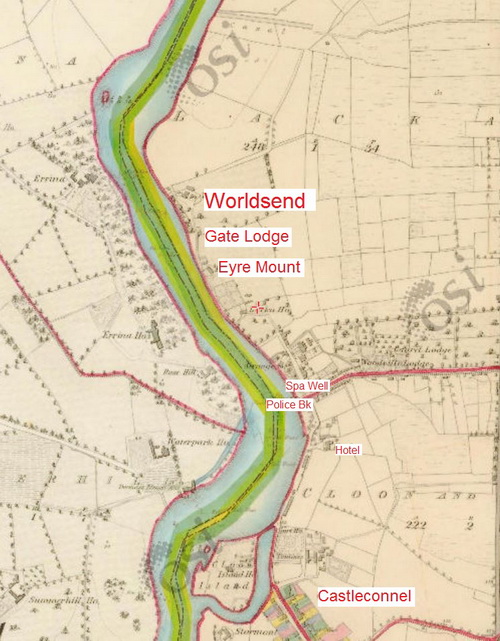
Castleconnell and Worldsend, Co Limerick (OSI 6" ~1840)

Castleconnell and Worldsend, Co Limerick (OSI 6″ ~1840)

The authors of a book called Village by Shannon, about Castleconnell, Co Limerick, say that the area of Worldsend, at the northern end of Castleconnell, derives its name from Worrall’s Inn, an establishment operated by a Mr Worrall in the early eighteenth century.

That may be so, but the book’s accounts of river-borne traffic — to a quay at the inn — do not seem to accord with what is known about the history of the Shannon navigation, and in particular of the Limerick Navigation between the city and Killaloe. Here are some of the problems.

My OSI logo and permit number for website

Travelling

Newry steam-packet

The Waterloo will sail hence for Warren’s Point, This Day (FRIDAY) the 16th instant, at Three o’clock; on TUESDAY the 20th, and SUNDAY the 25th instant.

Dublin steam-packets

The Mountaineer, C H Townley, will sail hence for Dublin, on SUNDAY next, the 18th instant, at Three o’clock.

The Belfast will also shortly resume her station between this Port and Dublin. These being the only Steam-packets which land their Passengers AT THE CITY, by them the Public avoid the dangerous landing at Dunleary in small boats, the hazardous and expensive mode of conveyance thence to Dublin (a distance of several miles), the disagreeable disputes with boatmen, the impositions practised by the lowest order of society, with various other difficulties; against which the complaints are universal.

Days of sailing from Liverpool will be, Sunday, Tuesday, Thursday, and Saturday.

Apply at the Packet-office, bottom of Redcross-street, or to WILLIAM STEWART.

Liverpool Mercury 16 May 1823

From the British Newspaper Archive run by Findmypast Newspaper Archive Limited, in partnership with the British Library.

New Engine and Propellers for Canal Navigation

Mr Peter Taylor, of Hollinwood, has recently taken out patents for two inventions — one for a rotary high-pressure marine steam engine on a new principle; and the other, that which chiefly calls for notice, for paddles or propellers, also of an entirely new construction. His principal object was to attain that desideratum in steam navigation on canals, sufficient motive power for considerable speed, without the injury to the canal banks caused by the action of the ordinary paddles.

The apparatus consists of a series of vanes or curved blades, placed obliquely, like the sails of a windmill, or like portions of a continuous screw. The apparatus is placed at the stern of the vessel in a small enclosure of water, the sides of the boat being continued beyond the stern, and the rudder being fixed beyond the propellers. They occupy a space of about a yard and a half in length, and, in the instance under notice, seven feet in breadth.

There are two parallel axes or shafts, which project from the stern, each shaft having four pairs of vanes or blades, at short distances, and so placed as to strike the water in quick succession, and obliquely, like the scull of a boat. The oars or blades on one shaft have an action like that of a right-hand screw, and those of the other like that of a left-hand one; and the vanes of each shaft work nearly up to the other shaft, and thus their joint action has the effect of propelling the boat forward, or when reversed, by altering the motion of the driving-wheel, in a direction stern first. They are said to differ (amongst other respects) from all propellers previously invented, both in their screw-like action, and in the axles being wholly under water.

By way of trying experiments with these propellers, Mr Taylor has had a set of them fitted to an old iron boat, about fifty-two feet in length, and seven feet in width, formerly worked on the canals by Messrs Buckley, Kershaw and Co. One of Mr Taylor’s new rotary engines of only five horses’ power has been fitted into the boat, which has been named “The Experiment of Hollinwood“. After several private trials, this boat made its first experimental trip on the river Irwell, yesterday week.

Mr Taylor and a few friends proceeded from the Old Quay, Manchester, as far as Barton-on-Irwell, and on the whole they state that the action of both engine and propellers was satisfactory; though in returning there was a deficiency of steam, from the filling-up of the fire-tubes with coke; a casualty which was remedied as soon as discovered. The speed was regarded as in a high degree satisfactory; being, it is stated, generally at the rate of six, and occasionally seven miles an hour. The motive power was deemed inadequate to accomplish all that the inventor had a right to anticipate; but it is mentioned as one proof of the superiority of his inventions, that the Jack Sharp, a passage boat belonging to the Old Quay Company (whose first trip, after being fitted with engine and stern paddles, we noticed some time ago), was not at all able to keep up with the Experiment, though the engine of the former is twelve horses’, and that of the latter is only five horses’ power.

On Wednesday the Experiment steamed down to Runcorn, by river and canal, and the whole distance was accomplished in about five hours’ working; including the stoppages at the locks, and those caused by the parties on the boat having themselves to open the bridges on the Runcorn Canal. The boat stopped a short time at Barton, and several hours at Warrington, which place it did not leave until dark, and performed the distance between Warrington and Runcorn (which, it is said, is about seven miles and three quarters) in about an hour, including delays from the cause just noticed. This increased rate was attributed to having obtained a better description of coke at Warrington.

The boat remained at Runcorn for some hours, and, having so far performed her work to the satisfaction of the voyagers, they determined to proceed in her to Liverpool. They started from Runcorn at half-past three o’clock on Thursday morning, with the tide, and reached the Rock Ferry, opposite Liverpool, by five o’clock, performing the distance in about an hour and a half.

The Experiment is considered to be by no means well adapted for the purposes of canal steam navigation. She is described as in form more like a box than a boat, and as drawing two feet nine inches water; a manifest disadvantage with so small an engine. We are informed, that all who have seen the boat’s performance, including several engineers who took a trip in her, have expressed themselves much pleased with her speed and general action. We understand there is some probability of the Old Quay Company making a trial of the propellers and engine in one of their twin quick passage boats on the Runcorn Canal.

The Experiment, in these trips, was placed under the care of Isaac Taylor, an experienced captain in the Old Quay Company’s employ, the aid of whose services, as pilot and steersman, was afforded for the occasion by Mr T O Lingard. Taylor says the boat answers her helm readily, turns well, and is very manageable. When at her greatest speed, it was found that the agitation and swell caused by her passing through the water, and by the propellers, had very little effect on the canal boats, the stream from the propellers being thrown off in the centre of the canal, leaving a considerable wake there.

Newcastle Courant 5 June 1840, quoting the Manchester Guardian

From the British Newspaper Archive run by Findmypast Newspaper Archive Limited, in partnership with the British Library.

The purity of the ladies of Limerick

The City of Dublin Steam Packet Company have kindly given the use of the Dover Castle, steamer, to the Ladies of Limerick, for Friday next, when the ceremony of laying the foundation stone of the New Docks will be performed. A band will be on board the steamer.

Limerick and Clare Examiner 4 July 1849

Immediately alongside the spot where the stone was to be placed floated the Dover Castle steamer, filled principally with ladies. The excellent Band of the 74th Highlanders was also on board, and contributed much to the delight that animated many a countenance. Several boats and barges were also provided for the accommodation of ladies. Most of the spectators were invited by Cards issued from the Office of Public Works.

Limerick Reporter 6 July 1849

Loud cheering attested the joy that pervaded every bosom at the prospect of employment, which the ceremony held out. The Dover Castle, moored within a few yards of the large platform, was, as a matter of course, the most attractive appendage. It was occupied by the ladies of Limerick. They, too, evidenced by waving their white handkerchiefs (the symbol of their purity, their virtues and sympathy for the suffering poor) how sincerely they felt the importance of the occasion. A stream of music was then poured forth by the beautiful brass band of the 74th, which was quite in keeping with the general harmony.

The proceedings of the day were then brought to a pleasing and chearful close. The military filed off; the Artillery withdrew; the masts and pinnacles became deserted; the groups, about the ground, dissolved; the Corporate functionaries retired; the mace-bearer beat a modest retreat; the ladies were led off by their attendant squires; the people wended their way homewards, the boats disappeared, and the Dock works and ground were left to the sole possession of their ordinary occupants.

May we not hope — at all events, let us pray, that yesterday was an auspicious day for Limerick.

Limerick and Clare Examiner 7 July 1849

From the British Newspaper Archive run by Findmypast Newspaper Archive Limited, in partnership with the British Library.

Cardboard and paper

Some folk have been sailing on the Thames in a boat made of cardboard.

Over two hundred years ago, Isaac Weld navigated the lakes of Killarney in a boat made of brown paper:

Whilst engaged in illustrating the scenery of that beautiful locality, Mr Weld derived additional pleasure from the occupation, in introducing a young and amiable wife to scenes so familiar to himself. To facilitate their rambles, and profiting by his Canadian adventures and his skill as a “voyageur“, he constructed with his own hands the model of an Indian canoe. In the absence, however, of birch bark, he had recourse to successive layers of stout brown paper, creating a sort of papier-maché boat, sufficiently roomy for two. In this paper skiff he actually had the hardihood to intrust himself and fair companion in sundry adventurous voyages on the Lakes.

That is from “Mr Foot’s Memoir of the late Isaac Weld, Esq” in The Journal of the Royal Dublin Society Volume I 1856–57 Hodges, Smith & Co, Dublin 1858. Wikipedia offers a shorter account of the life of the remarkable Mr Weld. His Statistical Survey of the County of Roscommon, Royal Dublin Society 1832, is an invaluable source of information about the Shannon and the Royal Canal, but Mr Weld is also notable for his voyage, along with his equally adventurous wife, on the steamer Thames [originally Argyle] from Dublin to London in 1815. There are brief accounts of the journey here and here; the captain, George Dodd, wrote a book An Historical and Explanatory Dissertation on Steam-Engines and Steam-Packets; with the evidence in full given by the most eminent engineers, mechanists, and manufacturers, to the Select Committees of the House of Commons; togerther with the Committees’ reports, distinguishing and defining safe and unsafe steam-engines, and their proper management: comprising particulars of the fatal explosions of boilers at Norwich, Northumberland, Wells-street, and in America: concluding with a narrative, by Isaac Weld Esq, of the interesting voyage of the Thames steam-yacht, from Glasgow, in Scotland, to Dublin and London [published for the author, London 1818] available here, and Isaac Weld’s account is available here. Mrs Weld may have been the first woman to take an extended sea voyage in a steam vessel.


Kilkee Bathing

The Fashionable Lounge and Temple of Fancy

Mr J Ely has now open for inspection at Russell’s Lodge (next the Post-office) a splendid Fancy Bazaar, consisting of Parisian, Geneva, Vienna, and Berlin

fancy goods,

which for taste and fashion may safely challenge comparison with the assortment of Paris and London. The splendid Stock of elegant Articles is such as cannot fail to gratify the taste of the most curious; but puffing not being the custom of the Proprietor, he will feel obliged by an early visit — occular demonstration being the best proof.

This elegant Stock comprises Musical Clocks, with Fountains; Alabaster Clocks, Musical Boxes, playing from two to twelve tunes each; Accordians of all sizes; a magnificent collection of Dresden China, with Flemish Paintings; a large assortment of newly invented Dresden Mat Glass; American Glasses; a fashionable assortment of Bracelets, Snaps, and Crosslets; a truly splendid assortment of the very best manufactured London Jewellery, best Sheffield Plate, finest Persian Perfumery, and a great number of other Articles too numerous to mention; also a large quantity of German Silver Plate, which the Proprietor pledges himself are of the very best description, imported by him from the Continent.

NB — The Proprietor begs to state the terms on which he disposes of his Goods will be found to be most inducing and advantageous to the public.

(2p)                                                                                  Kilkee, August 15

The Clare Journal, and Ennis Advertiser
20 August 1838

From the British Newspaper Archive run by Findmypast Newspaper Archive Limited, in partnership with the British Library.

Remarkable experiments in steam navigation

The duck’s paddle

A series of experiments has recently been tried in France by the Marquis de Jouffroy, with the view of getting rid of the inconveniences of the ordinary steam paddle. The apparatus of M de Jouffroy consists of two palms, or articulated duck’s feet, placed either at the sides or stern of a vessel, having an alternate motion, so as to open in order to give the impulsion, and close again precisely the same way as the foot of a duck.

M de Jouffroy’s first experiment was made in the canoe of the jardin de la Folia St James, near the Bois de Boulogne, with the model of a frigate made on a scale of 1 foot to 37 feet, and so constructed that the common paddle or his improvement might be used at will. With the common paddle the vessel performed a distance of 130 feet in seven minutes. The paddles having performed 130 revolutions, at this time the propelling power was completely exhausted.

The common paddles were then taken off, and the duck’s-foot paddles substituted. With one hundred and thirty oscillations of these paddles, the vessel performed in the same space of time a distance of 153 feet; but what was most remarkable, was the fact, that instead of stopping short when the clockwork, which in both cases put the machinery in motion, had run down, the impulsion communicated to the vessel by the steady and undisturbed motion of the duck’s-foot paddles was sufficient to keep the vessel moving 150 feet more.

The report on these experiments by the committee of the Institute is highly favourable.

The Vindicator, Belfast 16 December 1840. From the British Newspaper Archive run by Findmypast Newspaper Archive Limited, in partnership with the British Library.

Perhaps this marquis was the son of that marquis.

Tepid baths

1823

KILRUSH HOTEL, AND TEPID BATHS

This Elegant Establishment is fitted up in a superior style for the accommodation of Visitors, on the reduced terms of last Season.

The House adjoining the Hotel, now occupied by Mrs Colonel Stammers, of Cahernelly, will be Let, from the 12th of June, for the remainder of the Season; it has ample accommodation for a large Family, who can be supplied with any thing they may require from the Hotel; they will also have the use of the Bathing Machines and Bathing Houses — from this House to the Tepid Baths there is a covered passage.

The Lady of the Shannon steam packet sails from Limerick for the Hotel, on Tuesdays, Thursdays and Saturdays, and returns on Mondays, Wednesdays and Fridays, making her passage in five hours.

Kilrush, May 15th, 1823

Dublin Evening Post 20 May 1823. From the British Newspaper Archive run by Findmypast Newspaper Archive Limited, in partnership with the British Library.

1829

[…] The hotel and baths, for which this Town was remarkable, have been suffered to go to decay — at least, are not occupied as such at present.

Limerick Evening Post 8 May 1829. From the British Newspaper Archive run by Findmypast Newspaper Archive Limited, in partnership with the British Library.

The crimefighting Shannon steamer

Limerick, May 26. This morning the Lady of the Shannon steam yacht towed up, in grand style, the Fox cutter, captured by the Vandeleur Revenue cruizer, Capt Hopkins, as stated in our last. She lies at the Custom-house quay, is a very fine vessel, clinker built, pierced for eight guns, which were thrown overboard, in chase, and is remarkably well found. Her cargo is supposed to consist of 1000 gallons of highly rectified Geneva, in 10 gallon casks — 20 hogsheads of tobacco, in bales and half-bales — and a large quantity of teas — amount not yet ascertained.

Public Ledger and Daily Advertiser 5 June 1818 [quoting Irish Papers]. From the British Newspaper Archive run by Findmypast Newspaper Archive Limited, in partnership with the British Library.

Eccentricity by steam

Folk interested in eccentric early steam inventions, such as that described on my page about chain haulage, might also be interested in the invention of Captain George Beadon RN, as described on the invaluable Grace’s Guide site.

Her late Majesty Queen Victoria, by the Grace of God of the United Kingdom of Great Britain and Ireland Queen, had the foresight to acquire a photograph of Captain Beadon’s vessel and to make it available on tinterweb.

Captain Beadon’s route to London took him through Keynsham: that’s K-E-Y-N-S-H-A-M.