Category Archives: The turf trade

Ballylongford man’s posthumous honour

Herbert Kitchener, born in Ballylongford near Saleen in 1850, shortly after the Shannon Commissioners completed their work, is to appear on a new UK £2 coin.
Money from the bog

To a small extent reclamation is now going on in Ireland; Mr M’Nab, of Castle Connell, county Limerick, has reclaimed 80 acres of the worst red bog, devoid of vegetation and 20 feet deep. It was drained, then coated with the subsoil, and the land which was not worth 2s 6d per acre is now worth 30s per acre.

Thus Robert Montgomery Martin in his Ireland before and after the Union with Great Britain third edition with additions; J D Nichols and Son, London; James McGlashen, Dublin 1848.

I have written here about Mr Macnab (that was how the spelling settled down) and his talent for extracting money from the bog at Portcrusha, which is between Castleconnell and Montpelier, Co Limerick. It seems that his achievements are still remembered — and emulated.

Incidentally, in the same work, published in 1848, Mr Martin refers to the

… large practical mind, great experience,  and Christian philosophy …

of Sir Charles Trevelyan.

Lowtown Canal Yard is for sale

Details here.

If I won the lottery I’d buy it myself. Sad to see Robert and Caroline Few selling, after many years of service to the canal; I wish them all the best in the future.

Ticking all the boxes

Sometimes an idea comes along that is just so good, so right, so advantageous on all counts that it is simply irresistible. This idea comes from the Americas, from the US Coast Guard. Adapted to the Irish inland waterways, and specifically to the Shannon, it could:

  • help to promote industry in recession-hit rural areas
  • create direct employment
  • help to stimulate indirect employment
  • promote Irish energy independence by reducing reliance on imported hydrocarbons
  • counter pollution of water-courses
  • reduce the number of heavy trucks using remote rural roads
  • use environmentally-friendly water transport, by barge along the Shannon
  • honour and promote the industrial heritage of Co Leitrim and the transport heritage of the Shannon
  • help to defray the costs of maintaining the Shannon Navigation
  • solve Dublin’s water supply problem, at least for non-potable water.

How could anybody resist?

The US Coast Guard has proposed that wastewater from fracking [PDF] should be transported by barge, rather than by truck or railway train, from the fracking sites to remote storage or treatment facilities. So, when fracking begins around Lough Allen, the wastewater could be carried down the Shannon by barge and, if necessary, pumped to Dublin.

It sounds like a winner to me.

Bolshevism, boats and bridges

The balance bridge crossing the canal, near Newcomen-bridge, as designed and erected under the superintendence of Mr Bindon Stoney, engineer of the Dublin Port and Docks Board, has been completed, and adds considerably to the facilities for carrying on the traffic. This bridge has been erected in substitution of a lift-bridge, constructed in 1872, but to which an unfortunate accident occurred in February, 1878.

Ralph S Cusack, Chairman, in the report of the Directors of the Midland Great Western Railway, 19 February 1879, quoted in the Freeman’s Journal 27 February 1879

In mid-October I mentioned that Maureen O’Sullivan [Ind, Dublin Central] had asked the unfortunate Jimmy Deenihan [FG, Kerry North/West Limerick, and minister for waterways] about Effin Bridge, the lifting railway bridge below Newcomen Bridge on the Royal Canal in Dublin. The bridge is lifted, to allow boats through, on [IIRC] one Saturday each month in the summer, making five lifts a year. Waterways Ireland says on its website [click Bridges if necessary]

The Newcomen Lift Bridge in Spencer Dock is owned and operated by Irish Rail, and requires a rail possession to be lifted. It can only be lifted for boats at limited prearranged times organised with Waterways Ireland. For details of opening times and to arrange passage contact the Eastern Regional Office on 01 868 0148.

Maureen O’Sullivan wanted

… a meeting of interests concerned with the operation of the lifting bridge with a view to devising a management and operational system that is less hostile to the use of the waterway as currently it is an impediment and discouragement to navigation on the Royal Canal and an obstacle to navigation-communication between the Royal Canal and River Liffey and between Royal Canal and Grand Canal at their eastern reaches […].

Jimmy Deenihan said

The bridge is operated by Irish Rail staff on a request basis at Waterways Ireland’s expense.

However, he wasn’t giving any hostages to fortune by making rash promises or even by commenting on whether the bridge was an impediment to navigation. But Ms O’Sullivan was undeterred: she returned to the topic with two written questions on 5 November 2013 and a priority question, no less, on 7 November 2013 [for certain values of “priority”]. On 5 November she asked two questions of Jimmy Deenihan

To ask the Minister for Arts, Heritage and the Gaeltacht further to Parliamentary Question No. 59 of 16 October 2013, the extent of railway track that needs to be closed by Irish Rail in order for a vessel on the Royal Canal, Dublin, to be given access between the First and Sea Levels of the Royal Canal; if there has been an assessment of whether the extent of track closure could be reduced to facilitate greater ease of navigation on the Royal canal; and if he will make a statement on the matter.

To ask the Minister for Arts, Heritage and the Gaeltacht further to Parliamentary Question No. 59 of 16 October 2013, if the option of a introducing a drop lock to replace the need of the lifting bridge has been considered since the establishment of Waterways Ireland or if that assessment was made by Waterways Ireland’s predecessors; the level of use of the sea level assumed in relation to the assessment; if the impact of the Spencer Dock Greenway was taken into account and vice versa, was account taken of the impact on the Greenway were the sea level to be made accessible to navigation by replacing the lifting bridge; if the assessment includes analysis of whether the effective re-opening of the sea level of the Royal Canal to meaningful levels of year-round traffic would be consistent with the EU’s commitment to the ‘protection and preservation of cultural heritage, in view of the fact that Dublin’s waterway’s heritage is part of the cultural infrastructure of Europe, contributing to economic attractiveness, job opportunities and quality of life; and if he will make a statement on the matter.

The ever-patient Mr Deenihan replied:

I am advised that the option of constructing a drop lock to replace the need for the lifting bridge at the location in question has been considered by Waterways Ireland but it was not deemed viable due to the estimated costs involved, given that the minimum cost for a drop lock to replace the bridge would be of the order of €5m. Work to install a drop lock at this location would also involve considerable temporary works, the extent of which would be unknown until ground conditions were assessed in detail.

I am also advised that there have been no assessments or analyses undertaken by Waterways Ireland in respect of the level of use or impact on the Spencer Dock Greenway.

I can inform the Deputy that the length of railway track disconnected from the rest of the loop line from the station when the bridge is in the ‘up’ position is approximately 16 metres. However, as the control and operation of the railway line in the vicinity of the lifting bridge lies entirely with Irish Rail, only it can indicate the extent of the permanent rail line that needs to be closed when the bridge is opened.

He might also have pointed out that €5m is more than WI’s entire capital budget, which is under €4m for all southern waterways for 2014. And if he were an argumentative chap, he might have pointed out that there is no evidence of a demand for

… the effective re-opening of the sea level of the Royal Canal to meaningful levels of year-round traffic …

and no evidence that it would be of any economic benefit to anyone, least of all the residents of Dublin Central, even if boats were travelling that way every day of the week.

He might, if he were an impatient sort of chap, have pointed to the idiocy of the “cultural heritage” argument: with one or two minor exceptions, pleasure craft were not part of the “cultural heritage” of the Royal but, even if they were, such “heritage” wouldn’t be worth millions that might be spent instead on bringing soup to the deserving poor of Dublin Central.

Ms O’Sullivan was back with more on 7 November, this time trying to get Leo Varadkar [FG, Dublin West] to get the National Transport Authority to include Effin Bridge and the Sheriff Street non-lifting bridge (not a Scherzer) included in a National Transport Authority study of “the management and movement of people and goods to, from and within Dublin city centre”. Ms O’Sullivan’s rather confused and confusing case seemed to be that there was a greenway, and there were walking and cycling routes along the canal, so a road bridge (that works perfectly well for carrying a road) and a railway bridge (that works perfectly well for carrying a railway) should be included  in the study because the canal has navigational potential.

Or something. She even managed to bring water polo [does she mean canoe polo?] into the argument.

As far as I can see, walking, cycling, road travel and rail travel — and even water polo — are not in any way adversely affected by the current arrangements, while the canal is of negligible importance in the movement of people and goods. Boating on the canal is a leisure activity for a small number of people who are sufficiently well heeled to own pleasure-boats; I am rather surprised to find that their interests are a matter of such concern.

As the expenditure on reopening the Royal Canal is a sunk cost, I am all in favour of making its use easier — provided that it can be demonstrated that (a) there is a demand for increased use, (b) such increased use will have benefits that outweigh the costs of any improvements and (c) no alternative investment offers better returns. As far as I can see, Ms O’Sullivan has demonstrated none of the three: indeed I see no evidence that she has even considered them.

What’s depressing here is the absence of any indication of a rational approach to capital spending on waterways. They’re still cargo: a magical source of wealth, that will bring peace and prosperity as long as we all believe in fairies and avoid facts, thinking and analysis.

No wonder the country is in a state of chassis.

Update 15 November 2013: some information about demand for passage under Effin Bridge.

No queue for the quay …

… at Querrin on the Shannon Estuary. The page discusses its building and the early years of its operation.

Maureen O’Sullivan and Effin Bridge

A knowledgeable written question [h/t KildareStreet.com] from Maureen O’Sullivan [Ind, Dublin Central] about the Effin Bridge over the Royal Canal at Newcomen Bridge:

To ask the Minister for Arts, Heritage and the Gaeltacht if he will identify the parties concerned with the operation of the lifting bridge which occupies the site of the original first lock on the Royal Canal Newcomen Bridge, Dublin 1; the factors that contribute to the status of the lifting bridge; if he will convene a meeting of interests concerned with the operation of the lifting bridge with a view to devising a management and operational system that is less hostile to the use of the waterway as currently it is an impediment and discouragement to navigation on the Royal Canal and an obstacle to navigation-communication between the Royal Canal and River Liffey and between Royal Canal and Grand Canal at their eastern reaches; and if he considers the lifting bridge could be re-engineered as a dropping bridge.

The minister, Jimmy Deenihan [FG, Kerry North/West Limerick], responded:

I can advise the Deputy that the parties concerned with the operation of the lifting bridge over the railway line close to Newcomen Bridge are Irish Rail and Waterways Ireland. The bridge carries the rail line from Connolly Station to the lower line link to the docks area. The bridge was procured and installed by Waterways Ireland’s predecessors. The bridge is operated by Irish Rail staff on a request basis at Waterways Ireland’s expense. The option of introducing a drop lock to replace the need of the lifting bridge has been considered but not deemed viable due to the cost estimate involved.

Note that the question was about a “dropping bridge” but the answer was about a “drop lock”.

The answer suggests that the number of lifts each year is a function of the number of requests made by Waterways Ireland; it would be interesting to know whether that it actually so. If it is, then WI’s budget [cut again] is probably the ultimate determinant; if Irish Rail has a say in the matter, its operational needs may influence the decisions.

I cannot think of any cost-effective solution. I am not convinced that the bridge in itself discourages navigation.


Up with this sort of thing

Folk interested in the history of the Shannon before 1850 may like to know of a talk …

The smart green technology of the 1830s: the Shannon steamers and the definition of Ireland

… to be delivered to the Thomond Archaeological and Historical Society on Monday 4 November 2013. It’s in Room T.1.17, TARA Building, Mary Immaculate College, Limerick, at 8pm.

A related topic …

Charles Wye Williams and the Anglo-Irish Trade

… will be discussed in one of the papers at the Eighth [British] Waterways History Conference on Saturday 26 October 2013 at the University of Birmingham. Leave a Comment below if you would like contact information for the conference.

Water levels in Athlone

At time of writing, the depth of water at Athlone Weir is 1.7m. “Staff gauge zero is 35.360m above Poolbeg datum”, which means the water level is 37.06m OD (Poolbeg). According to Bob Cullen’s 2002 article for Inland Waterways News [PDF], “The minimum navigation level in Lough Ree is 36.88m OD”, so if the level drops another 0.18m, about 7 inches, there may be a WI Marine Notice.

It seems that the dropping of the level of Lough Ree is intended to provide a buffer against flooding in the area from Athlone downstream to Meelick. According to Brian Hayes “A meeting between the ESB, Waterways Ireland and the Office of Public Works to review the interim operating regime is due to take place shortly.” [I have asked Waterways Ireland for a report on the meeting.]

But, if we are to believe the Dublin Evening Mail, the Shannon Commissioners took a rather more robust attitude to flooding downstream of Athlone: steamers [and PR] came first.

Canal carrying 1846: the Grand Canal

Isaac Slater’s Directory[i] of 1846 lists those carrying goods on inland waterways. Most of the carriers on the Grand Canal, which runs from Dublin to the River Shannon with various branches, claim to serve a modest number of places, but Thomas Berry & Co have a very lengthy list. So long is their list that it will require two maps to show all the places they served, with a third map for the rest of the carriers.

Note that the maps are from the 25″ Ordnance Survey map of around 1900 rather than the 6″ of around 1840: I used it because it was clearer, but it shows features (eg railway lines) that were not present in 1846.

There may be some cases where I have misidentified a destination; I would be grateful to have my attention drawn to such cases.

Click on a map to get a slightly larger version.

Thomas Berry & Co

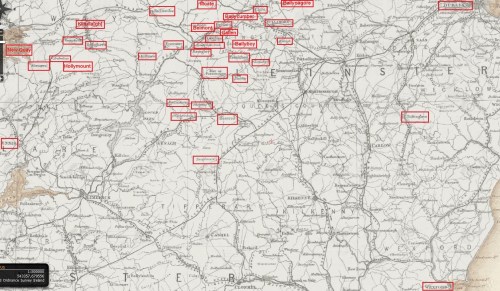
Thomas Berry & Co midland and south routes

Thomas Berry & Co midland and southern destinations (OSI)

The canal runs from Dublin, at the top right, left (roughly west) through Tullamore to Shannon Harbour, where it meets the river; there was an extension to Ballinasloe on the far side of the Shannon. Berrys served places along the canal and several others fairly close to it, but it looks to me as if there were three routes by road beyond that:

  • via Banagher (which has a bridge across the Shannon) to Eyrecourt and Killimor
  • from Ballinasloe to Loughrea and district and then south-west to Ennis in Co Clare
  • perhaps from Tullamore to Birr [Parsonstown], Roscrea (including Shinrone, Cloughjordan and Borrisokane) and Templemore.

There are also two outliers for which I can think of no plausible explanation: Baltinglass and Wexford. Perhaps their inclusion was a mistake. Certainly Berrys, like John M’Cann & Sons on the Royal Canal, seem to have had extensive road networks (perhaps using car-owning subcontractors?) to supplement their water-borne routes, but I don’t see why they would take on a route no part of which could sensibly have been conducted by inland navigation.

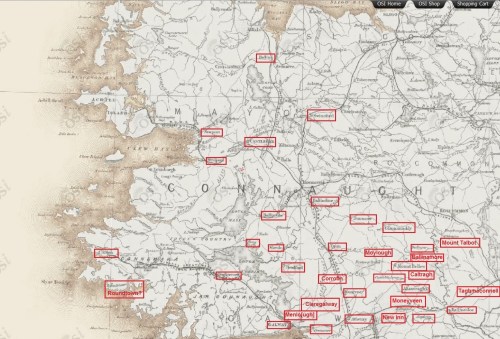
The next map shows the north-western destinations served by Berrys.

Thomas Berry & Co western routes

Thomas Berry & Co north-western destinations (OSI)

You can see that their network covered much of County Roscommon and went almost as far west into County Galway as it was possible to go; it also extended northwards into County Mayo.

I have not attempted to check what industries might have made these towns and villages worth serving. Berrys certainly seemed keen to take as much as possible of the traffic from west of the Shannon towards Dublin — excluding such of it as went by the Royal Canal: it is interesting to compare these maps with that for M’Cann on the Royal.

Finally, note that along the canal itself Berrys listed only destinations towards the western (Shannon Harbour) end: it seems likely that the roads took the valuable traffic from the eastern end into Dublin. There were no doubt turf boats taking fuel in from closer to Dublin, but they were not general carriers.

Other carriers

Now for the rest of the carriers.

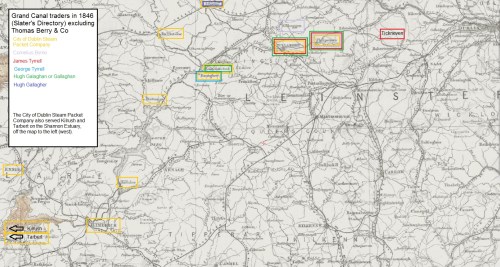
Grand Canal carriers 1846 excl Thomas Berry

Grand Canal carriers 1846 excluding Thomas Berry (OSI)

I have included the Shannon here as well as the Grand Canal; however I have covered the Barrow Line of the Grand Canal, as well as the navigable rivers Barrow, Nore and Suir, in a separate post. Of the carriers listed here, only the City of Dublin Steam Packet Company [CoDSPCo] (which employed horses to pull its boats on canals) ventured on to the Barrow Line, serving Portarlington and Mountmellick.

Berrys and the CoDSPCo were by far the largest firms on the Grand. I don’t know the size of the Berrys fleet, but the CoDSPCo had 52 barges in addition to its Shannon (and Irish Sea) steamers. Note that only on the middle Shannon, around the junction with the Grand Canal, and at Ennis did the two firms serve the same destinations: the CoDSPCo seems to have had the lower Shannon trade to itself.

With one exception, all the carriers, including Berrys, had Dublin depots at Grand Canal Harbour, James St; the Grand Canal Docks at Ringsend, joined to the Liffey, were not mentioned.

The exception is Hugh Gallagher, whose only listed destination was Athlone. It would be interesting to know how he served Athlone: whether by road or by water and, in the latter case, whether he used a steamer. I do wonder whether Hugh Gallagher might be the same person as the Hugh Galaghan (also Gallaghan) who served Philipstown [now Daingean], Tullamore and Shannon Harbour.

George Tyrrell is another who is listed with but a single destination, Banagher, whereas James Tyrrell is listed as serving Tickneven, Philipstown, Tullamore — and Edgeworthstown, which must be a mistake as it is closer to the Royal Canal.

Finally, Cornelius Byrne is shown as serving two destinations: Philipstown and Kilbeggan (which has its own branch off the main line of the canal).

Other information

A little extra information is available from the entries for towns other than Dublin in the Directory:

  • Naas has its own branch from the main line of the canal, but the directory says that “TO DUBLIN, there are Boats, as occasion require, but they have no fixed periods of departure.”
  • Edenderry also has its own branch, short and lock-free, but there is no mention of its being served by trade boats
  • Kilbeggan, with a longer, leakier, lock-free branch, was served by the CoDSPCo’s and Thomas Byrne’s boats travelling to Dublin three times a week. Is this Thomas Byrne related to the Cornelius Byrne mentioned above? It seems that Byrne went only eastward for only the CoDSPCo’s boats went westward (to Shannon Harbour, Ballinasloe and Limerick) two or three times a week
  • at Banagher, Fleetwood Thomas Faulkner of Main Street was the CoDSPCo agent; a downstream steamer left Shannon Harbour after the [passenger] boat from Dublin arrived and called at Banagher’s Bridge Wharf; an upstream steamer from Limerick called every afternoon at 3.00pm and met the night boat travelling to Dublin by the Grand Canal. I presume that this happened on every day except Sunday.

More

As far as I know, little has been written about the carrying companies, especially those of the nineteenth century. I would be glad to hear from anyone who can correct, supplement or comment on this information.

My OSI logo and permit number for website


[i] I Slater’s National Commercial Directory of Ireland: including, in addition to the trades’ lists, alphabetical directories of Dublin, Belfast, Cork and Limerick. To which are added, classified directories of the important English towns of Manchester, Liverpool, Birmingham, Sheffield, Leeds and Bristol; and, in Scotland, those of Glasgow and Paisley. Embellished with a large new map of Ireland, faithfully depicting the lines of railways in operation or in progress, engraved on steel. I Slater, Manchester, 1846