Category Archives: Tourism

Sinn Féin sheughs again

Sinn Féin demonstrates its continuing commitment to the unification of Ireland reconstruction of the Clones Sheugh. KildareStreet tells us that Sandra McLellan, TD for Cork East, no doubt motivated by the wealth of waterways in her own area, asked a written question on 18 July 2013:

To ask the Minister for Arts, Heritage and the Gaeltacht the position regarding the Ulster Canal restoration project; the remaining steps that must be taken to complete the project; if he will provide an indicative timeline for the completion of the project; and if he will make a statement on the matter.

She got a more or less standard answer from the minister, Jimmy Deenihan [FG, Kerry North/West Limerick]:

As the Deputy will be aware, in July 2007, the North/South Ministerial Council (NSMC) agreed to proceed with the restoration of the section of the Ulster Canal between Clones and Upper Lough Erne. The then Government agreed to cover the full capital costs of the project, which were estimated at that time to be of the order of €35m.

It was always the intention that the Ulster Canal project would be funded from the Waterways Ireland annual allocations, as agreed through the annual estimates processes in this jurisdiction, as well as the deliberations of NSMC in relation to annual budgets. It was a key consideration throughout the process that the Ulster Canal project would be supported by a significant level of projected income from the commercialisation of certain Waterways Ireland assets. However, as the Deputy will be aware, the economic downturn has had a negative impact on those plans.

In the meantime, the Ulster Canal project is progressing on an incremental basis. Planning approvals have recently been secured for the project in both jurisdictions. I welcome these developments, which, I am sure the Deputy will agree, are a significant milestone for the project.

I am continuing to explore all possible options to advance this project within the current fiscal constraints. In this regard, an Inter-Agency Group on the Ulster Canal has been established to explore and examine ways to advance the project and to examine possible funding options for it, including existing funding streams and the leveraging of funding from other sources, including EU funding options.

Isn’t it funny? Every so often the shinners ask a question to remind the minister that they, er, haven’t gone away, you know. They don’t get really aggressive about it and they don’t seem to be organising mass rallies in Clones to demand a sheugh. And the minister is equally polite, saying in effect “we haven’t shot your horse”.

This project is not very important: it’s a waste of money and will be of no benefit to the national economy, and a government seeking savings could easily kill it off. Yet it has refused, over several years, to take that obvious step. Instead, it’s devoting departmental time, and that of other public servants, to (admittedly low-cost) measures that seem to be intended to show that the project will be maintained on life support, even if it never rises from its bed.

Is there something in the St Andrew’s Agreement, or some other bit of northsouthery, that promises a sheugh to Sinn Féin, to enable them to claim credit for some high-profile but non-threatening all-Irelandism? Is the Clones Sheugh the price of SF support for the Police Service of Northern Ireland? I don’t know, but there must be some explanation for the failure to kill off the sheugh.
 

The uses of regulation

One of the things about being an Enemy of the Working People is that you start thinking about stuff like regulation. It tends to be supported by well-meaning liberal folk, who think that it will tame the wilder excesses of entrepreneurs, but its effects may not be those that were intended.

Consider, to take an example well away from Irish waterways matters, the study discussed here by Aaron Carroll of the effects of telling folk about the numbers of calories in their meals. The regulators’ idea was that, if fast-food eateries told consumers how many calories were in their food, fat folk would eat less (and the social and economic costs would be lower, I suppose). Some researchers decided to check. To quote Aaron Carroll:

Researchers approached 1121 McDonald’s customers both before and after calorie posting began in New York City. Each had a random chance of being handed (1) information that described the recommended calories a man and woman should eat each day, (2) information that described the recommended calories a man or woman should eat each meal, or (3) nothing. The hypothesis was that giving people information about recommended intake would help them to make better choices about how much to order. After all, the whole menu labeling thing is based on the idea that giving people calorie information will reduce obesity.

The result?

Giving people calorie recommendations didn’t change what people offered.

I think “offered” should be “ordered”. But the point is that the regulation, requiring that menus show calories, doesn’t seem to have had the effects that the regulators desired.

In a sense, though, that’s a fairly neutral outcome. At worst, as Carroll says,

[…] although the result was not statistically significant (p=0.07), people who were given more calorie information ordered more calories.

But there are outcomes than can be much worse than that, especially in regulatory capture, a topic that should be of interest in Ireland. One way of looking at the state is to see it as a tool or machine that can be used by powerful gangs to advance their own interests. In Ireland it is used by gangs of insiders (especially operatives in the state-protected industries: moneylenders, legal operatives, teaching operatives, body plumbers, enforcers and so on) to protect both their earnings and their status. The Troika has, alas, struggled in vain against them.

But I digress. Another way of using the power of the state might tempt folk who have commercial competitors (AKA “the enemy”). You could find a regulation or two that your opponent has broken: the more regulations there are, the more certain it becomes that your enemy has broken something or other. You can then use that breach to attack him or her.

Suppose, for example — and I realise I am in the wilder realms of the imagination here — you ran a business in the marine leisure sector which, if the decline in Shannon traffic is any guide, may be suffering from declining demand. And suppose you had several competitors in the same geographical area, and offering roughly the same services, as yourself. You could compete in the standard ways, perhaps using Jerome McCarthy’s Four Ps [Product, Promotion, Price, Place] in your marketing mix. But if your product and place were more or less the same, and if promotion were of little use in a declining market, you might be left competing on price, which might have its own drawbacks.

But there might be other weapons available to you: weapons that the innocent Mr McCarthy did not dream of. Suppose, for instance, that you found that one or more of your competitors had breached one or more of a body of regulations — there are lots of such regulations, mostly incomprehensible to the layman. You could cause or encourage the state (or one or other of its arms) to investigate your competitor. And, even if you didn’t have your competitor’s business shut down, you would have increased the costs to that business and forced its management to spend hours, nay days, as well as large fees, on trying to escape from the net. And perhaps a sympathetic politician might take up the matter, questioning ministers about it.

Given the general saintliness of the Irish people, and the high moral and ethical standards that have always prevailed, I am quite sure that nothing of the kind has ever happened, or could ever happen, but it does make me wonder whether regulation should be regulated.

Watering Dublin

Someone asked me recently about the progress of the scheme to supply Dublin with water from the Shannon. I had to confess that I haven’t been keeping up with the matter, because I don’t think it’s very important, but happily KildareStreet.com has provided an update. On Tuesday 16 July 2013 one of the Sinn Féin chappies, Brian Stanley of Laois-Offaly, asked a priority question:

54. To ask the Minister for Environment, Community and Local Government the progress being made on the Dublin, Garryhinch, Shannon water supply project; and the timeframe for planning, construction and completion phases of this project.

I suspect that most folk think of the scheme as one involving Dublin and the Shannon, so that the inclusion of Garryhinch may have been puzzling. It seems that Garryhinch is on the road from Portarlington to Mountmellick, just after that nasty bend where folk go to commit golf.

And Mr Stanley is interested not because he wants Garryhinch, Portarlington Golf Club, or indeed Portarlington and Mountmellick to be flooded but because he wants his constituents to be employed digging a hole in the ground there (a bit like the Clones Sheugh, really) and working in a water-based ecopark that will include a reservoir where the Shannon’s water will be stored.

Anyway, Fergus O’Dowd [FG, Louth], who is a Minister of State for something, replied:

The Dublin water supply scheme long-term water source is listed as a scheme at planning stage in my Department’s water services investment programme 2010 to 2013. Dublin City Council is the lead authority for this scheme, on behalf of all of the water services authorities in the greater Dublin area.

Studies carried out for the city council and a strategic environmental assessment have identified a preferred option which involves abstraction of raw water from Lough Derg and pumping the abstracted water through a new pipeline to a proposed storage reservoir at Garryhinch cut-away bog in County Offaly, forming part of a proposed midlands water-based eco-park. After treatment, water would then be conveyed to the west of Dublin where the new supply would be integrated with the existing storage and trunk distribution system.

In December 2012, the Department approved a brief for the engagement of consultants for the planning and statutory approval phase of the scheme. Dublin City Council has carried out a procurement process and I understand it will shortly be in a position to appoint a consultant to advance the further planning of this scheme.

The programme for project implementation has been developed based on the planning and statutory approval phase taking approximately two years. The detailed design and procurement phase should take a further two years, while the construction and commissioning phase should be completed in three years.

Following their appointment by Dublin City Council, the consultants will undertake the environmental impact statement and other statutory requirements in preparation for a submission to An Bord Pleanála which will adjudicate on the matter.

He forgot to mention “best practice”, so he’s lost some brownie points. Mr Stanley wanted it all to happen much faster, to be completed before 2021, but the discussion provided no more useful information. Bord na Móna has some more information about the eco-park here. All good stuff, much as I suggested for Lough Oughter, but I’d lose the eco title: eco stuff is so last millennium.

Mad foreigners

The August 2013 issue of Practical Boat Owner has just arrived. It has an article by Dick Everitt called “Mind your head …” in which he talks of dangers to boats from above rather than below: dangers from bridges and from electric power lines. He points out that electricity can jump to a metal mast and says:

So a safe clearance distance is given on the chart with a lightning-type symbol and in some countries a big warning sign is positioned nearby too. But do check local Notices to Mariners as long power cables can sag over time, reducing their official charted clearances.

Aren’t foreigners funny? Imagine having electricity suppliers actually telling boaters about the safe clearance under power cables! That would never happen here ….

I have spent several years trying to get ESB to tell me the safe clearances for cables across the Shannon. I thought I was getting somewhere at one stage but nothing happened. Perhaps ESB would prefer boaters to fry than risk getting sued for getting the clearance wrong.

Shannon traffic to June 2013

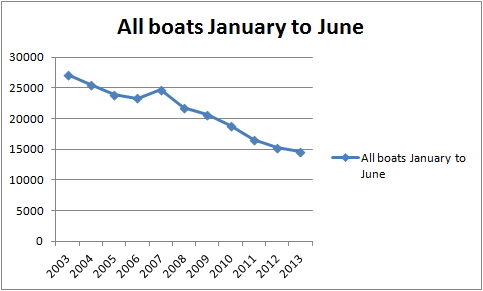
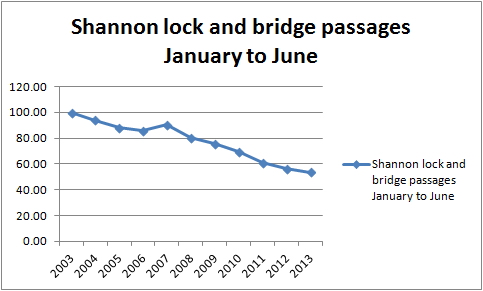
The figures for Shannon lock passages to the end of June 2013 are now available. The decline continues, though perhaps more slowly.

Shannon traffic Jan to June percent

Shannon lock and bridge passages January to June as percentages of the 2003 number

The usual caveats apply: the underlying figures (kindly supplied by Waterways Ireland) do not record total waterways usage because, for instance, sailing, fishing or waterskiing on lakes or river stretches, which did not involve a passage through a lock or Portumna Bridge, would not be recorded. The passage records are our only consistent long-term indicator of usage of the Shannon but they would not show, for instance, a change in the balance of types of activities from those in larger cruising boats to those in smaller (sailing, fishing, waterskiing) boats. It is quite possible, therefore, that overall usage might be increasing while long-distance cruising was declining.

Shannon traffic Jan to June private

Shannon lock and bridge passages by private boats January to June

As it happens, the figures show a small increase over 2012 in passages by private boats. I suspect that July’s warm weather will spur a further increase.

Folk living in Ireland, whether owners or prospective hirers, are likely to be able to react quickly to better (or worse) weather by doing more (or less) boating; folk living abroad may be less able to change their holiday plans. Accordingly, July’s weather might (I’m speculating here) mean an increase in passages by private boats and by boats hired by Irish residents; it might not lead to an increase in hiring from abroad.

Traffic in hired boats continued to decline in June.

Shannon traffic Jan to June hire

Shannon lock and bridge passages by hired boats January to June

That decline outweighed the small increase in private traffic, leading to an overall decline in the first six months as compared with the same period in 2012, which itself continued the pattern set in 2007.

Shannon traffic Jan to June all

Shannon lock and bridge passages by all boats January to June

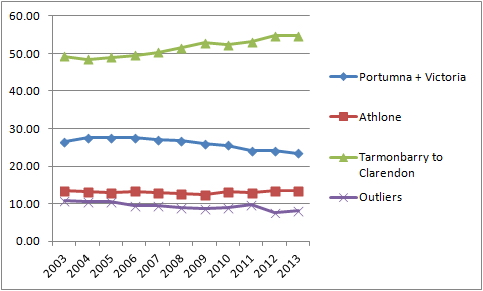
I wondered whether the figures might show any change in the geographical distribution of activity. WI’s reports don’t show separate figures for private and hired boats for the individual locks, but it seems to me that the hire business is becoming more concentrated on northern waters, from Lough Ree upwards. If that is so, then there might be an increase in the proportion of passages through the northern locks, from Tarmonbarry upwards, and a decrease in the proportion passing through Portumna Bridge and Meelick (Victoria) Lock.

I put the WI reporting stations in four groups:

  • Portumna + Meelick
  • Athlone
  • Tarmonbarry, Clondra, Roosky, Jamestown (Albert), Knockvicar (Clarendon)
  • the also-rans: the three locks leading to Lough Allen, Pollboy leading to Ballinasloe, the Limerick sea-lock (Sarsfield).

The figures suggest that the distribution is indeed changing, but gradually rather than dramatically. Athlone’s figures are pretty steady, the outliers are declining slightly and Portumna + Meelick are declining a bit more; the northern locks (Tarmonbarry to Knockvicar) are taking the gains. Comments or alternative interpretations welcome.

Change by region

Lock passages by group

The figures for 2013 are for the six months January to June; those for other years are for twelve months.

The locks could of course be grouped in other ways, and I may try some of them in future months.

Inland lifeboats to be exempt from VAT

Irish Water Safety has issued a press release [PDF] saying that the government is to introduce (or launch or make or pass or something) the Value-added tax (refund of tax) (rescue boats and related equipment) order 2013 which will allow inland community rescue boats to reclaim VAT on their purchases. Under the Value-Added Tax (Refund of Tax) (No 18) Order 1985, coastal community rescue boats have been able to reclaim VAT [PDF] but inland boats have not.

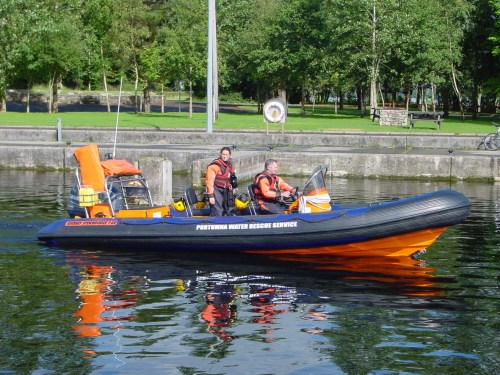
Portumna Water Rescue Service

Portumna Water Rescue Service

Irish Water Safety has a defined role in assessing the eligibility of community rescue boats for VAT exemptions; indeed its checklist and guidelines for community rescue services [PDF] are rather surprisingly headed Inspection for VAT Refund Certificate. The background is explained in another document Inshore Rescue Guidelines [PDF], which will presumably now be amended to include provision for inland boats. The “Declared Facility” boats [those approved and able to claim the VAT exemption] are listed here; there is also a list of other known rescue boats, some of which, being on inland waters, will now presumably apply to IWS for approval. Thus what is already a large rescue service will become even larger and more important.

I have photos of some of these boats on this page. I have none of the Corrib & Mask Rescue service, which I regret as today’s announcement was made on their turf and with their assistance. IWS says:

They will be the first Community Rescue Boat Ireland Lifeboat to be in a position to avail of this financial incentive.

Incidentally, I do not know whether the existing inland lifeboats operated by the Coast Guard and RNLI are affected by this or whether they could already reclaim VAT. If anyone can tell me, I’ll be glad to add the information here.

Dialogue

Some time ago I noted that Waterways Ireland was now down wid da kidz in da hood, doing groovy things like social meeja with a Youtube thingie. It features (inter alia) a flight in a helicopter gunship along a restored Clones Sheugh. At least, that’s what I presume was going on, although I couldn’t work out how to fire the rockets at the suspiciously large number of narrowboats found along the way. The scenic highlight of the journey was Clones.

There’s also a Facebook page, from which I learned that there is now a skippered boat available for hire on the Barrow. And there is a Twitter whatsit, which does two interesting things.

First, it has summaries of marine notices, which will be useful to those cruising on the waterways without internet access.

Second, it shows signs of WI’s engaging in public dialogue with users, even when their comments might be critical. This is very welcome; it will be interesting to see the extent to which such public dialogue is permitted to develop.


Domestic travel

The current appalling weather, with temperatures over 18C, seems to have increased the number of folk going boating on the inland waterways; it will be interesting to see how it affects the Shannon lock passage figures for July when they appear in August. But Constantin Gurdgiev says, of the data for the first quarter of 2013, that …

Data shows sustained declines in domestic trips undertaken for holiday purposes by Irish residents. Weather effects are of course a factor, but it is worth noting that holiday travel abroad by irish residents also contracted y/y in Q1 2013. In other words, it looks like even disregarding weather conditions, things are grim.

But in Q2 we may have to take “seasonal factors” literally.

Shannon Navigation Guide 1963

Messrs abebooks.co.uk have drawn my attention to the fact that Sharston Books of Manchester (which is a town or city within Her current Majesty’s Realm) have a copy of this 1963 Shell/BP guide for sale. John Weaving was Navigation Editor. I already have it, so I mention it here in case anyone else is interested.

I have no connection, commercial or otherwise, to the seller.

Bock goes boating …

… on the Shannon Estuary, the second most interesting coast of Clare (the inland coast is the most interesting, the north-west coast the least). Includes nice pics of the Scattery battery.