Category Archives: Water sports activities

NI21 and waterways charges

Basil McCrea is MLA for Lagan Valley and leader of NI21. He is a member of the NI Assembly’s Committee for Culture, Arts and Leisure. He has asked two questions of the Minister for Culture, Arts and Leisure:

AQW 35965/11-15: To ask the Minister of Culture, Arts and Leisure to detail the Department’s total expenditure to Waterways Ireland in (i) 2012; (ii) 2013; and (iii) 2014 to date.

AQW 35966/11-15: To ask the Minister of Culture, Arts and Leisure whether there is legislative provision for her Department to impose a charge on users of waterways.


Stealth seaplanes?

I have made several visits to Mountshannon this year, but unfortunately none of them coincided with an appearance by any of the “brand new fleet of aircraft, operating from destinations nationwide” that Harbour Flights promised would arrive “early in the new year” of 2014.

Shannon traffic figures to July 2014

I am grateful to Waterways Ireland for letting me have the Shannon traffic figures for July 2014. All the usual caveats apply:

  • the underlying figures do not record total waterways usage (even for the Shannon) as, for instance, sailing, fishing or waterskiing on lakes or river stretches, which did not involve a passage through a lock or Portumna Bridge, would not be recorded
  • the passage records would not show, for instance, a change in the balance of types of activities from those in larger cruising boats to those in smaller (sailing, fishing, waterskiing) boats
  • figures like these, for a small number of months, will not necessarily be representative of those for the year as a whole. The winter months, January to March, see little traffic in any year; for April, May and June, the weather can have a large influence on the amount of activity especially, I suspect, in private boats.

On the other hand, the figures do include the Shannon’s most significant tourism activity, the cruiser hire business. And they are our only consistent long-term indicator of usage of the inland waterways.

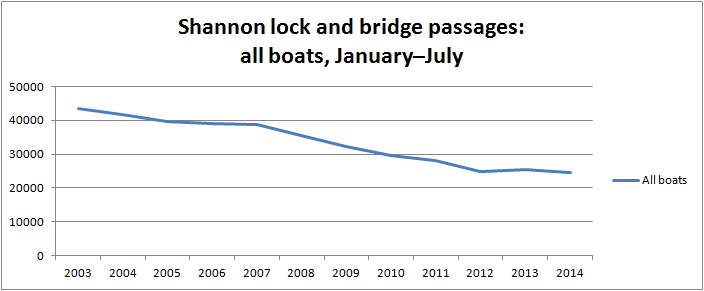
Shannon all boats Jan to Jul 2014

Total (private + hired) traffic for the first seven months of each year

Traffic in 2013 was up a bit on 2012; 2014 is down slightly below the 2012 level. It’s the lowest seven-month figure in the series (ie since 2003), which is a bit of a surprise: I thought that the good weather would encourage more boating.

The changes are small, so their importance must not be exaggerated, but they’re not cause for celebration. Let’s see whether the drop was amongst private or hired boats (or both).

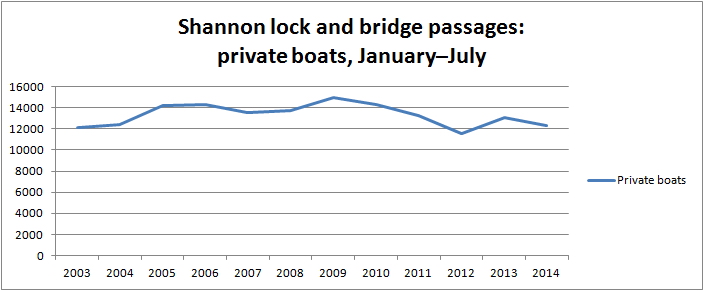
Shannon private boats Jan to Jul 2014

Private-boat traffic for the first seven months of each year

Private traffic is up a bit on 2012 but down on 2013.

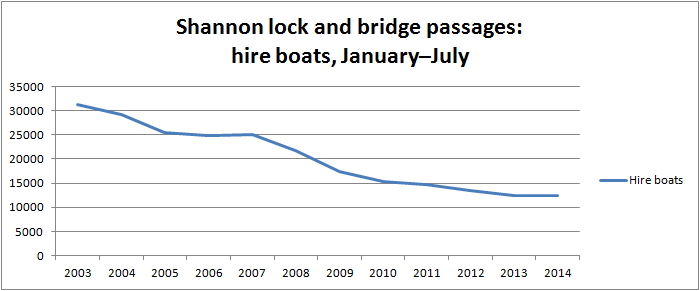
Shannon hired boats Jan to Jul 2014

Hire-boat traffic for the first seven months of each year

Hire-boat traffic is down on both previous years, but the pace of decline seems to have slowed.

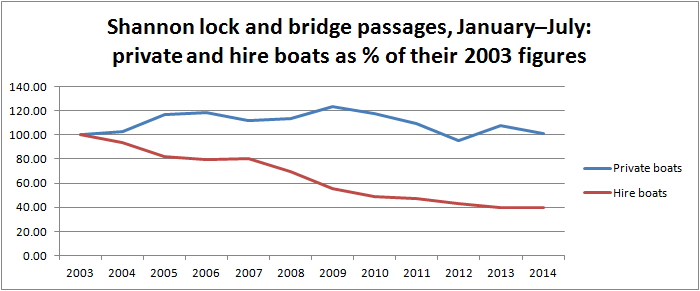
Shannon private and hired -v- 2003 Jan to Jul 2014

Changes since 2003: private and hired boats

Hire-boat traffic seems to be levelling off at 40% of its 2003 figure: a massive loss of business. I do not know whether anyone is trying to, or could, recover that amount of business. I am not aware of any new Shannon-based tourism business that could compensate for the losses in the cruising (hire-boat) business, but I would be glad to hear from anyone who knows of such projects. Something with high growth potential is required.

Private traffic is wobbling either side of its 2003 figure: the increases during the Celtic Tiger years have been lost.

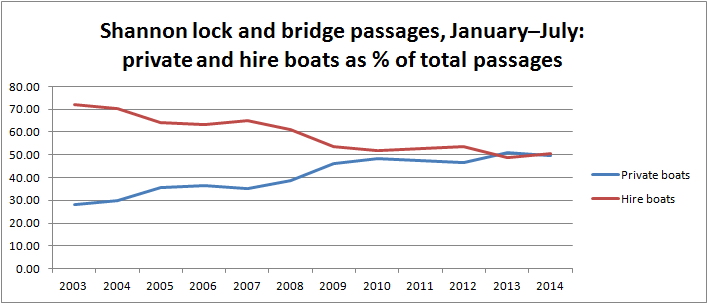
Shannon private -v- hired boats Jan to Jul 2014

Still roughly 50/50

In the year to July 2014, hire-boat traffic was just above private traffic, but there is very little in it. Private traffic is now comparatively more important to Waterways Ireland [which may be why it is now trying to establish its economic importance] but it does not bring in much money from outside the two jurisdictions, so the case for public spending on waterways becomes much weaker.

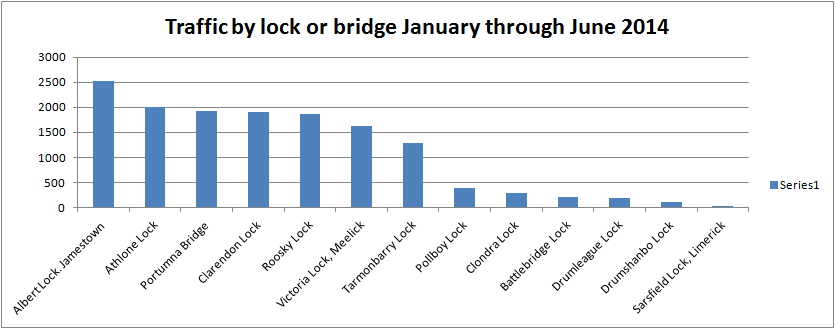
And, quite clearly, opening more waterways doesn’t work: as this chart showed last month, the branches off the main lines of the Shannon, Erne and SEW are little used. The Lough Allen Canal, the Suck and the navigation to Limerick are very little used and I see no sign that the reopened Royal Canal has attracted many visitors to Ireland. What is needed is more intensive usage of the main waterways, not further dilution by the opening of more branches [to Clones or anywhere else].

SnnNav JanJun 6

High and low usage

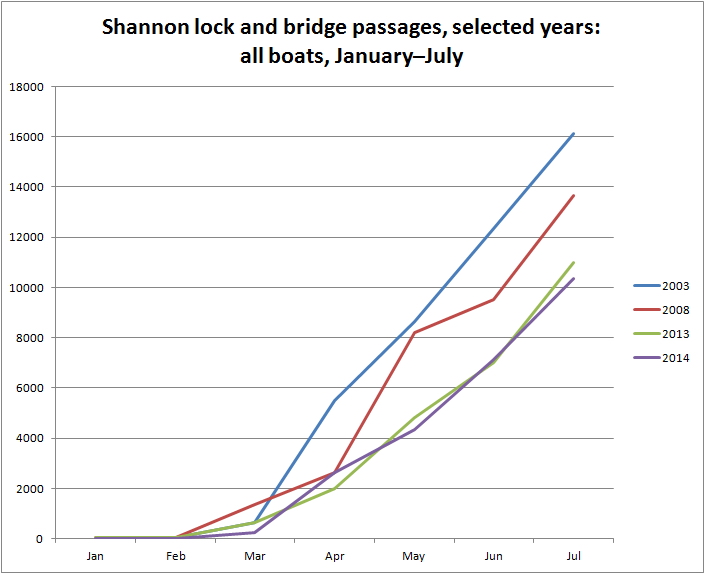
Finally, I thought it might be interesting to see whether the monthly pattern of usage has changed since 2003. To avoid an over-cluttered chart, I included only four years: 2003, 2003 +5, 2003 + 10 and 2014. The chart is for all boats, private and hired.

Shannon all boats by month selected years Jan to Jul 2014

Monthly traffic, selected years

The season seems to have got going earlier in 2003 and even in 2008. Was the weather better in those years?


Survey problems

Back in the dark ages, some unfortunate folk tried to teach me about Statistics, which included how statistical surveys should be conducted. Some snippets of information, perhaps misremembered or misunderstood, came back to me as I read Waterways Ireland’s press release about its research into the contribution of boating to the economy and as I attempted to complete its online questionnaire.

WI commissioned a similar survey in November 2005 (with the results being published in 2006). That survey was carried out on WI’s behalf by the Tourism Research Centre at Dublin Institute of Technology [about whose current status I can find little information]. The TRC folk posted questionnaires to the 6682 boat-owners registered with WI; 54 respondents said that the questionnaire was no longer relevant to them so the population was reduced to 6628. Owners returned 718 questionnaires; 14 were excluded as being incomplete so the 704 were analysed, a valid response rate of 11%.

Participation

The current survey is online. It is said to be “open to all boat owners on Ireland’s inland waterways” but there is no way of restricting participation. Question 1 is “Are you a Boat Owner?” It does not specify that the boat has to be on Irish inland waterways run by Waterways Ireland. However, answering No brings up a page stating, inter alia, “This survey is solely for owners of craft on the inland navigational waterways.”

There is nothing to stop truthful people who own boats on other waterways from participating. There is nothing to stop liars who don’t own boats from participating. There is nothing to stop people from participating twice, or even more often, as long as they delete cookies after each session; that makes the survey open to manipulation by evil-minded interest groups.

And, most significantly, there is no way of assessing whether the average expenditures to be reported by the survey are in any way representative of the amounts actually spent by the body of boat-owners on Irish inland waterways. All that can be said is that the reported results will represent what some people, who may or may not be owners of boats on WI’s inland waterways, said about their spending.

Initial Questions

According to the press release

The survey should take 10-12 minutes to complete.

That may be so if you happen to have all your financial records to hand and if your classification happens to coincide with that used by Waterways Ireland. It took me considerably longer than that, even though my records are all in an Excel spreadsheet. There is no provision for saving your answers and returning to complete them later.

Furthermore, I cheated: the survey asks about spending “between August 2013 to August 2014”; I had figures for y/e 31 December 2013 so I used those.

Q2 asks about gangs whereof you might be a member and Q3 about your three favourite waterways activities; I think you can get away with listing only two, but not only one. Q4 asks “Do you own your own craft outright or shared?” but does not distinguish between sharing with a spouse (or other close family member), sharing with friends and sharing via a commercial syndicate (if there are any: it would be interesting to know).

The next page has five questions: whether you bought your boat new or secondhand (Q5), when you bought it (Q6), how long (in months) you expect to keep it before buying another (Q7), the cost in euro (Q8: I don’t know whether, if you log in from NI, you can answer in sterling) and the number of days each year you spend boating (Q9).

I had difficulty with QQ6 and 7. Q6, for some reason, insists on your entering the day, month and year in which you bought the boat. I know the year, I’m pretty sure of the month but I have no idea of the day. Q7 assumes that you are going to sell your boat: there is no provision for saying “I don’t intend to [or have no plans to] sell it”. I thought I’d get around the problem by saying “ten years”, which meant entering 120, but the survey rejected that, whereas it accepted 99 (and, on later trials, accepted 100). My answer to Q7 is thus inaccurate because the question is badly designed.

That lot is more or less equivalent to QQ 1, 2, 3, 4, 9 and 10 on the 2005 survey.

One other feature of the survey is that error messaages appear in red between two questions; at first you have to guess which answer the system dislikes. And the message I got for entering too large a number for Q7 …

The comment you entered is in an invalid format.

… is not at all helpful: you have to guess what you are to do in response.

Expenditure questions

The next page has the detailed questions on expenditure; they are almost, but not quite, the same as those used in 2005. While that might allow comparison (were it not that the two surveys might be completed by non-comparable groups), some of the initial questions were so idiotic that they should have been dropped. I can’t imagine that anyone other than Ebenezer Scrooge would record a year’s spending on “Sweets/snacks” bought while on board. But there is no provision for showing that you have no records for a particular category: all you can do is record expenditure of 0.

The authors of the report on the 2005 survey said:

Another limitation is that respondents were asked to recall expenditure over a  twelve-month period, which is difficult to do accurately unless precise records are kept during the reference period and this leads to figures based on estimates. One way to address this issue in future studies and to ensure more detailed record keeping in future studies is to introduce an ‘Expenditure Diary’ for Waterways Ireland registered boat owners to track their expenditure.

I suspect that would not have been welcomed but the problem has not, as far as I can see, been addressed in any other way, apart from this instruction at the top of the page:

Please detail all expenditure for the last 12 months only, please ensure all expenditure, including credit card and cash payments.Where the exact value is not known,please give as close an estimate as possible and state clearly that it is just an estimate.

However, if you try to enter anything other than a numeric value (eg “Estimate”) in any of the fields for QQ10 and 12, you get this:

Please enter a positive number.

The questions are grouped in two major categories: Regular Expenditure and Irregular Expenditure. The latter provides for the purchase of a boat but it does not provide for improvements more significant than maintenance (which is under Regular). For instance, if you happen to have added three and a half tons of ballast, there is no suitable category for recording the expenditure.

Here, in flagrant breach of WI’s copyright, but in the interests of allowing folk to prepare their answers, are the expenditure questions.

10. Regular Expenditure (August 2013- August 2014)

Regular Expenditure (August 2013- August 2014)
Mooring Rental (per annum)
Insurance
Fuel
Winter Moorings
Maintenance (to include parts,repairs,servicing,paint.etc)
Equipment (Life Saving Appliances, Fire Extinguishers, Mooring lines etc)
Annual membership fees
Smart Cards
Permits
Lock Passes
Other

11. Please specify equipment purchased/or other expenses
12. Irregular Expenditure (August 2013- August 2014)

Purchase of craft/boat ( within the last 12 months)
Training
Navigational publications – charts, guide, GPS
Hire of boat (if applicable)
Internal transport cost associated with boating
Accommodation while using the waterways
Food in bars and restaurants while using the waterways
Drink in bars and restaurants while using the waterways
Shopping(food) – on board
Shopping(drink)- on board
Newspapers/magazines
Clothing associated with boating
Sweets/snacks
Souvenirs/crafts
Other purchases associated with boating (please detail below)

13. Please specify other expenses

There is some upper limit to the values you can enter in the fields for QQ10 and 12, but I haven’t discovered what it is.

Trips

If you survive that lot, you get asked about your trips.

14. How many boating trips do you take each year?
15. Average number of days spent on each boating trip?
16. Last Boating Trip

What waterway was visited:
How much did you spend on your last boating trip on Ireland’s Inland Waterways(euro):
Number of nights spent on your last boating trip:
Number of people in your party:
Adults:
Children:

17. 2nd most recent boating trip

[same questions][

18. 3rd most recent boating trip

[same questions]

19. Which of the above 3 boating trips was most typical/most accurately reflect your spending patterns?

There is a minor difficulty in that it is assumed that the same number of people was on board throughout. What I see as a more significant problem is that, for those who take their annual holidays “on Ireland’s Inland Waterways”, at this time of year the three most recent boating trips might include (say) a fortnight’s holiday, a weekend and a bank holiday weekend. Only the non-bank-holiday weekend is likely to be typical of trips within the year, but all three might be regular annual events. It is difficult to get that across in answer to Q19.

There seems to be no data validation on that page: ridiculous numbers are accepted, as are waterways that are not run by WI.

The rest

On the next page, QQ20, 21 and 22 ask about age, gender and personal status. Then, on the last, you can (but are not forced to) give your name and email address if you want a copy of the survey results or to get WI mailings.

The value of the survey

I am all in favour of gathering and publishing information. And I appreciate both the difficulty of doing so at low cost and the desirability of maintaining some sort of comparability with the earlier survey. But it seems to me that this survey is seriously flawed: the design of the questionnaire, the restrictions on the answers and the impossibility of drawing any reliable conclusions about the body of inland boat-owners are weaknesses that undermine the value of the exercise.

Having been one of the victims interviewees for WI’s other information-gathering exercise, the Survey of Waterways Users 2010 [PDF], I had reservations about that too, but the method might offer more control and, with better questionnaire design [tested on actual owners], might be applied to the “Economic Contribution” survey as well as to the user survey.

 

Waterways Ireland news

Lots of info pouring from Waterways Ireland at the moment: July Shannon traffic stats, which will take me some time to analyse, serviced moorings in Sallins, digital navigation thingies for the Erne and Lower Bann and an online survey.
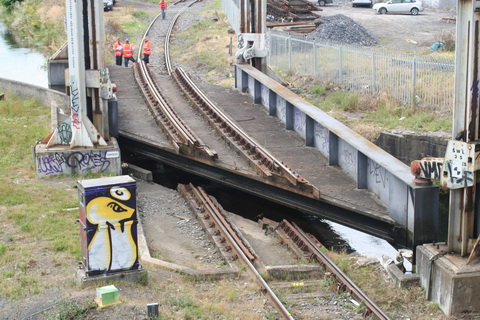
Here’s the press release for navigation thingies. I’ll cover the online survey in a separate message.

Waterways Ireland Pilots Digital Navigation Guides to the Inland Waterways

Waterways Ireland has developed an Online Navigation Guide for the Lower Bann for use on computers, tablets and mobile phones. In a major step change in the presentation of navigation guides for Ireland’s Inland Waterways, Waterways Ireland has, in consultation with user groups, developed, tested and now launched, pilot Online Navigation Guides, designed to provide a convenient alternative to printed navigation guides.

The online guide to navigation has been developed internally within Waterways Ireland using ArcGIS online. This interactive web mapping application details navigation features such as Locks, Moorings, Weirs, Navigation Markers and other facilities along the waterway. These data layers are then overlaid using ArcGIS online web maps. GPS surveys or digitising onscreen using Ordnance Survey Maps have been used to capture the location of features. The application enables the public to pan around the map, identify features, print maps, switch between base mapping & satellite view and switch on and off layers. The Lower Bann Guide is complete and available for free on our website and can be viewed on a PC, Tablet or Smartphone.
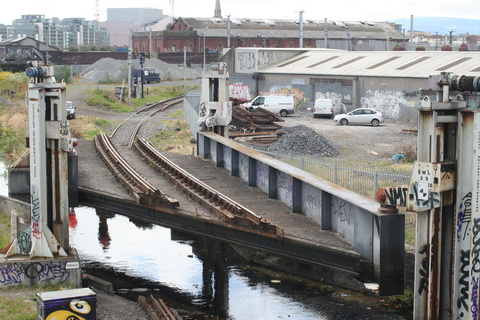
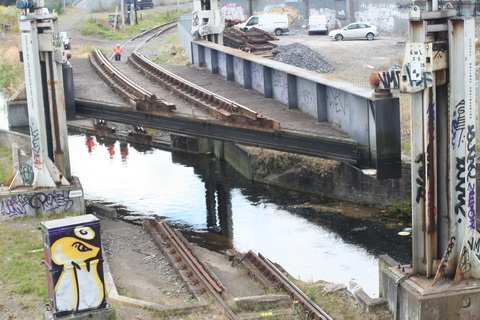
Waterways Ireland will update the maps on an ongoing basis so that the latest navigational information is always available online. Ongoing feedback is welcomed from users to keep the mapping information accurate.

With both the Lower Bann and the Erne System Navigation Guides presently available online, Waterways Ireland is commencing work with user groups on the Shannon and will subsequently cover the remaining waterways.

The maps are available on www.waterwaysireland.org by choosing the waterway and then selected the map tab. To directly access the Lower Bann & Lough Erne Online Navigation Guides, click [this] .

In the initial pilot period, broadband access or a wifi link will be required to use the online navigation guides for the Lower Bann and Erne Systems. Progress is being made on an offline/cached version which will be made available as soon as possible.
It is also planned that the next phase of the Online Navigation Guides will have additional layers of information for waterway & waterside recreational and tourism activity which the user can turn on and off.

In this transition period Waterways Ireland continues to offer a paper product to Waterway users. A comprehensive navigation guide for the Erne System, Shannon-Erne Waterway and Shannon Navigation is for sale at www.shopwaterwaysireland.org for €15/£12.60 and the Lower Bann Guide is also available.


Luddite loons

I have commented from time to time on the reluctance of some Irish folk to move beyond the technologies of the eighteenth century. Thus we find Shinners wanting canals all over the place and folk in Leitrim determined that, if Ireland has oil and gas, they must never be used. [That’s the Leitrim that had both a coal and an iron industry, by the way, as well as hydroelectricity, railways, a brickworks and a dockyard, to name but a few industries that come to mind.]

The latest target of the ire of the Luddites is that newfangled invention, the bicycle. Waterways Ireland might like to provide for folk to cycle along the trackway on the Barrow Navigation; some folk want to keep the dreaded bicycle, and presumably its Lycra-clad users, away from the trackway along which they like to walk.

Happily, some sane folk have written letters to the blatts and IndustrialHeritageIreland has a sensible comment.

I presume that the Luddites insist that the grass be cut using scythes, thus creating much local employment.

New guide to Shannon and Erne

In German. Bit of a coup for Sven and Anita, I think. Hawthorn‘s bow appears in one photo.

Some of Ireland’s competitors on this and the next two pages.

Salmon

In my youth, I tried angling once or twice, but with no success: the only time I ever caught fish was with mackerel feathers. So, despite having read Isaak Walton (several times), angling doesn’t really interest me. But it’s hard to read this without accepting that Something Must Be Done, whatever it is. Note, in particular, Dudley Mallett’s comment.

Loos change as TippCoCo hopes to swipe the loot

Er … sorry about the outbreak of headlineitis: it’s corresponding with journalists that does it.

The Tipperary Star reports (on paper, not on its website) that Tipperary County Council intends to issue “swipe cards for boating facilities along Lough Derg”. Michael Hayes, the engineer for Nenagh Municipal District Council, said that the cards were sold along the Shannon but that the revenue went to Waterways Ireland whereas the council bore all the costs. He is quoted as saying that “We are pursuing it to have them pay some of the costs”: another threat to WI’s budget.

Councillor Phyll Bugler said that it was “not acceptable” that shower and toilet blocks closed early, although she is not reported to have commented on the cost of having staff to clean the blocks late at night.

I suspect that Waterways Ireland’s income from the smart cards is minimal.


Effin mensuration

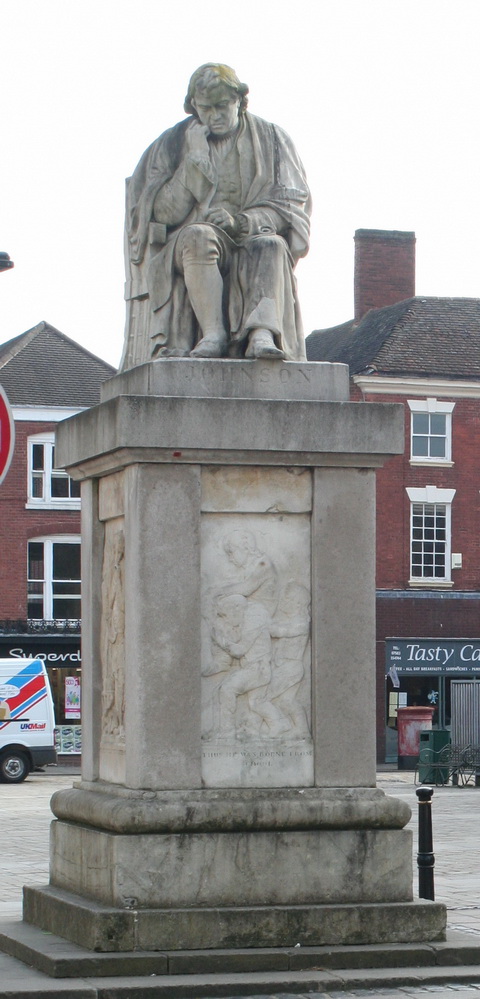
Statue of Dr Johnson near his birthplace in Lichfield

Statue of Dr Johnson near his birthplace in Lichfield

The learned readers of this site will not need to be reminded of the sapient advice of the late Dr Samuel Johnson:

[…] no man should travel unprovided with instruments for taking heights and distances.

There is yet another cause of errour not always easily surmounted, though more dangerous to the veracity of itinerary narratives, than imperfect mensuration. An observer deeply impressed by any remarkable spectacle, does not suppose, that the traces will soon vanish from his mind, and having commonly no great convenience for writing, defers the description to a time of more leisure, and better accommodation. […]

To this dilatory notation must be imputed the false relations of travellers, where there is no imaginable motive to deceive.

Samuel Johnson A Journey to the Western Islands of Scotland W Strahan and T Cadell 1775

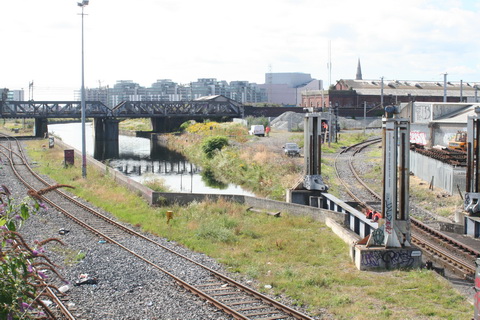
The good doctor would, I think, have welcomed the invention of the digital camera with inbuild chronometer. Equipped with just such a device I arrived yesterday at the first lock on the Royal Canal to witness the lifting of the railway bridge and the passage thereunder of fleets of boats. I thought it would be interesting to record how long each stage took.

I have written before about this bridge: reporting a question by Maureen O’Sullivan TD in October 2013 and another in November 2013 and providing statistics on usage a few days later:

  • only 58 boats went through in 2013
  • the bridge was lifted on seven dates
  • two other scheduled lifts were cancelled as no boats wanted to travel
  • Irish Rail charged Waterways Ireland €1200 per weekday lift and €2000 per weekend lift.

The first 45 minutes

A lift scheduled for early July 2014 was cancelled; yesterday’s lift catered for just two boats, whose passage was assisted or monitored by eight Irish Rail staff and four from Waterways Ireland. Four of the Irish Rail people may have been in training as others seemed to be demonstrating things to them, but that’s only a guess. Three of the WI staff travelled together in WI’s stealth van and operated the first lock; the other, who travelled separately in a 4WD vehicle, visited from time to time. As far as I could see there was no contact between the Irish Rail and WI teams.

The bridge was scheduled to be lifted by 1100.

Before the lift 0945

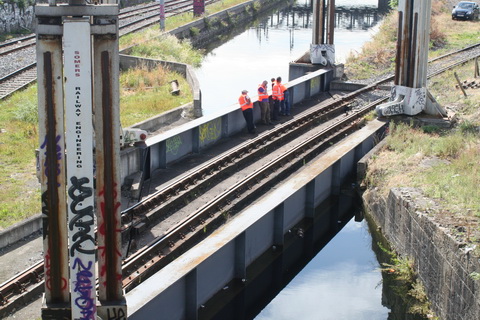
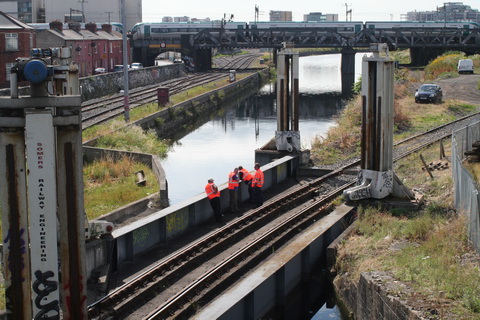
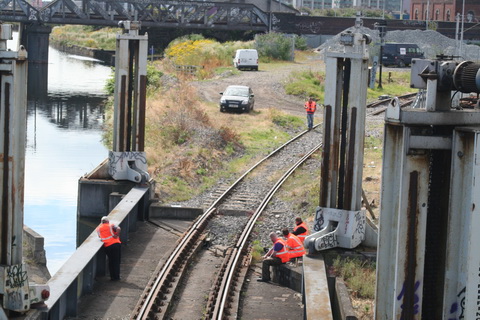
Before the lift: 0945. The lifting bridge is on the right of the photo

Before the lift 0946

One minute later: 0946. A separate group of workers, perhaps contractors, is going down the west side of Spencer Dock with equipment

Before the lift 0949

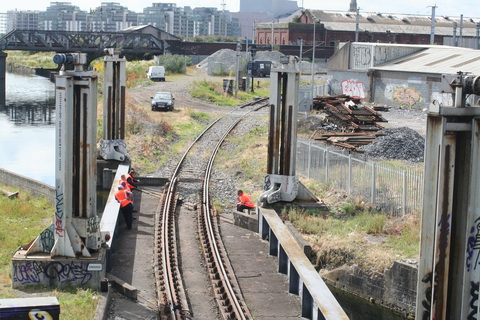
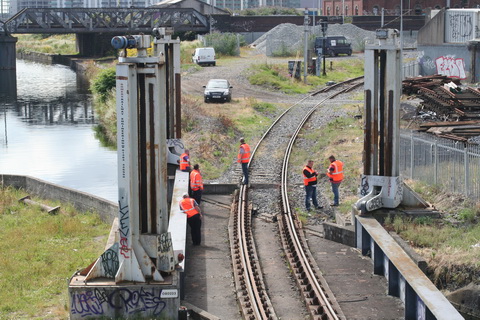
Four men still on the bridge 0949

Before the lift 0951

Two minutes later

Before the lift 0956

On the bridge 0956

Before the lift 0958

Still there 0958

Before the lift 0959

One minute later

Before the lift 1006

The bridge 1006

Before the lift 1012

The bridge 1012

Before the lift 1015

The bridge 1015: another person approaches

Before the lift 1020

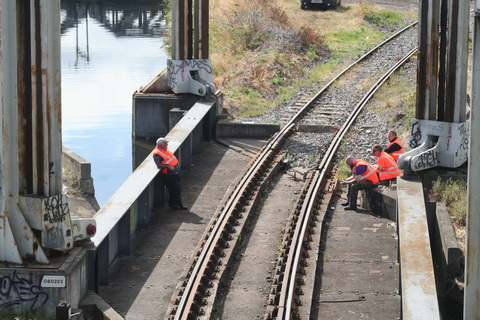
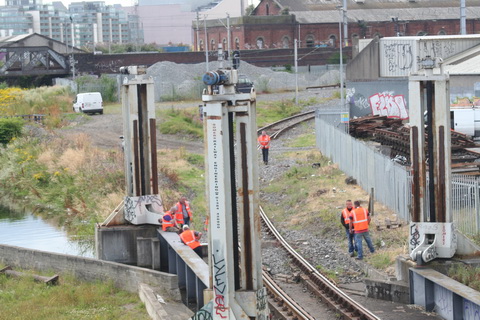
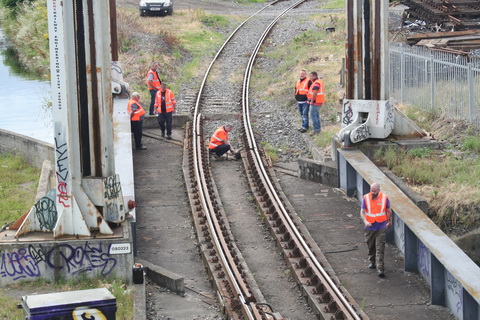
Six men at the bridge at 1020

Before the lift 1028

A seventh man approaches at 1028

Preparing to lift

The preparation stage, presumably involving the unlocking of some mechanism, took about five minutes altogether.

Preparing the bridge 5 mins 03_resize

One man worked on the far end while another walked to do the same at the near end

Preparing the bridge 5 mins 06_resize

An eighth man, behind the fence on the right, seemed to summon two of the men on the bridge

Preparing the bridge 5 mins 14_resize

They went to this building, which I guess houses the controls for the bridge

Preparing the bridge 5 mins 15_resize

Meanwhile work continued on the bridge itself

Preparing the bridge 5 mins 19_resize

Almost done

Preparing the bridge 5 mins 22_resize

A final check

Preparing the bridge 5 mins 25_resize

Everybody was off the bridge by 1033

Lifting

The lift itself took just over nine minutes; the bridge was up before 1044, in good time for the arrival of the boats.

The lift 9 mins 02_resize

After about one minute

The lift 9 mins 08_resize

Another minute later

The lift 9 mins 11_resize

Another minute (or so)

The lift 9 mins 15_resize

About four minutes have elapsed

The lift 9 mins 18_resize

After five minutes. The sides are clear of the water in which they usually rest; they are dripping on to the canal below

The lift 9 mins 20_resize

Six minutes in

The lift 9 mins 23_resize

Seven minutes

The lift 9 mins 24_resize

The men behind the fence may be controlling the lift

The lift 9 mins 28_resize

Not much further to go

The lift 9 mins 32_resize

Eight minutes

The lift 9 mins 40_resize

It’s up

The bridge up 16_resize

One of the jacks

After the boats passed_resize

Side view (taken after the boats had gone through)

The bridge up 13_resize

Water under the bridge

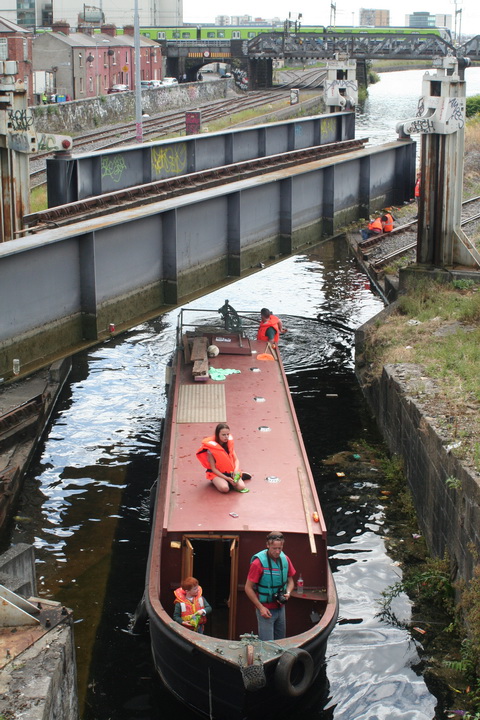
Boats go through

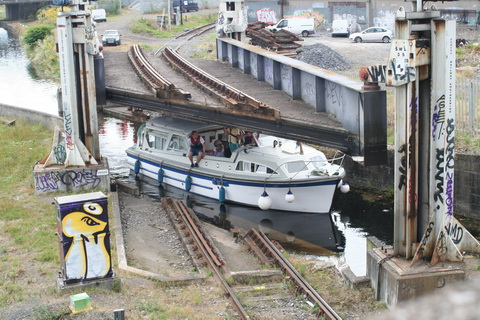
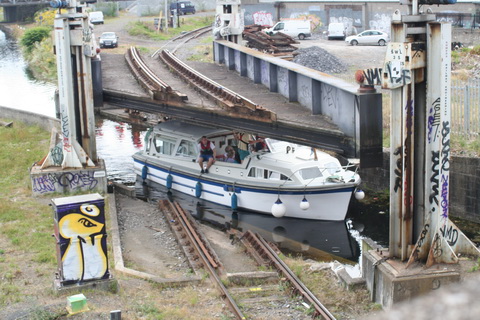
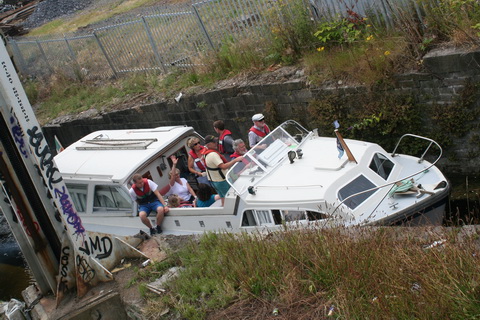
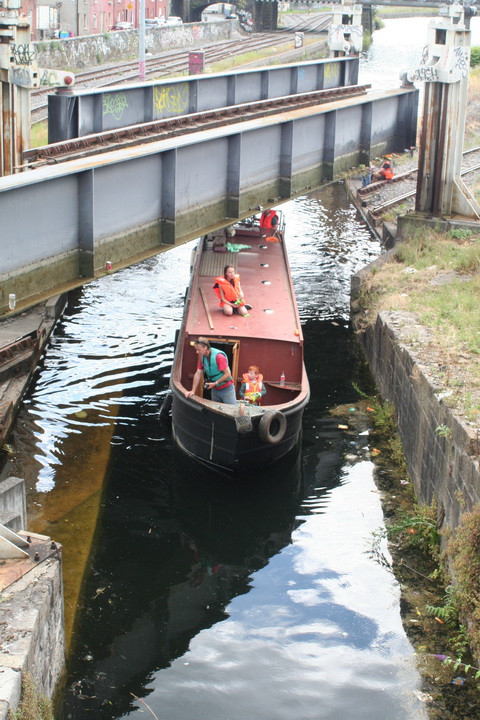
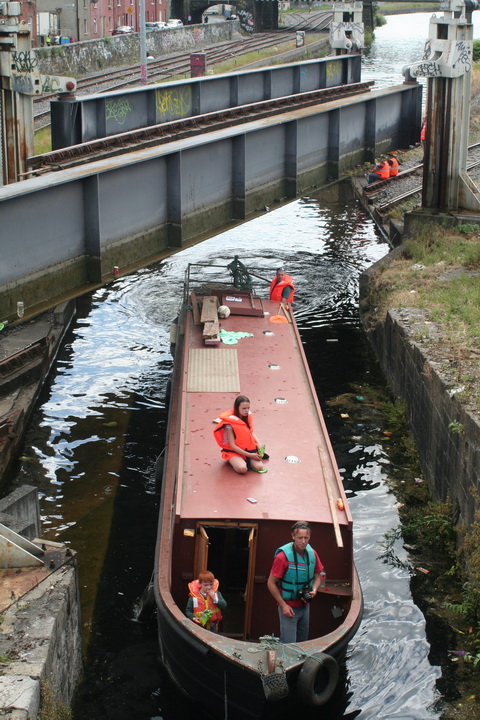
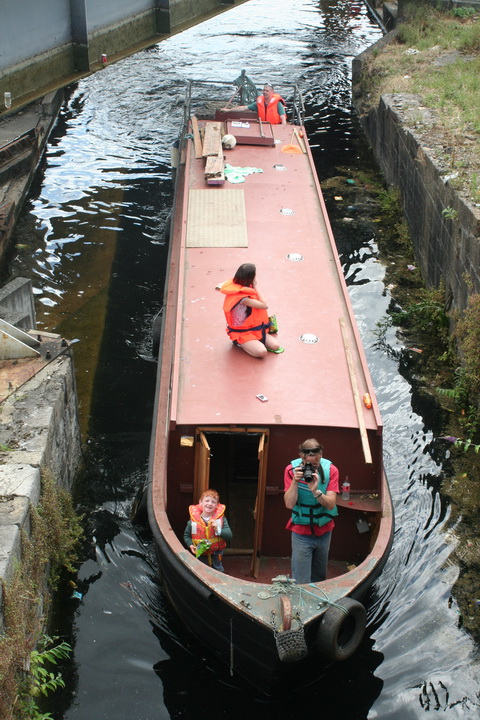
It took just over three minutes for the two boats to go under the bridge.

Boats approach 12_resize

Cruiser approaches; steel boat visible through the bridge

Cruiser goes through 03_resize

Cruiser about to enter

Cruiser goes through 04_resize

Heads down

Cruiser goes through 06_resize

Half way through

Cruiser goes through 07_resize

Leaving

Cruiser goes through 08_resize

Out

Steel boat goes through 12_resize

Steel boat entering

Steel boat goes through 20_resize

Almost through

Steel boat goes through 22_resize

Looking ahead to the lock

Steel boat goes through 25_resize

Done


I did not record the lowering of the bridge, which I presume took much the same time as the raising.

Preparation 5 minutes, lifting 9 minutes, passage 3 minutes, lowering and locking say another 14 minutes: say 45 minutes altogether, allowing some margin. But a large number of boats would take much longer as the rate at which they could move on from the bridge would be limited by the time taken to work through the lock.