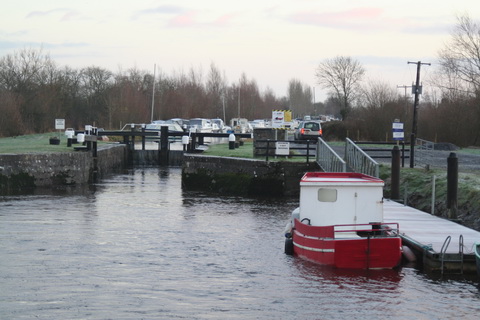
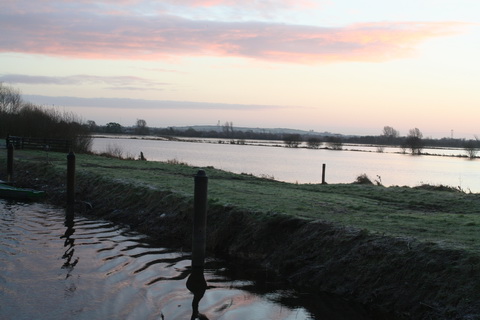
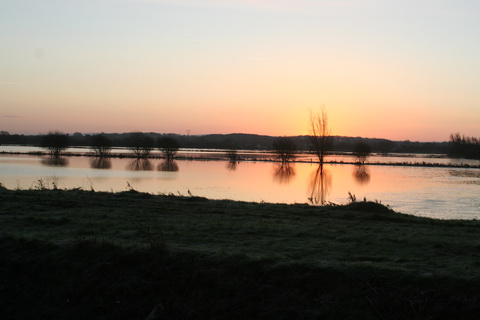
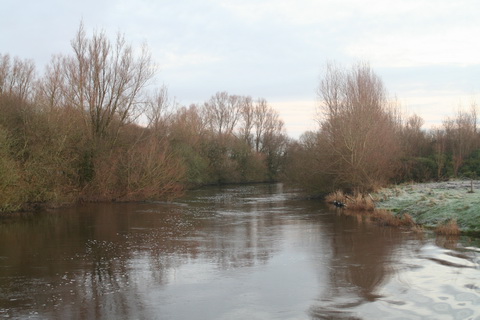
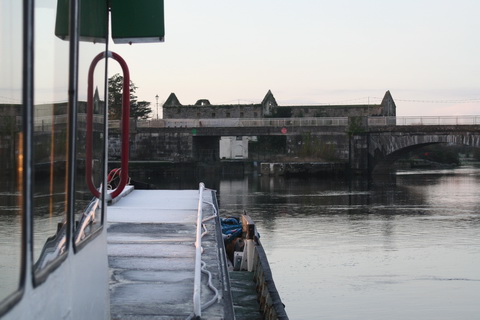
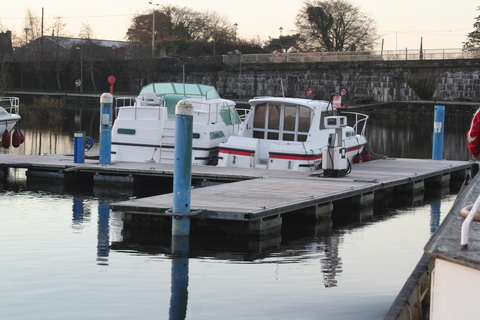
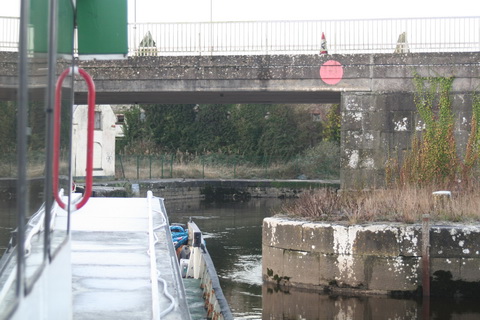
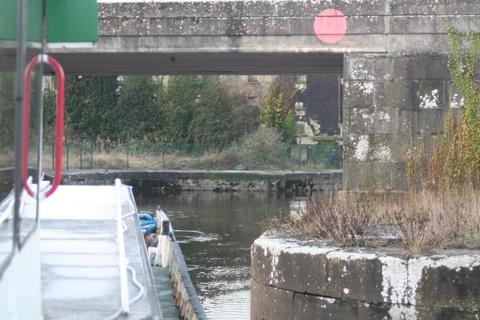
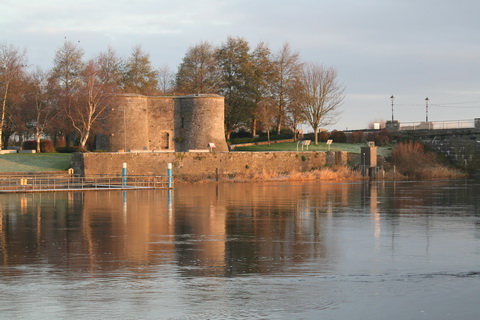
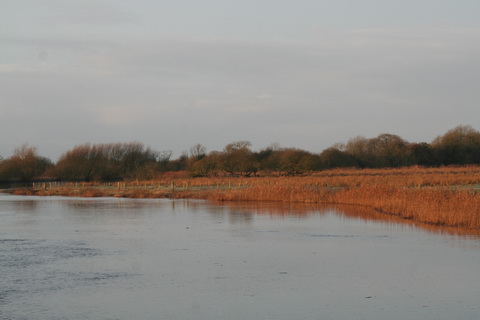
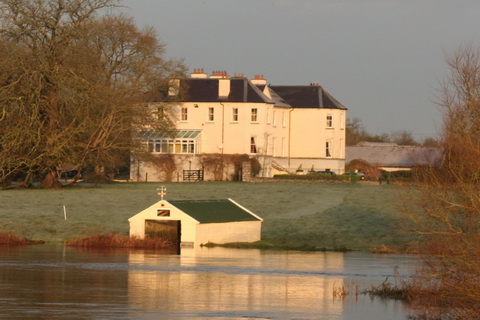
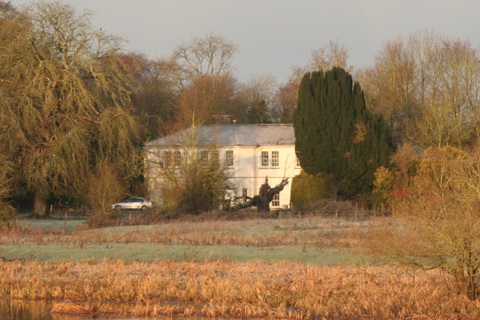
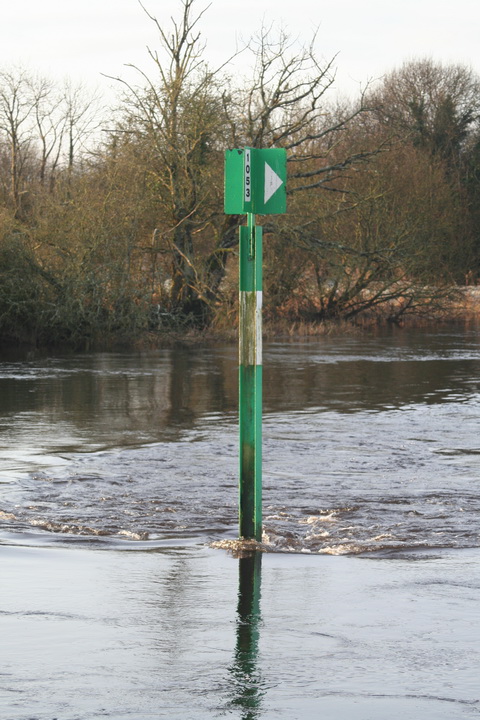
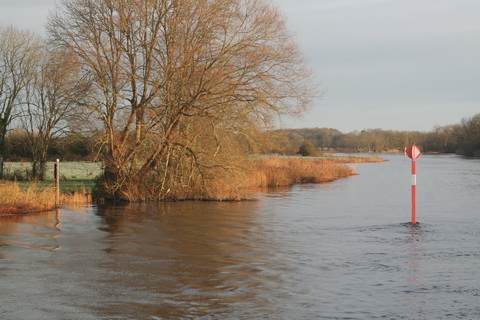
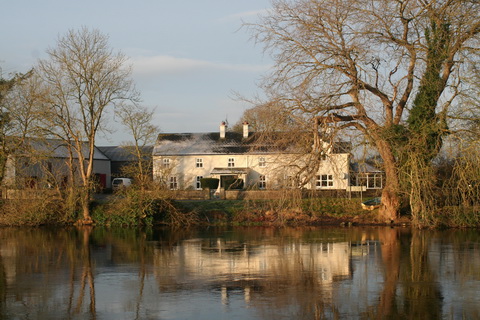
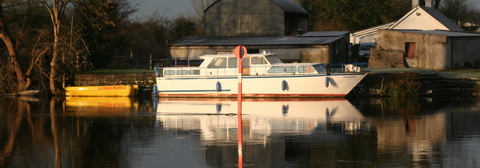
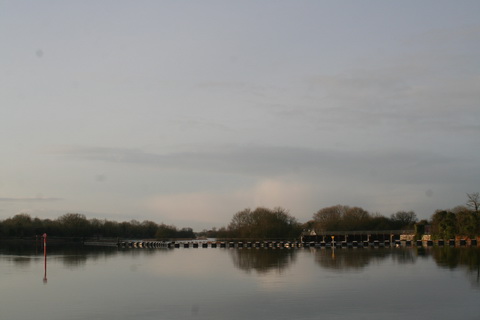
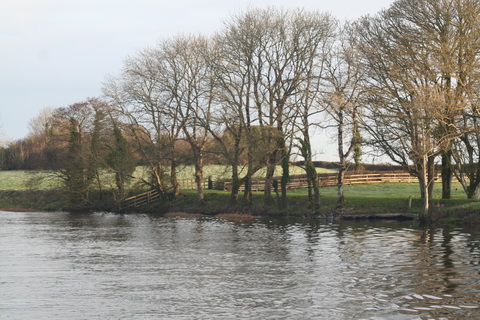
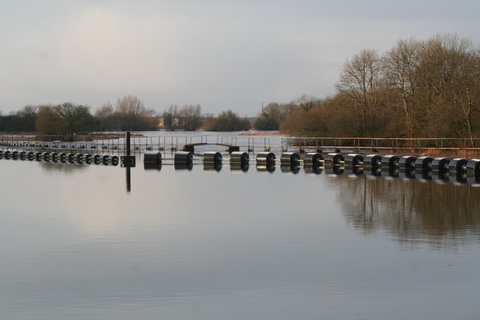
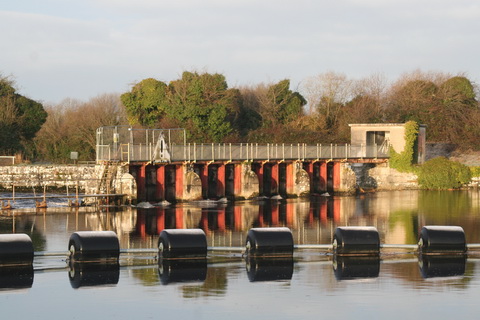
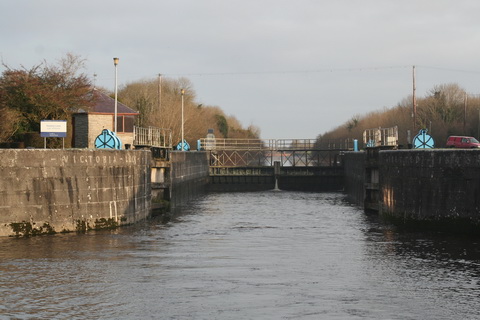
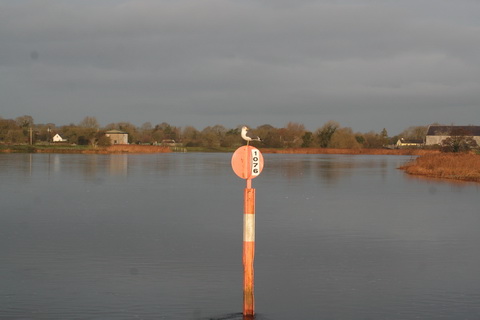
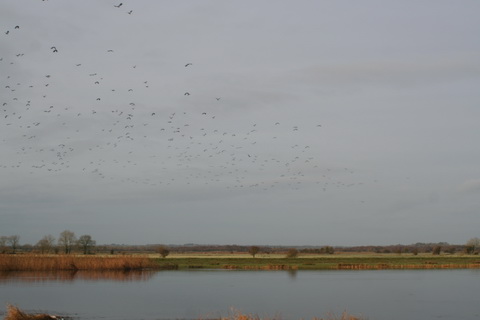
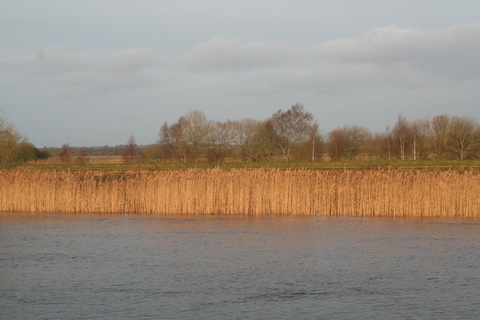
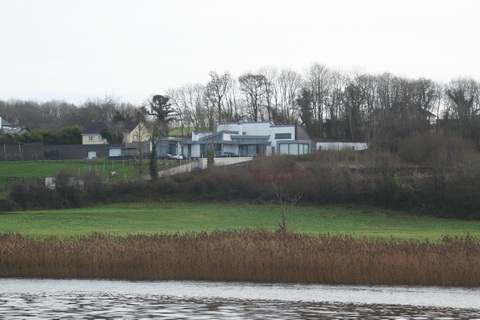
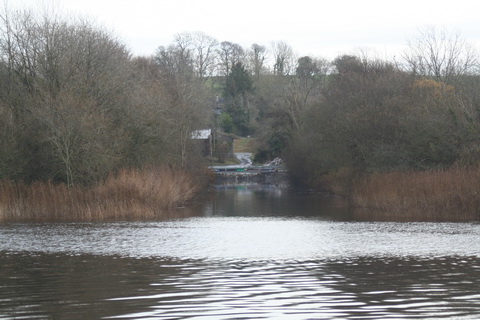
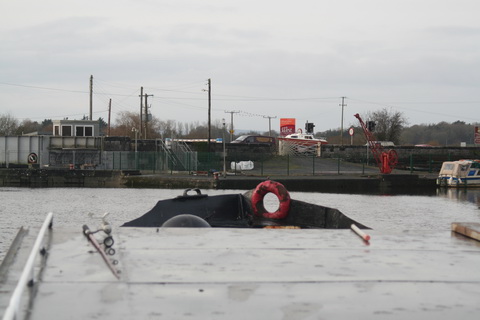
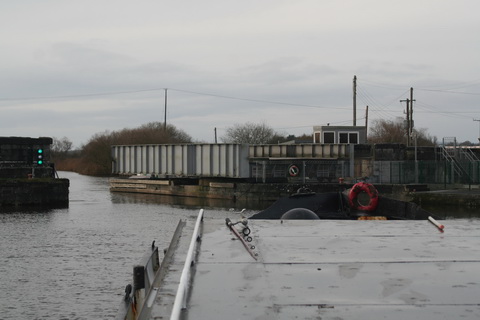
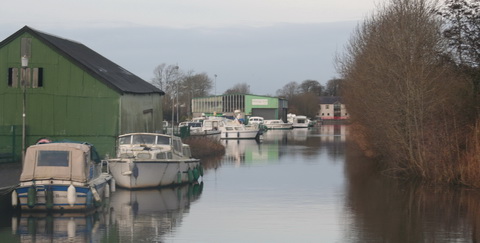
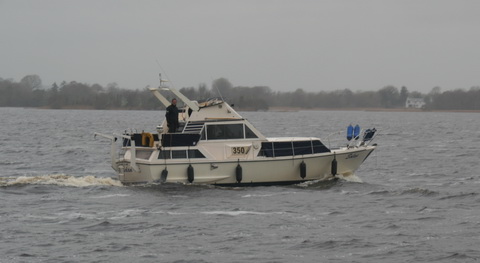
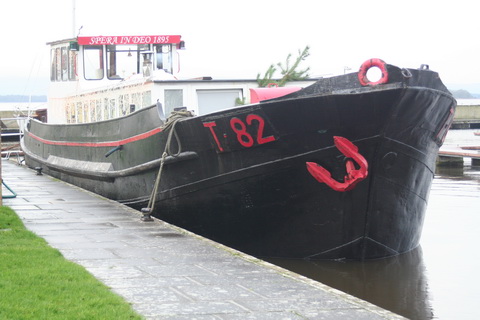
Downriver from Shannon Harbour to Dromineer in December 2014. It began as a bright, cold morning.
There is a YouTube video of the shooting of the bridge here. It seems to start automatically, including sound; I don’t know how to avoid that.
I have written here about a series of misfortunes suffered by DUKWs in Liverpool and London. On 16 June 2013 I put up some photos of DUKWs in Dublin and Liverpool; I pointed to what seemed to me to be two differences between practices in the two cities:
First, before they enter the water at Grand Canal Dock, Ringsend, the DUKWs are fitted with extra buoyancy in cylinders that slide into racks along their sides. I saw the VikingSplash crew removing the cylinders from the yellow DUKW; it took only a couple of minutes, and I presume that it didn’t take much longer to put the cylinders on.
Second, the Dublin passengers are issued with buoyancy aids before they take to the water. I can’t see any buoyancy aids on the Liverpool passengers, although it’s possible that they are out of camera shot.
There are links on that page to photos, news reports and a seriously scary video of the sinking of a DUKW in Liverpool. Then, in September 2013, a DUKW went on fire on the Thames; my brief report and links here. In October 2013 the UK Marine Accident Investigation Branch issued a safety bulletin (my report here, with links) pointing to foam buoyancy as a common factor. The Liverpool DUKWs did not have enough buoyancy to keep them afloat if they started taking water and MAIB thought it would be impossible to get enough into them. On the London vessel,
… the most likely cause of fire was the action of the rotating drive shaft (or other moving parts) on the oil contaminated surfaces of the buoyancy foam blocks.
In November 2013 I noted that the wearing of lifejackets had been discussed in London and I commented on the policy of the Dublin operator, VikingSplash:
The point that strikes me is that, in both UK accidents, passengers had little time to don lifejackets and would have been trying to put them on in a confined space and under less than ideal conditions. It seems to me that Viking Splash’s policy [having passengers don lifejackets before taking to the water] is the right one.
In December 2014 the MAIB published its report into the two accidents. There’s a Guardian news report here [h/t gjb] and you can download the MAIB’s full report and annexes from this page. The London and Liverpool accidents are covered in the same report.
It’s well worth reading and pulls (as far as I could tell) no punches, even tearing strips off the Maritime and Coastguard Agency and the Vehicle and Operator Services Agency, both within the UK Department for Transport and both involved because the DUKW is an amphibian.
I took three main points from the report.
First, the Irish authorities seem to have thought seriously about the safety problems. My understanding of the buoyancy requirements was mistaken: the UK DUKWs had added buoyancy (although not enough, and adding more foam caused fire) and the Irish buoyancy cylinders are not designed to keep the vessel afloat. Here’s what MAIB says:
In Ireland, APV operators have been permitted to operate vintage DUKWs without having to provide any residual buoyancy. To mitigate the consequences of serious flooding, the Irish regulator required the operators to:
- Fit external buoyancy tubes designed to slow the sinking process and make the vehicle sink bodily [my emphasis].
- Retract the canopy roof and open the side curtains prior to entering the water.
- Require passengers and crew to wear PFDs while on the water.
- Provide a fast rescue craft, rescue crew and an inflatable liferaft at the slipway.
- Limit operations to a non-tidal area.
This approach focused on passenger survivability by reducing the risk of entrapment and drowning, rather than vehicle survivability, and introduced several of the interim measures recommended by the NTSB following the sinking of Miss Majestic.
The Irish model demonstrates that open topped APVs can be operated successfully in similar weather conditions to those experienced in the UK, and that passengers are willing to wear PFDs.
So big it up for the Irish Maritime Administration.
Second, if you’ve seen the video of the Liverpool sinking you may have been struck by its speed. In both Liverpool and London passengers had very little time to get out and the report’s synopsis says
In both instances, the crew had little time to co-ordinate the evacuation process and the confined nature of passenger spaces made it almost impossible for them to control or assist the passengers.
And in 4.3 Common safety issues:
8. It was extremely fortunate that all on board WQ1 and Cleopatra were able to evacuate into the water unharmed. In both cases the passengers were forced to act on instinct and exit the vehicles under their own initiative.
Any of several issues could have cut the time available and “the risk of entrapment and the likelihood of loss of life would have been considerably higher”.
So Figure 63 of a Dublin DUKW doesn’t just show the external buoyancy cylinders: the passengers are wearing buoyancy aids, there is a crewman already stationed at the stern and the side and roof canopies are open, all giving more chance of escape.
I’m not in any position to assess the overall safety of the Irish DUKW operation. What interests me here is a more general point about the evacuation of passengers from trip vessels: getting a large number of people out of a small space in a short time is not easy. And the recent problem of getting people off the Norman Atlantic didn’t make me feel any better.
Third, I am delighted that my photo of a DUKW in Liverpool was useful to the UK Marine Accident Investigation Branch (see the report’s Figure 16) but they really should have asked for permission to use it.
Posted in Economic activities, Engineering and construction, Extant waterways, Foreign parts, Ireland, Irish inland waterways vessels, Operations, Safety, Sources, Tourism, waterways, Waterways management
Tagged Dublin, DUKW, fire, Ireland, Liverpool, London, safety, sink, vessels, Waterways Ireland
I mentioned back in October 2014 that the Joint Oireachtas Committee on Jobs, Enterprise and Innovation (whom god preserve, although I don’t know whether they have any connection with Utrecht) had applied its collective mind to COM (2014) 452. And I’m sure we were all very relieved at the news.
Regular readers, a well-informed lot, will not of course need to be told what COM (2014) 452 is all about. However, in case you’re new here, perhaps I should explain that COM (2014) 452 is a proposal for a European Council directive implementing the European agreement concluded by the European Barge Union, EBU, the European Skippers Organisation, ESO, and the European Transport Workers Federation, ETF, concerning certain aspects of the organisation of working time in inland waterway transport.
And rightly so, I hear you say. But the Joint Oireachtas Committee on Jobs, Enterprise and Innovation “agreed that this proposal warrants further scrutiny”, which is slightly odd given that (a) Ireland has no inland waterways transport and (b) the members of the Joint Oireachtas Committee on Jobs, Enterprise and Innovation presumably have other things they could be doing with their time. However, I thought (after wading through the gobbledegook) that the proposal might affect hours of work on the half dozen or so trip-boats on Irish inland waterways.
Well, the Joint Oireachtas Committee on Jobs, Enterprise and Innovation has been giving the proposal more scrutiny. It — or at least its chair, one Marcella Corcoran Kennedy, a Fine Gael TD for Banagher (where there is a trip-boat) and some other places — recommended that
[…] the committee consider the merit of the submission of a political contribution on this proposal. The political contribution would focus on the following: the committee’s concern regarding the lack of clarity in the scope of the agreement from a sufficiently early stage; the fact that an exemption was not carved out for Ireland and other member states, as had been done previously; the issue of proportionality; and that the committee recommends in future proposals which relate to sector policy areas within which certain member states have traditionally been exempted should indicate clearly from the beginning the intended scope of application, and this would allow member states the full opportunity to scrutinise the proposal and submit a reasoned opinion within the allowed 56 day timeframe.
That seems to mean “we didn’t read the stuff properly when it came out”. But the other members agreed to the recommendation: in fact their combined contributions spent more time on wishing each other happy xmases than on debating the proposal. I hesitate to suggest that they hadn’t actually read it, but the report of proceedings provides no evidence that they had done so. Any members of the JOC who wish to prove their mastery of the issues are invited to leave Comments below.
The upshot is that Ireland, which has no inland waterways transport, is to submit an objection, on procedural but not on substantive grounds, to a proposal that seems to have emanated from countries where there are real inland waterways transport industries. It seems that Ireland is following the lead of Her Majesty’s Government across the water, which is always nice.
Of course, the United Kingdom has no serious inland waterways transport either. And, as far as I can see, neither Cyprus nor Malta, the other driving-on-the-left imperial remnants that joined the resistance movement, has any inland waterways, never mind any transport thereon. Checking on waterways in the Czech Republic, Estonia, Greece and Hungary, the other heroes of the people’s revolution, is left as an exercise for the reader.
So we have countries with no serious inland waterways transport objecting to arrangements made by and for those who have real waterways. That should make the remnants of empire popular.
No doubt the members of the Joint Oireachtas Committee on Jobs, Enterprise and Innovation reached their decision on opposing the proposed EU directive after appropriate analysis and consideration. They have not, alas, revealed the results of either of those processes. It would be nice to know who in Ireland would be affected by the proposed directive and what representations such persons have made to the Joint Oireachtas Committee on Jobs, Enterprise and Innovation.
See the bottom of a lock (with no water in it). This is Carpenters Road Lock in London, which also featured here.
h/t CELR
Posted in Built heritage, Canals, Economic activities, Engineering and construction, Extant waterways, Foreign parts, Industrial heritage, Operations, Restoration and rebuilding, waterways, Waterways management
Tagged canal, canal & river trust, Carpenters Road Lock, gates, lock, Operations, sill, stop-planks
An interesting piece of information from Waterways Ireland’s feasibility study on the restoration of the Longford Branch of the Royal Canal. We learn on page 44 that the Royal Canal needs, on average, 10 million gallons of water per day to cope with “lockages, leakage, seepage and evaporation” and that the current supply arrangements, with much pumping, are costing €300,000 a year.
Posted in Ashore, Built heritage, Canals, Drainage, Economic activities, Engineering and construction, Extant waterways, Industrial heritage, Ireland, Operations, Restoration and rebuilding, Sources, waterways, Waterways management, Weather
Tagged evaporation, gallons, Ireland, leakage, lockage, Operations, pump, pumping, Royal Canal, seepage, water level, water supply, Waterways Ireland
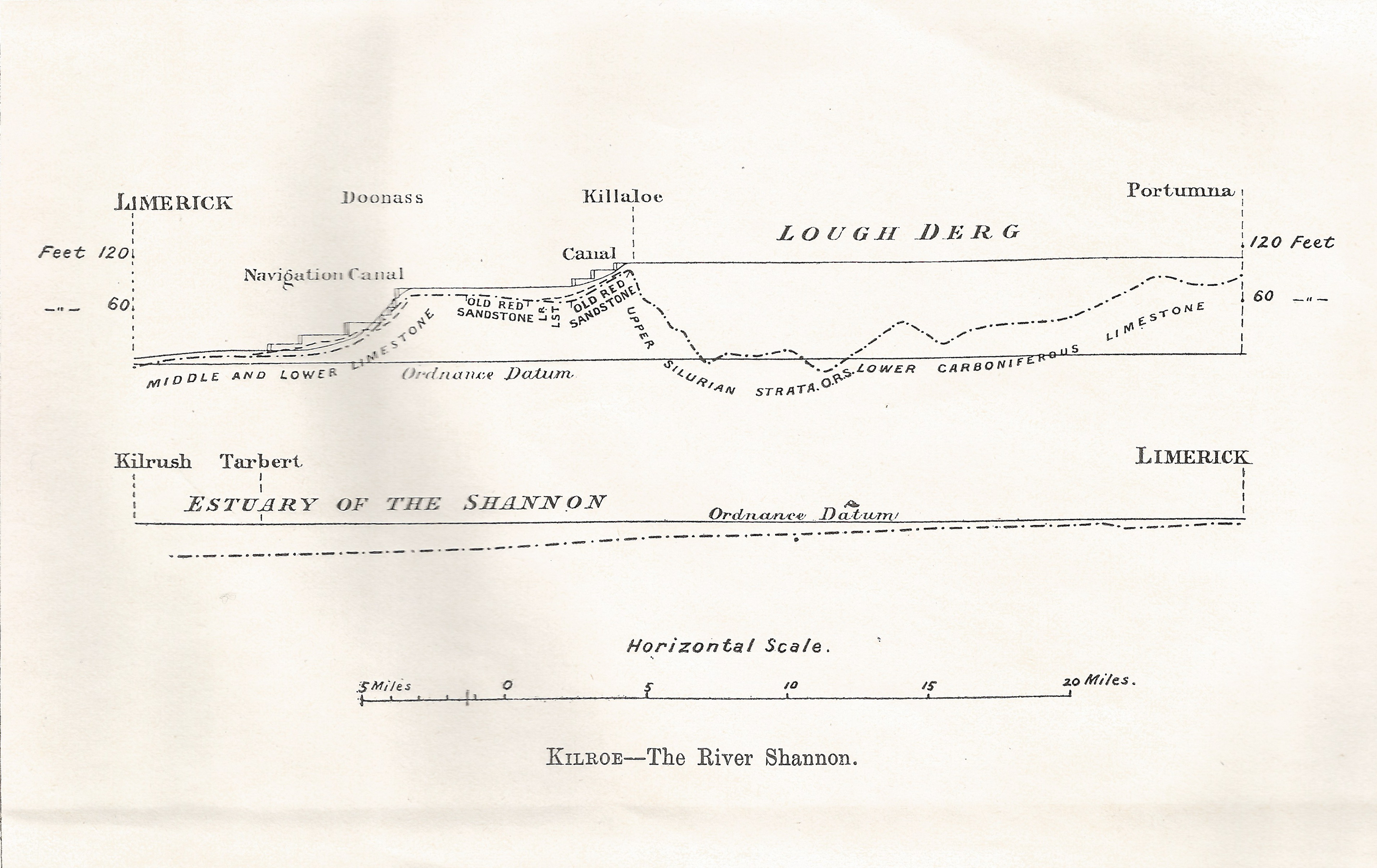
On 28 January 1907 James Robinson Kilroe [near the bottom of the page] of H M Geological Survey read to the Royal Irish Academy a paper on “The River Shannon: its present course and geological history” [Proceedings of the Royal Irish Academy Vol XXVI Section B No 8 Hodges, Figgis & Co Ltd, Dublin; Williams & Norgate, London 1907]. I thought that Plate V was interesting.
Kilroe wrote:
It will be perceived that instead of the river being shallow over the unyielding Silurian slate-rock, set almost vertically, and striking across the river-course, it is deeper than over the limestone of Lough Derg, and much deeper than over the comparatively easily eroded Old Red Sandstone at Killaloe. The river-bed actually drops below the datum line above the town, while at the town it is 100 feet above datum.
Old Red Sandstone strata are here to be seen in the river-bank, and Silurian rocks in situ in its bed. A barrier is thus formed, partly of Silurian, and partly of Old Red Sandstone rocks, which without the artificial impounding weir would retain the waters of Lough Derg to a depth of some 104 feet opposite Derrycastle — two miles above Killaloe.
One might have expected to find a fairly level shallow bed from Killaloe northward, a sudden drop from slate-rock to the sandstone floor, and a pronounced wide, well-formed valley in the limestone district southward to Limerick.
None of these elements exist; instead, we have the formidable barrier at Killaloe, naturally damming up a considerable depth of water in Lough Derg, and the river falling away southward by a series of rapids which correspond with drops in the canal, south of O’Briensbridge […], along an alternative course, possibly one used by a branch of the Shannon.
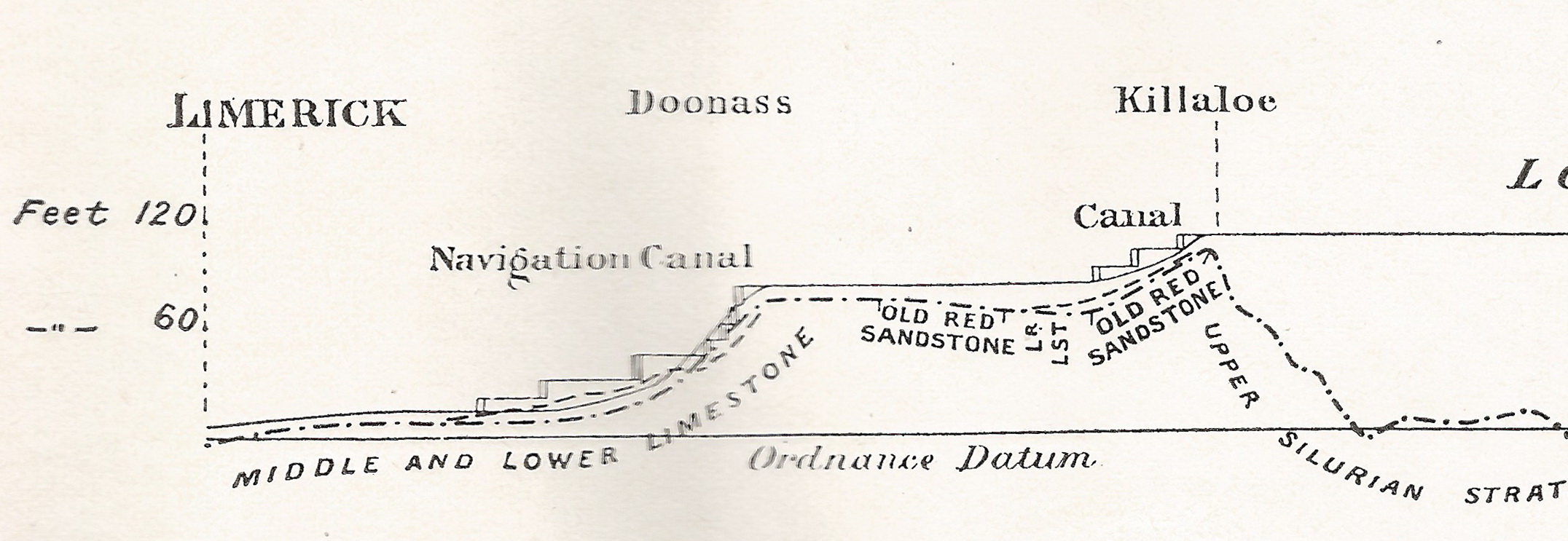
Here is an extract from the Plate V map, showing the steps of the (pre-Ardnacrusha) Limerick Navigation between Lough Derg and the sea.
Kilroe wrote of Lough Ree:
The waters of Lough Ree stood some 10 feet higher within recent times than they now do, as proved by evidence of solution, with under-cutting of limestone blocks, to be seen about five miles north-west of Athlone, close to the railway, in the townland of Cornaseer.
Under these conditions the lake must have been, perhaps, twice its width, and for a considerable period. Its ancient surface-level is clearly indicated by the caps of the mushroom-shaped blocks.
And of the Shannon between Lough Ree and Lough Derg:
The extreme flatness of the river between Athlone and Meelick is such that, consequent upon the completion of the Suck Drainage-works in 1892, it was found that the callows along the Shannon above the confluence of the Suck at Shannonbridge were much more liable to sudden and frequent floodings than they previously had been.
The more rapid discharge of the Suck waters into the Shannon, before ordinary extra water had time to pass away, had the effect of modifying the regimen of the main stream to an extent which resulted in an action at law [La Touche -v- The Suck Drainage Board].
I have found only one account of that case, in the Freeman’s Journal of 1 July 1893. The plaintiffs, Messrs Harrison and La Touche, owned land at Cappaleitrim, on the west bank of the Shannon above Shannonbridge. They said that the actions of the Suck Drainage Board had caused their lands to be flooded:
[…] that the defendants brought water from the Suck into the Shannon, containing a drainage of 40 miles, with such velocity and such volume that the Shannon was penned back, and that the back water caused the damage to the lands complained of.
[…] The jury disagreed and were discharged.
I don’t know whether the matter ever again came before a judge.
Posted in Ashore, Built heritage, Canals, Drainage, Economic activities, Engineering and construction, Extant waterways, Industrial heritage, Ireland, Irish waterways general, Natural heritage, Operations, People, Safety, Shannon, Sources, The cattle trade, waterways, Waterways management, Weather
Tagged bridge, canal, Cappaleitrim, Cornaseer, Doonass, drainage, estuary, floods, flow, Ireland, Killaloe, Kilroe, Limerick, lock, Lough Derg, Lough Ree, O'Briensbridge, Operations, RIA, Shannon, Shannonbridge, Suck, water level, waterways
Messrs Pesda Press have a new book on Canoe Camping. I haven’t read it, but Pesda produced the excellent Oileáin, David Walsh’s superb guide to 570 Irish offshore islands, many of them most easily accessible by kayak. With more emphasis on the development of blueways and canoe trails in Ireland, Tim Gent’s book on canoe camping might be of interest to canoeists and kayakers and to those providing facilities and services for them.
Big it up for Messrs Breakingnews.ie for the information that the European Commission is taking Ireland to court over the ludicrous regulations for the use of green diesel in private pleasure craft. The topic has been covered here more than once, most recently here; I discussed the ludicrous regulations here.
Breakingnews.ie says that Ireland ignored the EU’s “letters” (presumably the Reasoned Opinion) on the subject. That is consoling, because my own requests for information about Ireland’s response to the Reasoned Opinion have likewise been ignored.
The EU’s press release is here; the EU notes that
While Irish law requires craft owners to pay to the Revenue the difference between the tax paid on marked gas oil and that due if the gas oil had been charged at the standard rate, the low number of tax returns indicate that the minimum level of taxation is not applied.
Indeed.
Posted in Economic activities, Extant waterways, Ireland, Irish inland waterways vessels, Operations, People, Politics, Sea, Shannon, Tourism, Uncategorized, Water sports activities, waterways, Waterways management
Tagged green diesel, Ireland, mineral oil tax, Operations, revenue commissioners, Shannon, waterways