Category Archives: waterways

Co Offaly: too dangerous to visit?

One Marcella Corcoran Kennedy, a Fine Gael TD in Co Offaly, has been issuing press releases (I presume) to get her name in the local blatts. It seems that there is a major crime wave in Co Offaly and that armed Gardaí are required to counter it, as well as Garda stations every couple of hundred yards. Perhaps tourists should be advised to avoid the county.

Anyway, the blatt’s account ends with this:

I intend also to support An Garda Síochána with their proposal to have Shannonbridge Garda Station re-opened due to its strategic location on the Shannon River.

Shannonbridge is strategically located if you want to be able to repel a French invasion force that landed on the west coast. It is also strategically located if you want to protest against Ireland’s unwillingness to slow global warming. Otherwise it is hard to see any strategic value, unless the Gardaí are reviving their nonsensical idea about smuggling by boats along the Shannon.


Lock lox

Fishing extraordinary
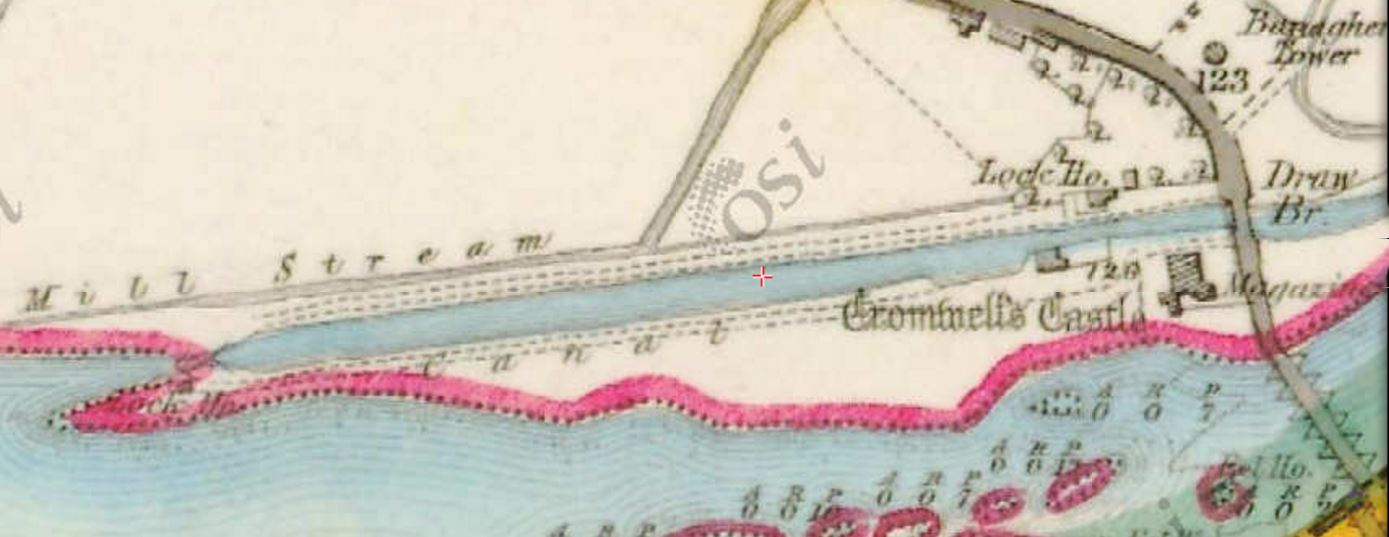
Banagher: the old canal (OSI 6″ map ~1830s)

Banagher, June 13. On Friday evening last a scene of a truly interesting nature to all lovers [of] angling took place near the old bridge which crosses the Shannon at Banagher, in the King’s County. An old and experienced fishermen, well known in that part of the country by the appellation of Tugg, between the hours of seven and eight o’clock in the evening, hooked a salmon of enormous weight and strength, a little above the bridge; the fish, after making a few violent efforts to extricate himself —

Flew through the glassy waves with finny wings,
Whilst Tugg still kept behind.

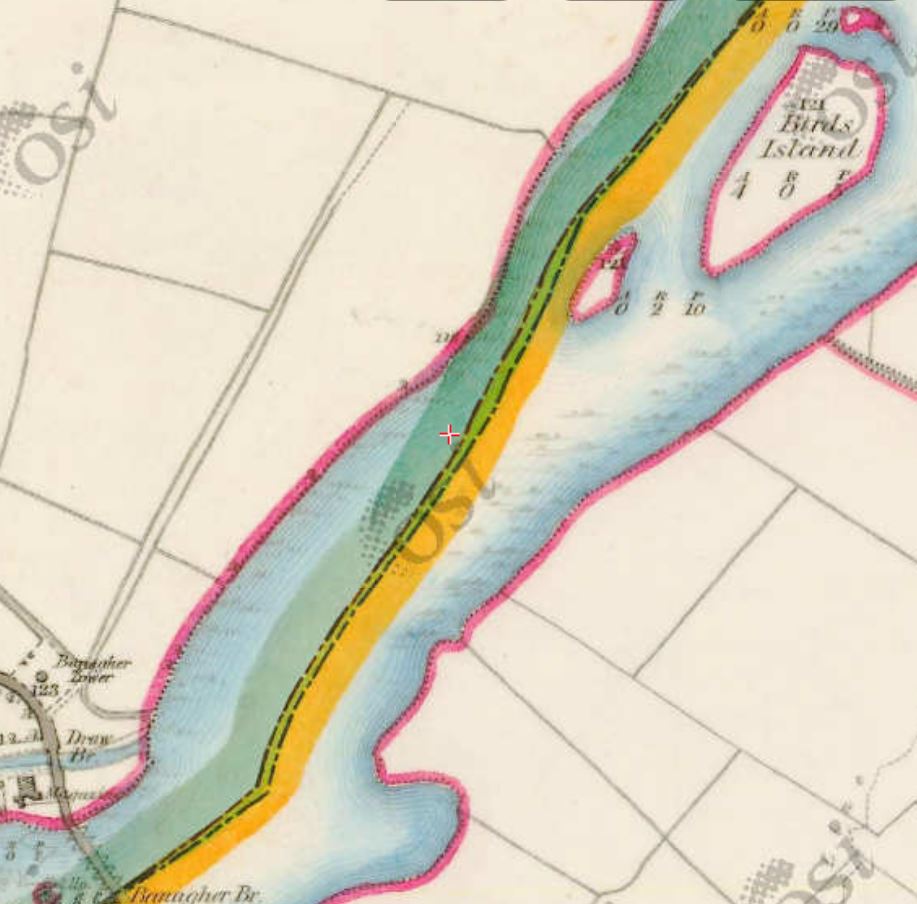
From eight until past eleven the contest was carried on with doubtful success, in nearly the centre of the river, which is here about half a mile wide — during which time the salmon was played (as anglers term it) up the stream, as far as Bird’s Island, a distance of more than an English mile from the place where the fish was first hooked; still the salmon was unwearied, and struggled as hard as when first hooked, notwithstanding the utmost skill of Tugg to weaken and bring him within reach of the gaff.
Bird’s Island, Banagher Bridge and the head of the canal (OSI 6″ map ~1830)

The town clock struck twelve at night, and yet victory had not declared for the indefatigable Tugg. Three hours more rolled by, when Tugg, nearly as exhausted as his adversary (after nine hours’ display of the utmost skill and perseverance in the Piscal art), had recourse to a strategem by which he made himself master of his finny prey.

Connecting the navigable parts of the Shannon above and below the bridge at Banagher, is a canal of about half a mile in length; into this canal, Tugg, with his wonted skill, coaxed the fish, and then letting him down to the lock, at the farther extremity, the upper gate of which had been opened to receive him, he was allowed to pass in, and the gate being immediately closed, the water was let off by the lower one, and thus the finny monster became an easy prey.

The salmon weighed 43½ lbs, and was presented by honest Tugg to our worthy and highly esteemed Magistrate, Thomas George Armstrong Esq of Gavey Castle. The sporting gentry of Banagher and its vicinity intend raising a sum by subscription to reward poor Tugg, in testimony of their approbation of his unwearied assiduity, skill, and, above all, for the strategem by which he became at length master of this noble fish.

Dublin Mercantile Advertiser, and Weekly Price Current 28 June 1830

That it should come to this …

A blue sleeping bag discarded near Binns Bridge in Drumcondra is the only clue that people once slept there.

On Thursday 2 November, fast and high waters covered the area under the bridge, and the pathway on either side of the canal that used to run under it.

In July this year, Waterways Ireland raised the water level to prevent homeless people from sleeping under the bridge, a spokesperson confirmed.

From a story by Laoise Neylon in the Dublin Inquirer on 8 November 2017. Well done to Ms Neylon for going and finding out stuff rather than just recycling press releases.

Here’s a map of the areas of the Grand Canal where eviction notices were served [PDF].

There must be some better way of responding to homelessness than by flooding people out.


Hamilton Lockhouse …

… is for sale.

h/t Ewan Duffy

Killaloe in the age of steam

That’s November’s talk at the Killaloe-Ballina historical society; details here and an account of Sandra Lefroy’s talk about the Phoenix here.

Tyres

There are other areas where tyres are used, namely, boat yards. I know this because I have a house on the Shannon. Are boat yard proprietors to be required to register as the proprietors of 30 or 40 tyres, which are often used to turn over boats safely? They are also used on informal jetties as protections for boats and so on. Is this area to be covered by the regulations?

Michael McDowell at the Joint Oireachtas Committee on Communications, Climate Action and Environment discussion of the Waste Management (Tyres and Waste Tyres) Regulations on Tuesday 17 October 2017.

Eels from Killaloe

Great quantities of salmon have been recently exported from Limerick to England, and the abundant supply of eels in the Shannon is furnishing a new and productive traffic in the English market. There are ten tons of this prolific fish now in tanks at Killaloe, awaiting a conveyance to London, and a vessel adapted for the trade will take on board from Limerick in the ensuing week forty tons of eels for the London market.

The Dublin Monitor 23 October 1844

Lough Neagh during World War Two

Ernie Cromie of the Ulster Aviation Society will talk about Lough Neagh during World War Two on Monday 13 November 2017 at 8.00pm, at the Gate Inn, Gawleys Gate, Aghalee, Northern Ireland BT67 0DJ. Admission is free; the event is sponsored by the River Bann and Lough Neagh Association.


Phoenix

On Wednesday 25 October 2017, at 7.00pm, Sandra Lefroy will be talking about the Phoenix, the (formerly steam-powered) vessel built in 1872, at the Malcolmson-owned Neptune Iron Works in Waterford, for Francis Spaight of Derry Castle on Lough Derg. The venue is the library in Killaloe, which is on the site of the lockhouse.

History afloat. The life and times of the Phoenix: a unique 1872-vintage heritage boat of Killaloe and Ballina

Now almost unique, the nineteenth-century Phoenix is one of the most historical boats in Ireland. She has been based in Killaloe for much of her life, mostly in the ownership of the Lefroy family. Sandra Lefroy will tell us something of the history of this wonderful craft, and what it is like to live on board a heritage vessel.

Details here.

Canals and popery

Between 1768 and 1774

… means were devised to provide secure investment facilities for Catholics in projects of national and public utility, which at the same time left the whole system of the popery laws intact.

The earliest example I have found of this opening of the back door to Catholic investment was an act of 1768 for improving navigation between Limerick and Killaloe. To encourage Catholics to invest in the enterprise all shares were to be regarded as ‘personal estate and not subject to any of the laws to prevent the growth of popery’. Thus the indirect ownership of land involved in such investment would not be at the mercy of Protestant discoverers.

A blanket concession on similar lines was given in 1772 to Catholic shareholders in all inland navigation companies and in insurance companies. The fact that these acts now made it possible for Catholics to become shareholders and sometimes directors in such companies as the Grand Canal Company, must have served to break down segregation barriers to some slight extent.

Maureen Wall “Catholics in Economic Life” in L M Cullen ed The Formation of the Irish Economy The Mercier Press, Cork 1969, rp 1976