Tag Archives: bridge

Erie warning: stuck with a sheugh

New York is a place in the Americas. There is a town of that name and there is also a state, whose economic development in the nineteenth century was assisted by the development of a canal, about which you can learn more on this excellent site. There is a trail along the canal that can be walked or cycled.

The canal is run by the New York State Canal Corporation, which is a subsidiary of the New York State Thruway Authority [a thruway is, it seems, a sort of road]. The canal loses money (naturally). The Thruway Authority sought to increase tolls; the State Controller said it should save money and improve management instead. Inter alia, it should

Commission an independent analysis of the Canal System to examine ways to streamline operations, seek new funding streams, and develop a realistically attainable vision for its future role in the upstate economy.

In his full report [Assessment of the Thruway Authority’s  Finances and Proposed Toll Increase [PDF] Office of the New York State Controller August 2012], the Controller said that

[…] the New York State Constitution forbids the Legislature to sell, abandon or otherwise dispose of the canals […]

but that

[…] choices regarding operational control and financial support for the Canal System are policy matters to be determined by the Governor and the Legislature.

His summary said that

Additional factors in the Thruway Authority‟s current weakened condition include the Authority‟s responsibility for financing and operating the State‟s Canal System as a result of legislation enacted two decades ago. The Canal System has consumed more than $1.1 billion of Thruway resources in the ensuing period. Contrary to the original legislative intent, responsibility for supporting the canals has diminished the Authority‟s ability to pursue its core mission. Moving the Canal System into the Thruway Authority was intended, in part, to stimulate tourism and economic development along the historic
canal corridors. This goal, too, has been elusive; boating activity on the canal has  declined substantially under Thruway control.

Later in the report he said

Second, the Authority‟s financial resources and organizational expertise, along with the then-newly created Canal Recreationway Commission, would position the underused Canal System to improve its facilities and marketing such that new users would be attracted from around the country, and even around the world.

Neither of these hoped-for outcomes has occurred. The Thruway Authority has invested more than $1.1 billion in the Canal System, and this drain of toll resources has also contributed to the deterioration of the Authority’s financial condition over the past decade. Meanwhile, despite major investments and new amenities, pleasure-craft activity on the Canal System in recent years is down by nearly one-third since the period immediately before the Thruway Authority assumed control.

The local media seem to take a somewhat more informed interest in their sheugh than do those in these parts:

Ireland and the United Kingdon could avoid finding themselves in these difficulties by refusing to recreate any more sheughs.


Chambers, pots

Folk knowledgeable about canal engineering and artefacts might be able to contribute to a current discussion, over at the Helpful Engineer’s website, of the Four Pots overflow and the side chambers at Lock 16 (Digby Bridge) on the Grand Canal.

Landing pills

They had two of them on the Slaney.

Naas

An account of the official opening of the Naas Branch (County of Kildare Canal) in 1788.

Two brief notes about eels

Fr Oliver Kennedy, of the Lough Neagh Fishermen’s Cooperative Society, which ran the eel fishery [PDF], has died at the age of 83.

The ESB eel-catching apparatus at Killaloe Bridge is being renewed (and not, as I feared, removed). Eels are caught now only to be transported around Ardnacrusha. Read about the fishery here and, at greater length, here.

Transition?

I am grateful to Waterways Ireland for letting me have the Shannon traffic figures for July 2013. As I said last month:

The usual caveats apply: the underlying figures (kindly supplied by Waterways Ireland) do not record total waterways usage because, for instance, sailing, fishing or waterskiing on lakes or river stretches, which did not involve a passage through a lock or Portumna Bridge, would not be recorded. The passage records are our only consistent long-term indicator of usage of the Shannon but they would not show, for instance, a change in the balance of types of activities from those in larger cruising boats to those in smaller (sailing, fishing, waterskiing) boats. It is quite possible, therefore, that overall usage might be increasing while long-distance cruising was declining.

I also said:

[…] the figures show a small increase over 2012 in passages by private boats. I suspect that July’s warm weather will spur a further increase.

And so indeed it proved to be.

Shannon all JanJul

A slight increase

July’s traffic was up enough to increase the total for the year to date: the first increase (for the period January through July) since 2003.

Here are the figures as percentages of the 2003 figure.

Shannon all JanJul %

Seven-month totals as percentages of the 2003 seven-month total

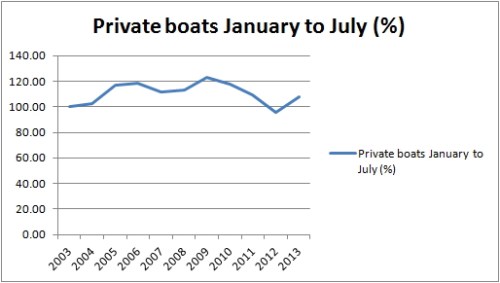
The total is still around 60% of 2003’s figure: a significant decline. But there was a marked increase in private traffic …

Shannon private JanJul %

Private traffic up

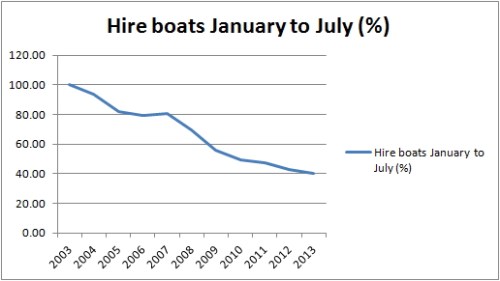
… while the decline in the hire-boat traffic continued.

Shannon hire JanJul %

Hire-boat traffic down

Over on Afloat, someone wrote that:

[…] a source close to Afloat.ie says that the falling numbers may be skewed by a growing emphasis on larger-capacity vessels on Ireland’s inland waterways, with eight- and 12-berth boats supplanting older four-berth vessels, and families and groups consolidating their recreational boating.

I don’t know what “skewed” is intended to mean. Well-capitalised hire firms may be adding larger boats to their fleets, but the number of passages is down by 60% and sources close to irishwaterwayshistory.com say that the combined hire fleet is down from about 500 to about 250 boats.

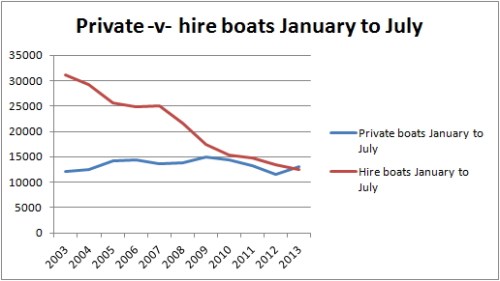
That doesn’t mean that the hire-boat industry is entirely dead, but it is much less important to the Irish waterways than it was. I don’t know of any published figures [if IBRA would like to supply them, I’ll happily publish them], but I suspect that employment within the industry has gone down and that its comparative economic importance to the Shannon and to the Irish tourist industry has declined too. And here is an interesting chart:

Shannon private v hire JanJul

The transition


For the first time that I know of, the seven-month figures show that measured private traffic outweighs hire-boat traffic. It may be that we need new approaches to attracting more overseas visitors to the Shannon. According to Waterways Ireland’s Lakelands & Inland Waterways Strategic Plan 2010–2015 (which I can no longer find on the WI website):

The mission of the Lakelands and Inland Waterways Strategic Plan is:
Throughout the Lakelands and Inland Waterways Region, to increase domestic and overseas visitors in number and revenue, while supporting existing sustainable tourism enterprises and encourage emerging tourism businesses through a series of practical business supports.

The plan was short on hard numbers for its targets, but at least as far as the Shannon hire business is concerned, it ain’t working.


Underwear and the Ulster Canal

In September 2010 I wrote:

[…] a government department, in a time of economic crisis, is proposing to commit to the spending of at least €35,000,000, without having any certainty of being able to get the money anywhere. Unless Waterways Ireland has surplus assets that I don’t know about, I cannot see how it can raise that amount by selling property in a slump; nor do I see any certainty that the Department of Finance will supply the money.

So the Department of Community, Equality and Gaeltacht Affairs won’t be choosing between two sources of funding. Its only possible source is the Department of Finance, and its only possible argument is that, unless the taxpayer stumps up, the shame will be too great: the neighbours will realise that we’re all fur coat and no knickers.

Since the creation of the Department of Arts, Heritage and the Gaeltacht in 2011, we’ve seen a slow striptease, with the government flicking up the corners of its fur coat and gradually hinting at the nakedness underneath.

The setting up of an inter-agency group of treasure hunters was the most explicit acknowledgement that the Irish government could not afford to build the Clones Sheugh. The group included folk from Fermanagh District Council, the Northern Ireland Tourist Board, the NI Strategic Investment Board and the Department of Culture, Arts and Leisure, so the burden of treasure-hunting was spread north of the border. But if that constituted the fifth veil — highlighting rather than concealing nakedness — the sixth has now been dropped.

On Tuesday 9 July 2013 the Select Sub-Committee on Arts, Heritage and the Gaeltacht was concluding its consideration of the revised 2013 estimates for the Department of Arts, Heritage and the Gaeltacht (and the National Gallery). Sandra McLellan, Sinn Féin TD for Cork East, said:

I have one more question, on subhead D4, Waterways Ireland. There is a promise of stage payments to Waterways Ireland to begin the process of making the opening up of the Ulster Canal a reality. Planning permission to begin the project was sought and is due to be approved at this month’s Fermanagh District Council planning meeting and permission has already been approved in County Monaghan. Once the Government releases the funding, the process should move quickly and whatever land purchases are needed will be made. Does the Government intend on doing this and will Waterways Ireland have the adequate funding to undertake the project in 2013–2014?

The minister, Jimmy Deenihan [FG, Kerry North/West Limerick], began by talking about planning permissions and compulsory purchases:

At this stage, the planning permissions have been granted. That, in itself, was a challenge because of environmental and other reasons. The next process will be the CPOs to get the land. In many cases, hopefully, we can acquire the land by agreement. That will be the next challenge.

He went on to say why the Irish government couldn’t afford the sheugh:

There is an inter-agency group sitting. It is something I established, where the local authorities and the statutory organisations, North and South, have all come together around a table and are looking for alternative sources of funding too rather than merely funding from the Dublin Government. Originally, the agreement was that this would be funded by Dublin and the funding for it was identified with the sale of property at the time. During the Celtic tiger, the property, down in the docklands, etc., was quite valuable. However, with the collapse of the property market, that potential source of funding was not there to the same extent, although, with the property market now recovering, that property could become valuable again. Hopefully, it will and can contribute to the overall costs.

Note that phrase “rather than merely funding from the Dublin Government”. But there is more to come:

The next stage would be the acquisition of the land in order to provide the canal and the inter-agency group is looking at possibilities. Also, my counterpart in Northern Ireland, the Minister for Culture, Arts and Leisure, Carál Ní Chuilín MLA, is looking at possible funding for the small portion that is in the North. Funding may be available for that from the Northern Executive and, maybe, Westminster. That, obviously, would help. Wherever we can get funding for this, certainly we will be striving to get it. It will be incremental. We will have to approach it on a staged basis but the important point is to get it started.

So the idea that the wealthy and munificent southern government would pay the entire cost of the sheugh, as a present to the benighted and miserable inhabitants of Norn Iron, and as a demonstration of the prosperity to be expected from a united Ireland, has been abandoned altogether. If Carál Ní Chuilín [who is, coincidentally, a Sinn Féin MLA] manages to extract money from her colleagues for that portion of the sheugh lying within Norn Iron, it will mean that the construction is being funded in the same way as other Waterways Ireland capital spending: each government pays for the development within its own jurisdiction.

Will Ms Ní Chuilín manage to persuade her colleagues? In September 2010 I wrote:

[…] I see no evidence whatsoever that the Northern Ireland executive, or Her Majesty’s government, has any intention of ever starting the JCBs rolling along the Ulster Canal. They are happy to support the principle of canal restoration; they are even prepared to allow southern taxpayers to spend money (borrowed from the bond markets) crossing northern soil. It is possible that, if the canal to Clones brings wealth and prosperity to Co Monaghan, the northern executive will rethink. But as it stands, the evidence suggests that the southern taxpayer will be permitted to dig to Clones, and perhaps even to Monaghan and Caledon, but that the canal will never get any further.

It is possible that having a Sinn Féin minister running DCAL will change  economic perceptions, and no doubt Simon Hamilton, the [DUP] Minister of Finance and Personnel, will be easily persuaded. Having an Irishman as UK Chancellor of the Exchequer may help the Sinn Féin cause: the last time that happened, HMG wasted half a million pounds on the Shannon.

But back to the minister:

It is a good North-South project. It links North and South. There also could be some possibilities under European funding, for example, there was funding available for the Ballyconnell canal and some of that was derived from European funding. We will be looking at every possible source of funding in order to get the project off the ground and to complete it over a period of time. Besides, Waterways Ireland, from its own capital budget, may have some small amount of funding available to initiate the project as well. I will be looking at identifying funding from different sources and, hopefully, over a period of time, we can provide the canal.

There are two sets of points in that paragraph. One suggests that the inter-agency group has not yet found the pot of gold, indeed that it has no very firm ideas about where to find it. Waterways Ireland is unlikely to be able to spare more than the price of a few shovels, but even if it devoted its entire capital budget to the Clones Sheugh it would take at least ten years to pay for it.

The other set of points is contained in the first two sentences:

It is a good North-South project. It links North and South.

Any minor boreen could be said to link North and South, but without costing €40 million or so. In fact, though, the Clones Sheugh is not a good project: it is a waste of money. It will link a couple of fields in the middle of nowhere to, er, Clones, which is no doubt a vibrant hub of culture. It will not attract significant numbers of foreign tourists, so it will merely displace waterways activity from elsewhere, and it will not generate new business or employment opportunities except perhaps for part-time summer jobs in a couple of pubs.

I have compared the Irish (and especially Sinn Féin) enthusiasm for canals to a cargo cult, but perhaps a more modern comparison, and one in line with this post’s heading, would be to the Underpants Gnomes (a metaphor I used here about the Shannon in 1792). It will be recalled that the Underpants Gnomes had a three-phase business plan:

  1. Collect Underpants
  2. ?
  3. Profit.

The Irish government’s (and perhaps Sinn Féin’s) devotion to the Clones Sheugh might be explained by their adherence to a similar plan:

  1. Build canal
  2. ?
  3. Peace and prosperity.

But, knickerless, they cannot gird their loins. Maybe Little Miss Higgins‘s video might provide useful advice.

Envoi

The minister’s extensive reply did not stop Sandra McLellan from asking pretty much the same question nine days later, causing me to wonder why the shinners want the sheugh:

Is there something in the St Andrew’s Agreement, or some other bit of northsouthery, that promises a sheugh to Sinn Féin, to enable them to claim credit for some high-profile but non-threatening all-Irelandism? Is the Clones Sheugh the price of SF support for the Police Service of Northern Ireland? I don’t know, but there must be some explanation for the failure to kill off the sheugh.

[h/t to the learned AD, who drew my attention to the meeting of the select sub-committee, which I had not myself noticed. AD is not, however, to be blamed for my views — or for my metaphors]

Sinn Féin sheughs again

Sinn Féin demonstrates its continuing commitment to the unification of Ireland reconstruction of the Clones Sheugh. KildareStreet tells us that Sandra McLellan, TD for Cork East, no doubt motivated by the wealth of waterways in her own area, asked a written question on 18 July 2013:

To ask the Minister for Arts, Heritage and the Gaeltacht the position regarding the Ulster Canal restoration project; the remaining steps that must be taken to complete the project; if he will provide an indicative timeline for the completion of the project; and if he will make a statement on the matter.

She got a more or less standard answer from the minister, Jimmy Deenihan [FG, Kerry North/West Limerick]:

As the Deputy will be aware, in July 2007, the North/South Ministerial Council (NSMC) agreed to proceed with the restoration of the section of the Ulster Canal between Clones and Upper Lough Erne. The then Government agreed to cover the full capital costs of the project, which were estimated at that time to be of the order of €35m.

It was always the intention that the Ulster Canal project would be funded from the Waterways Ireland annual allocations, as agreed through the annual estimates processes in this jurisdiction, as well as the deliberations of NSMC in relation to annual budgets. It was a key consideration throughout the process that the Ulster Canal project would be supported by a significant level of projected income from the commercialisation of certain Waterways Ireland assets. However, as the Deputy will be aware, the economic downturn has had a negative impact on those plans.

In the meantime, the Ulster Canal project is progressing on an incremental basis. Planning approvals have recently been secured for the project in both jurisdictions. I welcome these developments, which, I am sure the Deputy will agree, are a significant milestone for the project.

I am continuing to explore all possible options to advance this project within the current fiscal constraints. In this regard, an Inter-Agency Group on the Ulster Canal has been established to explore and examine ways to advance the project and to examine possible funding options for it, including existing funding streams and the leveraging of funding from other sources, including EU funding options.

Isn’t it funny? Every so often the shinners ask a question to remind the minister that they, er, haven’t gone away, you know. They don’t get really aggressive about it and they don’t seem to be organising mass rallies in Clones to demand a sheugh. And the minister is equally polite, saying in effect “we haven’t shot your horse”.

This project is not very important: it’s a waste of money and will be of no benefit to the national economy, and a government seeking savings could easily kill it off. Yet it has refused, over several years, to take that obvious step. Instead, it’s devoting departmental time, and that of other public servants, to (admittedly low-cost) measures that seem to be intended to show that the project will be maintained on life support, even if it never rises from its bed.

Is there something in the St Andrew’s Agreement, or some other bit of northsouthery, that promises a sheugh to Sinn Féin, to enable them to claim credit for some high-profile but non-threatening all-Irelandism? Is the Clones Sheugh the price of SF support for the Police Service of Northern Ireland? I don’t know, but there must be some explanation for the failure to kill off the sheugh.


Mad foreigners

The August 2013 issue of Practical Boat Owner has just arrived. It has an article by Dick Everitt called “Mind your head …” in which he talks of dangers to boats from above rather than below: dangers from bridges and from electric power lines. He points out that electricity can jump to a metal mast and says:

So a safe clearance distance is given on the chart with a lightning-type symbol and in some countries a big warning sign is positioned nearby too. But do check local Notices to Mariners as long power cables can sag over time, reducing their official charted clearances.

Aren’t foreigners funny? Imagine having electricity suppliers actually telling boaters about the safe clearance under power cables! That would never happen here ….

I have spent several years trying to get ESB to tell me the safe clearances for cables across the Shannon. I thought I was getting somewhere at one stage but nothing happened. Perhaps ESB would prefer boaters to fry than risk getting sued for getting the clearance wrong.

Shannon traffic to June 2013

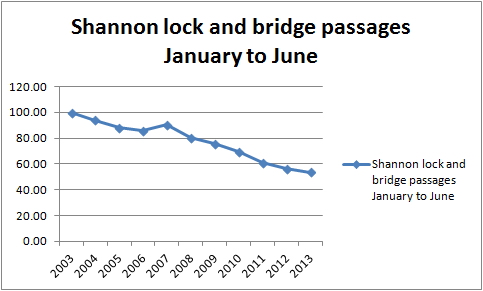
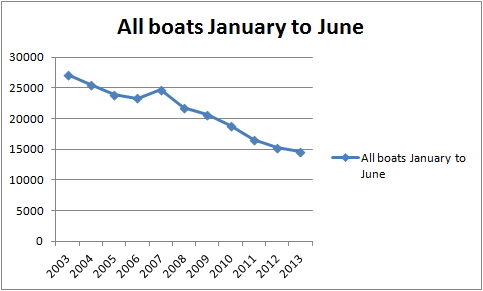
The figures for Shannon lock passages to the end of June 2013 are now available. The decline continues, though perhaps more slowly.

Shannon traffic Jan to June percent

Shannon lock and bridge passages January to June as percentages of the 2003 number

The usual caveats apply: the underlying figures (kindly supplied by Waterways Ireland) do not record total waterways usage because, for instance, sailing, fishing or waterskiing on lakes or river stretches, which did not involve a passage through a lock or Portumna Bridge, would not be recorded. The passage records are our only consistent long-term indicator of usage of the Shannon but they would not show, for instance, a change in the balance of types of activities from those in larger cruising boats to those in smaller (sailing, fishing, waterskiing) boats. It is quite possible, therefore, that overall usage might be increasing while long-distance cruising was declining.

Shannon traffic Jan to June private

Shannon lock and bridge passages by private boats January to June

As it happens, the figures show a small increase over 2012 in passages by private boats. I suspect that July’s warm weather will spur a further increase.

Folk living in Ireland, whether owners or prospective hirers, are likely to be able to react quickly to better (or worse) weather by doing more (or less) boating; folk living abroad may be less able to change their holiday plans. Accordingly, July’s weather might (I’m speculating here) mean an increase in passages by private boats and by boats hired by Irish residents; it might not lead to an increase in hiring from abroad.

Traffic in hired boats continued to decline in June.

Shannon traffic Jan to June hire

Shannon lock and bridge passages by hired boats January to June

That decline outweighed the small increase in private traffic, leading to an overall decline in the first six months as compared with the same period in 2012, which itself continued the pattern set in 2007.

Shannon traffic Jan to June all

Shannon lock and bridge passages by all boats January to June

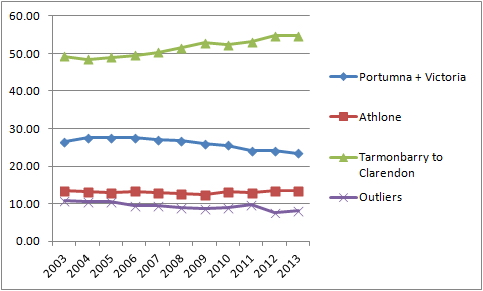
I wondered whether the figures might show any change in the geographical distribution of activity. WI’s reports don’t show separate figures for private and hired boats for the individual locks, but it seems to me that the hire business is becoming more concentrated on northern waters, from Lough Ree upwards. If that is so, then there might be an increase in the proportion of passages through the northern locks, from Tarmonbarry upwards, and a decrease in the proportion passing through Portumna Bridge and Meelick (Victoria) Lock.

I put the WI reporting stations in four groups:

  • Portumna + Meelick
  • Athlone
  • Tarmonbarry, Clondra, Roosky, Jamestown (Albert), Knockvicar (Clarendon)
  • the also-rans: the three locks leading to Lough Allen, Pollboy leading to Ballinasloe, the Limerick sea-lock (Sarsfield).

The figures suggest that the distribution is indeed changing, but gradually rather than dramatically. Athlone’s figures are pretty steady, the outliers are declining slightly and Portumna + Meelick are declining a bit more; the northern locks (Tarmonbarry to Knockvicar) are taking the gains. Comments or alternative interpretations welcome.

Change by region

Lock passages by group

The figures for 2013 are for the six months January to June; those for other years are for twelve months.

The locks could of course be grouped in other ways, and I may try some of them in future months.