Tag Archives: Dublin

Effin mensuration

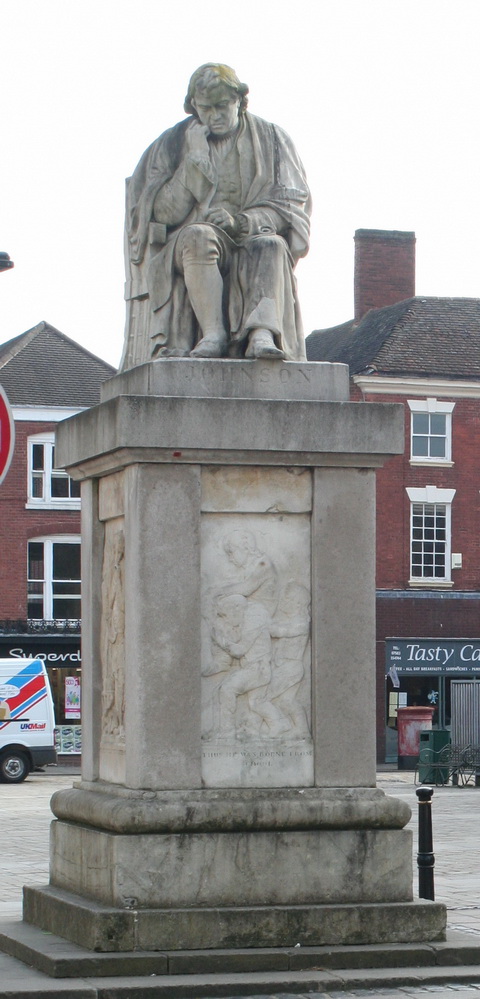
Statue of Dr Johnson near his birthplace in Lichfield

Statue of Dr Johnson near his birthplace in Lichfield

The learned readers of this site will not need to be reminded of the sapient advice of the late Dr Samuel Johnson:

[…] no man should travel unprovided with instruments for taking heights and distances.

There is yet another cause of errour not always easily surmounted, though more dangerous to the veracity of itinerary narratives, than imperfect mensuration. An observer deeply impressed by any remarkable spectacle, does not suppose, that the traces will soon vanish from his mind, and having commonly no great convenience for writing, defers the description to a time of more leisure, and better accommodation. […]

To this dilatory notation must be imputed the false relations of travellers, where there is no imaginable motive to deceive.

Samuel Johnson A Journey to the Western Islands of Scotland W Strahan and T Cadell 1775

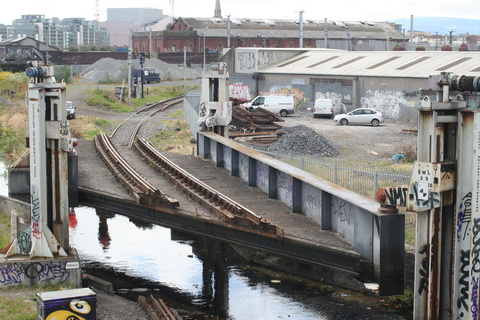
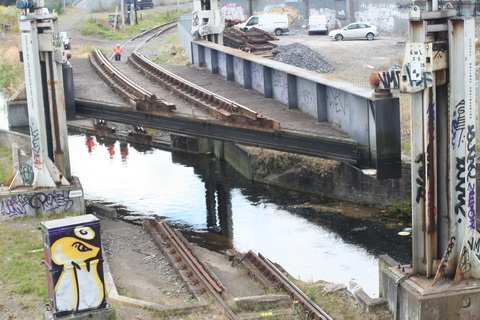
The good doctor would, I think, have welcomed the invention of the digital camera with inbuild chronometer. Equipped with just such a device I arrived yesterday at the first lock on the Royal Canal to witness the lifting of the railway bridge and the passage thereunder of fleets of boats. I thought it would be interesting to record how long each stage took.

I have written before about this bridge: reporting a question by Maureen O’Sullivan TD in October 2013 and another in November 2013 and providing statistics on usage a few days later:

  • only 58 boats went through in 2013
  • the bridge was lifted on seven dates
  • two other scheduled lifts were cancelled as no boats wanted to travel
  • Irish Rail charged Waterways Ireland €1200 per weekday lift and €2000 per weekend lift.

The first 45 minutes

A lift scheduled for early July 2014 was cancelled; yesterday’s lift catered for just two boats, whose passage was assisted or monitored by eight Irish Rail staff and four from Waterways Ireland. Four of the Irish Rail people may have been in training as others seemed to be demonstrating things to them, but that’s only a guess. Three of the WI staff travelled together in WI’s stealth van and operated the first lock; the other, who travelled separately in a 4WD vehicle, visited from time to time. As far as I could see there was no contact between the Irish Rail and WI teams.

The bridge was scheduled to be lifted by 1100.
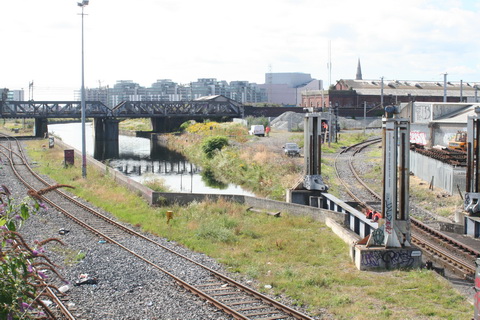
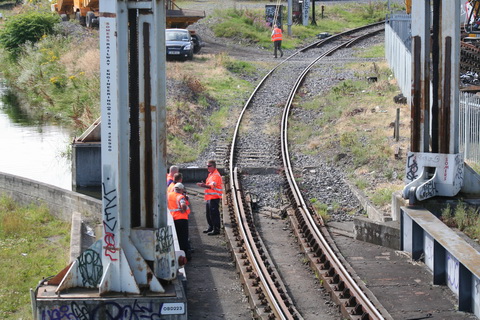
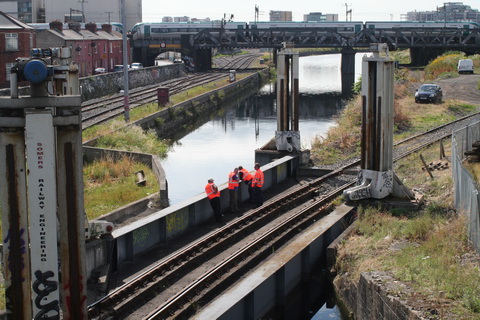
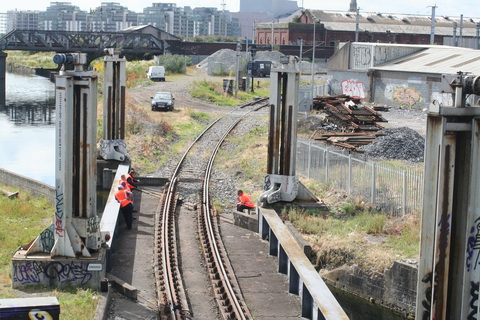
Before the lift 0945

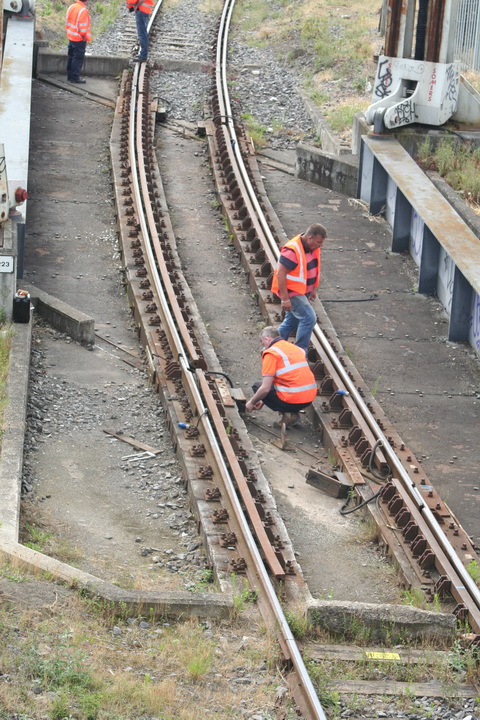
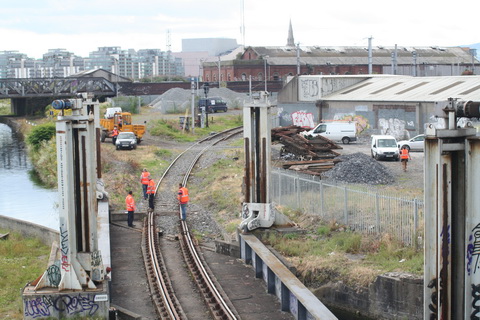
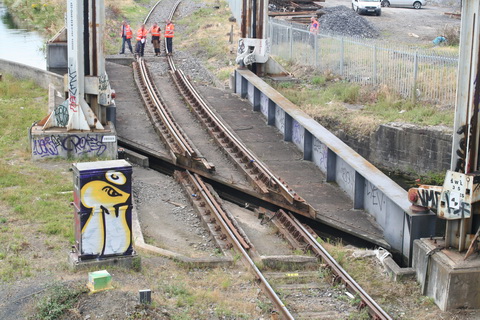
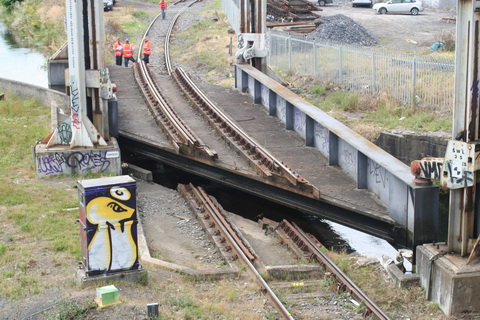
Before the lift: 0945. The lifting bridge is on the right of the photo
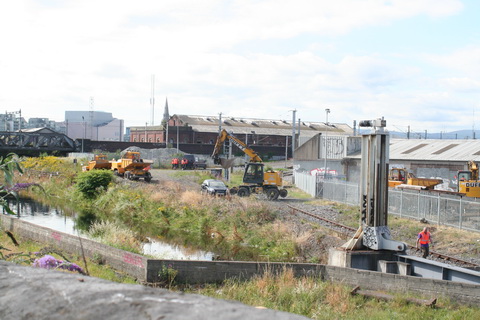
Before the lift 0946

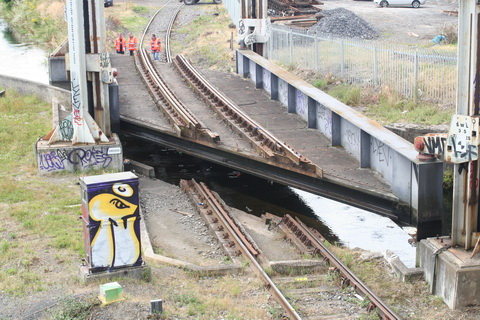
One minute later: 0946. A separate group of workers, perhaps contractors, is going down the west side of Spencer Dock with equipment
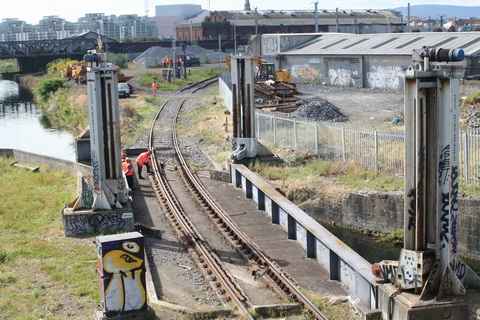
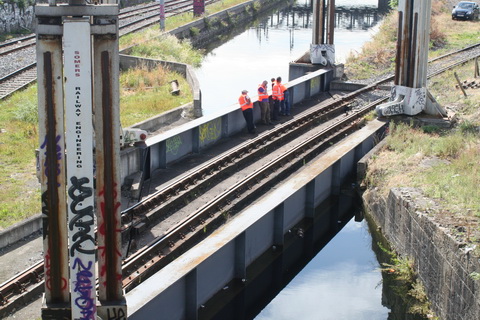
Before the lift 0949

Four men still on the bridge 0949

Before the lift 0951

Two minutes later

Before the lift 0956

On the bridge 0956

Before the lift 0958

Still there 0958

Before the lift 0959

One minute later

Before the lift 1006

The bridge 1006

Before the lift 1012

The bridge 1012

Before the lift 1015

The bridge 1015: another person approaches
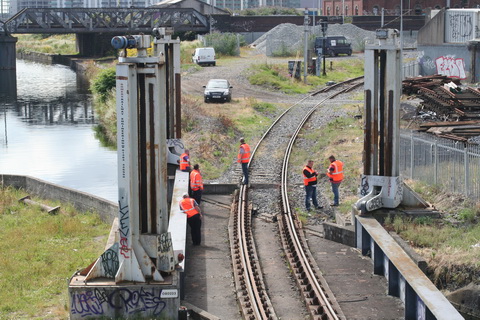
Before the lift 1020

Six men at the bridge at 1020

Before the lift 1028

A seventh man approaches at 1028

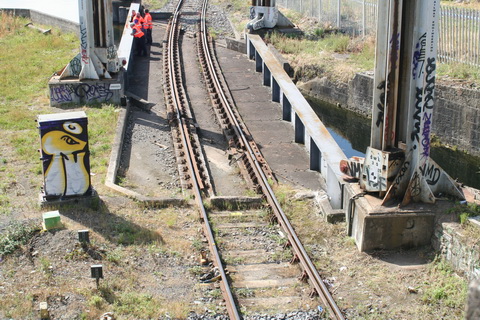
Preparing to lift

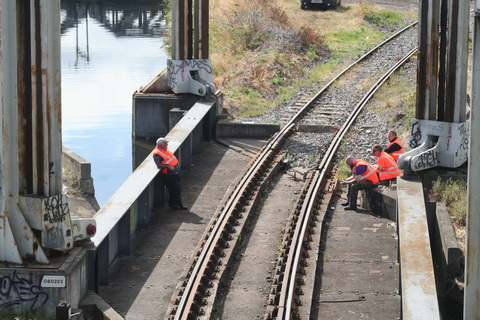
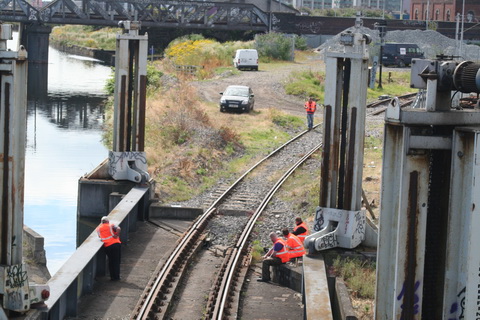
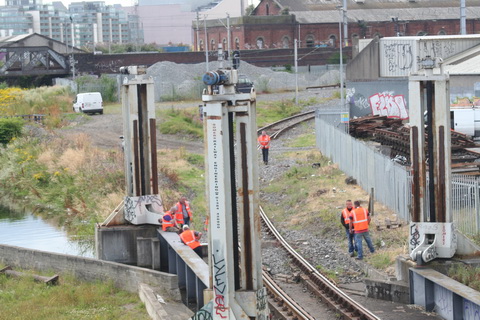
The preparation stage, presumably involving the unlocking of some mechanism, took about five minutes altogether.
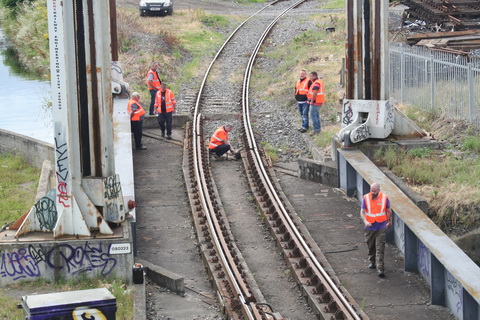
Preparing the bridge 5 mins 03_resize

One man worked on the far end while another walked to do the same at the near end
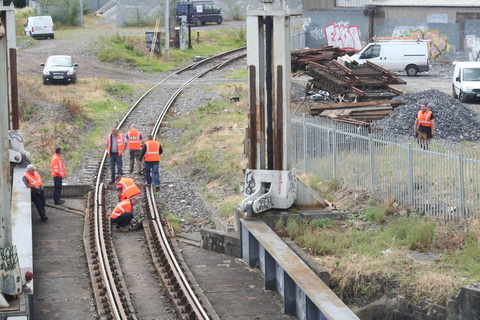
Preparing the bridge 5 mins 06_resize

An eighth man, behind the fence on the right, seemed to summon two of the men on the bridge
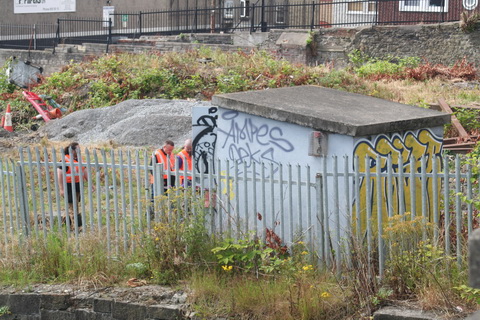
Preparing the bridge 5 mins 14_resize

They went to this building, which I guess houses the controls for the bridge
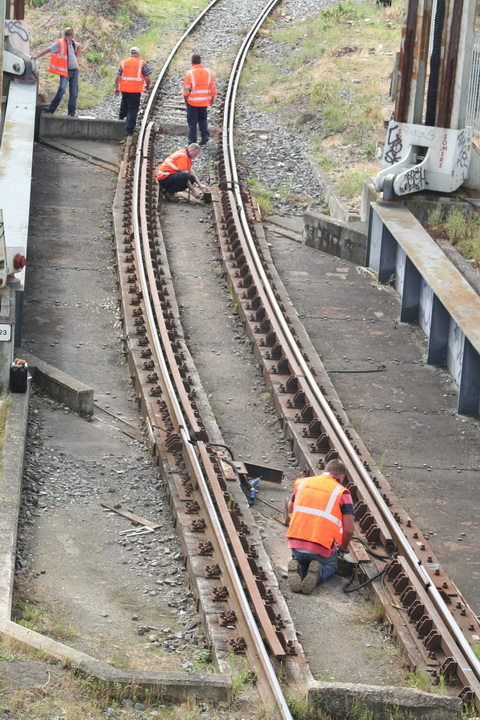
Preparing the bridge 5 mins 15_resize

Meanwhile work continued on the bridge itself
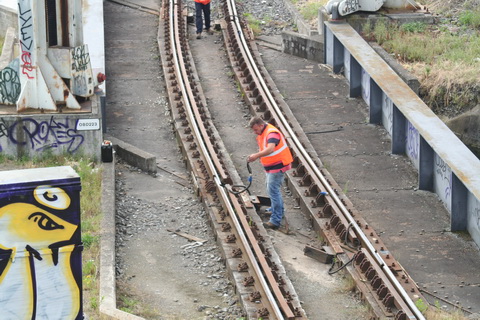
Preparing the bridge 5 mins 19_resize

Almost done

Preparing the bridge 5 mins 22_resize

A final check

Preparing the bridge 5 mins 25_resize

Everybody was off the bridge by 1033

Lifting

The lift itself took just over nine minutes; the bridge was up before 1044, in good time for the arrival of the boats.
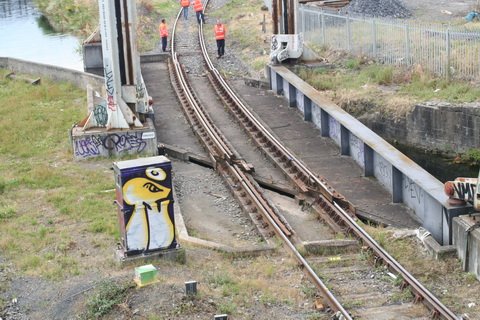
The lift 9 mins 02_resize

After about one minute

The lift 9 mins 08_resize

Another minute later

The lift 9 mins 11_resize

Another minute (or so)

The lift 9 mins 15_resize

About four minutes have elapsed

The lift 9 mins 18_resize

After five minutes. The sides are clear of the water in which they usually rest; they are dripping on to the canal below
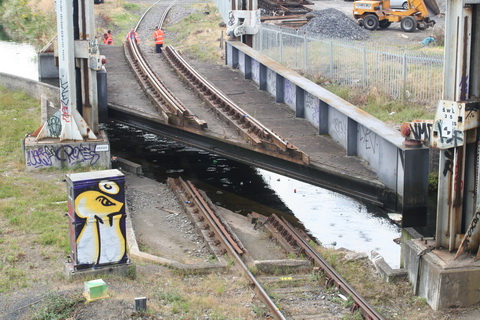
The lift 9 mins 20_resize

Six minutes in

The lift 9 mins 23_resize

Seven minutes

The lift 9 mins 24_resize

The men behind the fence may be controlling the lift
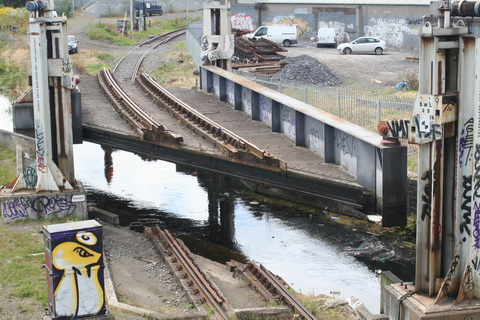
The lift 9 mins 28_resize

Not much further to go

The lift 9 mins 32_resize

Eight minutes

The lift 9 mins 40_resize

It’s up

The bridge up 16_resize

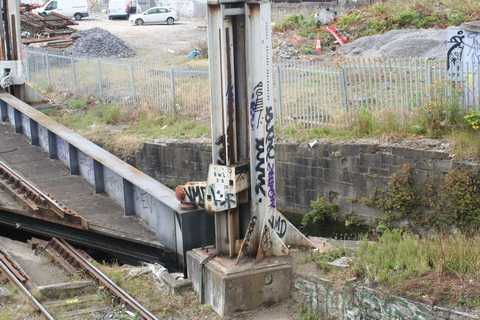
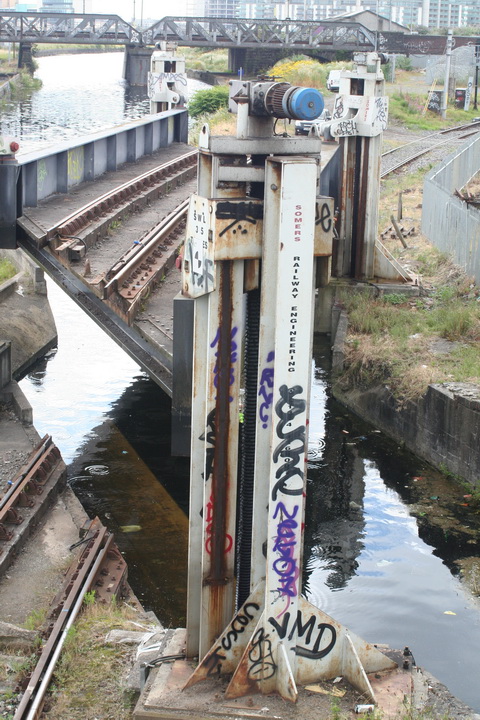
One of the jacks

After the boats passed_resize

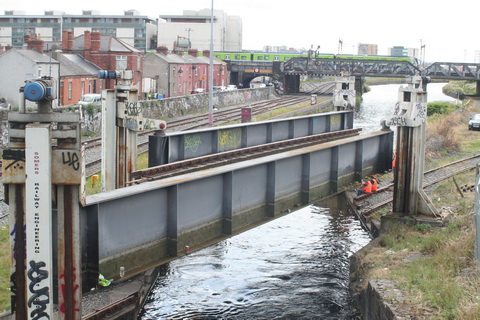
Side view (taken after the boats had gone through)
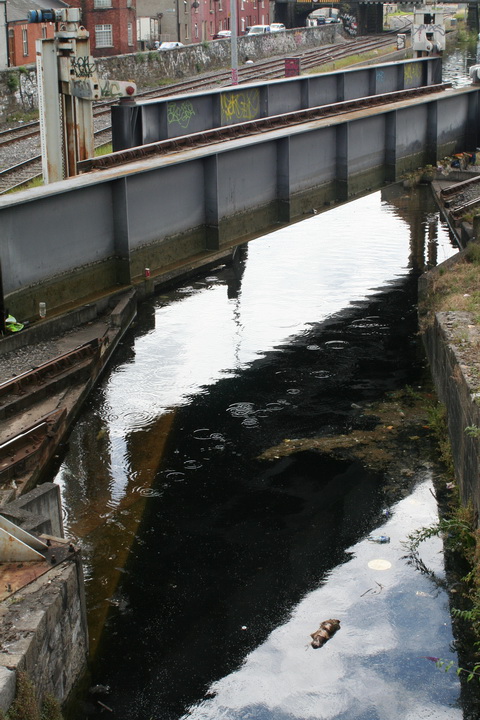
The bridge up 13_resize

Water under the bridge

Boats go through

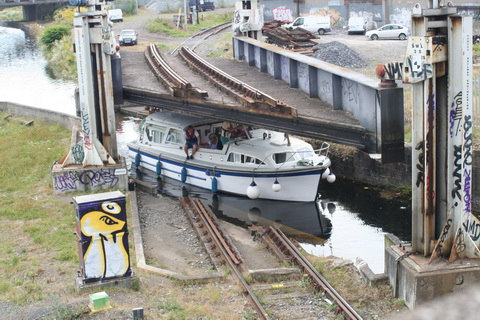
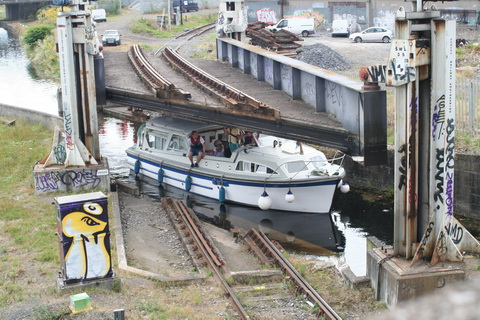
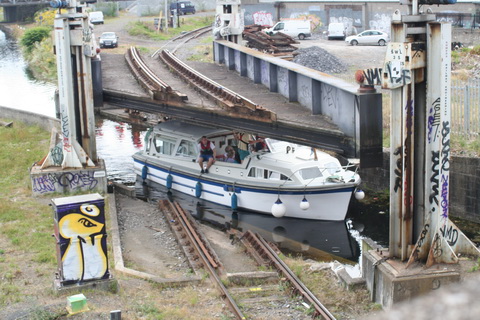
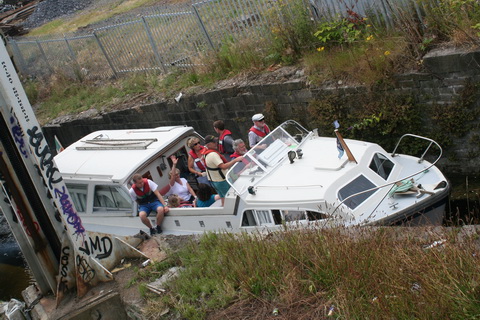
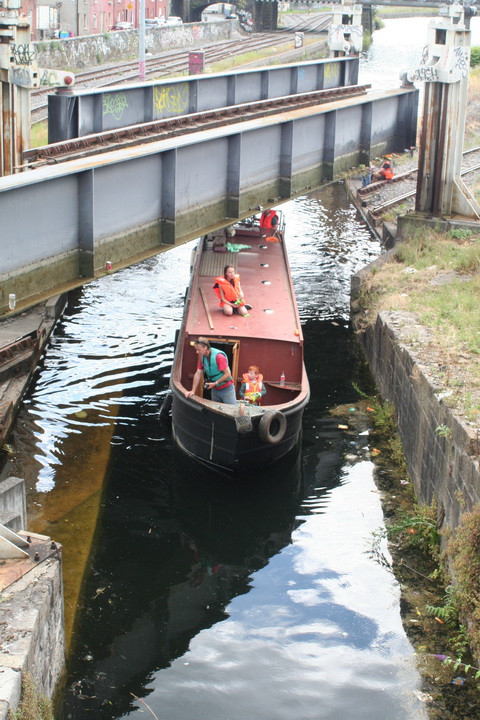
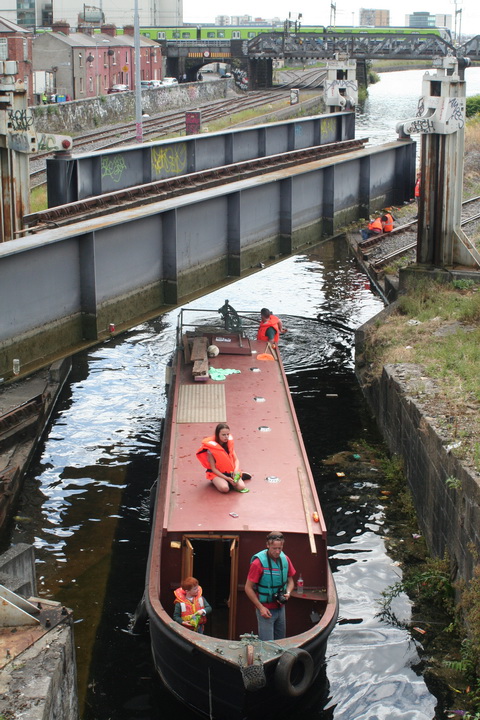
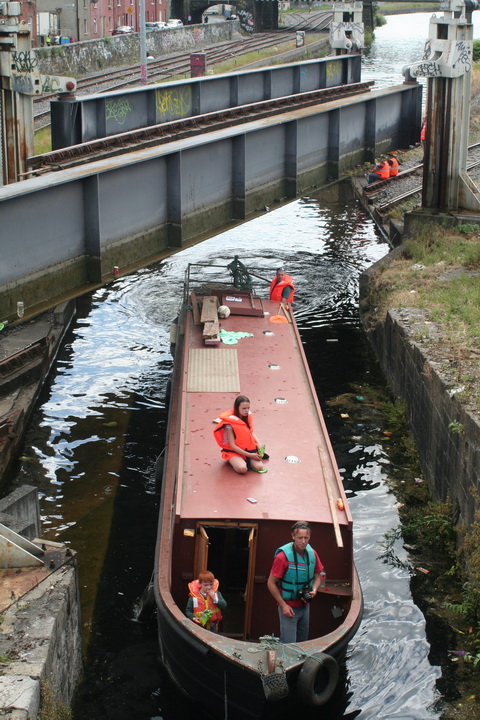
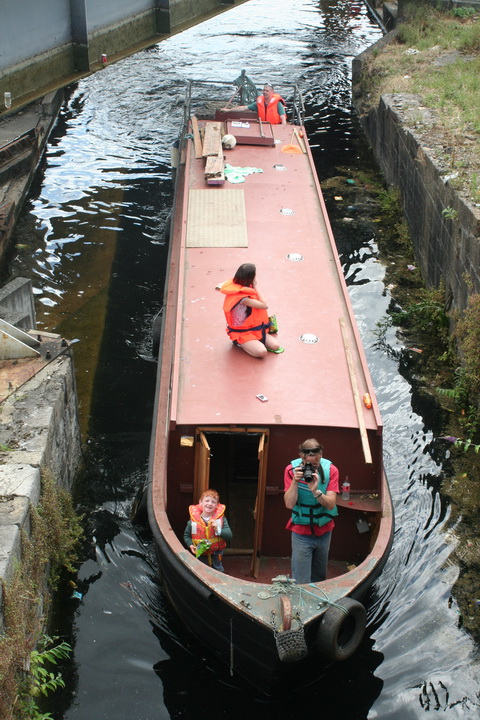
It took just over three minutes for the two boats to go under the bridge.
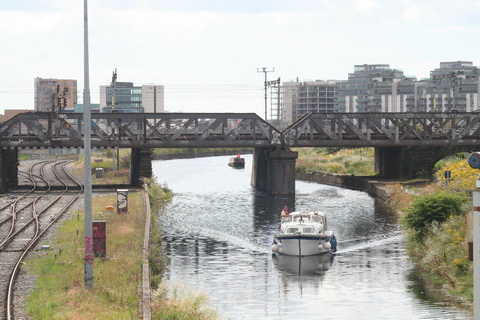
Boats approach 12_resize

Cruiser approaches; steel boat visible through the bridge
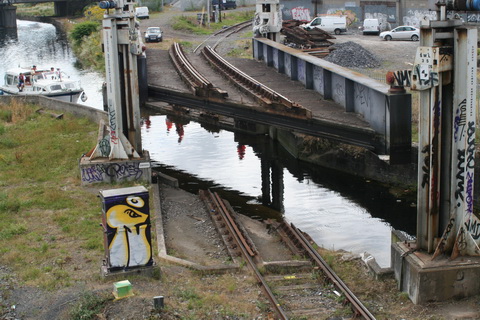
Cruiser goes through 03_resize

Cruiser about to enter

Cruiser goes through 04_resize

Heads down

Cruiser goes through 06_resize

Half way through

Cruiser goes through 07_resize

Leaving

Cruiser goes through 08_resize

Out

Steel boat goes through 12_resize

Steel boat entering

Steel boat goes through 20_resize

Almost through

Steel boat goes through 22_resize

Looking ahead to the lock

Steel boat goes through 25_resize

Done


I did not record the lowering of the bridge, which I presume took much the same time as the raising.

Preparation 5 minutes, lifting 9 minutes, passage 3 minutes, lowering and locking say another 14 minutes: say 45 minutes altogether, allowing some margin. But a large number of boats would take much longer as the rate at which they could move on from the bridge would be limited by the time taken to work through the lock.


Tullamore in 1947

T W Freeman “Tullamore and its environs, Co Offaly” in Irish Geography (Bulletin of the Geographical Society of Ireland) Vol 1 No 5 1948 (based on material collected in 1947):

The original geographical advantage lay in the canal, which placed it on the main line from Dublin to Limerick around 1800, but canal traffic, though still important, is no longer crucial.

However …

Social activities in Tullamore include a wide range of clubs for athletics, dances, bridge, a modern cinema, and the occasional extra shows and matches that mean so much to the people of a country town and its surroundings. On the athletic side the new swimming pool is the most attractive recent addition (but no mixed bathing) ….

The best-value CEO

Mary Lou McDonald [SF, Dublin Central] asked Jimmy Deenihan [FG, Kerry North/West Limerick], before his departure from the waterways (and other stuff) department,

… if he will provide in tabular form a list of the annual salaries of the chief executive officers of all non-commercial State sponsored bodies under his remit.

Which he did; you can see it here.

I thought it might be interesting to see how the salaries of the CEOs relate to the numbers of staff and the budgets they control. It’s not easy to compare them. The salary figures are presumably current; the various bodies offer, on their websites, accounts for years ending anywhere from 31 December 2011 to [well done, the National Concert Hall] 31 December 2013. In some cases I could find no proper accounts, but at least the Crawford Art Gallery gave a figure for its income, which is more than the Chester Beatty Library did [as far as I could see].

There were several other minor difficulties, but the big problem is that some bodies distribute grants to others, so their business is processing money: as a result, their income (usually from, or mostly from, the state) is higher than it would be for non-grant-distributing bodies. I have made no attempt to allow for that.

To make comparisons easier, I divided the number of staff in each body by the CEO’s salary (converted to euro where necessary) and multiplied the result by 1000 to remove leading zeroes. That tells you how many employees you get managed for each euro of CEO salary. Waterways Ireland is by far the biggest organisation, but has the second-lowest CEO salary.

Similarly, I divided the organisation’s income by the CEO’s salary to provide a crude measure of how much activity you get for each euro of CEO salary. Bodies dispensing grants look better than they otherwise might using this measure.

This is then a very crude comparison, with many caveats, but I think that Dawn Livingstone of Waterways Ireland is the best-value CEO of those running bodies under the aegis of the Department of Arts, Heritage and the Gaeltacht.


Organisation Staff Budget (m) CEO salary Staff X 1000/salary Budget/salary
Arts Council 48[1] €63.9[2] €85,750 0.56 745.19
Chester Beatty Library 37[3] ?[4] €90,591 0.41 ?
Crawford Art Gallery 15 €1.1[5] €72,124 0.21 15.25
Foras na Gaeilge 64[6] €21.5[7] €113,429 0.56 189.55
Heritage Council 18[8] €7.8[9] €113,123 0.16 68.95
Irish Film Board 15[10] €20.2[11] €97,981 0.15 206.16
Irish Museum of Modern Art 83[12] €8.3[13] €85,720 0.97 96.83
National Concert Hall 103[14] €4.6[15] €101,056 1.02 45.52
National Gallery of Ireland 117[16] €9.5[17] €93,297 1.25 101.83
National Library of Ireland 93[18] €9.5[19] €81,080 1.15 117.17
National Museum of Ireland 176[20] €17.6[21] €96,148 1.83 183.05
Údarás na Gaeltachta 86[22] €40.2[23] €126,200 0.68 318.54
Ulster-Scots Agency 20[24] €3.4[25] €61,997[26] 0.32 54.81
Waterways Ireland 328[27] €41.0[28] €77,071[29] 4.26 531.98

I’m sorry the table spreads so far to the right; I can’t work out how to narrow the column widths.


[1] 41 full time and 7 part time WTEs, according to note 2c to accounts in Arts Council Annual Report 2012

[2] Total income y/e 31 December 2012 from Arts Council Annual Report 2012. €56.6m was dispensed to other bodies in grants

[3] Excluding volunteers and vacant posts shown in the Staff List in Report of the Trustees Chester Beatty Library 2012

[4] The annual report for 2012 available here http://www.cbl.ie/About-Us/The-Chester-Beatty-Library/Reports.aspx does not include accounts. There is a one-page balance sheet, without the associated notes, from which I am unable to form any idea of the cost of the institution

[5] I am unable to find any accounts on the Crawford Art Gallery’s website http://www.crawfordartgallery.ie/aboutus1.html. Its Annual report 2011, the most recent available, says “The Department of Arts, Sport and Tourism pay allocation to the Gallery for 2011 was €475,000, while the non-pay allocation was €600,000. The capital allocation for 2011 was €275,000.” I have used the (rounded) sum of the first two figures

[6] Staff Costs and Board Remuneration in Foras na Gaeilge section of The North/South Language Body Annual Report and Accounts for 2011

[7] Total income y/e 31 December 2011 from Foras na Gaeilge section of The North/South Language Body Annual Report and Accounts for 2011

[8] Heritage Council website www.heritagecouncil.ie

[9] Total income y/e 31 December 2013 from Heritage Council Annual Report for 2012

[10] Note 6 to accounts in Annual Report 2011

[11] Sum of total income figures from Capital Income and Expenditure Account and Administration Income and Expenditure Account y/e 31 December 2011 in Annual Report 2011

[12] Note 9 to accounts in Irish Museum of Modern Art Annual Report 2011

[13] Total income y/e 31 December 2011 from Irish Museum of Modern Art Annual Report 2011

[14] Note 2 to accounts in National Concert Hall Annual Report 2013

[15] Gross income y/e 31 December 2013 from National Concert Hall Annual Report 2013

[16] Note 7 to accounts in National Gallery of Ireland Annual Report 2012

[17] Total income y/e 31 December 2012 from National Gallery of Ireland Annual Report 2012

[18] Rounded. From Human resource management and development in National Library of Ireland Annual Report 2011

[19] Total income y/e 31 December 2011 from National Library of Ireland Annual Report 2011

[20] Note 13 to accounts in The National Museum of Ireland Financial Statements for 2011

[21] Total income y/e 31 December 2011 from The National Museum of Ireland Financial Statements for 2011

[22] Údarás na Gaeltachta Annual Report and Accounts 2012

[23] Total income y/e 31 December 2012 from Údarás na Gaeltachta Annual Report and Accounts 2012

[24] Staff Costs and Board Members in Tha Boord O Ulster-Scotch section of The North/South Language Body Annual Report and Accounts for 2011

[25] Total income y/e 31 December 2011 from Tha Boord O Ulster-Scotch section of The North/South Language Body Annual Report and Accounts for 2011

[26] £49,244

[27] Excluding student placements and temporary and agency staff (total 19). Note 4 to accounts in Waterways Ireland Annual Report and Accounts 2012

[28] Total income y/e 31 December 2013 from Waterways Ireland Annual Report and Accounts 2012


All sheugh up

Heather Humphreys [FG, Cavan-Monaghan] is to be Minister for Waterways (as well as arts and heritage).

That’s Heather Humphreys, who asked her predecessor as minister three questions about the Clones Sheugh (some of which would be in Monaghan):

21 July 2011: To ask the Minister for Arts, Heritage and the Gaeltacht if €35 million was ring-fenced for the restoration of the section of the Ulster Canal between Clones and Upper Lough Erne; if this funding was included in any budget between 2008 and 2010; and if he will make a statement on the matter.

30 January 2013: To ask the Minister for Arts, Heritage and the Gaeltacht if he will provide an update on progress on the Ulster Canal Project; and if he will make a statement on the matter.

6 March 2014: To ask the Minister for Arts, Heritage and the Gaeltacht if he will provide an update on the progress of the Ulster canal project; the work carried out to date by the interagency group which was set up to examine possible funding options; and if he will make a statement on the matter.

How could a Fine Gael minister hold back the tide of Shinners in Cavan-Monaghan? Not, I hope, by wasting public money on porkbarrel projects.


GCC Shannon steamers 1866

Here is a new page with an illustrated article from 1866 about the steam engines in three Grand Canal Company steamers of that era, which were used on the Shannon. I am grateful to Mick O’Rourke of Irish Shipwrecks for sending the article to me.


Don’t tread on my decks

Dublin Police — yesterday

Threatening to shoot

Edward Farrell, a boat-owner on the Grand Canal, was held to bail to keep the peace to his brother-in-law, Simon Farrell, also a boat-owner on the same canal, and at whom he presented a loaded gun, the same morning at James’s-street harbour, threatening to shoot him for passing across his (Edward’s) boat for the purpose of getting into his own vessel, which was lying alongside.

Freeman’s Journal 23 November 1842

Thon sheughery business

It will be recalled that Her Majesty’s Loyal Home Rule Government in Belfast is considering investing in the Clones Sheugh [aka Ulster Canal] and that I asked DCAL, the department responsible, for a copy of the Business Case. To my surprise, it said:

Your request is being treated as a Access to Information request and will be handled under either Freedom of Information Act 2000 or the Environmental Information Regulations 2004.

Either way, DCAL has now told me that I can’t see it. The Business Case, which is apparently an addendum to the 2007 Business Case (which was rotten: see here passim), won’t be complete until November. I have made a note to remind myself to ask for it then.

I quite sympathise with the DCAL folks: it can’t be easy thinking of any good reason to spend taxpayers’ [British or Irish] money on the Clones Sheugh. But perhaps DCAL can spin it out until the Shinners have taken over the Free State, at which point the economics of Grattan’s Parliament will be in vogue and we can all take up growing flax, spinning and weaving, giving grants for canals and making money out of the slave plantations.

Speaking of Shinners, there’s one called Cathal Ó hOisín, a member of HM Loyal Home Rule Government in Belfast representing East Londonderry, who said there recently:

The possibility of the reopening of the Ulster canal would open up limitless opportunities in tourism. The idea that, once again, we could travel from Coleraine to Limerick, Dublin and Galway by boat would be absolutely wonderful.

Well, you can do that: by sea. There was never an inland navigation from Coleraine, Limerick or Dublin to Galway, despite the urgings of Lord Cloncurry and the nitwitted ideas of Sir Edward Watkin.

As for a connection between Limerick or Dublin and Coleraine, I suspect that Mr Ó hOisín is perpetuating the error into which Her late Majesty Victoria, by the Grace of God of the United Kingdom of Great Britain and Ireland Queen, etc, seems to have fallen when she appointed

Commissioners to inquire respecting the System of Navigation which connects Coleraine, Belfast, and Limerick

which Commissioners reported in 1882. There was no such system and, if Mr Ó hOisín can provide evidence that any vessel ever travelled by inland navigation between Coleraine and Limerick, I would be glad to hear of it. I prefer to think of the Commissioners’ conclusion that

As an investment for capital the whole canal system in Ireland has been a complete failure.

I see no reason why politicians of the twenty-first century should repeat the errors of their predecessors in the eighteenth, nineteenth and twentieth centuries.

You expect the Parnellite members to have a bit more sense, but one John Dallat said in the same debate:

[…] when the Ulster canal is open, tourists will come in their thousands and that will benefit the Lower Bann, the Foyle as well, and right over to Scotland.

Er, John? There are actually canals in other countries. Even in Scotland. Folk are familiar with canals. They’ve seen them before. And a short sheugh to Clones is not going to attract tourists (apart from the relatively small number of canal twitchers, who will need to tick it off on their lists) unless the town of Clones is particularly attractive. Which … well, let me put it this way: why not look it up on TripAdvisor?

Of course I’m all in favour of Clones myself: I am quite interested in concrete engine-sheds and former canal stores.


NSMC explained

I reported here on April’s meeting of the North-South Ministerial Council (inland waterways flavour). I wasn’t there, though, and Carál Ní Chuilín was. Here is her account of the meeting, as explained to the Northern Ireland Assembly yesterday. There is much of interest, including the prospect of new byelaws on the Erne.

Members of the free state parliament don’t, as far as I know, get similar briefings.

It is slightly disconcerting to note that Jim Allister, the Traditional Unionist Voice MLA, seems to be the only person on the island, apart from me, to worry about delays in approving Waterways Ireland’s budgets.


Euroloot for the Clones Sheugh?

According to today’s Irish Times [which will disappear behind a paywall at some stage]

EU seeks feedback on plans to invest €500m in North and Border counties.

For full information, go to the SEUPB website. The Consultation Information Document [PDF may open or download as soon as you click] is the more useful and most readable document, but there are several others, including drafts of the PEACE and INTERREG Cooperation Programmes.

I have not myself been initiated into the Mystical Brotherhood of Euroloot Interpreters, so I can’t be sure, but I don’t think that either of these programmes contains, or could contain, anything that could fund the Clones Sheugh. It is difficult to see how a Sheugh-related action could be made to fit any of the objectives of either programme. But who knows what Fine Gael’s desperation might drive it to do? It faces the threat, in Monaghan, that the Shinners might arrive from Stormont bearing money from Her Majesty’s Treasury [NI branch office].


An R in the Royal

From the Freeman’s Journal 3 October 1839:

LISSADILL OYSTERS

Having made a contract with Mr Daniel O’Hara, of No 1, French-street, for the entire and exclusive Sale of all my Oysters, known by the name of Cullamore and Lissadill, and having made arrangement with Mr McCann, owner of the Fly Boats, for the speedy transmission of the Oysters from hence to Dublin, no disappointment can take place. The first cargo arrives THIS DAY, and sent per Order Twice a Week.

As to the quality, flavour, and size, these Oysters cannot be surpassed, and one trial will prove the excellence of them.

M W having taken unusual care of these Oysters, he recommends them as far superior to any that has hitherto been sent to Dublin.

MATTHEW WALSH, Glen-House, Sligo.
28th September, 1839.

D O’H begs to return thanks for past favours, and to say that he commences THIS DAY with that delicious dish, so much admired, Cow-heel and Tripe; Beef Steak, and Oyster Sauce, as usual.

All Malt Liquors of the best description.
Private rooms for large or small parties.
1, French-street, and 17, York-street, Sept 30, 1839.