
Here’s an event.
I think that Heuston Station means Kingsbridge.
Here’s an event.
I think that Heuston Station means Kingsbridge.
Posted in Ashore, Built heritage, Canals, Economic activities, Engineering and construction, Extant waterways, Historical matters, Industrial heritage, Ireland, Modern matters, Non-waterway, Operations, Rail, Scenery, Shannon, waterways, Waterways management
Tagged Ardnacrusha, Dublin, Kingsbridge, Shannon, train
Older readers may, at some stage, have been forced encouraged to read some part of In Memoriam A H H, an extraordinarily long poem [make sandwiches (preferably anchovy) and a flask of coffee before you start reading it] written by Alfred Tennyson about the early death of his friend Arthur Henry Hallam. The poem was finished sixteen years after Hallam’s death in 1833.
In 1830 Tennyson and Hallam visited France and returned from Bordeaux by steamer. The steamer was the SS Leeds, owned by the City of Dublin Steam Packet Company, which had been operating on the route from Belfast to Dublin and Bordeaux, in the summer months, since 1827. Passengers from England were given free transport from Liverpool to Dublin [Saunders’s News-Letter 11 June 1827 via the British Newspaper Archive].
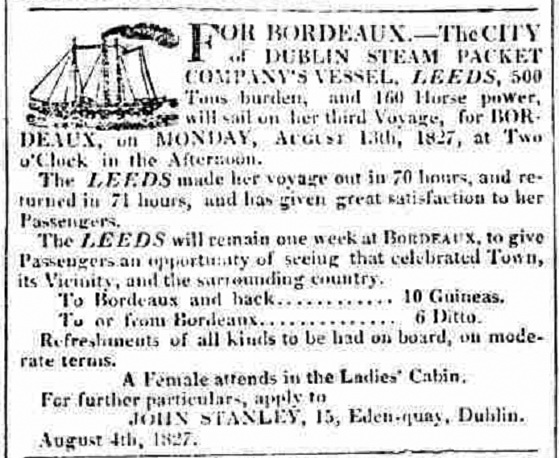
CoDSPCo ad from the Dublin Evening Mail of 8 August 1827. Image © The British Library Board. All rights reserved.
On their homeward journey, Tennyson and Hallam met the Tipperary-born landowner John Harden and his family. Harden lived in the English Lake District; he and his wife were “talented amateur artists”. The shipboard meeting is described in this extract from Leonee Ormond’s Alfred Tennyson: a literary life [Macmillan Press, Basingstoke 1993]. Harden sketched the group on deck`; here it is.
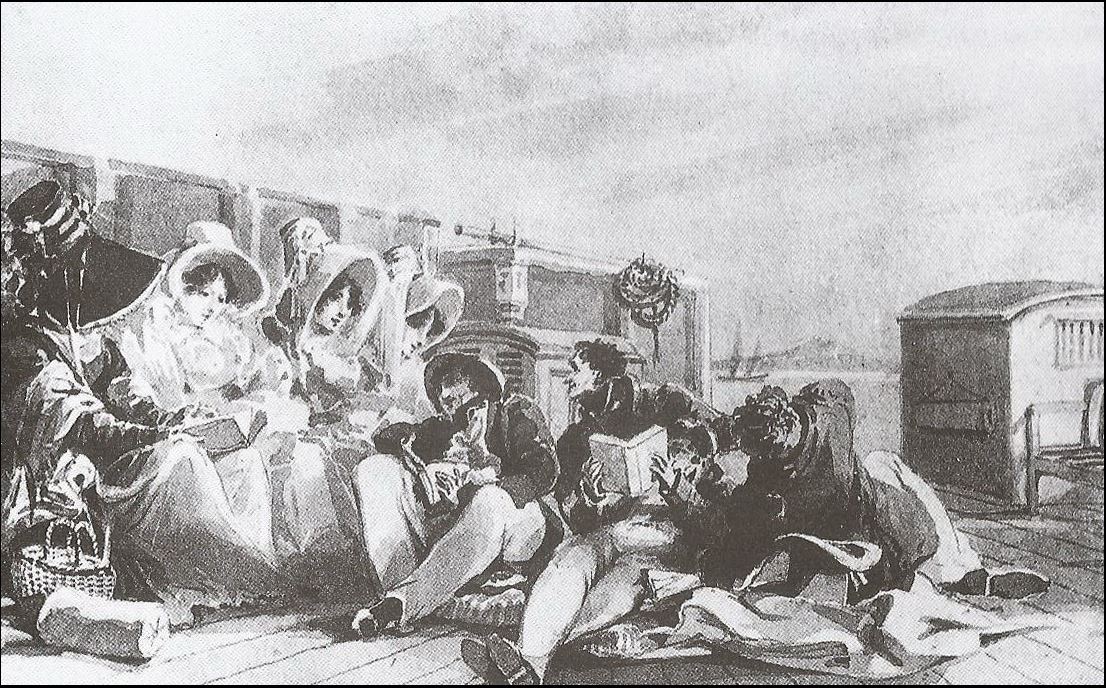
Tennyson, Hallam and the Harden family on board SS Leeds 1830
I cannot remember where I got that image. I presume that Harden’s copyright is long expired but it may be that a publisher or someone owns rights to the image. If I am in breach of copyright, leave a message below and I’ll remove the image.
Posted in Charles Wye Williams, Economic activities, Engineering and construction, Foreign parts, Historical matters, Ireland, Operations, Passenger traffic, People, Sea, Sources, Steamers, Tourism
Tagged belfast, Bordeaux, City of Dublin Steam Packet Company, Dublin, Hallam, John Harden, Liverpool, Tennyson
The Derry Castle Estate and splendid Demesne, near Limerick, on the Bank of the Shannon, exceeding 4500 Acres, with its vast Lake.
MR GEORGE ROBINS is flattered by having received the instructions of the excellent Proprietor,
Michael Henry Head Esq,
to SELL (without any limit as to protecting price), by PUBLIC AUCTION, at the GRESHAM HOTEL, in SACKVILLE-STREET, DUBLIN, on THURSDAY, the 27th of AUGUST, at Twelve o’Clock, in One Lot,
The magnificent ESTATE, which is Freehold of Inheritance, and designated
THE DERRY CASTLE PROPERTY,
which, for its splendour and renown, stands high amongst the most favoured throughout Ireland. This circumstance is not a little refreshing, inasmuch as the writer is relieved from an attempt to do it adequate justice, and to content himself with a mere outline.
It may be well, first, to observe that, fortunately, the Estate is free from that fearful pest to agricultural improvement and the yeomen’s comfort — the middle men. All are yearly tenants; the tithe is commuted; and it is a fact of no small importance to know that the use of spirituous liquors is unknown throughout this vast district; the necessary consequence is a total absence of
POLITICAL DIFFERENCES, OR DISTURBANCES
of any kind. Having thus cleared the ground of the great difficulty that has but too frequently prevailed in the minds of
THE TIMID ENGLISH CAPITALIST,
it may be well to point out a few of its multifarious advantages.
The Mansion is of importance; it stands on an elevated position above the level of the water, and is entirely suited to a family of high pretensions, with corresponding offices within and without. This edifice and its noble demesne is on the
BANK OF THE FAR-FAMED SHANNON,
the finest river in the empire. In front is a
SPLENDID LAKE, EMBRACING ONE HUNDRED SQUARE MILES OF WATER
20 miles in length, adorned by several delightful islands, whereon are interesting ruins of ancient castles.
The whole comprehends about
FOUR THOUSAND FIVE HUNDRED ACRES
of land, highly cultivated, and in the occupation of a happy and contented tenantry. The best illustration of this circumstance is the fact that the arrear is literally a mere bagatelle.
The mountain scenery, which forms a magnificent amphitheatre, is really of surpassing beauty; the cloud-capp’d mountains rising in majestic grandeur until they seem to approach the clouds — the mighty lakes like oceans of liquid silver — the valleys teeming in fertility — present a scene of such grandeur, beauty and variety, as quite to forbid the hope of conveying a just idea of it by description. The views are extensive and indescribably beautiful, extending over the rich surrounding country, and including
THREE WHOLE PROVINCES OF IRELAND,
and alone terminated by
THE VAST ATLANTIC OCEAN,
“Its mighty waters, ever rolling on
Their myriad countless waves.”
Nature has vouchsafed its kindness to a degree infinitely beyond comparison anywhere, and presents a scene well calculated to elevate and impress the human mind, and incline it better to estimate “THE PERFECT PARADISE BELOW”.
THE FISHERIES AND THE FIELD SPORTS
may safely challenge competition throughout the civilised world. Millions of water fowl congregate on the vast lake. It should be remarked that, independently of
THE IMMENSE ANNUAL REVENUE
from the Lands, there are
EXTENSIVE SLATE QUARRIES
of which the engineers’ report speaks most intelligibly: proving, past doubt, that for quality, extent, and situation, Mr Pennant’s favoured works, now producing
FIFTY THOUSAND POUNDS PER ANNUM
are not at all superior. Copper and Lead Mines are also on this estate, which, if worked, would realise an immense income. Much more might, and perhaps ought to be said, in praise of Derry Castle. Mr Robins, however, prefers to entreat of the intended competitors to seek ocular demonstration. He knows full well that this hasty and imperfect sketch will not impress them with half the delight they are sure to find there.
To those who may still be sceptical it may be added that the vast renown acquired by this
PRINCELY TERRITORY
has rendered it indispensable to indulge the nobility and travellers visiting Ireland by throwing open wide the demesne two days in each week throughout the year.
To conclude — an immense additional income is within reach by those who have money at command, by building
FIFTY OR ONE HUNDRED VILLAS ON THE BANKS OF THE LAKE.
The estate is in the quiet, unpolitical part of Ireland, thirteen miles only from the city of Limerick.
Particulars and Plans, and a drawing of the Castle, are in progress, and may be had 28 days antecedently, at the mansion — of Mr Salmon, at his Offices, 44, Moorgate-street, or Mr David Daly, Solicitor and Receiver, Fitzwilliam-street, Dublin — at Messrs Pyne and Richards’s, George-street, Hanover-square — Gresham Hotel, Dublin — the Auction Mart — and at Mr George Robins’s Offices, London.
PS — The title is clear, concise, and intelligible.
Dublin Evening Mail 7 August 1840
It is possible that Robins was brought in, with his purple pen, after earlier ads failed to attract a buyer. In March 1840 the Limerick Reporter carried an ad that concentrated on the estate’s earning potential.
FEE SIMPLE ESTATES.
To be sold, the
NOBLE DEMESNE AND ESTATES
of
DERRY CASTLE,
With Mansion House, and suitable Square of Offices; Extensive Old Plantation of Valuable
TIMBER
Generally of above 100 years’ growth, situate on that part of the River Shannon
Which forms that Beautiful Expanse of Water, called
LOUGH DERG.
Above 20 Miles long, and 4 broad, on which STEAMERS and TRADING VESSELS ply between Limerick and Shannon Harbour, giving this Estate all the advantages of the
SHANNON AND CANAL NAVIGATION,
And Trade between Limerick and Dublin.
THE HOUSE stands in a most commanding position with respect to this Magnificent LAKE, with most picturesque Mountain Views, and overhung by ranges of nearly 100 Acres of young plantation along the adjoining slopes, planted from 20 to 30 years’ since, by the late Michael Prittie Head, Esq. It is impossible adequately to describe the
BEAUTY OF THE SCENERY
The town and harbour of Killaloe is distant about 3 miles, Nenagh about 9, and Limerick about 12 miles, by land or water.
The Mail Coach Road, from Dublin to Limerick, runs through the detached part of the Estates, called Burgess.
MANURE
Of a most Peculiar and Valuable quality (and the quantity inexhaustible) is obtained from Lough Derg, for the entire Estate, at all seasons.
It is a BLUE SHELLY MARL, which is dredged from the bottom of the Lake into boats by the Tenantry, for which Quays and Harbours are arranged. It has been analysed, and was found to contain 50 per Cent of CARBONATE OF LIME, with other valuable properties set forth in the Analysis.
The more elevated divisions of these Estates abound in
SLATE QUARRIES
So long celebrated as SUPERIOR to any in EUROPE, and are now in full operation, with the splendid outlay of capital by the IMPERIAL SLATE COMPANY, in whose employ several hundred men are permanently engaged to the great advantage of the proprietor of the Estates, who participates in the income under the deeds of contract.
The specimens of COPPER and LEAD MINES afford every reason to believe that, if properly brought into operation, they may become
A RICH SOURCE OF WEALTH.
The MOUNTAIN COMMONAGE comprises about 550 Acres, which has
GREAT CAPABILITIES FOR IMPROVEMENT,
having regard to the MARL raised from the LAKE, being far superior to lime, and an
INCALCULABLE SOURCE OF WEALTH TO THESE ESTATES.
The extensive ranges of
YOUNG PLANTATIONS
Outside the Demesne, along the elevated Divisions of the Estate, are also of GREAT VALUE, comprising large sections of
OAK, LARCH, FIR, &c &c
The thinnings of which would materially tend to the improvement and growth of the Timber.
THE OLD AND YOUNG PLANTATIONS
Are estimated at considerably above £10000.
The Estimated PRODUCTIVE RENTAL VALUE of the Estate, exclusive of the Mansion, Offices, &c may be set down by way of General outline, at £3000 per annum, with the ADDITIONAL INCOME to be derived from the vast outlay of capital by the Imperial Slate Quarry Company, to a proportion of which Mr Head is entitled.
Mr Head had arranged with the principal incumbrancers to the amount of about £30000, to allow their demands to remain outstanding at 5 per cent interest, being disposed to pay off other claims by instalments; but some creditors becoming pressing, he has at length decided upon selling the entire Estate, or a competent part, to pay off the Incumbrances, and a purchaser may, if so disposed, avail himself of
LEAVING ABOUT SAID £30000 OUTSTANDING
to suit his convenience.
Any further particulars will be explained by Michael Henry Head, Esq, Derry Castle, Killaloe.
David Daly, Solicitor, No 26, Fitzwilliam-street, Dublin, is Receiver and Land Agent of the Estates, and has all Rentals, &c and will give every information, furnish statements of title, and receive propositions from purchasers, and under Mr Head’s sanction, will at once conclude a contract for sale.
Te title is perfectly clear, concise, and intelligible, and all seaarches ready for inspection.
The Estates contain 4347 statute Acres, and the young plantations 74800 Trees, exclusive of the old plantations in the Demesne.
February 21
Limerick Reporter 20 March 1840
Neither ad was successful; the estate was not sold until 1844.
The Derry Castle and Burgess estate, county of Tipperary, was knocked down to Francis Spaight, Esq, of Limerick, for £39500 at the Chambers of Master Goold, on Tuesday. The highest bona fide offer for this property at the sale last May was £37500, and it was then bought in at £38000. The estate comprises 3000 acres of land, with mansion house, and offices, on the most picturesque and frequented part of the Upper Shannon, near Killaloe.
Statesman and Dublin Christian Record
16 August 1844

Posted in Ashore, Built heritage, Canals, Charles Wye Williams, Economic activities, Engineering and construction, Extant waterways, Historical matters, Industrial heritage, Ireland, Irish inland waterways vessels, Operations, People, Shannon, Steamers, The grain trade, Waterways management
Tagged Burgess, City of Dublin Steam Packet Company, Clare, commonage, Derry, Dublin, fir, George Robins, Head, incumbrance, Killaloe, larch, Limerick, manure, marl, oak, Prittie, slate, Spaight, steamer, timber, Tipperary, trading boat
An article from the Dublin Penny Journal of 13 September 1834 [Vol III No 115], conducted by P Dixon Hardy MRIA, solves that and other longstanding problems.

The tunnel or archway through Lord Cloncurry’s grounds
Having in our last described the line of railway from the entrance station in Westland-row to the Pier at Kingstown, we now take the opportunity, while presenting our readers with two other views of the road, of inserting an article which, since our last publication went to press, has appeared in The Sun newspaper, relative to the carrying on of public works in Ireland. Our readers will perceive that its general bearing is in perfect accordance with the opinions we have more than once before expressed, when speaking on the subject of railways. We have already stated our reasons for giving a preference to railways over other modes of conveyance; but we fully agree in opinion with the writer of the article to which we refer, that no greater benefit could be conferred upon Ireland than the introduction of a cheap and expeditious means of conveying her agricultural produce from the heart of the country to the extremities — whether this be by canals or railways is a matter to be decided by the locality of those districts through which the lines of road may pass.
“We do not often derive so much pleasure from the perusal of a public document as we have from a careful inspection of the plans, and consideration of the suggestions, contained in the Second Report of the Commissioners of Public Works in Ireland, just printed by order of the House of Commons. Notwithstanding the low ebb at which the tide of Ireland’s prosperity stands at present, we predict, from the great improvements that are now being carried on, in clearing harbours, opening canals, and making roads along the eastern, southern, and northern coast, that the day is not very long distant when Ireland will, from being a bye-word among the nations of Europe, become equal to some of its proudest states in industry, wealth, intelligence, and love of order.
The worst crimes of Ireland are the results of the poverty and despair, rather than the evil disposition of her population. Public works, besides giving employment to thousands of her labouring poor, whom want has rendered almost desperate, will be the means of inducing capitalists to establish factories where facilities are afforded for carrying on an extensive trade; and will enable agriculturists to raise produce wherever a line of good road, a cheap water carriage, or convenient shipping, supplies them with a sure market for the fruits of their industry.
During the last eighteen months the sum of one hundred and twenty-nine thousand, six hundred and thirty-three pounds were expended in the improvement of Kingstown and Dunmore harbours, the making of roads on the Antrim coast, and the building of bridges, and other improvements in different parts of Ireland. The consequences of these works are already beginning to be manifested in the improved condition of the inhabitants in their vicinity, and the altered aspect of the immediately adjoining face of the country.
The commissioners themselves say that ‘Wherever a new road is constructed, flourishing farms at once spring up, and the carts of the countrymen press on the heels of the road-makers as the work advances’. And in a preceding paragraph the following most important information is given: — ‘In traversing a country covered with farms, and in a high state of cultivation, showing every sign of a good soil and of amply remunerating produce, it becomes difficult to credit the fact that, ten or twelve years since, the whole was a barren waste, the asylum of a miserable and lawless peasantry, who were calculated to be a burden rather than a benefit to the nation; and that this improvement may entirely be attributed to the expenditure of a few thousands of pounds, in carrying a good road of communication through the district’.
What Ireland stands most in need of at the present moment is, a cheap and expeditious means of having her agricultural produce conveyed from the heart of the country to the extremities. Now, in our judgment, the best way of effecting this would be by canals, of which she stands in the greatest need.
The first of these should be a canal from Dublin to Galway, which would cut the whole island across, from east to west, uniting St George’s channel with the Atlantic ocean. This line of communication between the capital of Ireland and a great commercial town on the extreme coast, would be of immense importance to the inhabitants of both, but of still more so to the whole population of Connaught, among whom it would be the direct means of introducing manufacturing industry, and a taste for the arts, enjoyments, and elegancies of civilized life. The distance between Dublin and Galway is about one hundred and four miles, through which a direct line of canal has already been carried for forty-two miles — namely, from Dublin to Philipstown; so that in point of fact the work is already begun, and only wants the aid of government, and the assistance of the landed proprietors in King’s County, Roscommon, and Galway, the value of whose estates would be trebled by it, to effect its entire completion.
The next line of canal should be from Ballyshannon Harbour to Dundalk, by Enniskillen, by which the greatest facilities would be given to agriculture and manufacturing improvements in the counties of Donegal, Fermanagh, and Leitrim; and more especially to the trade of Ballyshannon and Dundalk, which, though capable of being made emporiums of provincial industry and wealth, are now little better than marts for the fish caught along their coasts. However, great praise is due to Colonel Conolly, the member for Donegal, who has advanced a thousand pounds, and given security for four thousand more, for repairing the harbour of Ballyshannon, which, when finished, will be of great benefit to the people of the town, and the inhabitants along the western coast, from Sligo to Killybegs.
The last line of communication which we would suggest to the government, besides the navigation of the Shannon, which is sufficiently dwelt upon in the reports of the select committee on that subject, is a canal from Waterford to Sligo, intersecting the canal from Dublin to Galway, somewhere about Philipstown.
This, with such a line of communication from Dublin to Belfast, would unite all Ireland; and in a very few years would render the country as prosperous, as rich, and as contented as any in Europe. The intercourse which those canals would give rise to between the people in every part of the provinces, would extinguish that spirit of religious animosity which now divides and destroys them. Bring men only together, and they will soon remove the prejudices of each other.
The people of Ireland are at present as much removed from each other at the distance of fifty miles apart, as if the whole Indian ocean rolled between them. Hence, the jealousies, and hatreds, and cherished recollections of feudal wrongs, so common in almost every district of Munster and Connaught. But let once manufacturing industry prevail in these districts — let the voice of the mechanic be heard in the villages — and we will pledge ourselves that the people of Ireland, with all their alleged love of mischief, will find other employment than that of parading nightly in a Captain Rock uniform, or recording vows of vengeance against Sassenachs and collectors of king’s taxes.”
Posted in Canals, Economic activities, Engineering and construction, Extant waterways, Historical matters, Ireland, Shannon, Unbuilt canals, waterways
Tagged Ballyshannon, Daingean, Dublin, Dundalk, Enniskillen, Galway, Ireland, Killybegs, Phipipstown, prosperity, railways, Sligo, trade, Waterford
The Directors of this Company will receive Tenders for providing and erecting (exclusive of masonry) two Wrought Iron Water Tanks, each to contain, when full, 6000 gallons of water, and each to be connected with two swing water cranes, with proper valves, &c. Also, for two Water Cranes, connected by pipes, 6 diameter [sic], with the water in the Royal Canal. Tenders to quote price per 100 feet, length of pipes, and to be sent in with a drawing and short specification, addressed to the Chairman at 23 College-green, Dublin, and endorsed, “Tender for Water Tanks and Cranes”, on or before Noon of 9th November, 1846. The whole to be completed on or before the 20th January, 1847, under a penalty of £2 per day. If further information is required apply to G W Hemans Esq, Engineer to the Company, at 53 Upper Sackville-street, Dublin; and the Directors do not bind themselves to take the lowest tender.
By order, Henry Beausire, Sec, Dublin, 23 College-green, 26th Oct, 1846
Saunders’s News-Letter 3 November 1846
Posted in Ashore, Built heritage, Canals, Economic activities, Engineering and construction, Extant waterways, Historical matters, Industrial heritage, Ireland, Operations, Passenger traffic, Rail, waterways, Waterways management
Tagged Beausire, Dublin, Hemans, Midland Great Western Railway, Royal Canal, water crane, water supply, water tank
The Grand Canal Company do hereby give Notice, that they are ready to receive Proposals for supplying Ashler Stones for repairing the Locks upon the Grand Canal; the Stretching Stones to be twelve Inches Bond, and the Heading Stones two Feet Bond. All Persons willing to furnish the same, are desired to apply to Captain Charles Tarrant, No 45, Cuffe street, who will inform them where the same are to be layed down. —
Proposals will be received for Building, by Contract, two Boats on the Canal (the Size and Dimentions to be known upon Application as above), the Contractor finding Timber and every Article requisite.
Also for furnishing Lime per Hogshead, in the Neighbourhood of Ballyfermott Bridge.
June 18, 1777. Signed by Order, R BAGGS, Sec
WHEREAS the Sluice erected upon the Canal in the Barrenrath Level, has been wantonly and feloniously broken down, a Reward of Twenty Guineas shall be paid for discovering and prosecuting to Conviction the Person or Persons who have committed the said Offence.
By Order of the Grand Canal Company, June 7, 1777, R BAGGS, Sec
Saunders’s News-Letter 23 June 1777
Posted in Ashore, Built heritage, Canals, Economic activities, Engineering and construction, Extant waterways, Historical matters, Industrial heritage, Ireland, Irish inland waterways vessels, Operations, Safety, Sources, waterways, Waterways management
Tagged ashlar, Baggs, Ballyfermot, Barrenrath, boat, bridge, canal, Charles Tarrant, Cuffe street, Dublin, Grand Canal, hogshead, lime, lock, reward, sluice, stone
The Royal Canal’s origins have never been satisfactorily explained: a later legend even seeks to explain its origins in an obscure dispute between a retired shoemaker and other members of the Grand Canal Company. But in fact its origins were political. As the Grand Canal Company was taken over by the conservative La Touche clique, the opposition launched a new venture: its patron was the duke of Leinster; businessmen and opposition politicians rallied to it; and Gleadowes, rivals of the La Touches, were bankers to the company. In other words, there was to be a left-wing as well as a right-wing way to reach the Shannon. Almost symbolically on its more northerly route to the Shannon, it passed through the duke of Leinster’s land.
L M Cullen “Politics and Institutions, 1731–1835” in Economy, Trade and Irish Merchants at home and abroad, 1600–1988 Four Courts Press, Dublin 2012
Posted in Built heritage, Canals, Economic activities, Engineering and construction, Extant waterways, Historical matters, Industrial heritage, Ireland, People, Politics, Restoration and rebuilding, Shannon, Sources, waterways, Waterways management
Tagged Dublin, duke of leinster, Gleadowes, La Touche, Royal Canal, Shannon
On 27 May 2017 the Royal Canal Amenity Group and Waterways Ireland are to commemorate the fact that
In May 1817 the Royal Canal was officially opened from Dublin to the Shannon ….
[Unfortunately I am unable to find anything about the commemorative event on WI’s website, although they did send me some information about it.]
I wondered how the opening might have been celebrated in 1817, but I haven’t been able to find out anything about it. I am hoping that some more knowledgeable person might be able to provide information: please leave a Comment below if you can help.
Ruth Delany gives 26 May 1817 as the date on which the contractors said that the western end of the canal (to the Shannon at Richmond Harbour) would be ready to hand over to the Directors General of Inland Navigation, who were running the show after the Royal Canal Company collapsed under the weight of its debts.
However, as far as I can see, the British Newspaper Archive contains no mention of any opening ceremony at any time in 1817. The Lanesborough Trader, the first boat to travel from the Shannon to Dublin did so in January 1818 [Saunders’s News-Letter 2 February 1818] and in May Mr Peel moved that a further £15000 be granted for completion of the navigation, where “shoals were
found to interfere” [Dublin Evening Post 23 May 1818].
Traffic increased later in 1818: in October the directors of the New Royal Canal Company went by boat
… from Dublin to Tarmonbury, and thence to the termination of the Canal, near the river Shannon, to inspect the works and give every necessary direction for the entire completion of that great and important undertaking ….
[Dublin Evening Post 20 October 1818]
The same newspaper reported that several boats of coal, found on the banks of the canal near Tarmonbury, had arrived in Dublin. It seems, therefore, that the canal was usable even if not entirely finished.
Later that month Christopher Dillon of Athlone, who had been trading on the Grand Canal and the Shannon, announced that he was moving his boats to the Royal Canal — but the western terminus for his boats was at Ballymahon, from which (although he did not say so) goods could be carried by road to Athlone: just the situation the Grand Canal Company had feared. [Dublin Evening Post 27 October 1818]
I have found no evidence of an opening ceremony in 1817; nor have I found evidence that the canal was actually open from the Shannon to the Liffey (or the Broadstone) in 1817, in that no boat seems to have travelled between the Shannon and the Liffey. At least one boat did so in 1818, but again I have no evidence of any opening ceremony.
There is one further mystery. The Royal Canal harbour at the junction with the Shannon is called Richmond Harbour. I presume that that is a compliment to the Lord Lieutenant of Ireland, His Grace Charles Lennox, 4th Duke of Richmond, 4th Duke of Lennox, 4th Duke of Aubigny, KG, PC. But he had ceased to be Lord Lieutenant in 1813 and was presumably unable to dispense favours after that, so why was the harbour named after him? I don’t know when the construction of the harbour was begun or finished.
I have not visited the National Archives in Dublin to look at the papers of the Directors General of Inland Navigation, which may have something on the events of 1817 and 1818. Perhaps WI’s archive has something relevant too. I would therefore be glad to hear from anyone who has searched those archives or found other evidence about the period.
Newspapers cited here were accessed through the British Newspaper Archive.
Posted in Ashore, Built heritage, Canals, Economic activities, Engineering and construction, Extant waterways, Historical matters, Industrial heritage, Ireland, Irish inland waterways vessels, Modern matters, Operations, People, Politics, Restoration and rebuilding, Roads, Shannon, Sources, waterways, Waterways management
Tagged Athlone, Ballymahon, boat, Broadstone, DGIN, Directors General of Inland Navigation, Dublin, Duke of Richmond, national archives, Richmond Harbour, Royal Canal, Royal Canal Amenity Group, Shannon, Tarmonbarry, Waterways Ireland
According to Waterways Ireland’s website, there is to be a half Marathon [a marathon is an old chocolate bar, my advisors tell me] in Clontarf on 1 June 2017. No doubt some politician will be on hand to emulate the miracle of the loaves and the fishes; otherwise most of those attending are likely to go hungry.
But what interests me is Waterways Ireland’s assertion that the location of this chocolate bar is the Grand Canal.
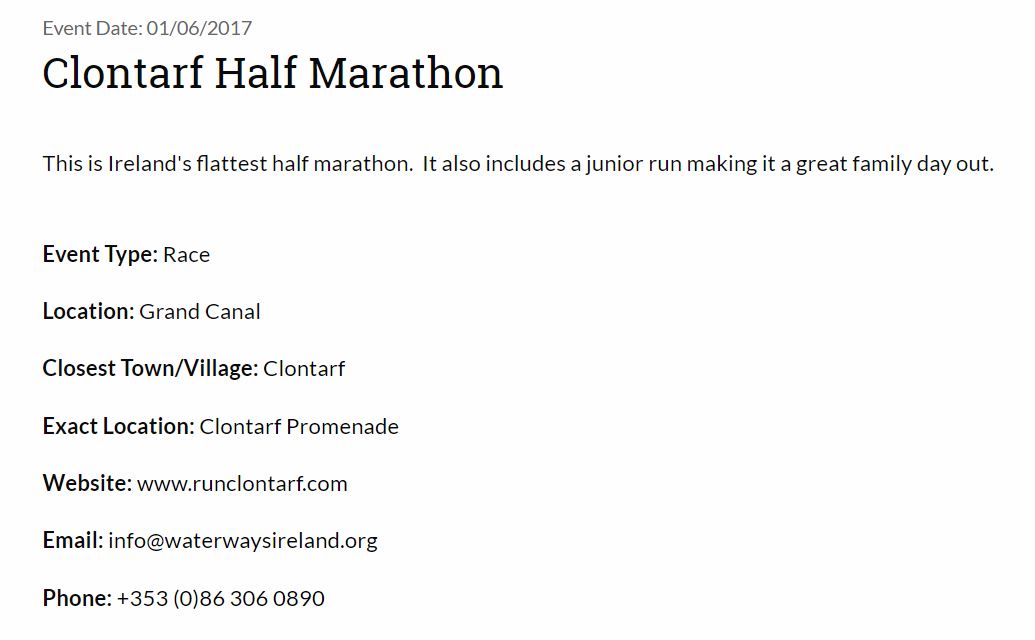
Now, when ah wur a lad, it was generally understood that Clontarf was on the north side of the Liffey, where the natives ate their babies, whereas the Grand Canal was on the south side, where the better element of the population resided. We don’t, of course, talk about that sort of thing nowadays, but I am still surprised to find that the Grand Canal, or any part of it, has been relocated to the north side of the Liffey. Where, I ask myself, is the aqueduct on which it crosses the Liffey?

 Irish waterways history