
Have you ever wondered, as you grounded on a sand bar or fought a current upstream, quite why the River Barrow is so challenging?
Here is a confession (with photos) from the man wot done it — in 1931 ….
… just some of the things you can see from the Killimer to Tarbert ferry.
Actually, I lied about the weirs, but they were there once. As were the salmon.
Posted in Ashore, Built heritage, Charles Wye Williams, Economic activities, Engineering and construction, Extant waterways, Industrial heritage, Ireland, Irish inland waterways vessels, Irish waterways general, Natural heritage, Non-waterway, Operations, Scenery, shannon estuary, Sources, Steamers, The cattle trade, The fishing trade, The turf trade, Tourism, waterways, Waterways management, Weather
Tagged battery, boats, Clare, Endesa, ESB, estuary, ferry, flow, fort, Ireland, jetties, Kerry, Kilkerin, Killaloe, Killimer, Kilrush, lighthouse, Limerick, Napoleon, Operations, power station, quay, redoubt, Shannon, Tarbert, Tarbert Race, Tarbert Roads, vessels, waterways, weir, workboat
The installation of the new pontoon, the flood control gates (flash lock) and the walkway continues apace.
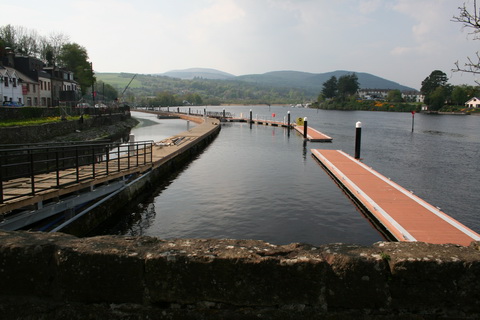
Walkway (left) and pontoon from the lockhouse
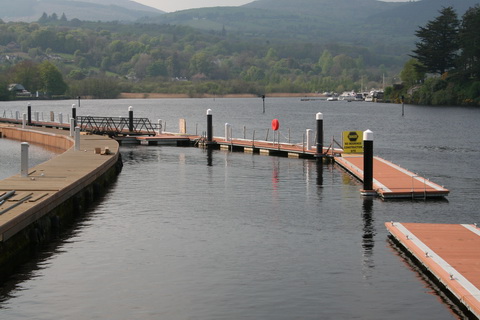
The lower (nearer) section of pontoon may be for the lakeboat hire business
Boats mooring on the lower end of the pontoon, and turning to approach upstream, may get quite close to the bridge. The navigation markers may confuse too: perhaps they’ll be relocated.
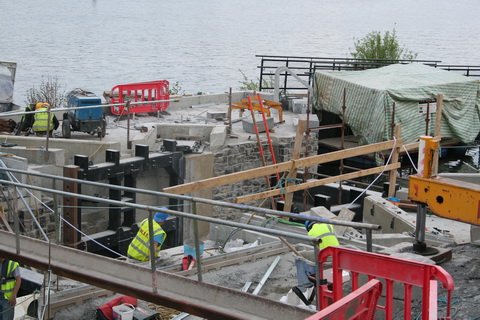
The flood control gates (flash lock?)
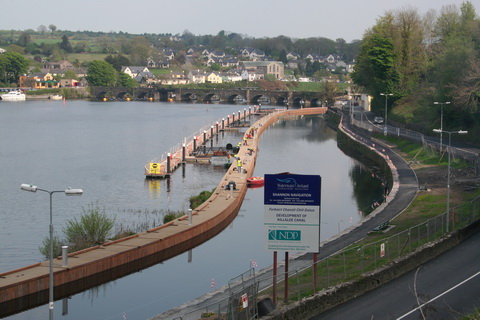
From upstream (and uphill)
It all looks very nice. There are lots of people working on site.
Posted in Ashore, Economic activities, Engineering and construction, Extant waterways, Restoration and rebuilding, Tourism, Water sports activities, Waterways management
Tagged Ballina, boats, bridge, canal, Clare, flow, Ireland, jetties, Killaloe, L & M Keating, lock, Lough Derg, moorings, pontoon, Shannon, vessels, walkway, water level, waterways, Waterways Ireland, workboat

The Barrow at Monasterevan (or -in)
Wouldn’t it be better if the Council ordered weak currents instead?
Posted in Ashore, Extant waterways, Operations, Tourism, Water sports activities, Waterways management
Tagged bank, Barrow, county council, current, flow, Kildare, lifering, Monasterevan, Monasterevin, river, water level
I have written a page suggesting that, on good economic principles, the Irish government should use the Royal Canal as a giant rubbish dump.
This step would solve the impending shortage of landfill sites, avoid the need for an incinerator at Poolbeg and allow Keynesian bottles to be used to provide employment and stimulate the economy.
I have also suggested an alternative use for the Royal, but I’m afraid the alternative is almost laughably implausible: it is that folk should be encouraged to go boating on the Royal. I even suggest — I know it’s ridiculous — that some folk might like to complete the “Irish ring” or triangle: along the Grand to Dublin, to the Shannon along the Royal and then completing the circuit by travelling south along the Shannon.
If the numbers travelling were to justify the upkeep of the canals, large numbers of hirers would be needed, as would large numbers of hire boats. But not all of the existing hire firms are keen on the idea and none of them (as far as I know) is advertising the route. Waterways Ireland promoted it at a recent Birmingham boat show, but without the sort of detailed information that a would-be hirer would need.
It may be that Waterways Ireland is holding back until an adequate water supply for the Royal has been secured and until the obstacles at the Dublin end have all been removed. Perhaps it intends to persuade hire firms (new or existing) to provide packages; perhaps it will have a super new marketing campaign once everything is ready, and perhaps it’s just playing for time at the moment.
The problem with that approach is that it risks losing goodwill from potential hirers who, having heard of the reopening of the Royal, are now finding it difficult to arrange a trip.
One of the major sources of difficulty, as I see it, is the absence of information about what a trip might entail. Only the IWAI Dublin Branch seems to have made any effort to help folk who want to travel the route; neither the RCAG nor the Waterways Ireland site is of much use to anyone.
Accordingly, I have written a second page with some suggestions about how a hirer might tackle the trip. I still think it’s ridiculously difficult to plan, especially for a would-be hirer form overseas, and my information is not complete. I hope that folk will suggest improvements and help to tie down the details. And if anyone knows of a hire firm that is offering packages, with all the schedules worked out and the bookings made, do please give the details.
Posted in Economic activities, Engineering and construction, Extant waterways, Industrial heritage, Operations, Restoration and rebuilding, Tourism, Waterways management
Tagged boats, bridge, canal, flow, Grand Canal, Green and Silver, hire firm, Ireland, Ireland canals Grand Royal, Irish ring, lock, Newcomen, Operations, Rolt, Royal Canal, Shannon, triangle, vessels, water level, waterways, Waterways Ireland

 Irish waterways history