Tag Archives: Grand Canal

The Royal under the Railway

A new, short book, on aspects of the history of the Royal Canal, published by the Railway and Canal Historical Society, will be launched at the Clinker Lecture on 18 October 2014. The title is The Royal under the Railway: Ireland’s Royal Canal 1830–1899 and it covers a number of topics, mostly about the canal after it was bought by the Midland Great Western Railway. From the Introduction:

The accounts of the Midland Great Western Railway for the half year ending 31 December 1849, four years after it bought the Royal Canal, showed its gross income from the railway as £23,773 and its income from the canal as £7,677, roughly a quarter of the total. By 1899, though, income from the railway was £264,393 and that from the canal £2,220, less than one per cent of the total. The Royal Canal, never particularly successful, had declined into utter irrelevance.

It may seem perverse, therefore, to offer even a short book on the canal’s history in that period, especially as there exist two full histories, by Peter Clarke and by Ruth Delany (with Ian Bath in the most recent edition). This, though, is not a full history, even of the limited period, roughly 1830–1899, from just before the railway took over until the end of the nineteenth century. This is rather a complement to those histories, providing just enough background information to  enable the book to stand alone while covering some new topics and providing new or extra information on others. The topics include:

  • the 120-foot steam-powered narrowboat
  • the Midland Great Western Railway’s early attempts at running canal boats
  • the ingenious Mr Mallet’s moveable bridge
  • the whore who held the mortgage on the canal
  • the competition between the roads of Roscommon and the Royal Canal
  • the reconstruction of Dublin bridges over the canal
  • the horses who slept on board their boat.

[…] this book is not intended to be the last word on any of those topics. I hope that it might encourage others – those researching local, family, social, industrial, transport, economic or technological history – to record and transmit anything they might learn about the history of the Royal Canal. To take just three topics, we know very little about canal employees, the operations of canal traders or the management of the horse-drawn canal boats. On any one of those, useful information could just as easily be found by a local or family historian as by a canal specialist.
 

Steam, the Shannon and the Great British Breakfast

That is the title of the Railway and Canal Historical Society‘s 2014 Clinker Memorial Lecture, to be held at the Birmingham and Midland Institute, Margaret Street, Birmingham B3 3BS, at 1415 on Saturday 18 October 2014.

The lecture will concentrate on the period before 1850 with such interesting topics as

  • Shannon steamers
  • the Grand and Royal Canals
  • the first Irish turf (peat) to reach the USA (possibly)
  • port developments in Dublin, Limerick and Kingstonw
  • the Dublin and Kingstown Ship Canal
  • the Midland Great Western Railway
  • what “cattle class” really means
  • bacon and eggs.

Admission is free and booking is not required. However, if you plan to attend, it would be helpful if you could e-mail […] to this effect.

The Clinker Memorial Lecture is named for Charles R Clinker, an eminent railway authoe and one-time historian of the Great Western Railway, who died in 1983.

If you would like the contact email address, leave a Comment below and I’ll get in touch with you direct.


Ballinasloe footbridge

Here is a new page with a brief account of the Ballinasloe Line of the Grand Canal and some photos of a footbridge that seems to have been built across it in the twentieth century.

Saving canals

Barrow Line 20140721 03_resize

Barrow Line 1

Barrow Line 20140721 06_resize

Barrow Line 2

Barrow Line 20140721 08_resize

Barrow Line 3

Barrow Line 20140721 09_resize

Barrow Line 4

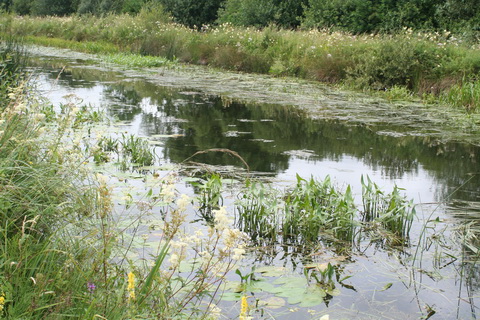
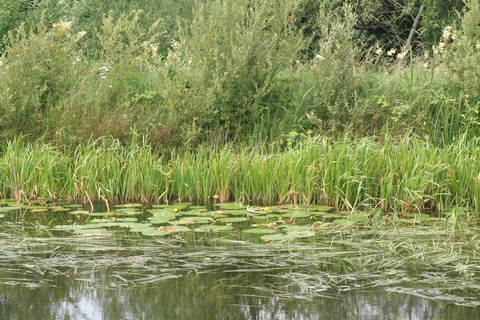
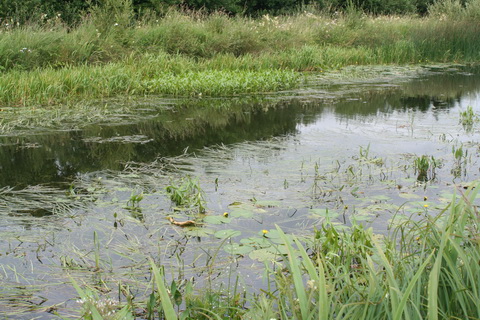
When I get a moment, I must find out how many boats have been down that way in this warm, sunny July, the peak of the holiday season. The warmth will have encouraged the vegetation, but I suspect relatively few boats have been through. And only two boats entered the Royal through Dublin in July, even though two openings were offered.

Apart from giving artistic verisimilitude to an otherwise bald and unconvincing narrative about the value of the canal tourist industry and the abiding love of boaters for the canal, using canals helps to keep the weed down.


Tullamore in 1947

T W Freeman “Tullamore and its environs, Co Offaly” in Irish Geography (Bulletin of the Geographical Society of Ireland) Vol 1 No 5 1948 (based on material collected in 1947):

The original geographical advantage lay in the canal, which placed it on the main line from Dublin to Limerick around 1800, but canal traffic, though still important, is no longer crucial.

However …

Social activities in Tullamore include a wide range of clubs for athletics, dances, bridge, a modern cinema, and the occasional extra shows and matches that mean so much to the people of a country town and its surroundings. On the athletic side the new swimming pool is the most attractive recent addition (but no mixed bathing) ….

GCC Shannon steamers 1866

Here is a new page with an illustrated article from 1866 about the steam engines in three Grand Canal Company steamers of that era, which were used on the Shannon. I am grateful to Mick O’Rourke of Irish Shipwrecks for sending the article to me.


Don’t tread on my decks

Dublin Police — yesterday

Threatening to shoot

Edward Farrell, a boat-owner on the Grand Canal, was held to bail to keep the peace to his brother-in-law, Simon Farrell, also a boat-owner on the same canal, and at whom he presented a loaded gun, the same morning at James’s-street harbour, threatening to shoot him for passing across his (Edward’s) boat for the purpose of getting into his own vessel, which was lying alongside.

Freeman’s Journal 23 November 1842

The hire business, as we know and love it …

… is screwed.

That is my interpretation [and not, I should stress, to be attributed to the report’s authors, sponsors or supporters] of the results of the June 2014 report Ireland’s Inland Waterways – Review & Outlook  prepared by  Tourism & Transport Consult International for the Irish Tourist Industry Confederation “with support from the Irish Boat Rental Association (IBRA)” and downloadable here [PDF].

The report is well worth reading. I’ve been charting the decline in the cruiser hire industry, as indicated by Shannon lock passages, for some time now; a source within the industry told me recently that the decline was actually worse than those figures indicated. The report shows that the IBRA fleet size went from 388 in 1992 to a peak of 533 in 1997 but down to 225 in 2013.

The fleet refinancing problems look to be horrific and it doesn’t seem to me that more marketing (if marketing is taken to be Promotion rather than any of the other Ps) is going to be enough: another P, Product, needs to be redefined rather more usefully than in Tourism Ireland’s segmentation waffle about “Great Escapers” and the “Culturally Curious”. Tourism is good for waterways, but products other than (or as well as) straightforward cruising need to be offered.

And consider this:

Over the past 10 years upwards of €200 million in state expenditure has been invested in upgrading infrastructural facilities along the waterways. The investment has helped to transform the quality and quantity of moorings, navigational aids, signposting. Mooring capacity has been doubled over the period as well as the developments of several integrated harbors including berths with associated on-shore facilities including toilet and shower blocks, picnic and play areas, looped walks, etc. Such developments have taken place at locations on the Shannon and Grand Canal, including Boyle, Clondara, and Killaloe.

No wonder WI’s budget is being cut, if €200 million went to subsidising the Irish bourgeoisie rather than to bringing in more tourists. Of course if the Clones Sheugh were reconstructed tourists would come flocking from Germany, Austria and Switzerland: indeed from all around the world.

And the report says of the Lakelands and Inland Waterways Initiative, about which I have expressed scepticism,

The relevance of the well intentioned initiative and proposed branding to the cruising business was diluted by the large area encompassed by the new regional initiative and the less than adequate resources invested in effective marketing in key source markets. Unfortunately the results of the marketing effort do not appear to have raised the profile of Shannon and linked waterways.

I did think it odd that Abbeyleix got funding ….

This report is a very welcome dose of realism. I want to give it more thought before commenting on individual points, so I’ll come back to it again, but in the meantime I urge everyone to read it (it’s pretty short).

h/t Antoin Daltún

[amended]


Shannon traffic to May 2014

I am grateful to Waterways Ireland for letting me have copies of the recorded numbers of boat passages through Shannon locks and Portumna Bridge for the first five months of 2014. All the usual caveats apply:

  • the underlying figures do not record total waterways usage (even for the Shannon) as, for instance, sailing, fishing or waterskiing on lakes or river stretches, which did not involve a passage through a lock or Portumna Bridge, would not be recorded
  • the passage records would not show, for instance, a change in the balance of types of activities from those in larger cruising boats to those in smaller (sailing, fishing, waterskiing) boats
  • figures like these, for a small number of months, will not necessarily be representative of those for the year as a whole. The winter months, January to March, see little traffic in any year; for April and May, the weather can have a large influence on the amount of activity especially, I suspect, in private boats.

On the other hand, the figures do include the Shannon’s most significant tourism activity, the cruiser hire business. And they are our only consistent long-term indicator of usage of the inland waterways.

Shannon passages May 2014 01


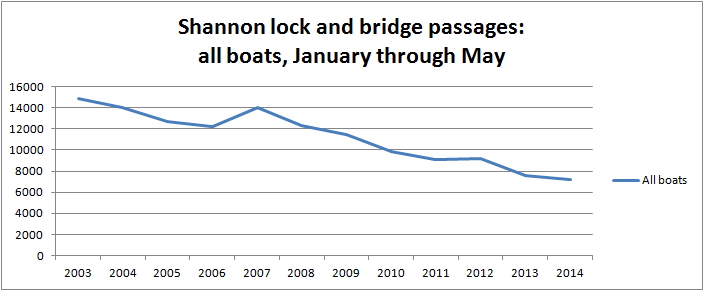
The total amount of traffic continues to decline.

Shannon passages May 2014 02

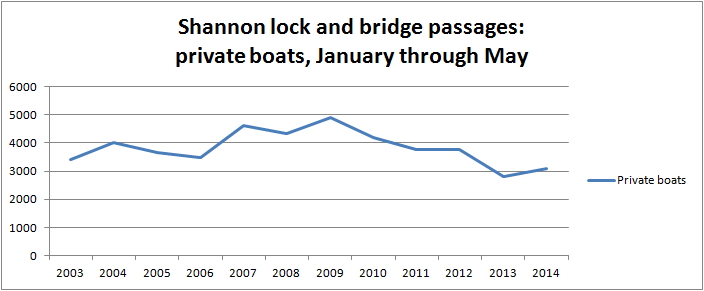
Private-boat traffic is still below its average for the period but increased slightly on the same period of the previous year [but see the third caveat above].

Shannon passages May 2014 03


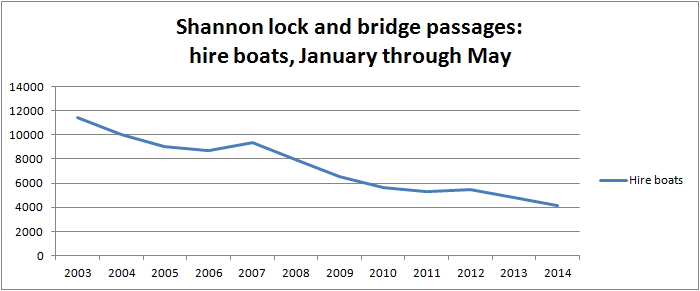
Hire-boat traffic is just over one third of its 2003 level.

Shannon passages May 2014 04


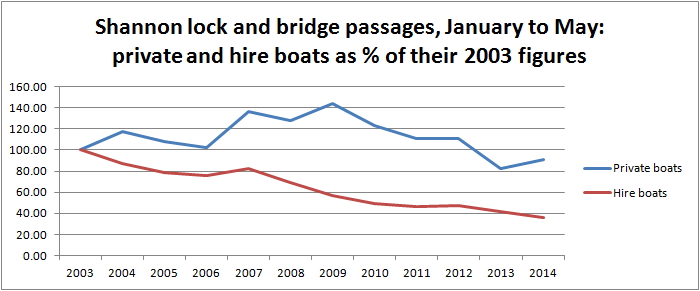
Since 2003, both private and hired traffic have fallen, from the highest figures attained within the period, by about 60% of the 2003 figure. But private traffic first rose by 40% of the 2003 figure, so it is now only about 20% below that figure. Hire traffic has fallen pretty consistently since 2003.

Shannon passages May 2014 05


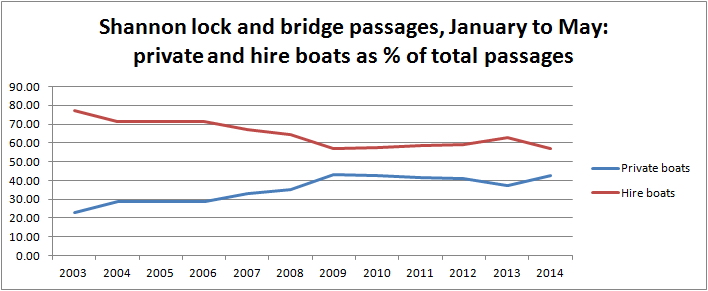
Hire traffic is usually greater than private traffic between April and October (roughly speaking), but the gap is closing.

Carál Ní Chuilín, NI’s [SF] waterways minister, said the other day:

Waterways Ireland delivered a presentation to Ministers entitled ‘Ireland’s Inland Waterways — Building a Tourism Destination’. The presentation provided an overview of the progress that Waterways Ireland is making in placing waterways and the waterway experience at the centre of the tourism offering in Ireland and internationally.

And a good thing too, but the waterways need new water-based tourism products to complement, and perhaps to replace some of, the hire-boat cruising business. Opening new waterways — Royal Canal, Longford Branch, Ulster Canal, Kilbeggan Branch or anything else — is a waste of money until demand, domestic and visitor, private and hired, exceeds existing capacity.


Sallins

Houseboat facility starts again.