
… no more licensed traders in marked fuels [xls] along the Shannon.
Funny how few marinas sell diesel nowadays.
… no more licensed traders in marked fuels [xls] along the Shannon.
Funny how few marinas sell diesel nowadays.
Posted in Ashore, Economic activities, Engineering and construction, Extant waterways, Ireland, Irish inland waterways vessels, Irish waterways general, Non-waterway, Operations, People, Politics, Shannon, Sources, Tourism, Water sports activities, waterways, Waterways management
Tagged boats, Clare, green diesel, Ireland, Killaloe, Lough Derg, marked fuel trader's licence, Operations, Shannon, Tipperary, vessels, waterways
Paul Quinn’s photos showed the new Marlborough Street Bridge being constructed across the Liffey. Last Saturday’s Irish Times reported that Dublin City Council would soon be advertising to seek suggestions for naming the bridge; it said that a body called Labour Youth [whose members may be socialists, I fear] wanted it named after one Rosie Hackett, who went on strike many years ago. It did not report that there is another campaign to have the bridge named after E T S Walton, a physicist.
The north-eastern corner of the bridge features the site of the offices of the City of Dublin Steam Packet Company, whose crest still adorns the walls. I suggest that the bridge be named after the company’s founder, the remarkable Irish entrepreneur Charles Wye Williams: the father of the Shannon, the master of scheduled steam shipping, the founder of the CoDSPCo and a founder director of the Peninsular and Oriental Steam Navigation Company, godparent of the Irish livestock industry, innovator in marine safety, promoter of the turf industry, writer and experimenter on steam technology, tireless campaigner ….
Apart from his company’s crest on Eden Quay, and his name on a bridge he caused to be built in Limerick, there is no monument to this remarkable man. Name the bridge after him and move the plaque to it (and protect it adequately).
Posted in Ashore, Charles Wye Williams, Economic activities, Engineering and construction, Extant waterways, Industrial heritage, Ireland, Irish inland waterways vessels, Operations, People, Shannon, shannon estuary, Sources, Steamers, The cattle trade, Tourism, waterways, Waterways management
Tagged boats, bridge, Charles Wye Williams, City of Dublin Steam Packet Company, Dublin, Eden Quay, estuary, Fergus, Grand Canal, Ireland, Killaloe, Kilrush, Liffey, Limerick, Lough Derg, Marlborough Street, Operations, P&O Line, quay, Royal Canal, Shannon, steamer, vessels, waterways
In May 1895 the fear induced by the prospect of a passage under Baal’s Bridge, on the Abbey River in Limerick, as revealed in the commercial court in London before Mr Justice Mathew and reported by the Freeman’s Journal of 20 May 1895.
Arthur George Mumford of Colchester, Essex, was described as an agent, but was actually a marine engineer and manufacturer of steam engines. He owned a 25-ton steam yacht called Gipsy, which he decided to sell through Messrs Cox & King, the well-known yachting agents (their 1913 catalogue is here).
The buyer was Ambrose Hall, the man responsible for the statue of Patrick Sarsfield. A former mayor of Limerick, he was an alderman and a “house and land commission agent”; his address was given as Mignon House, Limerick, which I have not so far found.
Hall bought the boat for £500; it was to be delivered to him at Limerick. The original plan was to sail it around the coast of Ireland and up the Shannon estuary, but bad weather in late 1894 caused Cox & King to suggest taking it to Dublin and then down the Grand Canal and the Shannon to Limerick. Hall agreed; the boat left Dublin in January 1895. It reached Killaloe on 19 January and Limerick “a day or two afterwards”, where it was moored in the canal harbour.
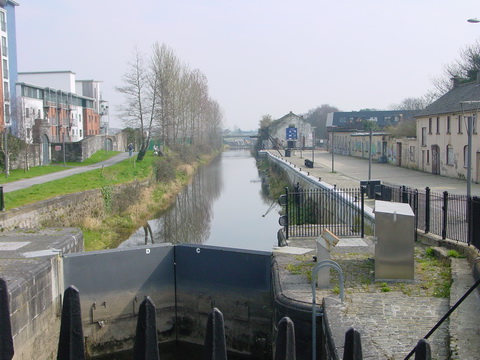
Canal harbour, Limerick in March 2007
Hall refused to accept the boat in the canal, saying that it should have been delivered to Limerick dock, a short distance downstream. Mumford and Cox & King sued him and the National Bank.
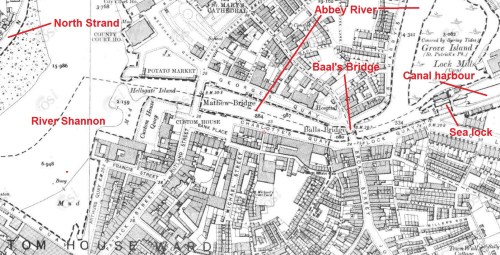
Ordnance Survey ~1900
Hall, an alderman and a former mayor, who had lived at North Strand, presumably knew the river and its difficulties.
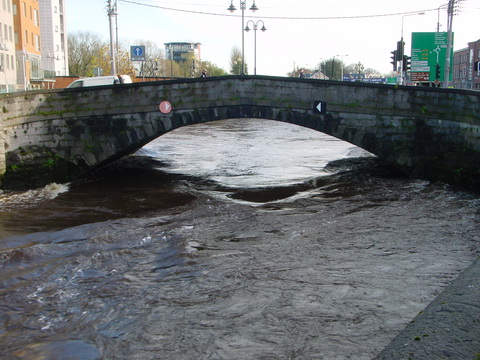
Baal’s Bridge looking upstream towards the canal harbour in the floods of 2009
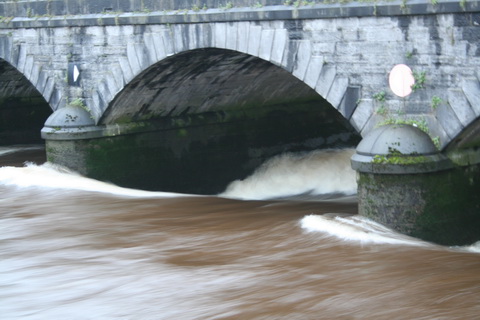
The navigation arch at Mathew Bridge looking downstream in the floods of 2009
It was contended by the defendant that to get the vessel from the canal into the estuary of the Shannon there was a considerable risk involved. The passage was only a few hundred yards, but it was stated it could only be effected at certain states of the tide when it would be possible to get through Ballsbridge.
The judge sensibly suggested that it should be possible to insure the boat for the journey; the plaintiffs agreed to deliver it; Hall agreed to accept delivery and to pay £15 for the cost of the caretaker who had been looking after the boat since 23 January; the case was settled.
Clearly Ambrose Hall didn’t know Pat Lysaght.

Posted in Built heritage, Charles Wye Williams, Economic activities, Engineering and construction, Extant waterways, Foreign parts, Forgotten navigations, Industrial heritage, Ireland, Irish inland waterways vessels, Natural heritage, Operations, People, Shannon, shannon estuary, Sources, Steamers, Tourism, Water sports activities, waterways
Tagged Abbey River, Ambrose Hall, Baal's Bridge, boats, bridge, canal, Clare, Colchester, Cox & King, Dublin, estuary, floods, flow, Gipsy, Grace, Grand Canal, Ireland, Killaloe, Limerick, lock, Mumford, O'Briensbridge, Operations, Pat Lysaght, quay, Shannon, steam yacht, steamer, vessels, water level, waterways
Here are some photos of recent L+M Keating projects.
Posted in Ashore, Built heritage, Economic activities, Engineering and construction, Extant waterways, Ireland, Irish inland waterways vessels, Operations, Restoration and rebuilding, Scenery, Shannon, Sources, waterways, Waterways management
Tagged boats, bridge, canal, Clare, dredging, Dublin, embankment, ESB, estuary, Grand Canal, Ireland, Killaloe, L & M Keating, Limerick, Lough Derg, Meelick, Operations, Portumna, Shannon, vessels, waterways, Waterways Ireland, workboat
I’ve moved my pics of dredgers to a new page and added a few more.
Posted in Drainage, Economic activities, Engineering and construction, Extant waterways, Foreign parts, Industrial heritage, Ireland, Irish inland waterways vessels, Operations, Shannon, shannon estuary, Suir, waterways, Waterways management
Tagged boats, bridge, canal, Clare, dredger, dredging, Dublin, Erne, estuary, Ireland, Killaloe, L & M Keating, Limerick, lock, Lough Derg, Operations, Shannon, Shannon-Erne Waterway, vessels, waterways, Waterways Ireland, workboat
I’ve moved my photos of rescue boats to a new page and added photos of some more services. Still a lot missing, though.
Posted in Ashore, Economic activities, Extant waterways, Foreign parts, Ireland, Irish inland waterways vessels, Operations, People, Shannon, shannon estuary, Suir, Water sports activities, waterways, Waterways management
Tagged boats, Clare, Coast Guard, Erne, estuary, Ireland, Killaloe, Limerick, Lough Derg, Lough Neagh, Operations, rescue, RNLI, Shannon, Suir, Tipperary, vessels, Waterford, waterways, workboat

 Irish waterways history